The Mangalagiri Panakala Lakshmi Narasimha Swamy Temple, in the Krishna–Guntur region of Andhra Pradesh, stands as a living center of Vaishnava devotion and a remarkable case study in South Indian sacred geography. Revered as one among the Ashta Mahakshetrams traditionally associated with Lord Vishnu’s protective grace, the site is distinguished by its elephant-shaped hill profile and the temple’s singular ritual of offering panakam (sweet jaggery water) to the Ugra form of Narasimha. Pilgrims, scholars, and architecture enthusiasts alike recognize the temple as a nexus where devotional praxis, narrative memory, and regional artistry have interacted continuously for centuries.
The sacred complex operates as a triad of shrines across an “elephant-hill” (gajaparvata) terrain. The Panakala Lakshmi Narasimha Swamy Temple occupies the hillside and enshrines the Ugra aspect of Narasimha, the Lakshmi Narasimha Swamy Temple at the foothill exhibits a monumental Dravidian rajagopuram, and a smaller Gandala Narasimha shrine at the summit preserves the memory of lamps traditionally lit on the hilltop. This vertically ordered sacralityfrom base to crestembodies a classical kshetra logic: approach, ascent, and culmination, each stage inviting reflection, prayer, and darshan.
Puranic and local sthala-purana narratives converge on a central motif: after slaying the asura Hiranyakashipu, the Ugra energy of Narasimha required cooling and pacification. Panakam, offered as a sweet, cooling medium, became emblematic of this transformation from raudra (fierce) to shanta (peaceful) rasa. Another enduring memory links the hill’s elephant-like form with auspiciousness (mangala), suggesting a natural landscape already predisposed to sanctity, later affirmed through ritual, inscription, and patronage.
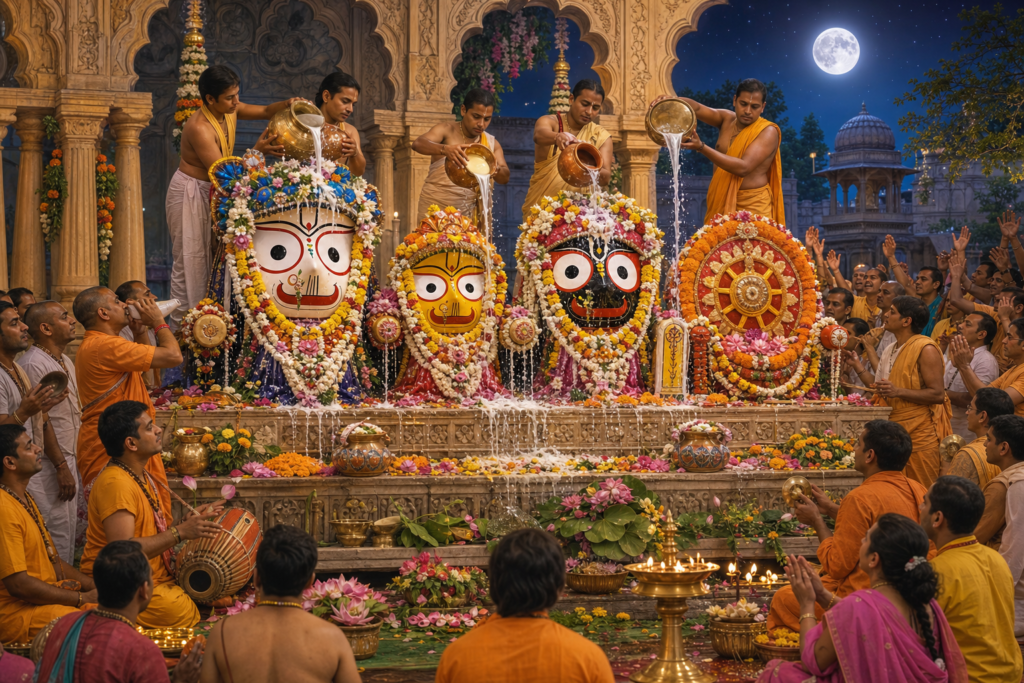
The panakam rite remains the temple’s most distinctive practice. During forenoon hours, priests pour jaggery wateroften lightly spiced with dry ginger and black pepperdirectly into the deity’s mouth-like orifice in the sanctum. Devotees report an audible gurgling or hissing as though the Lord “drinks” the offering, with a portion traditionally seen to be returned, signifying divine acceptance of just what is needed. The ritual consciously avoids evening naivedyam for the Ugra form, preserving a liturgical rhythm that privileges daylight pacification.
Interpreted through a wider dharmic lens, the ritual functions as theological pedagogy. The act of sweetening and cooling the fierce mirrors the cultivation of kṣānti (forbearance) and śama (tranquility) emphasized across Hindu, Buddhist, and Jain traditions, and aligns with Sikh ideals of seva that transform intensity into compassionate action. Such resonances illustrate shared ethical intuitionsself-regulation, care, and collective well-beingcentral to the unity of dharmic paths.
Historically, the site shows layered patronage. Epigraphic and stylistic evidence indicate sustained support under regional polities, with significant early nineteenth-century contributions by the illustrious zamindar Raja Vasireddy Venkatadri Naidu, whose endowments are celebrated in local memory. His patronage is credited with the massive foothill rajagopuram and improvements to access routes, anchoring the temple’s visibility in the Krishna delta’s cultural landscape and ensuring its continued institutional vitality under subsequent custodianship.
Architecturally, the complex reveals two complementary vocabularies. The foothill Lakshmi Narasimha Swamy Temple’s soaring multi-tiered rajagopuram exemplifies late Dravidian monumentalism, framed by yali-pillared mandapas and sculptural programs honoring Vaishnava iconography. By contrast, the hillside Panakala sanctum is intimate and elemental, organized around the unique mouth-orifice of Narasimha rather than a conventional anthropomorphic murti. This contrastmonumental proclamation below and ritual singularity aboveunderscores the site’s rare synthesis of public spectacle and esoteric practice.
The festival calendar further contextualizes devotion. Annual Brahmotsavam in the Phalguna month (Feb–Mar) mobilizes processions, alankarams, and cultural performances that draw large pilgrim streams from Andhra Pradesh and beyond. Narasimha Jayanti during the Vaishakha bright fortnight intensifies the panakam symbolism, renewing the community’s memory of divine protection tempered by compassion. On these days, the triadic movement between the three shrines, the hill ascent, and the evening cultural programs creates a full-spectrum experience of sacred time and space.
Devotee accounts often highlight the approach and ascent as a contemplative sequence. The presence of well-laid stone steps and a motorable ghat road enables different modes of yatra. Many choose to climb at dawn, allowing the body’s exertion to align with mantra-japa and silent remembrance. The midday emphasis of the panakam rite shapes the day’s rhythm; pilgrims plan darshan accordingly and then return to the foothill precincts for pradakshina, prasadam, and quiet reflection.
For contemporary visitors, practical considerations maintain both sanctity and comfort. The temple lies between Vijayawada and Guntur, with Mangalagiri railway station serving the locality on the Guntur–Vijayawada line. Vijayawada International Airport (Gannavaram) connects the region to major Indian metros. Moderate months (October to March) offer the most temperate conditions; respectful attire and mindful conduct are expected. Given the forenoon centering of the principal offering, early arrival is advisable, especially during Brahmotsavam and Narasimha Jayanti.
The wider heritage corridor enhances interpretive depth and inter-dharmic appreciation. Nearby Amaravati preserves the memory of a great Buddhist mahācaitya; Undavalli Caves display rock-cut artistry associated with both Buddhist and Hindu iconographies; and Vijayawada’s Kanaka Durga Temple testifies to Shakta devotion on the banks of the Krishna. Together with Mangalagiri, these sites illustrate a regional ecology of sacredness where Hindu, Buddhist, and Jain ideals historically informed one another, echoing the Sikh ethic of seva in their shared emphasis on community and reverence.
From a scholarly perspective, Mangalagiri’s enduring appeal lies in how it integrates text, terrain, and technique. Puranic motifs are dramatized through a rare, sensory rite; a hill resembling an elephant organizes pilgrimage movement; and Dravidian architecture frames the liturgical theater. From a devotee’s standpoint, the same elements become an invitation to inner work: to sweeten and steady the mind, to climb patiently, and to behold a deity whose ferocity shields the good but rests in compassion.
In sum, the Mangalagiri Panakala Lakshmi Narasimha Swamy Temple embodies a compelling synthesisnarrative memory anchored in an elephant-shaped hill, a uniquely embodied ritual of panakam, and a historical built environment that amplifies both. Its message, read across dharmic traditions, is unifying: the transformation of intensity into care, the balancing of strength with tenderness, and the shared human aspiration to approach the divine through service, restraint, and love.
Inspired by this post on Hindu Blog.