
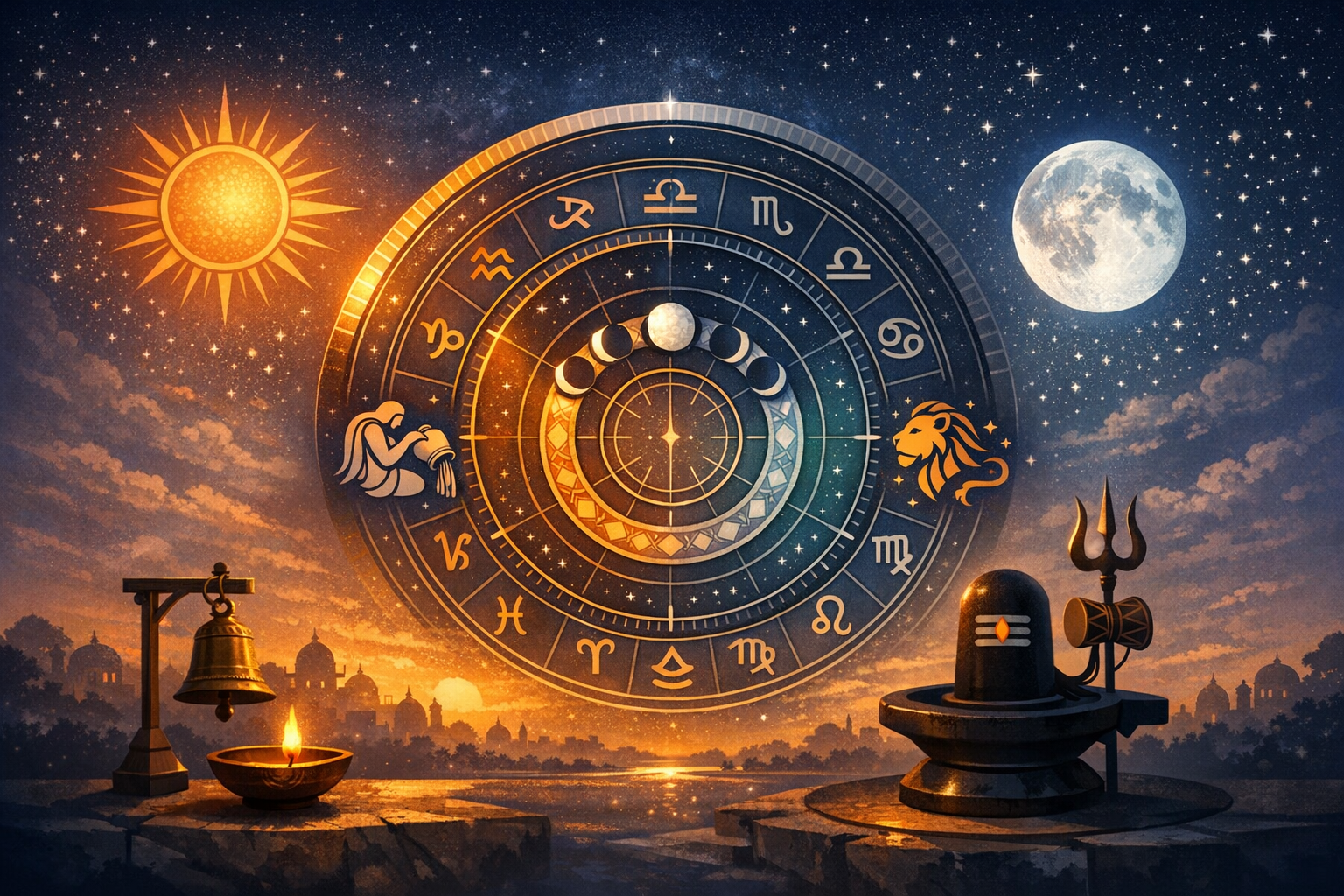
Sunday, 1 March 2026 (IST) in the Hindu calendar (Panchang) begins with Shukla Paksha Trayodashi, the thirteenth lunar day of the waxing fortnight, and transitions to Shukla Paksha Chaturdashi in the evening. In most regions, Shukla Paksha Trayodashi prevails until approximately 18:30 IST on March 1; thereafter, Shukla Paksha Chaturdashi continues through the night. As with all Panchang elements, city-specific horizons can shift the exact minute of transition, so local verification is advised.
Situated on the cusp of Purnima, Phalguna Shukla Trayodashi–Chaturdashi carries a contemplative and preparatory quality in the wider dharmic world. While the Panchang is a core Hindu timekeeping tool, its lunisolar cadence resonates with Buddhist Uposatha and Jain Poshadha cycles that also align ethical focus and practice with the moon’s phases. Sikh tradition historically referenced lunar almanacs for certain commemorations while today employing the Nanakshahi solar framework. Framed in this shared continuity, daily Panchang guidance serves as a gentle bridge across dharmic traditions.
Technically, a tithi marks every 12° increase in the angular separation between the Sun and Moon. Trayodashi corresponds to an elongation near 156°, and Chaturdashi to approximately 168°. A single civil date containing both tithisas on 1 March 2026means individuals can structure actions to harmonize with the two subtly different rhythms present on the same day.
Pradosh Vrat in the bright fortnight (Shukla Pradosh) is traditionally observed when Trayodashi overlaps the Pradosh Kaal (the evening window beginning after local sunset and lasting about 1 hour 24 minutes). Because Trayodashi extends to around 18:30 IST and many Indian cities experience sunset near this time in early March, numerous local almanacs will likely place Ravi Pradosh (Sunday Pradosh) on 1 March 2026. The determining rule is simple and precise: Trayodashi must be present during the Pradosh Kaal at the observer’s location; if it is not, the observance shifts accordingly under standard dharma-shastra prescriptions.
For undertaking auspicious activities when a bespoke muhurta is not available, Abhijit Muhurta is regularly recommended. This window centers on local solar noon, extending roughly 24 minutes before and after the midpoint between sunrise and sunset. Within day and night, the Choghadiya framework adds further granularity, with Amrit, Shubh, and Labh segments considered productive for study, commencements, correspondence, and travel.
Time blocks generally avoided for fresh undertakings are Rahu Kaal, Gulika Kaal, and Yamaganda. On Sundays, Rahu Kaal occupies the 8th division of the daylight span, Gulika Kaal the 6th, and Yamaganda the 2nd. To compute these precisely, measure the duration from sunrise to sunset at the location, divide the interval into eight equal parts, and map the weekday-specific segments. As a rule-of-thumb illustration for a 12-hour day, Sunday’s Rahu Kaal would approximate 16:30–18:00 local time; the exact interval scales with the actual daylight length.
Pradosh Kaal itself, the focal evening window for Shiva upasana, begins after local sunset and runs for approximately 1 hour 24 minutes. Where Trayodashi touches this window on 1 March 2026, devotees may observe Ravi Pradosh with dipa, naivedya, dhyana, and a vrata-sankalpa suited to personal and family circumstances. The contemplative atmosphere at dusktemple bells, soft lamps, and collective quietoften makes this period particularly conducive to introspection and sankalpa.
Nakshatra and Rashi context are also meaningful for the day’s character. In early March, the Sun is in Kumbha (Aquarius). Near the Full Moon, the Moon stands opposite the Sun, placing Chandra in Simha (Leo). Accordingly, many almanacs list the Moon in the Purva Phalguni–Uttara Phalguni corridor around this date. The precise nakshatra change and the Moon’s Rashi timings vary by longitude and latitude; a city-specific Panchang should be consulted for exact spans.
Yoga and Karana refine muhurta quality beyond tithi and nakshatra. As Chaturdashi approaches, karanas such as Gara, Vanija, and Vishti (Bhadra) can arise. Since Vishti (Bhadra) is widely avoided for initiating travel, contracts, and ceremonial beginnings, confirming whether Bhadra coincides with a planned action is prudent. The yogaa function of the combined solar–lunar longitudesfurther nuances the day’s texture and is best checked with local parameters.
Calendar correspondences help situate this date across regional systems. The civil date 1 March 2026 aligns with Phalguna Shukla Trayodashi–Chaturdashi in both Amanta and Purnimanta reckonings. It falls in Vikram Samvat 2082 and Saka year 1947 (pre–Saka New Year, which typically begins near the March equinox). Local sunrise determines how the tithi is ascribed to the civil day in each location.
A practical city-by-city method streamlines planning. First, note precise local sunrise and sunset. Second, compute daytime length and divide it into eight equal parts to place Rahu Kaal, Gulika Kaal, and Yamaganda based on the weekday rules. Third, determine solar noon to center Abhijit Muhurta. Fourth, identify Pradosh Kaal as the first one-and-a-half hours after sunset. Finally, overlay the local tithi, nakshatra, yoga, and karana windows from a reliable Panchang for that latitude and longitude.
For those scheduling meaningful tasks on 1 March 2026, aligning actions with auspicious windows increases symbolic coherence. New initiatives, letters of intent, and educational milestones sit well within Amrit/Shubh/Labh Choghadiya or Abhijit Muhurta. High-stakes signings may warrant a tailored muhurta. Where applicable, Shiva puja during Pradosh reinforces the evening’s reflective ethos, while care is taken to avoid Rahu Kaal and any Vishti (Bhadra) spans for fresh beginnings.
In daily life across the subcontinent and the diaspora, many households still glance at the Panchang before booking travel, launching projects, or even starting a child’s first lessons. This living habit, though practical, also builds a subtle kinship across dharmic communities that honor lunar rhythm. The shared cadencebrightening toward Purnima and deepening toward Amavasyaencourages reflection, generosity, and community service that transcend labels.
Key snapshot for reference (IST): Shukla Paksha Trayodashi prevails until approximately 18:30 on 1 March 2026; thereafter, Shukla Paksha Chaturdashi holds through the night. Being a Sunday, the day is also linked with Surya-centered attributes of clarity, vitality, and service, while the evening honors Shiva within Pradoshwhere Trayodashi’s presence during that window is confirmed locally.
Rule precedence is worth remembering. For most fasting and vrata observances, Udaya tithi (the tithi at local sunrise) is primary. Pradosh is a clear exception: pradosh-kala tithi presence decides the observance. Similarly, rites oriented to Purnima or Amavasya may weight the evening or midnight spans differently across traditions, so cross-checking the relevant rule for the specific rite is essential.
An interpretive note for those who also consider astrological tone: with Chandra near Simha and Purva Phalguni–Uttara Phalguni, creative expression, relationship harmony, and dignified leadership are often emphasized, while Surya in Kumbha encourages collective benefit and systems thinking. These are supportive suggestions rather than prescriptions, and they are always best integrated with prudent planning, ethical intent, and local Panchang confirmation.
As always, accuracy hinges on the observer’s horizon. Tithi, nakshatra, yoga, karana, and the quality blocks of the day-night cycle all shift with longitude, latitude, and date-specific sunrise and sunset. Before finalizing time-sensitive actions or ritual observancesespecially Ravi Pradoshconsult a reliable, city-specific Panchang to confirm the exact windows.
Inspired by this post on Hindu Blog.
