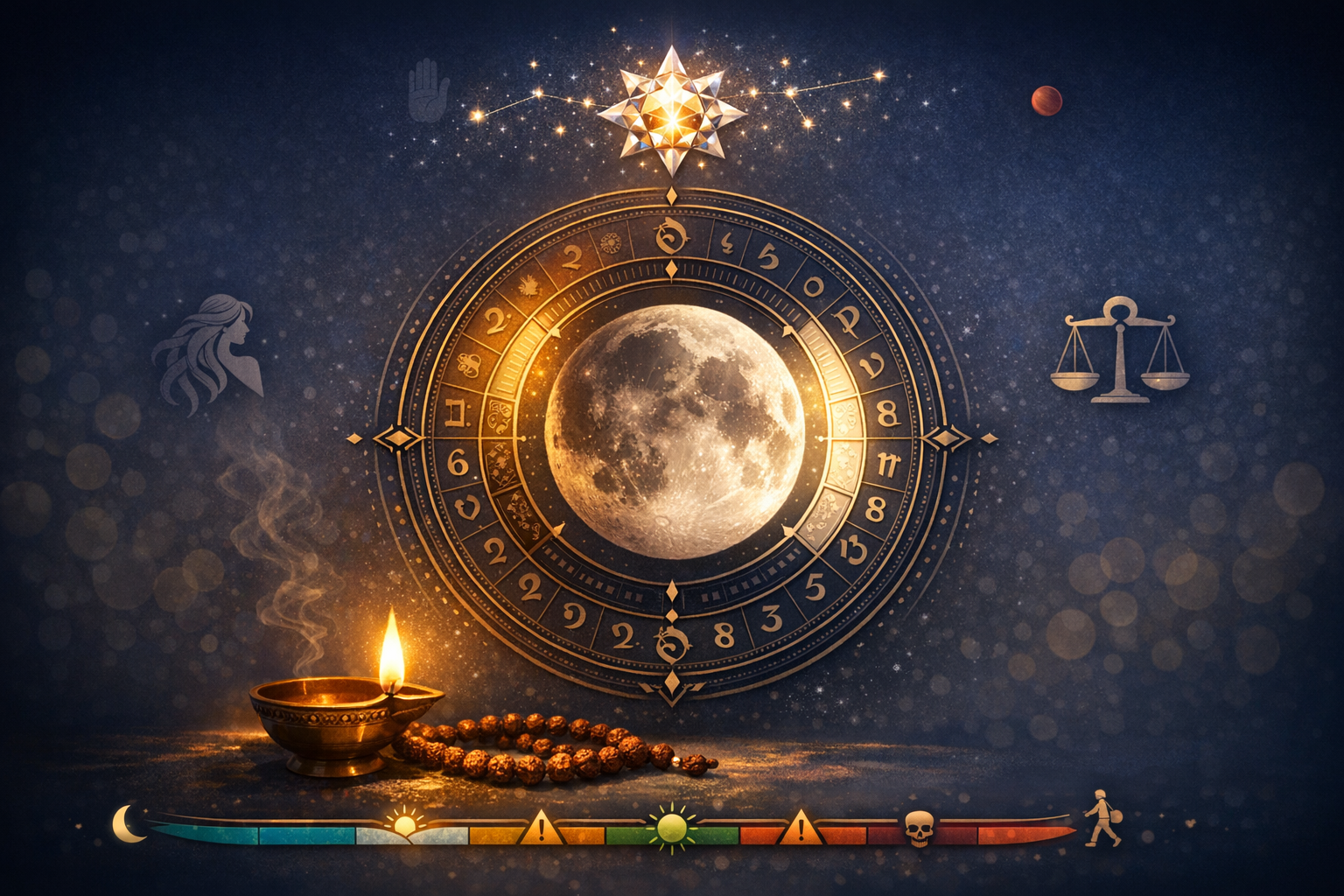
Tuesday, March 31, 2026, aligns in the Daily Hindu Calendar (Panchang) with Shukla Paksha Trayodashithe thirteenth lunar day of the waxing phaseuntil 6:33 AM in most regions; from that time onward, Shukla Paksha Chaturdashi prevails. The day therefore unfolds across two tithi, closing in on the Chaitra Purnima and inviting careful timing for initiations versus completions.
Within both Amanta (southern) and Purnimanta (northern) month traditions, this date falls in Chaitra Shukla paksha, a period associated with renewal, clarity, and preparation for the full-moon culmination. This shared lunar framing aids coherence across regions while preserving local variations in observance.
In ritual terms, Trayodashi gains prominence when it coincides with the evening Pradosha Kāla; for this date, because Trayodashi ends at 6:33 AM in most Indian almanacs, the corresponding Pradosha observance would have occurred on the preceding evening (Monday, March 30, 2026) in those locales. Where time-zone differences push Trayodashi into the evening, regional Panchang should guide observance so that Pradosha aligns with the correct twilight window.
Chaturdashi during Shukla Paksha is widely treated as a day of refinement before the full moon, favoring introspective sāttvika practicesjapa, dāna, and svādhyāyawhile remaining compatible with everyday responsibilities. Many families experience a quiet uplift as routines are aligned with the lunar rhythm, reflecting a shared dharmic ethos that resonates across Hindu, Buddhist, Jain, and Sikh households.
Because the Chaitra full moon is named for Chitra Nakshatra, many regions will experience Chitra’s influence for a significant portion of March 31, with some localities observing a final transition from Hasta into Chitra earlier in the day; exact boundaries depend on longitude, latitude, and sunrise. Chitra, presided over by Tvaṣṭṛ/Viśvakarma, privileges creativity, design, architecture, and balanced agreements, making it conducive to planning, drafting, and aesthetic or artisanal work.
Correspondingly, the Moon resides in Kanya Rashi (Virgo) and approaches or enters Tula Rashi (Libra) around this phase of the cycle; both are encompassed by Chitra’s padas (1–2 in Kanya, 3–4 in Tula). Kanya emphasizes precision and service, while Tula lends harmony and measured judgment, a pairing often used to pace the dayanalytical tasks earlier, consensus-building or presentation-oriented tasks latersubject to local lunar timings.
In Panchang, the daily Yoga derives from the sum of the Sun’s and Moon’s longitudes; it refines muhurta selection beyond tithi and nakshatra. Practitioners commonly prioritize auspicious yogas for beginnings while using neutral or mixed yogas for maintenance activities; as the specific Yoga varies by location and time, local ephemerides or reliable Panchang applications remain essential for March 31 assessments.
The Karanahalf a tithioffers still finer granularity for timing. Moving (cara) karanas such as Bava, Balava, Kaulava, Taitila, Garaja, Vanija, and Viṣṭi (Bhadra) recur in a fixed order through the fortnight, with Viṣṭi generally avoided for ceremonies that seek unimpeded growth; fixed karanas (Śakuni, Catuṣpāda, Nāga, Kiṁstughna) close the lunar month. Given the pre-dawn tithi shift on this date, karana boundaries will straddle the early morning, reinforcing the need for locality-specific Panchang data.
A widely used general-purpose window is Abhijit Muhurat, centered on local solar midday and spanning roughly 24 minutes on either side; it is traditionally viewed as tridoṣa-śamana (balancing) and suitable for quick decisions or signatures when bespoke muhurta is impractical. Because solar noon depends on longitude and the equation of time, exact start–end moments should be taken from a location-aware Panchang.
Pre-dawn Brahma Muhurtaapproximately 96 minutes before sunriseremains ideal for meditation, prāṇāyāma, mantra-japa, and study. Across dharmic paths, this quiet interval is valued for mental clarity and sattva, offering a unifying practice space that enhances attention and well-being throughout the day.
For risk management, many avoid Rahu Kalam, Yamaganda, and Gulika Kalam for initiating major undertakings. On Tuesdays, when the notional daylight is 12 hours (for example, 6:00 AM–6:00 PM), the canonical guidance places Rahu Kalam around 3:00–4:30 PM, Yamaganda around 9:00–10:30 AM, and Gulika Kalam around 12:00–1:30 PM; if daylight differs, each window scales proportionally by dividing the day into eight equal parts from local sunrise.
Daytime Choghadiya offers another practical heuristic: favor Amrit, Shubh, and Labh periods for beginnings, and avoid Kāla, Roga, and Udvega for sensitive starts; Cāra suits travel and errands. The sequence cycles from sunrise and repeats through the day, so location-aware charts remain the best reference for March 31 selections.
Practical alignment for this Tuesday benefits from Mangala’s (Mars) rulership: tasks involving courage, disciplined effort, technical repair, machinery, property rectification, or structured training tend to flow wellprovided they do not commence within Rahu Kalam or other inauspicious slices. Many households find that even routine chores feel smoother when keyed to these Panchang guardrails.
Because tithi, nakshatra, and muhurta boundaries shift with longitude, latitude, and time zone, diaspora communities outside South Asia should anchor calculations to their local sunrise and moonrise. IST-based almanacs typically report March 31 as Shukla Paksha Trayodashi until 6:33 AM, then Shukla Paksha Chaturdashi; regions several time zones west or east may register the shift at a different clock time while preserving the same sequence.
Approached in this way, March 31, 2026 becomes more than a date on the Hindu Calendar: it is a living Panchang that harmonizes lunar phases (Tithi), star-lore (Nakshatra), and planetary rhythms (Rashi) into choices that foster clarity, care, and cohesion. In honoring these shared time-keeping arts, the broader dharmic family strengthens a common rhythm of reverence and responsibility.
Inspired by this post on Hindu Blog.