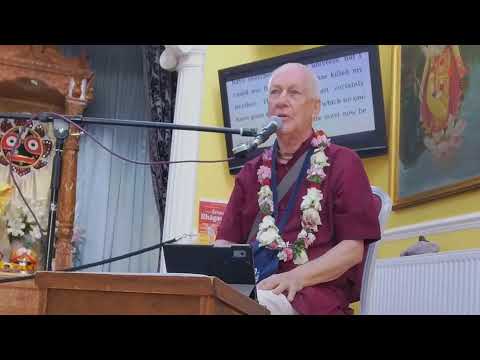
On October 31, 2025, at the Hare Krishna temple in Alachua, Florida, Nagaraja dasa delivered a thoughtful class on Srimad-Bhagavatam (Bhagavata Purana) 3.20.3. Situated within Canto 3, chapter 20“Conversation Between Maitreya and Vidura”the session examined how sacred dialogue functions as a disciplined path to knowledge, devotion, and ethical living in the Vaishnava tradition.
Srimad-Bhagavatam, one of the most revered works of Vedic literature, presents its insights through refined inquiry and compassionate instruction. In this text, Vidura’s sincere questions and Maitreya’s measured responses establish a model of learning grounded in humility, clarity, and purpose. By emphasizing text 3 within the chapter, the class clarified the tone and method of the dialogue, preparing listeners to approach the chapter’s subsequent metaphysical and cosmological details with attention and reverence.
Nagaraja dasa highlighted three thematic pillars: the seeker’s humility, the teacher’s compassion, and the shared discipline of truth-seeking. This model resonates across dharmic traditionsBuddhism’s kalyāṇa-mitta (noble friendship), Jainism’s anekāntavāda (many-sided truth), and Sikhism’s sangat (spiritual community)affirming a unifying ethos of respectful inquiry. The class framed these convergences not as mere parallels but as a shared civilizational commitment to wisdom, ethics, and spiritual maturity.
Analytically, the session underscored how the Maitreya–Vidura exchange exemplifies precise inquiry (questions shaped by purpose), receptive listening (suspending haste and bias), and transmission of knowledge (teaching that elevates without condescension). Within the Vaishnava perspective, this pedagogy is inseparable from devotion to Sri Krishna, yet the intellectual rigortextual context, definitions, and logical sequencingstands as exemplary scholarship in its own right.
Practical applications emerged throughout: cultivate sattva through daily reflection before study; approach a guide with service-mindedness and focused questions; read the Bhagavata Purana with attention to sequence and context; and anchor insight in lived ethicstruthfulness, compassion, and self-discipline. These practices render the “Conversation Between Maitreya and Vidura” not only a historical dialogue but also a contemporary guide to decision-making and inner clarity.
The setting at ISKCON Alachua enhanced the contemplative tone, with the community’s devotional atmosphere supporting careful study. Participants encountered an academic yet devotional readingneither merely theoretical nor narrowly sentimentalencouraging mature engagement with scripture as both literature and lived wisdom.
In closing, the class invited continued exploration of Canto 3’s structure and intent: how cosmology and devotion interweave, how questions refine understanding, and how embodied practice converts learning into virtue. In this way, Srimad-Bhagavatam 3.20.3 becomes a shared touchstone for dharmic unityhonoring Hinduism’s scriptural depth while affirming values cherished across Buddhism, Jainism, and Sikhism: humility, discernment, and compassionate action.
Inspired by this post on Dandavats.