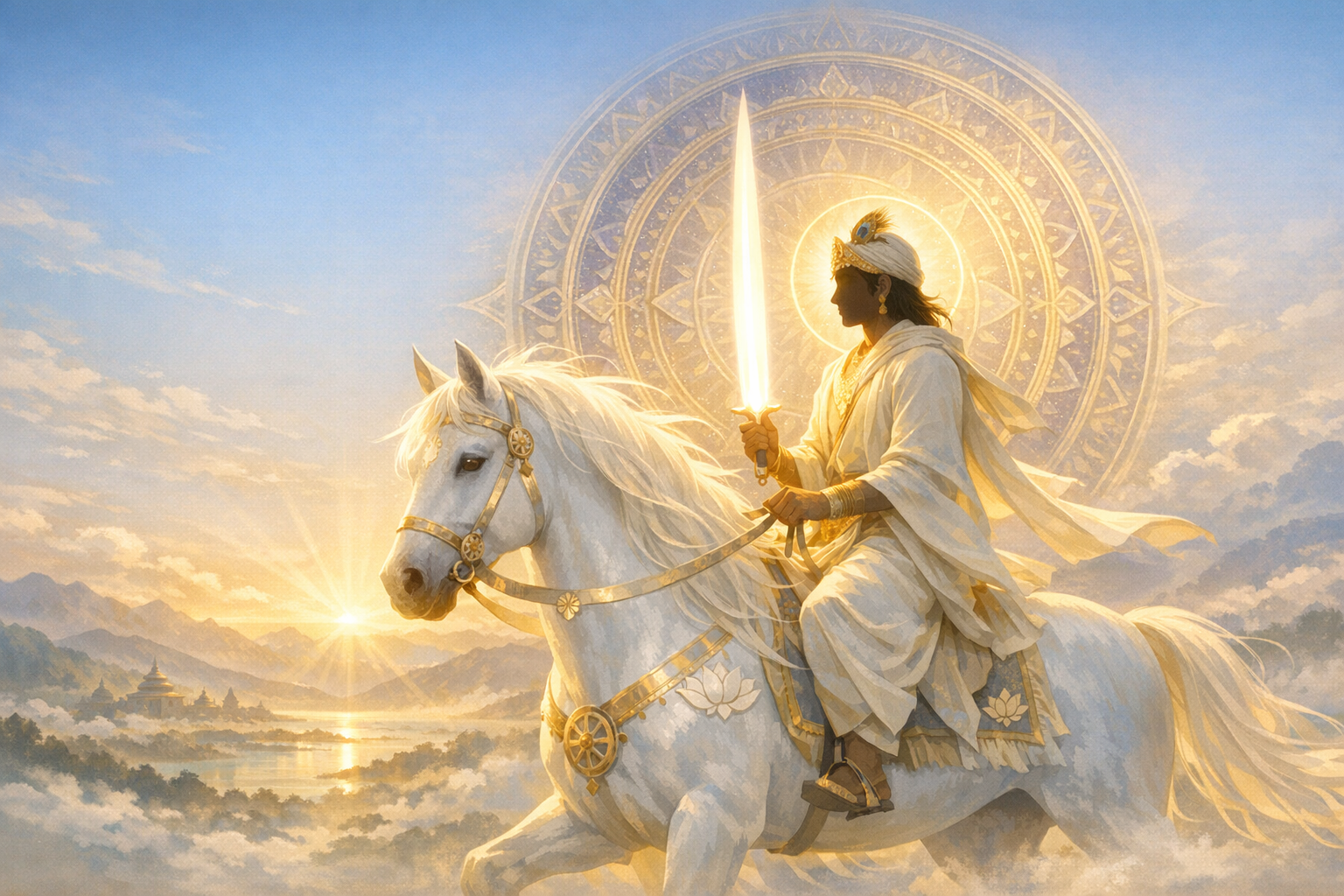
The image of the Kalki Avatar astride a radiant white horse is among the most arresting motifs in Hindu iconography. In the Puranic imagination, Kalkiprophesied as the tenth and final avatar of Bhagwan Vishnuappears at the end of Kali Yuga to reestablish dharma and open the cycle toward Satya Yuga. The steed, often named Devadatta in various texts, is not merely a vehicle but a richly layered symbol that communicates purity, disciplined power, and the rightful turning of the cosmic wheel.
Puranic sources such as the Vishnu Purana, the Agni Purana, and the Bhagavata Purana (Skandha 12) ground this motif in a coherent scriptural narrative. The Bhagavata Purana describes the advent of Kalki, born in the lineage of Viṣṇuyaśas and appearing from Shambhala, to dispel adharma at the terminal phase of Kali Yuga. Within this corpus, Devadatta emerges as a traditional name for the divine horse, conveying a sense of celestial mandate“god-given”that frames Kalki’s mission as sanctioned by the cosmic order rather than by contingent human ambitions.
Philologically, “Kalki” is often derived from “kalka,” meaning impurity or defilement, thus rendering Kalki as “the destroyer of impurity.” That etymology, when paired with the image of a white horse, stages an elegant semiotic tableau: the force that removes impurity is borne by an emblem of luminous clarity and controlled vigor. In this way, the icon unites metaphysical purpose with aesthetic presence.
The name Devadattacommon in Sanskrit and employed across different Indian traditionsrequires careful reading in context. In the Kalki corpus, Devadatta signifies the horse as a boon of the devas, underscoring divine authorization and protection. This usage is wholly distinct from other occurrences of the name (for example, in Buddhist narratives), reminding readers that Sanskrit names are polyvalent and must be situated within their textual ecosystems.
Color symbolism is crucial. In the guṇa framework of Sāṅkhya and allied Vedantic thought, white is the signature of sattvaluminosity, harmony, and discriminative clarity (viveka). The “white” of the horse, then, is not a chromatic flourish but a doctrinal cue: Kalki’s agency is saturated with sattva, and the coming transition toward Satya Yuga is, in essence, a reinstatement of a sattvic world-order where truth, restraint, and compassion predominate.
The horse (aśva) itself is a cardinal Vedic symbol. In the Br̥hadāraṇyaka Upaniṣad’s cosmic reading of the aśvamedha, the horse is mapped onto the architecture of the cosmos and time. In Ṛgvedic hymns, the horse represents swift energy, prāṇa in motion, and mastery over force. Solar imagerySurya’s chariot drawn by horsesextends this theme: the horse mediates between raw dynamism and directed, illumined action. Devadatta, as Kalki’s aśva, thus condenses millennia of Vedic and Upanishadic semiotics into a single kinetic icon.
Interpreters often read the white horse as time-aware power harnessed toward renewal. At the end of Kali Yugaan age typified by confusion, moral inversion, and attenuation of memorythe arrival of Kalki on Devadatta signals a precise counterpoint: sattvic speed without recklessness, strength without cruelty, and the swift restoration of moral grammar. The horse embodies rajas under the guidance of sattva, channeling momentum toward righteous ends.
The Katha Upaniṣad’s chariot metaphor provides a helpful inner map. There, horses represent the senses; the reins are the mind; the charioteer is buddhi (intelligence). Transposed to the Kalki motif, the perfectly responsive white horse expresses senses entirely harmonized by higher insight. Devadatta, in this interior reading, is not simply an external mount but the purified psychophysical organismprāṇa and indriyassurrendered to dharma and steered by awakened discernment.
Where some depictions place a drawn sword (asi) in Kalki’s hand, a non-violent hermeneutic within dharmic philosophy often reads the weapon as a sign of viveka: the cutting away of falsehood by truth-knowledge. The white horse, bearing that discriminative power, becomes the dynamic base for ethical clarity. In this synthesis, Kalki’s force is not an anarchic rupture but the precise surgery of cosmic law reclaiming its own equilibrium.
Iconographically, it is important to distinguish Kalki’s equestrian form from Hayagriva, the horse-headed manifestation associated with knowledge and the retrieval of the Vedas. Kalki rides the white horse; Hayagriva bears the horse’s head. Both affirm learning and order, yet their symbolic scopes differ: Hayagriva centers textual restoration and wisdom, while Kalki focuses on temporal renewal and the ethical recalibration of society.
Because the blog’s purpose is the unity of dharmic traditions, it is instructive to note resonances without collapsing distinctions. Within the Buddhist Kalachakra tradition, the royal title “Kalki” (or Kulika) is associated with the Shambhala kings who safeguard the dharma across cyclical time. The thematic overlapguardianship of dharma, cyclical renewal, time-conscious leadershipsuggests a shared civilizational grammar that values ethical sovereignty and cosmic harmony.
Jain philosophy, while not advocating avatars, converges on the ethics of purification, restraint, and inner conquest (jina). Read through this lens, the white horse may be appreciated as disciplined life-force guided by ahiṃsā and satya. The vehicle is vigor; the direction is non-violent truth. Such a reading honors Jain commitments while affirming the pan-dharmic aspiration to sublimate energy toward liberation.
Sikh itihasa and iconography frequently portray Guru Gobind Singh on horseback, epitomizing the sant-sipahi idealthe inseparability of contemplative depth and righteous action. The horse becomes a public sign of readiness to defend justice, restrain tyranny, and embody dharma-yuddha as a last resort. Without equating traditions, one may still recognize a unifying motif: power must be trained by ethics and animated by spiritual clarity.
Psychologically, Devadatta personifies a mature relationship with vitality. Untrained speed scatters attention; trained speed serves discernment. In a Kali Yuga setting marked by distraction and disinformation, the white horse calls for coherence: prāṇa synchronized with purpose, attention stabilized by contemplation, and will yoked to wisdom. This is the living art of making energy ethical.
Socially, the Kalki-Devadatta motif invites a dharmic civic ethos. Restoration of dharma is not reducible to coercion or partisanship; it begins with truthful speech, stewardship of resources, compassion in policy, and the refusal to instrumentalize human beings. Just as the reins guide the horse with sensitivity and skill, institutions must be guided by transparent laws and the higher ends of human dignity.
From a cyclical-time perspective, the movement from Kali Yuga toward Satya Yuga is less an abrupt overthrow than a phase-change, akin to the first light of dawn. That dawn is evoked by whitenesssattvic clarity returning to a fatigued world. Devadatta, then, is dawn’s motion: the quickening by which societies remember their center and the cosmos reasserts moral intelligibility.
Historically and ritually, certain regional calendars observe Kalki-related commemorations (often termed Kalki Jayanti), and a modest number of shrines honor Kalki’s future advent. While practices vary, public devotion typically emphasizes ethical renewal, remembrance of dharma, and the inner readiness to serve truth when cycles demand courage.
Comparative semiotics further enrich the picture. In Vedic thought, horses draw the sun’s chariot; in yogic physiology, prāṇa must be regulated through yama and niyama; in ethical philosophy, force requires telos. Devadatta gathers these lines into one image: force that illumines, breath that obeys truth, and motion that leads to stillness at the heart of being.
It is helpful, finally, to clear two common confusions. First, the Kalki prophecy is not a warrant for sectarian triumphalism; its grammar is dharmic, not chauvinistic. Second, the horse’s whiteness is a moral-aesthetic code of sattva, not a social or racial marker. Both clarifications sustain a reading that is faithful to scripture and generous to the broader dharmic family.
In sum, the white horse of the Kalki AvatarDevadattais a master-symbol. Scripturally, it confirms divine commission; philosophically, it encodes sattva-guided energy; psychologically, it models disciplined vitality; socially, it gestures toward an ethical polity; and civilizationally, it harmonizes with Buddhist, Jain, and Sikh ideals of righteous strength harnessed to truth. When the image is contemplated with nuance, it becomes less a distant apocalypse and more a present invitation: to make every motion white with clarity, and to ride, together, toward a world where dharma breathes freely again.
Inspired by this post on Hindu Blog.