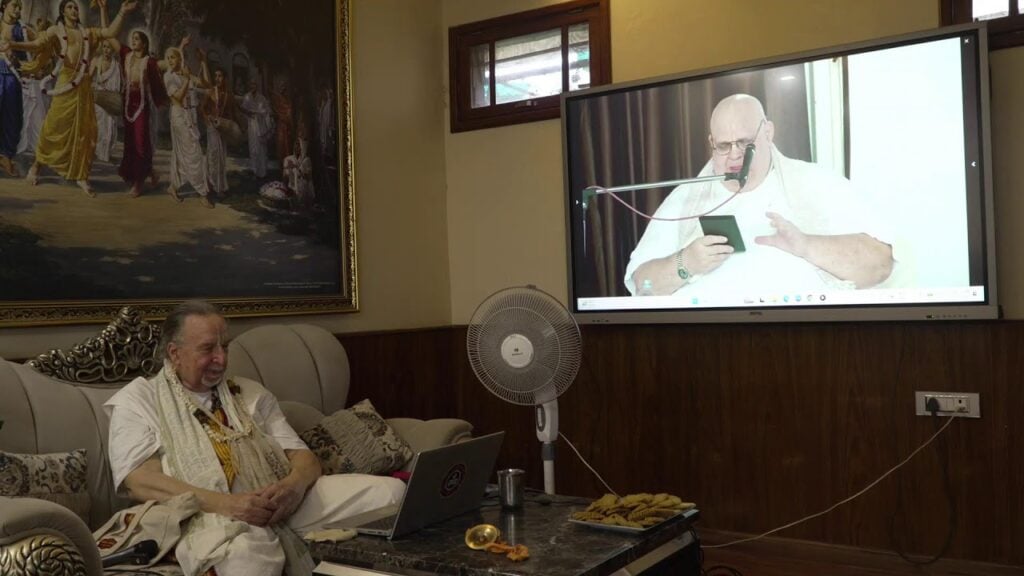
In a lucid exposition often described as the “final examination” of life, HH Guru Prasad Swami (ISKCON Kathwada) clarifies a core teaching of the Bhagavad-gita that is as practical as it is profound: the state of consciousness at the time of death shapes the trajectory of what follows. This thesis, framed not to induce fear but to inspire disciplined preparation, situates everyday spiritual practice as the decisive training ground for the most consequential moment each person will face.
Bhagavad-gita 8.6 states: “yam yam vāpi smaran bhāvam tyajaty ante kalevaram tam tam evaiti kaunteya sadā tad-bhāva-bhāvitaḥ.” The verse emphasizes that whatever “bhāva” (deeply impressed state of being) one recollects at life’s end, that is attained in the next embodiment. The text does not reduce this to a fleeting thought; it points to an enduring disposition formed by sustained remembrance throughout life (“sadā tad-bhāva-bhāvitaḥ”).
A close reading of key terms yields a technical map. “Smaran” is not a stray memory but stabilized, affect-laden recollection; “bhāva” connotes an interior stance, permeated by emotion and understanding; “ante kalevaram” denotes the critical threshold where identity loosens from the body. Together they express a law of continuity: the mind’s strongest, most rehearsed pattern surfaces at the decisive instant.
The surrounding verses provide essential context. In 8.5 (“anta-kāle ca mām eva smaran muktvā kalevaram”), Kṛṣṇa extols exclusive remembrance at death; in 8.7 (“tasmāt sarveṣu kāleṣu mām anusmara yudhya ca”), He prescribes remembrance at all times amid one’s duties. Read together, the Gita rejects escapism and sacralizes responsible action informed by unbroken mindfulness of the Divine.
Hence the pedagogical force of the “final examination” metaphor: the moment of death does not reward improvisation; it rewards formation. Everyday abhyāsa (disciplined repetition) sediments saṁskāras (deep impressions) that, over time, configure desire, attention, and reflex. The outcome at the end reflects a lifetime of choices.
Classical Hindu philosophy explains this in the idiom of antaḥkaraṇa (the inner instrument comprising manas, buddhi, ahaṅkāra, and citta). Repeated contemplations etch grooves in citta; buddhi then recognizes and endorses or resists them; manas oscillates among sensory and intentional objects; ahaṅkāra identifies with chosen patterns. Modern psychology, without affirming metaphysics, concurs on the power of habit and attentional training: what is most rehearsed tends to be most retrievable under stress.
Bhagavad-gita 8.8–8.14 details a training protocol combining abhyāsa and bhakti. Abhyāsa stabilizes attention; bhakti orients it with love toward the Supreme Person. This dual approach outperforms mere technique: it links method to meaning. The point is not only to concentrate but to concentrate on the Personal Absolute, thereby transforming cognition into devotion.
Within the Bhakti Tradition, Śrīmad-Bhāgavatam (7.5.23–24) articulates nine complementary practicesśravaṇaṁ kīrtanaṁ viṣṇoḥ smaraṇaṁ pāda-sevanam, arcanaṁ vandanaṁ dāsyaṁ sakhyam ātma-nivedanam. These map a holistic curriculum: hearing and chanting anchor knowledge; remembrance and service stabilize affect; worship and prayer refine reverence; servitorship and friendship cultivate intimacy; self-surrender seals the transformation.
ISKCON’s emphasis on nāma-japa and kīrtan operationalizes this curriculum for householders. The mahā-mantraHare Kṛṣṇa, Hare Kṛṣṇa, Kṛṣṇa Kṛṣṇa, Hare Hare | Hare Rāma, Hare Rāma, Rāma Rāma, Hare Harerenders remembrance portable and rhythmic. Sound becomes the vehicle of attention; attention becomes the vehicle of love; love becomes the default state that arises under pressure.
Lifestyle supports practice by lifting the mind toward sattva (clarity). Sattvic diet, sufficient sleep, ethical livelihood, and sat-saṅga (elevating association) reduce agitation, sharpens recall, and lowers reactivity. This is not moralism; it is cognitive hygiene. The clearer the substrate, the more reliably divine remembrance can arise when physiology is most taxed.
The Gita also acknowledges breath and attention dynamics at life’s end (8.10–8.12): prāṇa alignment, the focus “between the eyebrows,” and recitation of “Om” (8.13: “om ity ekākṣaraṁ brahma”). Bhakti integrates these with devotion so technique does not eclipse the goal. In practice, a little well-timed japa, kīrtan, and gentle guidance can steady attention more than advanced breathwork attempted late and in distress.
Real-world end-of-life conditionsfatigue, medication, deliriumargue for earlier formation and communal care. ISKCON’s pastoral praxis often surrounds a departing devotee with soft kīrtan, mahā-prasāda, Tulasī, and sādhus’ presence, thus furnishing environmental cues for remembrance. Compassionate presence, not performance anxiety, is the hallmark of authentic spiritual care.
This principle harmonizes with the wider dhārmic family. Buddhism trains marana-sati (mindfulness of death) and, in Tibetan lineages, phowa, to stabilize awareness during transition. Jainism’s sallekhanā (samādhi-maraṇa) seeks equanimity and non-attachment at life’s close under rigorous ethical safeguards. Sikh tradition stresses constant simran (remembrance of the Divine Name), especially at the final breath. While metaphysical frames differ, all affirm that cultivated remembrance and virtue shape the dying moment and, by extension, what follows. This unity in spiritual diversity amplifies, rather than dilutes, Sanatana Dharma’s wisdom.
Common misunderstandings merit correction. First, Gita 8.6 is not fatalism; it is formation. Second, reliance on a last-minute “hack” ignores that stress reveals, not creates, one’s center. Third, exclusivist triumphalism is foreign to the text; the Gita persuades by truth and love, not by coercion. Fourth, the teaching does not negate divine grace; rather, it rightly orders human effort under grace.
Grace and continuity appear explicitly in Gita 6.37–45: spiritual effort is never lost. If one stumbles, progress carries forward to a more conducive birth or environment. This assures those concerned about sudden death or lapses: cumulative saṁskāras matter, and compassionate guidance remains available.
Ethics and devotion are not parallel tracks; they are interwoven. Karma-yoga purifies intention; yama–niyama stabilize conduct; satya and ahiṁsā quiet turbulence; dāna and sevā extend love outward. Such virtues are not merely social; they are neurological and spiritual preconditions for reliable remembrance.
For householders, small, consistent anchors work best: a fixed japa quota at dawn, one scriptural śloka memorized each week, kīrtan one evening with family, a digital sabbath window to protect attention, brief nāma-smaraṇa during commutes, and reflective gratitude before sleep. The aim is to make remembrance natural rather than episodic.
Assessment is qualitative, not performative. Indicators include spontaneous attraction (ruci) for hari-nāma, resilience under adversity without losing perspective, reflex movement toward service when faced with choice, and a steady preference for sattva over rajas–tamas. These are signs that the inner instrument is being re-tuned toward Kṛṣṇa.
Ultimately, the Gita’s promise is not merely an auspicious departure but a transformed life here and now. “Man-manā bhava mad-bhakto” (e.g., 18.65) matures into “mām eva ye prapadyante” (18.66)a personal, trusting relationship with the Divine that outlasts bodily change. The so-called final examination then becomes the natural culmination of a lifelong friendship rather than a last-minute ordeal.
HH Guru Prasad Swami’s framing thus does not dramatize death; it normalizes devotion. By weaving abhyāsa and bhakti into ordinary days, by cultivating unity and respect across Hinduism, Buddhism, Jainism, and Sikhism, and by anchoring ethics in love, one preparesnot to escape the worldbut to meet its final threshold with clarity, courage, and grace.
Inspired by this post on Dandavats.