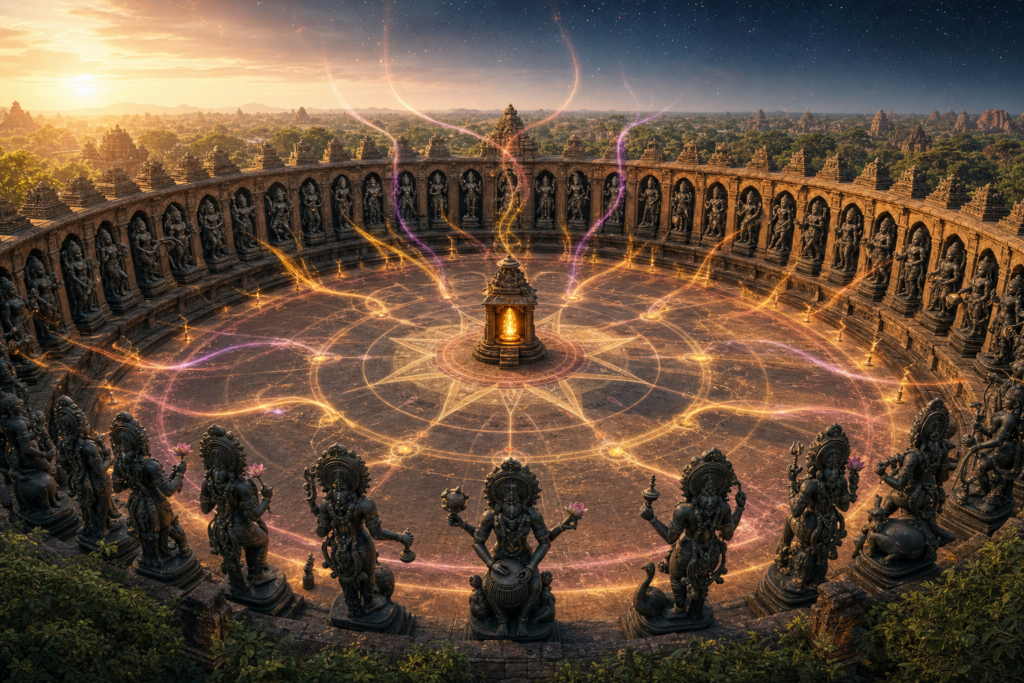
Dashavatara Moorthy is a revered epithet of Lord Vishnu, the preserver in the Hindu Trimurti, highlighting the ten principal incarnations (Dashavatara) taken to uphold dharma and protect all beings. According to the Puranas, nine avatars have already manifested, while the tenth, Kalki, is prophesied to appear at the end of the present age to restore cosmic balance.
Within Hindu scriptures, these incarnations are understood as compassionate interventions that restore order whenever adharma prevails. Each avatar addresses the moral and spiritual needs of its era, offering guidance, reassurance, and a renewed path toward righteousness for society at large.
Many traditions enumerate the Dashavatara as Matsya, Kurma, Varaha, Narasimha, Vamana, Parashurama, Rama, Krishna, Buddha (in numerous Vaishnava lists) or Balarama (in some regional recensions), and Kalki, who is yet to come. Variations across regions and texts acknowledge the breadth of Hindu belief and practice, while preserving the central insight that the avatars of Vishnu emerge to safeguard dharma.
Scholars and devotees alike often observe a symbolic arc in this sequencefrom aquatic to human and royal formsreflecting the unfolding of social ethics and spiritual consciousness. This interpretive lens does not negate the scriptural narrative; rather, it enriches appreciation of how the Dashavatara engages both the cosmic order and lived human experience.
Primary sources such as the Vishnu Purana and the Bhagavata Purana, alongside the Ramayana and the Mahabharata, situate the Dashavatara within the wider tapestry of Hindu scriptures. Temple iconography, festival observances, and daily worship further embed Dashavatara Moorthy in cultural memory, making the avatars a living presence in contemporary spiritual life.
These narratives resonate beyond sectarian boundaries, highlighting virtues cherished across dharmic traditionskaruna (compassion), Ahimsa (non-violence), satya (truth), and seva (service). In this way, the Dashavatara fosters unity in spiritual diversity, offering points of dialogue and shared ethical ground among Hinduism, Buddhism, Jainism, and Sikhism while honoring each tradition’s integrity.
For many families and communities, festivals such as Rama Navami, Janmashtami, and Vamana Jayanti become occasions to retell these stories, reflect on their ethical teachings, and cultivate inner resilience. Such practices encourage individuals to translate the wisdom of Lord Vishnu’s avatars into daily choicesbalancing courage with compassion and conviction with humility.
As a result, reverence for Dashavatara Moorthy remains both devotional and practical: a source of hope during uncertainty, a framework for moral clarity, and a reminder that the preservation of dharma is a shared human responsibility. In this enduring vision, the awaited Kalki avatar symbolizes not only a future restoration but also the timeless call to live by dharma here and now.
Inspired by this post on Hindu Pad.