Recent remarks attributed to Mani Shankar Aiyarindicating a personal non-identification with Hindu Dharma and a perception of temple icons as mere stonehave reignited a familiar national conversation about the contours of Indian secularism amid a deeply plural Dharmic society. Rather than amplifying polarization, the moment invites a careful, evidence-informed examination of how personal disbelief, public discourse, and civilizational heritage negotiate space in a constitutional democracy committed to equality, dignity, and mutual respect.
At the level of individual rights, Indian constitutional guarantees (Articles 25–28) protect the freedom of conscience: one may believe, not believe, or question. Yet public rhetoric surrounding sacred spaces carries broader social effects. Language that appears to reduce consecrated icons to inert matter can be experienced by many as a denial of lived religious realities and cultural memory. That tensionbetween private skepticism and public empathysits at the heart of the current debate.
Indian secularism is often described as sarva-dharma-samabhavaequal regard for all faithscomplemented by the idea of a principled distance of the state from religion. In practice, the ideal calls for consistent standards across communities, avoiding both preferential endorsement and derisive exceptionalism. Critiques of what some term “selective secularism” arise when majoritarian traditions are publicly trivialized while parallel sensitivities about minority traditions receive deference. A stable, fair-minded public square requires uniform norms of respect for allHindu, Buddhist, Jain, Sikh, and others.
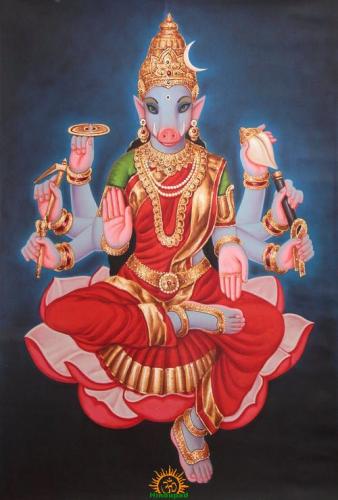
Within the Hindu way of life, the metaphysics and practice of murti-puja are neither naïve materialism nor simple aesthetic homage. Through prāṇa-pratiṣṭhā, ritual specialists invoke presenceconsciousness, not mere physicalityinto the icon, aligning the devotee’s inner life with the temple’s consecrated field. In Vedantic and Āgamic terms, form (saguṇa) and the formless (nirguṇa) are understood as complementary, not contradictory; the icon functions as a pedagogical and meditative aid for realizing the non-dual ground of being. In this view, the question is not whether stone exists, but whether consciousness can be encountered through consecrated form.
Iconic and aniconic symbolism both have deep roots in Dharmic traditions. The Śiva liṅga, for instance, is a paradigmatic aniconic sign that gestures beyond anthropomorphic depiction toward metaphysical infinitude. Early Buddhist communities venerated the stūpaan aniconic presencebefore the widespread emergence of Buddha-rūpa images; Jain traditions similarly engage with both aniconic emblems and iconographic tirthaṅkara images. Across these streams, Anekantavada (the Jain doctrine of many-sidedness) illuminates how multiple, seemingly divergent perspectives may all apprehend partial truths about ultimate reality.
Ishta in Hinduism further articulates this plural logic: individuals align practices with their inner disposition, choosing pathwaysbhakti, jñāna, karma, or dhyānafit for temperament and stage of life. The Ishta principle avoids insistence on a singular, exclusive approach and instead affirms a spectrum of valid sādhanā. Translated into civic life, this ethos counsels humility in judgment and generosity in interpretation when encountering rituals or symbols that one does not personally follow.
Sikh praxis, which does not endorse idol worship, centers the living authority of the Guru Granth Sahib and the communal discipline of sangat and langar. Reverence in a gurdwara is concentrated not on icons but on the shabad-gurudivine wordand a disciplined ethical life. Yet even here, a shared Dharmic sensitivity to sanctified space, music, and collective remembrance creates bridges of understanding with Hindu, Buddhist, and Jain milieus. Each tradition holds distinctive forms while sharing a commitment to inner cultivation, truthfulness, and service.
Anthropology and cognitive science offer further clarity on why consecrated images and sites become powerful in lived practice. Repeated ritual acts such as abhishekam, ārati, and mantra-japa, situated within acoustically and architecturally tuned spaces, shape attention, memory, and moral emotion. Over time, devotees report a reliable phenomenology of presencedarśanexperienced not as superstition but as a cultivated relational awareness fostered by communal rhythms, narrative meaning, and disciplined embodiment.
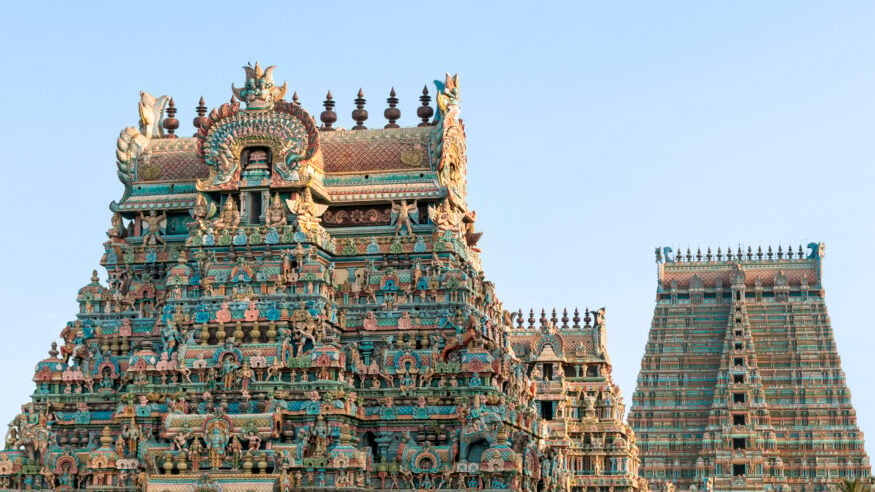
Beyond metaphysics, temples and other sacred institutions serve as social anchors. They host annadānam and seva, provide cultural education, safeguard crafts and performing arts, and maintain archives of local history. In diaspora settings, they often become hubs of intercultural exchange and Interfaith Dialogue, introducing neighbors to India’s civilizational grammar of Religious Pluralism. To dismiss such institutions as mere repositories of stone risks overlooking their material contributions to social capital, welfare, and cultural continuity.
The constitutional terrain adds further nuance. The Essential Religious Practices doctrine, while contested, recognizes that certain ritual forms and institutional structures merit protection as integral to religious identity. A principled secular state does not adjudicate theological truth claims but protects the conditions under which communities can pursue them peacefully. Public figures, who shape discourse at scale, bear special responsibility to frame disagreement in ways that honor both freedom of conscience and the dignity of believers.
Constructive dialogue in a plural society benefits from several habits: interpretive humility rooted in Anekantavada; acknowledgment of Ishta, which normalizes diverse spiritual temperaments; constitutional courtesy that protects speech while discouraging derision; and a commitment to evidence over caricature. Such habits align with the broader Dharmic Traditions of cultivating self-restraint, compassion, and clarity even amidst sharp debate.
Many families across India can attest to the quiet dignity of standing before a dīya-lit sanctum, or the solace found in a stūpa’s circumambulation, or the moral anchoring of listening to kīrtan in a gurdwara. Others locate meaning in purely ethical or philosophical practice without ritual forms. Indian secularism is capacious enough to hold both trajectoriesdevotional and non-devotionalso long as neither seeks to demean the other’s path.
Placed in this broader frame, the episode surrounding Mani Shankar Aiyar should be approached as an opportunity to reaffirm India’s unique model: a secular republic grounded in the civilizational wisdom of Religious Pluralism. When public discourse resists reductive characterizationssuch as reading temple icons as “only stone”and instead engages the philosophical, social, and constitutional dimensions at stake, it strengthens unity among Hinduism, Buddhism, Jainism, and Sikhism. That unity, rooted in respect and mutual learning, is the surest foundation for a resilient and genuinely inclusive India.
Inspired by this post on Hindu Jagruti Samiti.