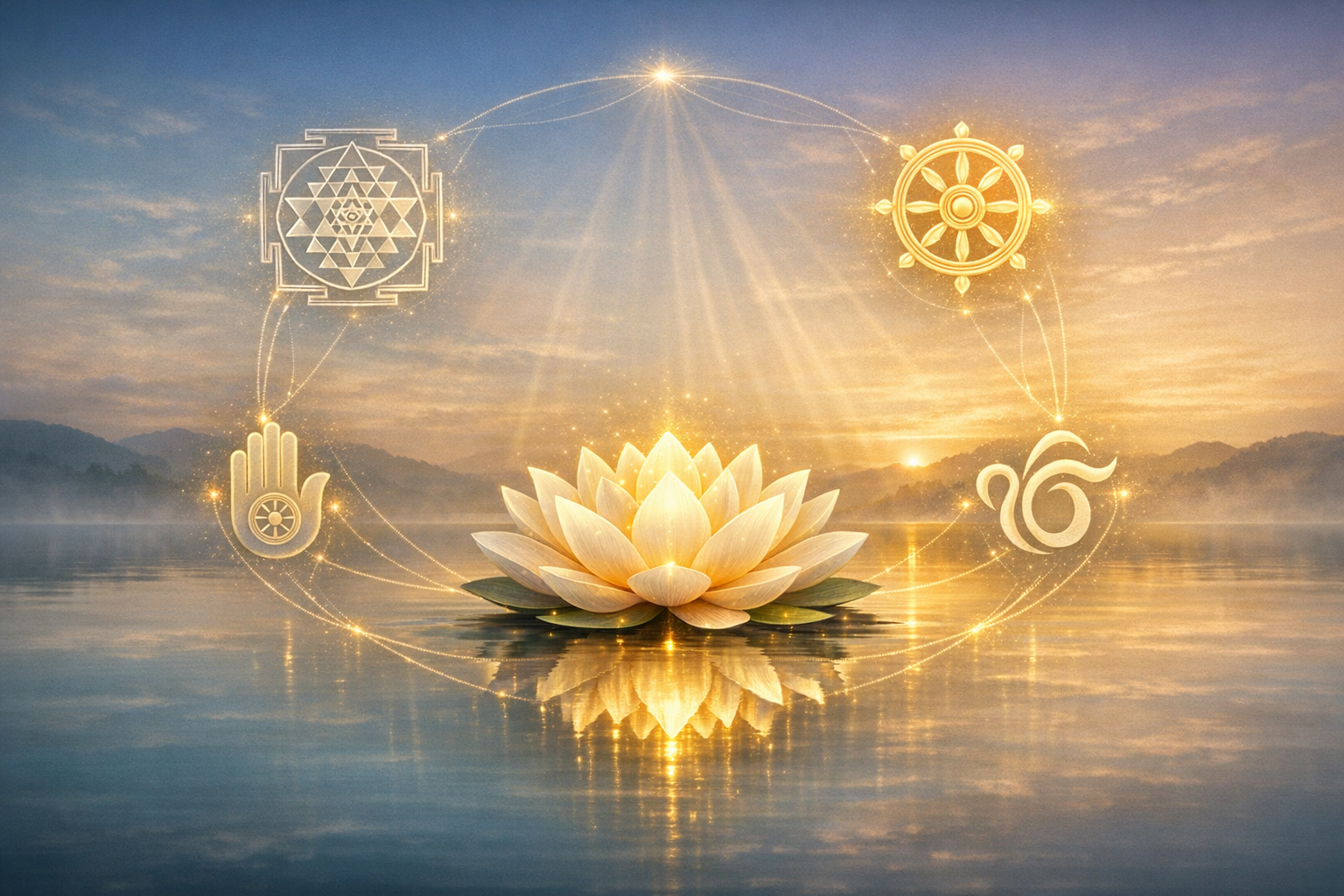
The aphorism “wise men know that there is only knowledge, so they remain one with it and do not struggle” articulates a timeless insight: liberation is not won through contention with reality but through lucid recognition of it. Within the dharmic traditionsHinduism, Buddhism, Jainism, and Sikhismknowledge is not merely informational content; it is transformative cognition (jnana, vidya, prajna, giān) that dissolves ignorance and its afflictive struggle. Read as a unifying thesis rather than a sectarian claim, the statement signals a shared civilizational conviction: right knowing reorients life toward clarity, compassion, and freedom.
Epistemologically, “there is only knowledge” is best understood as asserting the primacy of knowing in human experience. In Hindu philosophy, especially Vedanta, knowledge aligns with consciousness (cit) and the realization of Brahman; in Buddhism, prajna discloses the emptiness (shunyata) of clinging constructions; in Jainism, jnana-tattva culminates in kevala-jñāna, unobstructed awareness; in Sikhism, giān, guided by the Sabda-Guru, aligns human perception with Ik Oṅkār and Hukam. These distinct formulations converge on one functional truth: liberating knowledge rectifies perception, thereby attenuating suffering and conflict.
The corollary“so they remain one with it and do not struggle”does not sanction passivity; it prescribes non-contradiction with truth. In the Gita’s idiom, action continues as niṣkāma karmaengagement without grasping. In the Yoga tradition, steadiness arises through abhyāsa and vairāgya, a rhythm captured by the phrase nairantarya abhyase (unbroken practice). Buddhism pairs energy (vīrya) with non-grasping, so effort is free of craving; Jain ethics tempers endeavor with ahiṃsā and aparigraha; Sikh thought names this poised alignment sehaj, an ease born of remembrance (simran) and surrender to Hukam. Non-struggle here means non-conflict with what is known to be true.
Across Indic knowledge-systems, the means of valid knowing (pramāṇa) are carefully curated. Hindu darshanas deploy perception (pratyakṣa), inference (anumāna), and trustworthy testimony (śabda), with nuanced elaborations by Nyāya and Mimāṃsā. Buddhist epistemologists such as Dignāga and Dharmakīrti distill pramāṇa to perception and inference, with refined analyses of how cognition avoids error. Jain philosophy complements these with Anekantavada and Syādvāda, affirming the many-sidedness and conditionality of truths. Sikh epistemology centers śabdathe revelatory word of the Guru Granth Sahibwhile honoring lived verification through disciplined remembrance and service. The shared thrust is rigorous, humility-based inquiry rather than dogmatic assertion.
Ontologically, “only knowledge” need not be read as metaphysical idealism. Advaita Vedanta treats consciousness as self-luminous reality (Brahman), while non-Advaita schools emphasize knowledge as accurate relation to a real, richly stratified world. Buddhism refrains from positing an ultimate substance, directing prajna to see dependent arising and the emptiness of reified essences. Jain realism, balanced by Anekantavada, resists absolutizing any single standpoint. Sikh thought affirms the oneness of the Divine (Ik Oṅkār) as both immanent and transcendent, known through grace and giān. Each tradition treats knowledge as that which discloses how things actually are, thereby ending inner contention.
This primacy of knowing is inseparable from ethics. When perception is purified, conduct naturally tends toward compassion (karuṇā), non-violence (ahiṃsā), truthfulness (satya), and service (seva). The struggle that knowledge ends is not the responsible struggle against injustice, but the inner friction generated by ignorancegrasping, aversion, and delusion. As these kleshas recede, social life benefits: dialogue replaces rancor, and the civilizational ideal of Vasudhaiva Kutumbakam becomes actionable rather than aspirational.
Practice operationalizes the thesis. In Vedantic pathways, śravaṇa–manana–nididhyāsana internalize the Upanishadic vision, while Karma Yoga sanctifies daily work without attachment. In Buddhist disciplines, mindfulness and insight (vipassanā) cultivate direct seeing of phenomena as impermanent, unsatisfactory, and non-self, loosening the compulsions that fuel struggle. Jain sādhanā emphasizes samayik (equanimity), pratikraman (periodic ethical review), and rigorous ahiṃsā to refine cognition and character. In Sikh rehat, simran, kirtan, and seva align the heart-mind with Sabda and Hukam, nurturing sehaj. Distinct methods, one arc: stabilizing knowledge so that effort is free of friction.
Anekantavada offers a powerful integrative key for inter-traditional understanding. By acknowledging the conditional validity of multiple standpoints, it protects discourse from absolutism and fosters Unity in spiritual diversity. Applied across dharmic conversations, it encourages learning across lineagesAdvaita’s clarity about consciousness, Buddhism’s analysis of cognition, Jainism’s perspectival realism, and Sikhism’s luminous devotionwithout collapsing their distinctions or encouraging rivalry.
Readiness for non-struggle can be assessed in experiential terms. Attention becomes panoramic yet precise; reactions give way to responses; ethical intuitions quicken; and joy becomes less contingent on outcomes. In classical language, the mind’s modifications (vṛttis) settle; craving (rāga) and aversion (dveṣa) lose momentum; equanimity (upekkhā, samatā) stabilizes. These are not mystical accessories but practical markers of knowledge maturing into freedom.
Contemporary relevance is immediate. In an information-saturated age, the distinction between information and wisdom is decisive. The Indic knowledge tradition trains discernment (viveka) to filter noise, align intention (saṅkalpa) with dharma, and act with clarity under uncertainty. Leaders and communities that privilege such jnana foster resilience, reduce polarization, and unlock genuine Knowledge Integration across domainsethical, social, and scientific.
Ultimately, “there is only knowledge” signals a criterion for peace: do not contest what clear seeing has made evident. The dharmic map is diverse, but its destination is sharedfreedom through right knowing. When cognition is clarified, the heart naturally harmonizes with the real; and when the heart harmonizes, struggle as compulsion dissolves, leaving engaged, compassionate, and wise action in its place.
Inspired by this post on Hindu Blog.