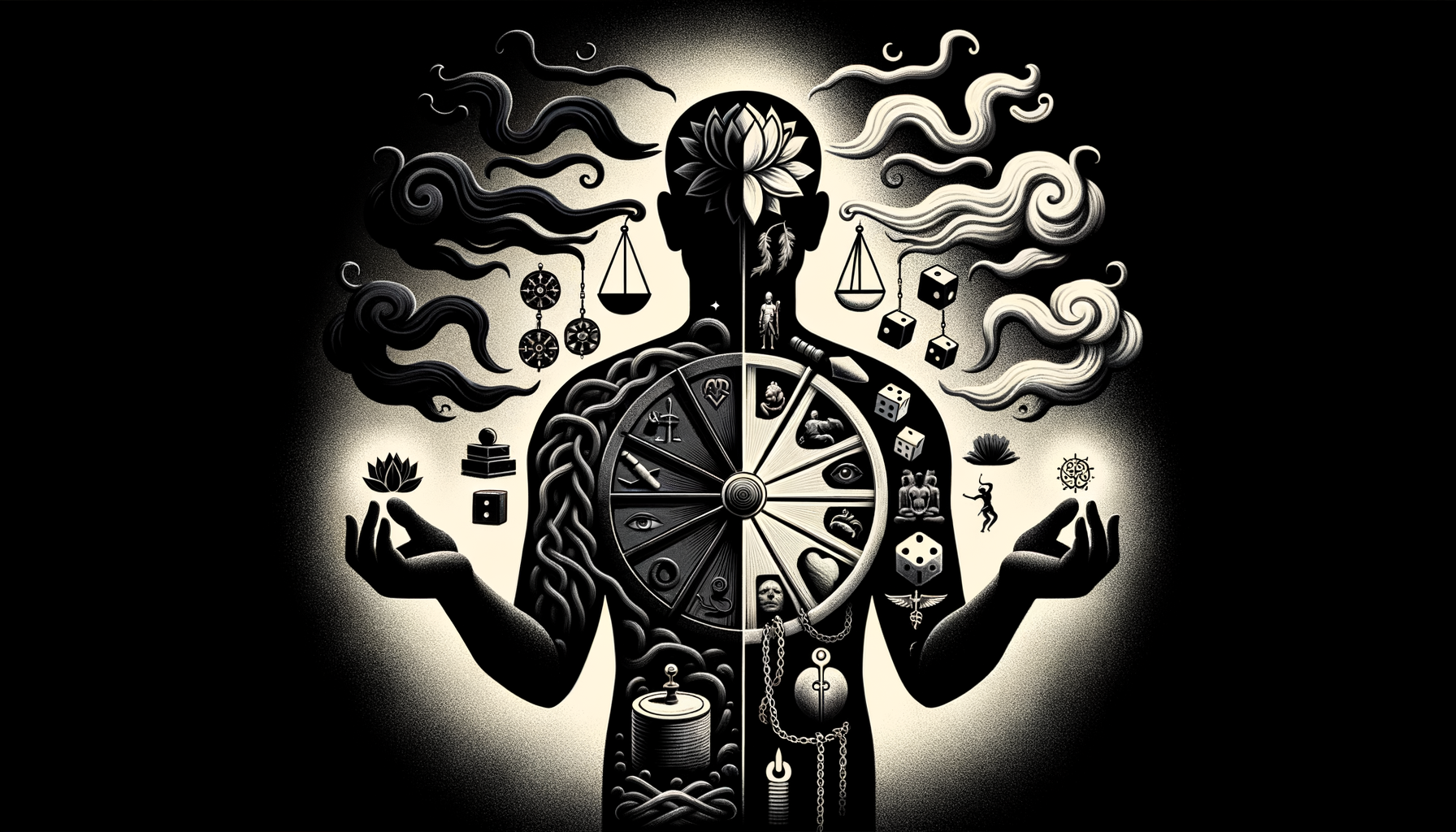
The Mahabharata endures not merely as an ancient chronicle of rivalry but as a lucid mirror of human nature. Read symbolically, the Kauravas and Pandavas personify the ongoing tension between Adharma and Dharma within every mindimpulses toward greed or integrity, envy or compassion, arrogance or humility. This inner Kurukshetra renders the epic an ethical guide rather than a distant legend.
In this interpretive frame, the Kauravas reflect tendencies such as resentment, possessiveness, and unchecked ambition, while the Pandavas represent conscience, courage, justice, and self-mastery. The narrative thus offers a vocabulary for understanding everyday moral psychology: desires that pull toward short-term gain and principles that call one back to long-term welfare and truth.
Contemporary readers often find that the epic’s characters map onto lived experience. In competitive workplaces, strained family conversations, or public life, Duryodhana-like defensiveness may arise as quickly as Yudhishtira-like clarity. Recognizing these patterns fosters self-awareness, reduces impulsivity, and supports ethical decision-making grounded in Dharma and Adharma discernment.
The Bhagavad Gita crystallizes this inner conflict through Arjuna’s hesitation. His paralysis mirrors the human condition: when consequence, duty, and compassion collide, confusion is natural. Krishna’s counselcultivating clarity, disciplined action (karma-yoga), and equanimityframes a method of ethical engagement where responsibility is embraced without attachment to outcomes.
Practical application follows from this insight. Individuals strengthen “Pandava” qualities by practicing truthfulness, empathy, and accountability; by regulating anger and envy; and by aligning personal ambition with social good. Such habits transform inner conflict into growth, making virtue not a static label but a trainable capacity.
This inner battle is not unique to one tradition. Dharmic philosophies converge on the same terrain of human psychology: Buddhism analyzes kleshas (defilements) such as craving and aversion; Jainism examines kashayas (anger, pride, deceit, greed); Sikh teachings warn against the five thieveskām, krodh, lobh, moh, ahankār. Each offers disciplined practicesmindfulness, self-restraint, seva, meditationthat refine attention and character, uniting these paths in a shared pursuit of liberation from inner bondage.
Seen this way, the Mahabharata becomes a bridge for unity among Hinduism, Buddhism, Jainism, and Sikhism. All emphasize ethical self-mastery, compassionate action, and community well-being. By adopting this integrative lens, readers move beyond sectarian boundaries toward a common ethic: reducing harm, expanding insight, and serving a larger harmony.
Emotionally, this perspective is consoling. It normalizes inner conflict and reframes setbacks as part of a universal human struggle. Rather than condemning oneself for Kaurava-like impulses, one can observe them, understand their causes, and cultivate Pandava-like responsescourage, patience, and discernmentanchored in Dharma.
The benefit is practical and immediate: clearer choices under pressure, resilient relationships, and steadier leadership. When individuals consistently choose Dharma over Adharma, the cumulative effect is social trust and cohesion. In this sense, the “victory” of the Pandavas is not only historical; it is reenacted through daily acts of integrity that advance peace and justice.
The Mahabharata thus offers more than Interesting Facts about an Indian epic; it provides a method for ethical living. By unmasking human nature and training the mind toward virtue, it turns the inner Kurukshetra into a field of learningwhere wisdom, like the Pandavas, prevails through disciplined practice, humility, and unwavering commitment to the good.
Inspired by this post on Hindu Blog.