

This article is based on a Twitter thread from TrueIndology
Guru Tegh Bahadur was the 9th Guru of Sikhism.
In this article, we will explore the sanatani shared values of Guru Tegh Bahadur Ji. We will strictly be using primary sources.
Let us start with most apparent marker: Guru Tegh Bahadur’s appearance. In old Sikh paintings, Guru Tegh Bahadur is depicted with Tilak like a Sanatani Hindu. The second painting is housed in Lahore Museum. This is not merely artistic convention. This is supported by history.
Sikh chronicles attest that when Guru Tegh Bahadur when was anointed as the Guru, a Tilak was applied on his forehead. This incident happened on 11th August, 1664. It was a tradition among Sikh Gurus and Kings to be thus anointed with Tilak.
Sikh chronicles attest that when Guru Tegh Bahadur when was anointed as the Guru, a Tilak was applied on his forehead. This incident happened on 11th August, 1664.
True Indology (@TrueIndology) March 22, 2023
It was a tradition among Sikh Gurus and Kings to be thus anointed with Tilak. pic.twitter.com/8LQSyXv4Dt
This past has caused a lot of consternation and discomfort among the recent SGPC Amritsar and Singh Sabha ideologues. Such paintings of Guru Tegh Bahadur with Tilak have completely vanished and are not found today. Instead, he is depicted like this in recent paintings.
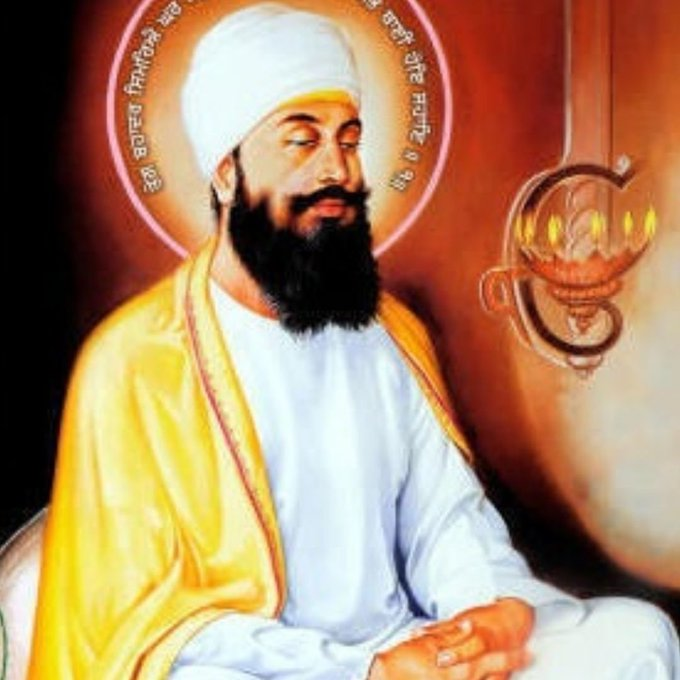
Hindu self identification: Guru Tegh Bahadur identified himself as a Sanatani Hindu and devotee of Naina Devi. He also identified himself as a kshatriya. The Guru called himself a descendant of Rishi Vishvamitra. We have contemporary primary evidence for this.
In 1662 CE, Guru Tegh Bahadur visited the Hindu holy pilgrimage site of Prayaga (Prayagraj, formerly called Allahabad). This visit to Prayaga and its details are recorded in contemporary documents called the ‘Panda Vahi‘ records. These documents have been published by Sikh historian Madanjit Kaur (1978).
In 1662 CE, Guru Tegh Bahadur visited the Hindu holy pilgrimage site of Prayaga.
True Indology (@TrueIndology) March 22, 2023
This visit to Prayaga and its details are recorded in contemporary documents called the ‘Panda Vahi’ records.
These documents have been published by Sikh historian Madanjit Kaur (1978). pic.twitter.com/XbQWxl0I7r
In these records is a document that was personally signed by Guru Tegh Bahadur. In this document, Guru Tegh Bahadur calls himself a devotee of Goddess Naina Devi. This perfectly explains why Guru Tegh Bahadur established his seat Anandpur Sahib just beside temple of Naina Devi.
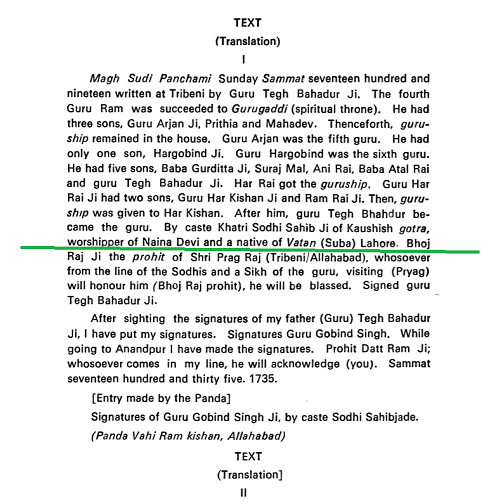
Note: In this document, Guru Tegh Bahadur does not call himself a devotee of Akal Purakh or Waheguru. Rather, he calls himself a devotee of Goddess Naina Devi. Importance of Naina Devi has persisted in Sikh tradition. Naina Devi is venerated in Guru Gobind Singh’s Dasam Granth.
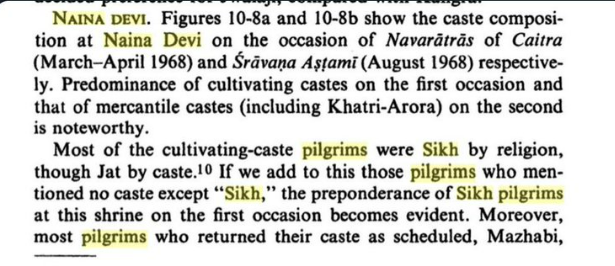
Naina Devi remained a popular pilgrimage site for Sikhs for centuries. Even in 1968, Naina Devi temple drew more Sikh Pilgrims than Hindus. Of course, it is not the same anymore now.
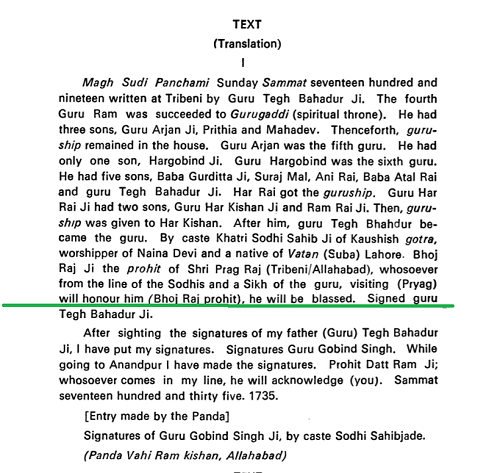
Guru Tegh Bahadur calls himself a Sodhi Khatri by Varna and says that he belongs to Kaushish (Kaushik) Gotra. Kaushish/ Kaushik is the Gotra of Rishi Vishvamitra. Kaushika is just another name of Rishi Vishamitra. Gotra indicates descent from the Rishi. Guru Tegh Bahadur identified himself with his Varna and Gotra. This is exactly how orthodox Sanatanis identify themselves even today.
Guru Tegh Bahadur identified himself with his Varna and Gotra.
True Indology (@TrueIndology) March 22, 2023
This is exactly how orthodox Hindus identify themselves even today. pic.twitter.com/YPeLv7TPyt
Brahmin Purohit: The document further tells us that Guru Tegh Bahadur sought the services of a Brahmin priest to perform Hindu rituals. Guru further ordered his Sikhs and followers to honor the Brahmin. Needless to say, he is undeniably following traditional Hinduism!
Hindu identity: Guru Tegh Bahadur identified himself as a Hindu according to Sikh chronicles themselves. As an example, consider the popular Sikh Chronicle Sri Guru Pratap Suraj Granth. It preserves a rare passage which tells us what Guru Tegh Bahadur said in Mughal court.
According to the Sikh Chronicle, this was what the Guru Tegh Bahadur said in the Mughal court when he was asked to convert to Islam. Guru Tegh Bahadur said
I believe my Hindu Dharma to be most superior.
How can I abandon that which is most dear to me?
According to the Sikh Chronicle, this was what the Guru Tegh Bahadur said in the Mughal court when he was asked to convert to Islam.
True Indology (@TrueIndology) March 22, 2023
Guru Tegh Bahadur said:-
“I believe MY Hindu Dharma to be most superior.
How can I abandon that which is most dear to me?”. pic.twitter.com/fZPVe1tT3X
Further, Guru Tegh Bahadur calls himself “The Guru of Hindus” but not “Guru of Sikhs”. Guru Tegh Bahadur said:
They imprisoned me, the Guru of Hindus,
Whatever I said, they listened not
The Guru’s own passages preserved in Guru Granth Sahib corroborate that the Guru was every inch a Hindu. Guru Tegh Bahadur says:
“This is indeed the blessing of Vedas and Puranas, that you may meditate in the name of Hari”
The Guru’s own passages preserved in Guru Granth Sahib corroborate that the Guru was every inch a Hindu.
True Indology (@TrueIndology) March 22, 2023
Guru Tegh Bahadur says:-
“This is indeed the blessing of Vedas and Puranas, that you may meditate in the name of Hari” pic.twitter.com/UJoDAxFmOL
Guru Tegh Bahadur celebrated Dipavali (aka Diwali, sanatani festival of lights) according to the injunctions of Puranas. In Puranas, it is stated that cattle & clothes should to be presented on the auspicious occasion of Dipavali. The same ritual was followed by Guru Tegh Bahadur as explicitly stated in his Hukumnamah.
It is to be observed that Guru Tegh Bahadur refers to the festival as ‘Diwali‘ and he does not use the word ‘Bandi Chor Divas‘ in any of his writings. He celebrates the festival just as traditional Sanatanis did for thousands of years.
It is to be observed that Guru Tegh Bahadur refers to the festival as ‘Diwali’ and he does not use the word ‘Bandi Chor Divas’ in any of his writings.
True Indology (@TrueIndology) March 22, 2023
He celebrates the festival just as traditional Hindus did for thousands of years.
Sources:
- “A study of the Panda Vahis” by Sikh historian Madanjit Kaur (Indian History Congress 1978).
- Suraj Prakash(original) by Kavi Santokh Singh (c.1843 CE)
- Guru Granth Sahib (original): Ang 220.