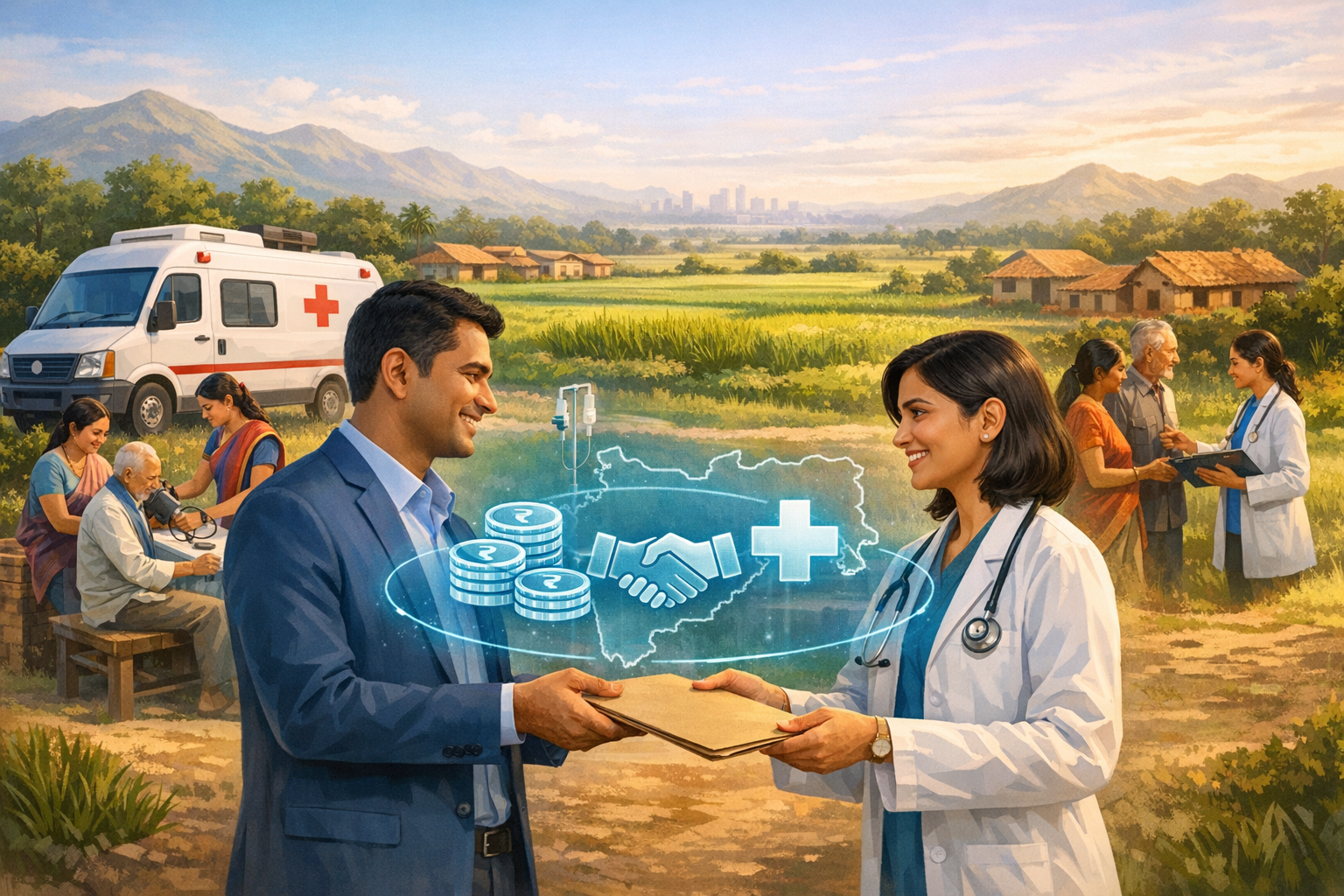
On 24th April 2026 in Pune, during the inauguration of the State Bank of India’s (SBI) Local Head Office (LHO) for the Maharashtra Circle, the SBI Foundation announced a grant of ₹2 Crores to Shri Chaitanya Health and Care Trust under the SBI Gram Saksham project. The moment marked a strategic commitment to strengthen last-mile health services for underserved communities, aligning philanthropic capital with measurable social impact in Rural India.
The significance of this allocation extends beyond ceremonial philanthropy. It signals a structured approach to Charity and Philanthropy that prioritizes Healthcare access, Inclusive Development, and Social Impact through evidence-based program design. By linking resources to a defined rural development platform, the partnership is positioned to advance equitable health outcomes while reinforcing institutional capacity at the community level.
Shri Chaitanya Health and Care Trust, associated with ISKCON GEV’s service ecosystem, has long emphasized seva-driven Community service. In collaboration with the SBI Foundation, the Trust can leverage established relationships with local stakeholders to enable integrated health and care pathways that are culturally sensitive, cost-effective, and responsive to the needs of marginalized households.
The SBI Gram Saksham project—conceived to catalyze village-level empowerment—provides a programmatic scaffold within which the healthcare component can be scaled prudently. In this context, the ₹2 Crores support can prioritize essential primary care functions and strengthen referral linkages, creating a continuum of care that bridges households, village health workers, and formal health facilities across Maharashtra.
Priority interventions in rural Healthcare typically include preventive screening for non-communicable diseases, maternal and child health services, immunization linkages, nutrition counseling, oral and eye health camps, and mental health first aid. Where feasible, telemedicine and mobile medical units can expand reach to geographically isolated settlements, while health education drives improve awareness, treatment adherence, and early care-seeking behavior.
An effective delivery model in Rural India often combines a hub-and-spoke approach with mobile outreach. Village-level outreach (the spokes) can focus on screening, follow-up, and health promotion, while a block- or taluka-level hub anchors diagnostics, clinician teleconsultation, and referral coordination. Such a model reduces the burden of travel for families and creates predictable service touchpoints that communities can trust.
Human resource development is central to quality. Training village health facilitators, Accredited Social Health Activists (ASHAs), and auxiliary nurses in standardized protocols can raise the reliability of frontline care. Structured mentorship, refresher modules, and supportive supervision help ensure that competencies are retained and that patient pathways—from screening to treatment to follow-up—remain clear and accountable.
Robust monitoring and evaluation should underpin the grant. A results framework can track key performance indicators such as villages covered, outpatient consultations, screening coverage for hypertension and diabetes, maternal and child health counseling sessions, telemedicine connect rates, referral completion, and patient-reported satisfaction. Digital registers and a basic health management information system can improve data quality, enable real-time course correction, and support transparent Social Impact reporting.
Financial stewardship benefits from clear governance. Disbursements can be milestone-linked; procurement can be standardized; and independent audits, community feedback forums, and periodic third-party evaluations can strengthen accountability. Alignment with India’s Corporate Social Responsibility (CSR) norms under the Companies Act, 2013 and Schedule VII—especially the focus on promoting healthcare including preventive healthcare—helps ensure compliance and program integrity.
Data protection and ethics must be integral. Patient privacy, informed consent, linguistic accessibility, and gender-sensitive service design are essential for trust. Adherence to applicable Indian data protection standards, including the Digital Personal Data Protection Act, 2023, alongside secure data handling practices, reduces risk and protects beneficiary dignity.
Systems integration elevates outcomes. Coordination with Primary Health Centres, Health and Wellness Centres under Ayushman Bharat, and district referral hospitals can streamline patient movement across levels of care. Collaborative planning with local health authorities and Panchayati Raj Institutions promotes ownership, while partnerships with civil society organizations can help address water, sanitation, and nutrition determinants that shape long-term health.
At a human level, the grant can reduce the distance between need and care. For a mother seeking immunization for her child, a nearby outreach clinic reduces wage loss and travel costs; for an elder living with hypertension, regular screening and counseling can prevent complications; for an adolescent, timely vision screening can improve educational participation. These relatable improvements capture how Inclusive Development translates into everyday security and dignity.
The spirit of seva that animates this collaboration resonates across dharmic traditions—Hinduism, Buddhism, Jainism, and Sikhism—each affirming compassion, non-harm, and service to the vulnerable. Structuring community participation to welcome volunteers and professionals from these traditions can deepen social cohesion, reinforce shared ethical commitments, and model unity in diversity through practical action.
Strategically, the intervention aligns with India’s DevelopmentGoals and the Sustainable Development Goals, particularly SDG 3 (Good Health and Well-being), SDG 6 (Clean Water and Sanitation) when linked to WASH education, SDG 10 (Reduced Inequalities), and SDG 17 (Partnerships for the Goals). With careful documentation of methods and costs, the model can be replicated across districts, improving cost per beneficiary over time and building a repository of proven rural health practices.
By anchoring service delivery in rigorous measurement, ethical practice, and community ownership, the ₹2 Crores grant from the SBI Foundation to Shri Chaitanya Health and Care Trust under the SBI Gram Saksham project can catalyze durable improvements in rural Healthcare. The announcement in Pune thus represents more than a funding milestone; it sets the stage for a transparent, outcomes-oriented program that advances equitable health access and embodies the dharmic ethic of compassionate service.
Inspired by this post on Dandavats.