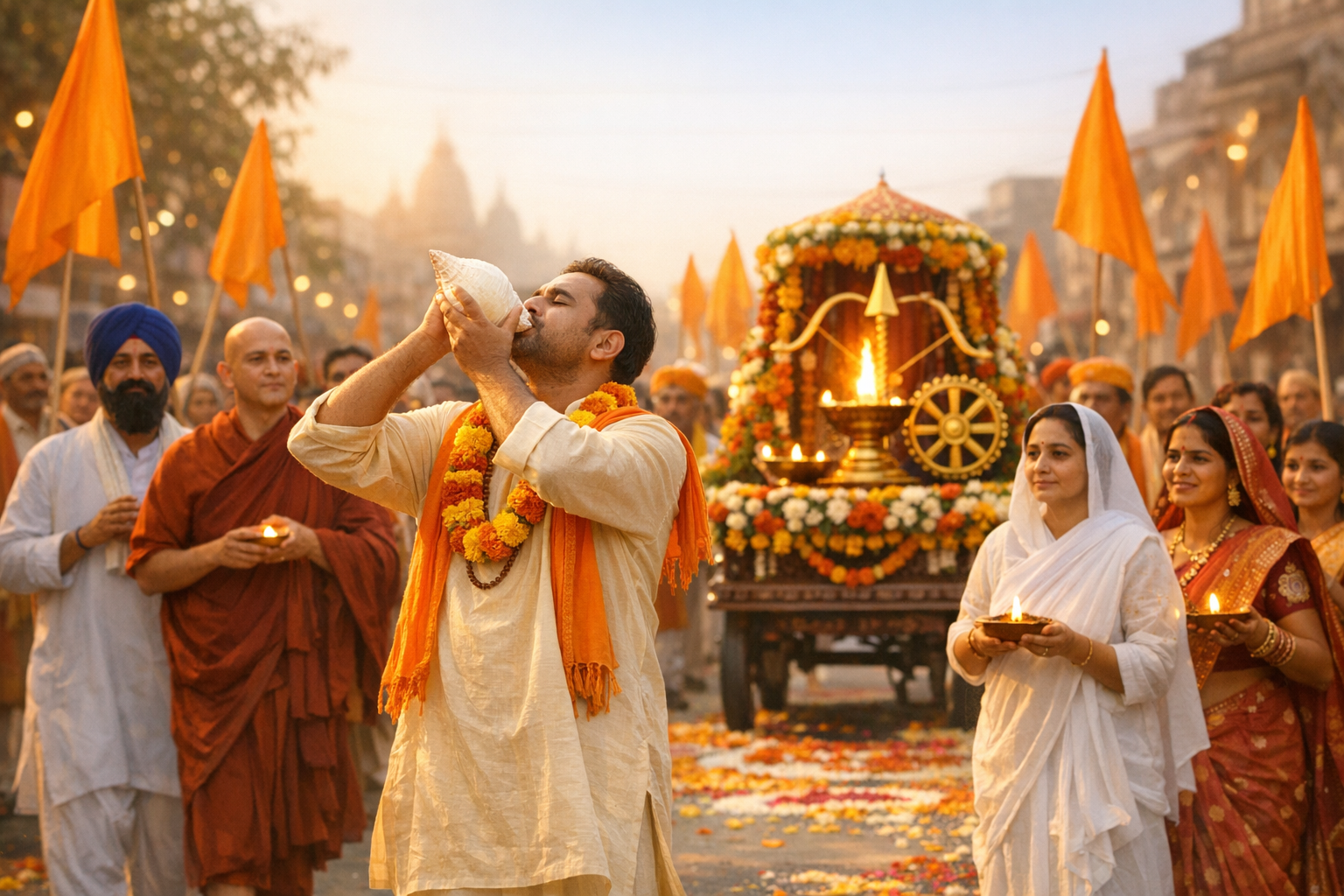
In Pratapgarh, the Sanatan Rashtra Shankhnaad Shobha Yatra convened on the anniversary of the inauguration of the Shri Ram Temple, drawing broad participation from several Hindu organisations. In a central address, Shri Vishwanath Kulkarni of Hindu Janajagruti Samiti (HJS) underscored unity and called for organised efforts directed toward the civilisational ideal of Ram Rajya.
As a commemorative public procession, the Shobha Yatra functioned as a vehicle for community cohesion and cultural memory. Such eventsrooted in Sanatan Dharma’s living traditionsconsolidate social capital, transmit ethical norms across generations, and create platforms for constructive, lawful civic engagement.
The anniversary of the Shri Ram Temple’s inauguration continues to operate as a powerful mnemonic of shared heritage beyond any single locality, connecting Pratapgarh to a wider cultural arc that includes Ayodhya and the pan-Indic network of pilgrimage, seva, and devotion. Within this frame, the aspiration for Ram Rajya acquires contemporary relevance as a normatively rich, inclusive vision of just governance and social harmony.
Historically and philosophically, Ram Rajya denotes rule anchored in dharmajustice (nyaya), restraint (maryada), truthful conduct (satya), welfare for all (sarvodaya), and care for the most vulnerable (antyodaya). It resonates with teachings found across Dharmic traditions: ahimsa and aparigraha in Jainism, karuna and upaya in Buddhism, and seva and sarbat da bhala in Sikhism. Understood inclusively, Ram Rajya becomes a shared ethical horizon rather than a sectarian project.
Within this inclusive reading, calls for Hindu unity are best interpreted as invitations to strengthen the broader Dharmic family through mutual respect, inter-tradition dialogue, and collaborative service. The emphasis on organised efforts, as articulated by Shri Vishwanath Kulkarni (HJS), aligns with evidence from community development studies: coordinated networks deliver better outcomes than isolated initiatives.
Translating a pledge for Ram Rajya into practice typically involves programmatic pillars: ethical education for youth; heritage conservation and documentation; environmental stewardship; equitable social welfare and disaster relief (seva); legal-literacy campaigns to deepen rule-of-law awareness; and interfaith bridge-building that affirms sarva dharma sambhava while preserving distinct identities. Each pillar contributes measurable public goodsreduced conflict costs, higher trust, and resilient local institutions.
Operationally, effective efforts rely on transparent governance and measurable goals. Community councils can set charters of conduct, define volunteer training standards, adopt grievance-redress mechanisms, and publish impact dashboards (for example, volunteer hours, service coverage, inclusion metrics). Such structures ensure that devotional energy expressed in a Shobha Yatra is channelled into sustained, accountable action.
Cultural processions of this kind also represent intangible cultural heritage, integrating music, symbolism, and ritual to sustain continuity with the past while adapting to present civic realities. When responsibly stewarded, they nurture pride without exclusion, deepen reverence without dogmatism, and turn memory into a resource for ethical action.
Safeguards remain essential. Commitments to non-violence, constitutional compliance, and respect for all communities protect the moral core of Sanatan Dharma and fortify public confidence. By centring dignity, dialogue, and service, community mobilisation avoids polarisation and embodies the dharmic spirit of lokasangrahaupholding the welfare and coherence of society.
Viewed in this light, the Pratapgarh Sanatan Rashtra Shankhnaad Shobha Yatra illustrates how remembrance of the Shri Ram Temple inauguration can catalyse constructive civic purpose. The call to establish Ram Rajyagrounded in dharma and widened through Dharmic unityinvites citizens to translate devotion into disciplined service, thereby strengthening community resilience and the shared civilisational fabric.
Inspired by this post on Hindu Jagruti Samiti.