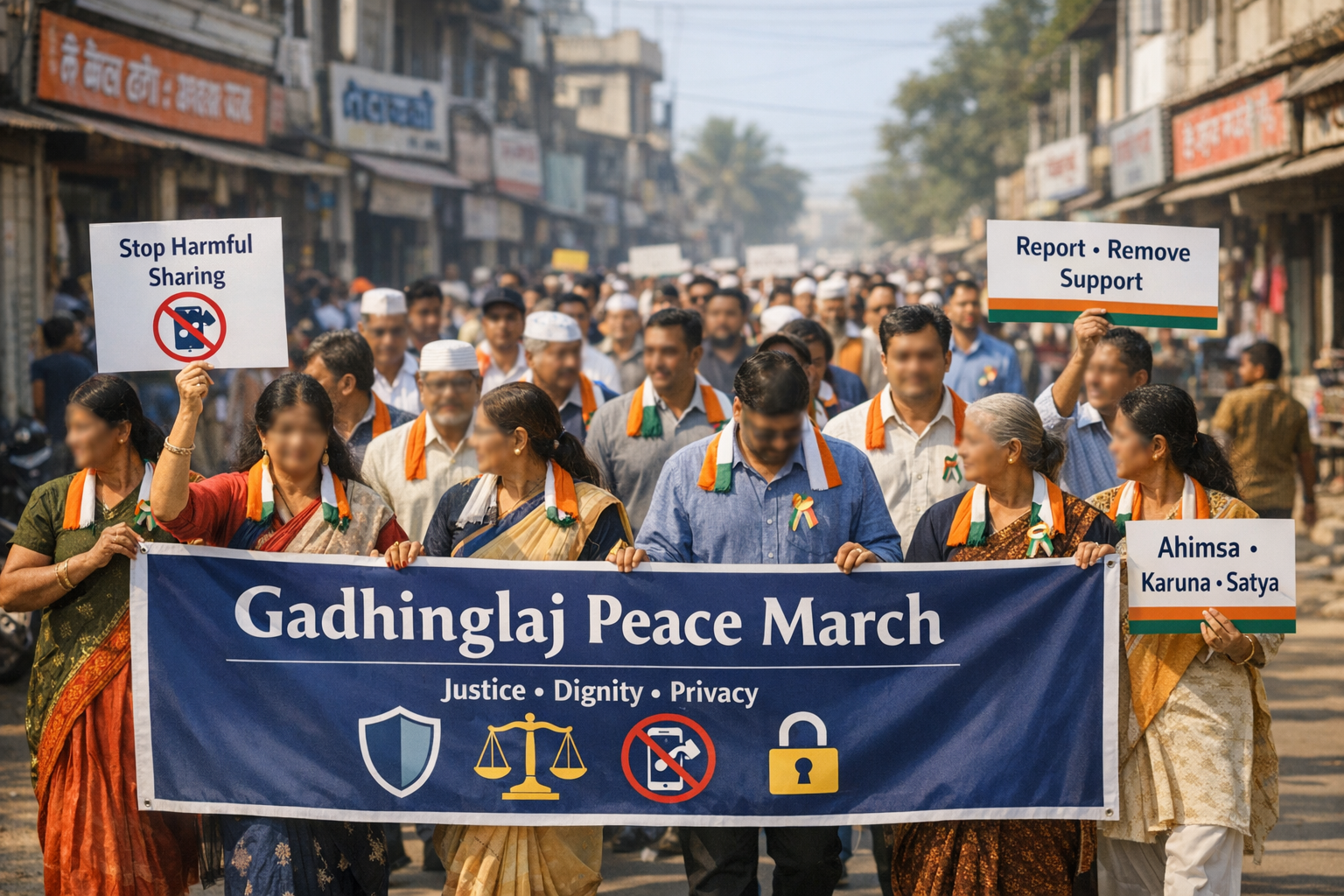
In Gadhinglaj, Maharashtra, multiple Hindu organisations led a peaceful protest march condemning the alleged abuse of a Hindu girl in Shiroli Pulachi and the unlawful circulation of her video. The demonstration called for swift, transparent investigation, immediate takedown of the content across platforms, and a victim-centric response that safeguards dignity, privacy, and due process.
The march reflected a broader civic demand that public safety, gender dignity, and digital ethics be upheld without compromise. Participants expressed concern that the secondary trauma caused by sharing such content online can rival, and sometimes exceed, the initial harm, underscoring the need for responsible digital citizenship and community vigilance.
Viewed through a socio-legal lens, the incident entails two distinct but interlinked harms: the underlying abuse and the non-consensual dissemination of the recording. The latter—often described as image-based abuse or non-consensual intimate imagery—multiplies victimisation by expanding the audience, amplifying stigma, and prolonging the injury over time.
Indian criminal law provides multiple avenues for redress depending on the facts and the survivor’s age. Relevant provisions may include sections of the Indian Penal Code such as 354 (assault or use of criminal force on a woman with intent to outrage modesty), 354A (sexual harassment), 354C (voyeurism), 354D (stalking), and 509 (word, gesture, or act intended to insult the modesty of a woman). Section 228A IPC prohibits disclosure of the identity of certain survivors, reinforcing confidentiality in reporting and coverage.
If the survivor is a minor, the Protection of Children from Sexual Offences (POCSO) Act imposes stringent obligations, including child-friendly procedures, mandatory reporting, and enhanced penalties. In all scenarios, the Code of Criminal Procedure (CrPC) requires prompt registration of an FIR under Section 154 for cognizable offences, early recording of the survivor’s statement under Section 164, and time-bound investigation culminating in a report under Section 173.
Digital offences arising from the creation, capture, or circulation of intimate content also implicate the Information Technology Act, 2000. Depending on the specific facts, applicable provisions can include Section 66E (violation of privacy), Section 67 (publishing or transmitting obscene material), and Section 67A (sexually explicit material). If the survivor is a minor, Section 67B of the IT Act is engaged in addition to POCSO’s specialised protections.
Intermediary liability and platform duties are framed by the Information Technology (Intermediary Guidelines and Digital Media Ethics Code) Rules, 2021. Intermediaries must act with due diligence and, upon receiving a valid complaint from an individual or authorised representative, expeditiously remove or disable access to content depicting nudity or sexual acts within a defined period, typically within 24 hours for such sensitive takedowns. Robust grievance redressal mechanisms and preservation of relevant logs to assist lawful investigation are integral to compliance.
From an evidentiary standpoint, immediate preservation matters. Complainants are advised to save URLs, timestamps, device details, and screenshots, and to avoid forwarding the content further. Forensically sound collection supports admissibility under Section 65B of the Indian Evidence Act, which governs electronic evidence.
Reporting channels include the local police station and the National Cyber Crime Reporting Portal, which accepts complaints related to sexual abuse material and image-based offences. Survivors can also seek assistance from one-stop centres, district legal services authorities for free legal aid, and hospital-based crisis support for medical and psychological care. Confidentiality, non-disclosure of identity, and informed consent are core to a trauma-informed approach.
Jurisprudence after Justice K.S. Puttaswamy (2017) affirms the constitutional right to privacy under Article 21, reinforcing the state’s duty to prevent and redress privacy-invasive harms. Complementary guidance from the Supreme Court, including Nipun Saxena v. Union of India (2018) on non-disclosure of survivors’ identities, establishes ethical and legal guardrails for law enforcement, media, and the public.
Community responses, such as the Gadhinglaj protest, can be pivotal in ensuring accountability while maintaining social harmony. Organisers bear a corresponding responsibility to coordinate with authorities, avoid rhetoric that fuels communal polarisation, and prioritise survivor dignity. The emphasis must remain on justice, lawful process, and protection of fundamental rights.
Unity across dharmic traditions—Hinduism, Buddhism, Jainism, and Sikhism—provides a constructive ethical framework for such crises. These traditions collectively affirm ahimsa (non-violence), karuna (compassion), and satya (truth), encouraging communities to act firmly against abuse while upholding solidarity, mutual respect, and coexistence.
The right to peaceful assembly under Article 19(1)(b) of the Constitution empowers citizens to voice legitimate concerns, subject to reasonable restrictions under Article 19(3). Best practices for public demonstrations include clear messaging focused on safety and justice, designated marshals for crowd management, and prompt de-escalation if tensions arise—ensuring that civic action strengthens, rather than strains, public order.
Media and bystander ethics are central to harm reduction. Newsrooms and social media users must refuse to share or describe sensitive content, obscure any identifying details, and align with Press Council norms. Responsible coverage should emphasise available remedies, helplines, and legal procedures rather than sensationalism.
Educational institutions and community organisations in Maharashtra, including those in and around Gadhinglaj and Shiroli Pulachi, can help build resilience through regular modules on digital safety, consent, privacy, and cyber-law literacy. Practical sessions on reporting mechanisms, takedown notices, and platform grievance processes demystify recourse for students and families.
Actionable steps for citizens include preserving evidence without resharing; filing a complaint promptly; requesting immediate platform takedown under the IT Rules, 2021; seeking psychosocial support; and contacting district legal services for no-cost counsel. Civil society groups can maintain survivor funds, coordinate pro bono legal assistance, and convene dharmic inter-community dialogues that reinforce shared ethical commitments.
At the policy level, state and district authorities can strengthen standard operating procedures for image-based abuse, invest in cyber forensics capacity, and adopt survivor-first protocols across police stations and one-stop centres. Regular audits of platform takedown responsiveness and targeted public-awareness campaigns can help curb the normalisation of digital harms.
The Gadhinglaj protest underscores a non-negotiable civic message: neither abuse nor the circulation of such videos will be tolerated, and both demand urgent, lawful, and compassionate response. When communities stand together—grounded in constitutional rights and dharmic values—society can ensure that dignity, safety, and justice prevail for every woman and girl.
Inspired by this post on Hindu Jagruti Samiti.