
Global Beatles Day, observed each year on June 25, is often treated as a celebration of musical nostalgia. Yet its deeper cultural significance lies in the way The Beatles helped carry questions of peace, consciousness, devotion, and spiritual identity into modern popular life. When viewed through George Harrison’s relationship with Krishna consciousness, the day becomes more than a tribute to a band; it becomes a study in how music can transmit dharmic ideas across language, class, nation, and generation.
The date itself is meaningful. June 25 recalls The Beatles’ 1967 participation in the BBC’s global broadcast Our World, where they performed All You Need Is Love for an international audience. That performance represented a new kind of mass culture: live, transnational, emotional, and idealistic. In the same historical period, George Harrison was moving beyond pop stardom into a sustained engagement with Indian music, Hindu philosophy, mantra meditation, vegetarian ethics, and the devotional theology of Krishna bhakti.
Harrison’s spiritual journey should not be reduced to a fashionable 1960s experiment. His interest in India deepened through his study of the sitar with Ravi Shankar, his exposure to sacred sound, his travels, and his later association with A. C. Bhaktivedanta Swami Prabhupada, the founder of the International Society for Krishna Consciousness, widely known as ISKCON or the Hare Krishna Movement. For Harrison, Indian spirituality was not merely an aesthetic influence; it became a disciplined framework for understanding fame, mortality, selfhood, and devotion.
ISKCON emerged in New York in 1966 as a modern global expression of the Gaudiya Vaishnava tradition. Its core practices included bhakti yoga, congregational chanting of the Hare Krishna maha-mantra, study of the Bhagavad Gita and the Srimad Bhagavatam, vegetarian discipline, and devotional service. In religious studies terms, the movement became one of the most visible examples of a Hindu devotional sampradaya entering Western urban life during the late twentieth century.
London became central to this story. In the late 1960s, ISKCON devotees arrived in Britain and began public chanting, temple worship, publishing, and community outreach. Harrison’s meeting with the London devotees gave the movement access not only to a sympathetic celebrity, but to recording infrastructure, public legitimacy, and cultural attention. This was a decisive moment in the history of Hindu spirituality in the West.
In 1969, Harrison produced the Radha Krishna Temple’s recording of the Hare Krishna Mantra for Apple Records. The recording translated a Sanskrit Vaishnava mantra into the format of a pop single without removing its devotional core. Its instrumentation, call-and-response structure, mrdanga rhythm, kartal percussion, and choral repetition made the piece accessible to Western listeners while preserving the essential sonic architecture of sankirtana.
The technical achievement of that recording is easy to overlook. It was not simply a rock musician borrowing from India. It was a devotional community using the tools of the modern recording studio to amplify a liturgical practice. The result reached the British charts, entered public broadcasting, and brought the Hare Krishna mantra into spaces where Sanskrit sacred sound had rarely been heard: record shops, radio programs, television studios, festivals, and ordinary homes.
The 1971 Apple Records album The Radha Krsna Temple, also produced by Harrison, extended this cultural work. It presented Sanskrit prayers, Vaishnava hymns, and devotional chanting not as exotic background music, but as living religious practice. In historical terms, the album became both a musical artifact and a documentary record of early ISKCON in Britain.
Harrison’s support was also institutional. He helped finance the publication of Krishna, the Supreme Personality of Godhead, a major presentation of Krishna’s life and teachings based on the Tenth Canto of the Srimad Bhagavatam. This contribution mattered because it moved beyond performance into scripture, education, and theological transmission. The public could hear the mantra, but it also needed access to the philosophical world from which the mantra emerged.
The most enduring symbol of Harrison’s ISKCON legacy is Bhaktivedanta Manor. In 1973, he donated the Hertfordshire property, formerly known as Piggott’s Manor, to the Hare Krishna community. The estate became one of the most important Krishna temples in Europe, serving as a center for worship, education, festivals, farming, cow protection, vegetarian hospitality, and intergenerational Hindu community life.
Bhaktivedanta Manor demonstrates the difference between celebrity endorsement and civilizational continuity. A passing endorsement might have created headlines for a season. A temple, however, creates daily practice: mangala-arati, kirtan, prasadam, scriptural study, festivals, children’s education, pilgrimage, and service. Harrison’s gift therefore helped transform a moment of countercultural curiosity into a durable religious institution.
The Manor’s later history also reveals the practical challenges of diasporic religious life. As attendance grew, the temple faced planning disputes, traffic concerns, and restrictions on public worship. The campaign to preserve access to Bhaktivedanta Manor became a significant chapter in British Hindu history because it raised questions about religious freedom, minority faith infrastructure, public space, and the right of immigrant and convert communities to worship collectively.

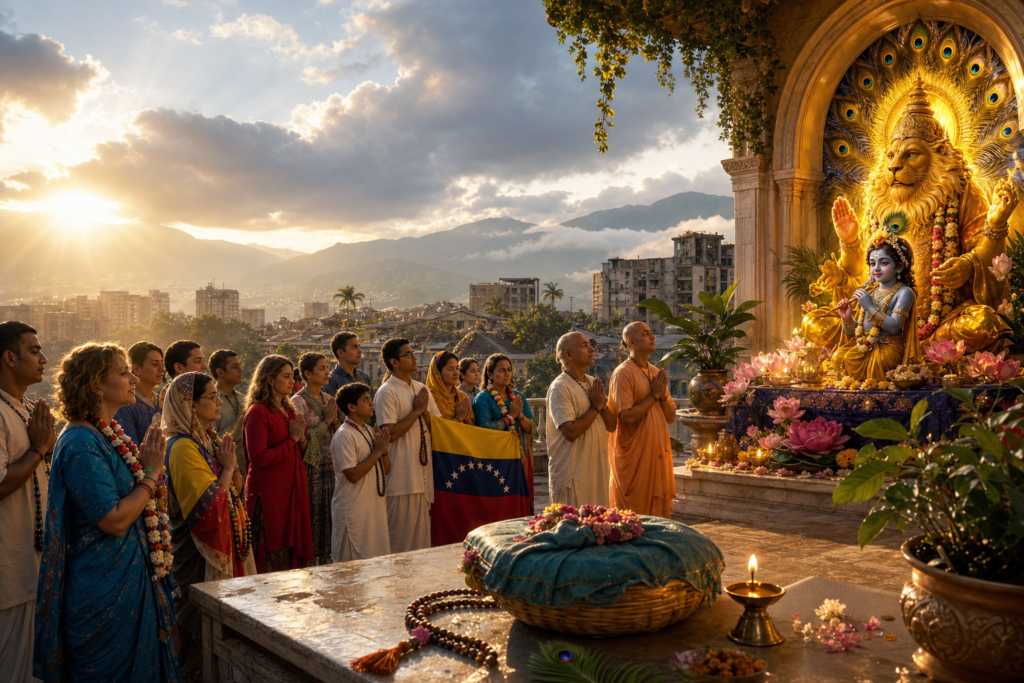
Contemporary London observances of Global Beatles Day, including harinama and Food for Life service, bring this history into the present. Harinama is not merely street music. It is public sankirtana, a devotional practice in which sacred sound is shared openly through melody, rhythm, repetition, and participation. It changes the atmosphere of a street by turning movement through the city into a form of remembrance.
Food for Life expresses the same theology through service rather than sound. In the Vaishnava understanding, food prepared with devotion and offered to Krishna becomes prasadam, sanctified food received as grace. When distributed freely, it becomes a form of seva that unites spirituality with social care. The practice speaks to an old dharmic conviction: feeding others is not peripheral to religion, but one of its most concrete expressions.
These two practices, harinama and prasadam distribution, explain why Harrison’s ISKCON legacy remains alive. One works through the ear, the breath, and the collective voice. The other works through the hand, the kitchen, and the shared meal. Together they show how bhakti is embodied: sung, cooked, offered, received, remembered, and carried forward by community.
The broader dharmic meaning is especially important. ISKCON belongs to the Hindu Vaishnava tradition, yet its public vocabulary of chanting, compassion, non-violence, food service, disciplined remembrance, and spiritual equality resonates across Hindu, Buddhist, Jain, and Sikh traditions. These traditions are not identical and should not be flattened into one system. Their unity is better understood as a shared ethical horizon: reverence for life, self-discipline, humility, service, and the search for liberation from ego-centered existence.
Harrison’s music often gave secular listeners a first emotional vocabulary for these questions. Songs such as Within You Without You and My Sweet Lord placed longing, impermanence, divine remembrance, and the limits of material success within popular music. This mattered because modern audiences often encounter philosophy first through art. A melody may open a door that an abstract argument cannot.
There is also a sober academic lesson in this history. Cultural transmission requires more than charisma. It needs texts, teachers, institutions, rituals, translations, recordings, kitchens, legal recognition, and ordinary people willing to practice consistently. Harrison’s importance lies in the way he connected charisma to continuity. He helped move Krishna bhakti from the margins of Western public awareness into a recognizable part of Britain’s religious landscape.
For many listeners who first knew The Beatles as a soundtrack of youth, hearing Hare Krishna chanted in London today can feel like a historical circle closing. The sound that once passed through Apple Records, Abbey Road-era studios, television charts, and countercultural gatherings now returns to the street as a living devotional practice. The movement is from performance to prayer, from celebrity to service, from cultural fascination to spiritual discipline.
Global Beatles Day therefore offers a rare opportunity to reflect on the sacred consequences of popular culture. The Beatles changed music, but George Harrison’s engagement with ISKCON helped change the way millions encountered Hindu spirituality, Krishna consciousness, and dharmic practice. His legacy is not only preserved in songs and archives; it is present wherever the maha-mantra is sung with sincerity, wherever prasadam is shared with dignity, and wherever spiritual traditions meet without hostility.
The most meaningful tribute to this legacy is not nostalgia. It is careful remembrance joined with practice: listening deeply, serving generously, honoring distinct dharmic paths, and recognizing that sacred sound can travel through unexpected instruments. On Global Beatles Day, George Harrison’s ISKCON legacy stands as a powerful example of how devotion can move through music and become a bridge between cultures.
Historical references for this account include public records on Global Beatles Day, ISKCON, the Radha Krishna Temple recordings, Apple Records, Bhaktivedanta Manor, and Food for Life: Global Beatles Day, Radha Krishna Temple, Bhaktivedanta Manor, ISKCON, and Food for Life.
Inspired by this post on Dandavats.








Leave a Reply
You must be logged in to post a comment.