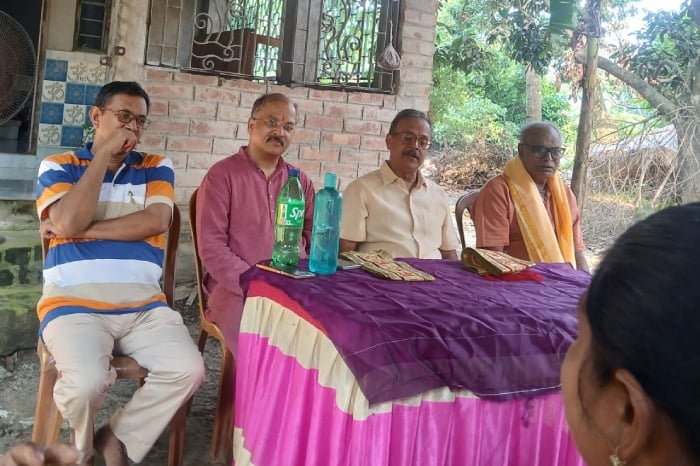
Representatives of the Hindu Janajagruti Samiti (HJS) paid a courtesy visit to Dr U. Krishnakumar at Amrita Vishwa Vidyapeetham, Kochi, signaling a constructive opening for collaboration between civil society and higher education on values-based learning, cultural literacy, and community engagement in Kerala. While the meeting was exploratory by design, the exchange reflected a growing national emphasis on integrating ethics, Indian Knowledge Systems (IKS), and service-learning within mainstream curricula.
Set within India’s evolving higher-education ecosystem, such courtesy calls operate as low-stakes trust-building forums. They allow academic leadership and social organizations to map common ground around constitutional values, social responsibility, and dharmic heritage, thereby de-risking later program design. In Kochi, this conversation gains additional salience because the city’s diverse communities and innovation-oriented institutions form a natural laboratory for impactful university–community partnerships.
Amrita Vishwa Vidyapeetham is a multi-campus, research-driven institution that consistently ranks among India’s leading universities in national assessments. The Kochi campusanchored by strong healthcare and allied disciplines and complemented by arts, humanities, and commerce programshas cultivated a reputation for translational research and socially responsible education. Its emphasis on seva, interdisciplinary inquiry, and technology-for-society provides a robust platform for initiatives that blend academic rigor with field application.
Within this context, Dr U. Krishnakumar, long associated with academic leadership at the Kochi campus (including the School of Arts and Sciences), has been known for fostering integrative learning that connects classroom knowledge with community needs. Engagements of this nature frequently examine how experiential pedagogy can strengthen both student competencies and societal well-being without compromising academic neutrality or research ethics.
HJS is a socio-cultural organization that undertakes awareness initiatives on dharmic values, cultural heritage, and lawful civic participation. In the spirit of unity under Sanatana Dharma, HJS-led dialogues increasingly foreground themes that resonate across Hinduism, Buddhism, Jainism, and Sikhismsuch as ahimsa, seva, and disciplined self-cultivationwhile emphasizing constitutional propriety and respectful coexistence. This aligns with Kerala’s long tradition of plural scholarship and interfaith dialogue.
The visit underscored a convergence around values-based education, cultural literacy, and CommunityEngagement. Universities seek structured, measurable ways to weave ethics, civic learning, and heritage appreciation into credit-bearing experiences; civil-society groups bring lived expertise, volunteer networks, and grassroots insights. Together, they can co-create evidence-backed programs that are inclusive, apolitical, and outcomes-driven.
Policy-wise, the meeting’s spirit complements the National Education Policy (NEP) 2020, which encourages holistic education, IKS integration, multilingualism, and community-oriented curricula. It also aligns with accreditation and ranking frameworkswhere outreach and inclusivity, institutional values, and societal impact are all formally assessedmaking such partnerships strategically relevant for institutional quality enhancement.
Three practical domains routinely emerge in academia–civil society dialogues of this sort. First, co-designed modules on ethics, constitutional duties, and digital civility can strengthen student judgment in an information-saturated era while keeping instruction non-partisan and research-informed. Second, heritage literacycovering ritual arts, temple architecture, and regional knowledge traditionscan be taught as cultural studies, documenting intangible heritage with methodological rigor and community consent. Third, service-learning tied to local priorities (health awareness, mental well-being, waste management, and environmental stewardship in coastal and backwater ecosystems) can translate classroom theory into measurable public benefit.
Technically, robust partnership design depends on sound governance. Institutions often establish a joint steering group that includes faculty, student representatives, and community stakeholders to define scope, guardrails, and indicators. Alignment with the Internal Quality Assurance Cell (IQAC), research ethics oversight for human-participant interactions, and data-protection protocols ensure that outreach remains compliant with university, UGC, and statutory norms. Such structures preserve campus neutrality while enabling meaningful field exposure.
Measurement is equally important. A transparent logic modellinking inputs and activities to outputs, outcomes, and long-term impacthelps both sides track progress. Mixed-method evaluation (quantitative participation metrics, pre–post learning assessments, and qualitative reflections) can illuminate how initiatives influence student competencies, community trust, and cultural understanding. Where appropriate, contributions can be mapped to Sustainable Development Goals (SDGs) and to national quality benchmarks, strengthening institutional reporting without inflating claims.
Safeguards must also be explicit. University–community programs function best when they are non-coercive, inclusive, and dialogue-driven. Clear codes of conduct, grievance redressal, and boundary-setting around political activity protect academic freedom and student well-being. Training in ethical fieldwork, informed consent, and respectful engagementespecially when documenting cultural practicesprevents extractive research and sustains community goodwill over time.
Kerala’s unique social fabric offers fertile ground for context-rich projects. In Kochi, students routinely interface with diverse neighborhoods, coastal livelihoods, and faith-based institutions that carry centuries-old pedagogies of compassion and discipline. University-guided field immersionwhether supporting health awareness near major hospitals, mapping living heritage in urban wards, or co-developing environmental solutions with local bodiescan be transformative for learners and beneficial for communities, provided design and evaluation are rigorous.
A dharmic framing further strengthens cohesion without privileging any single path. Buddhism’s metta, Jainism’s anekāntavāda and ahimsa, Sikhism’s seva, and Hinduism’s disciplined pursuit of dharma articulate complementary virtues that universities can translate into reflective pedagogy and practice. Within India’s plural constitutional order, this multi-path ethic deepens Spiritual coexistence in India by anchoring shared civic action in empathy, restraint, and responsibility.
From a learner’s perspective, values-infused community engagement often enhances employability and leadership by cultivating cultural intelligence, ethical decision-making, and collaborative problem-solving. Students frequently report that thoughtfully mentored fieldworkwhether at the Kochi campus, in neighborhoods by the backwaters, or alongside healthcare outreachadds meaning to academic study. Faculty, for their part, gain practice-based insights that can seed new research questions and grounded publications.
For communities, the benefits lie in respectful attention to local knowledge, improved access to university expertise, and the translation of research into practical solutions. When co-created properly, projects move beyond one-off events to become dependable partnerships with shared metrics, transparent communication, and periodic course-correction. In turn, trust grows, enabling richer forms of collaborative inquiry.
Viewed this way, the HJS courtesy visit to Dr U. Krishnakumar functions as a deliberate first step rather than a conclusion. It opens a channel to explore academically sound, socially sensitive programs that honor Kerala’s heritage while preparing students for the ethical complexities of modern life. In doing so, it reinforces a central Indian idealVasudhaiva Kutumbakam, the world as one familytranslated into the idiom of contemporary education and public service.
As conversations progress, the touchstones for success will remain clear: academic integrity, measurable impact, and unwavering respect for India’s civilizational plurality. If those standards guide design and delivery, a simple courtesy call in Kochi can mature into a replicable model of university–community partnership that advances both scholarship and social harmony.
Inspired by this post on Hindu Jagruti Samiti.