
For millions, Wikipedia functions as both the first and final reference point on complex subjects. Over years of community engagement, a discernible pattern emerged: articles related to Hinduismand by extension, other dharmic traditionswere often framed through increasingly narrow ideological lenses. In light of a commitment to accurate, fair, and inclusive representation across Hindu, Buddhist, Jain, and Sikh traditions, Wikipedia became an essential arena for careful observation and scholarly intervention.
Sustained volunteer efforts focused on improving pages through rigorous sourcing and academic citations frequently encountered swift reversions, lengthy talk-page debates, and an opaque editorial process. Meanwhile, selectively framed interpretationsat times relying on thin or highly contested sourcingappeared to take hold. The recurrence of these dynamics suggested not merely the ebb and flow of open-source editing, but the imprint of coordinated editorial initiatives.
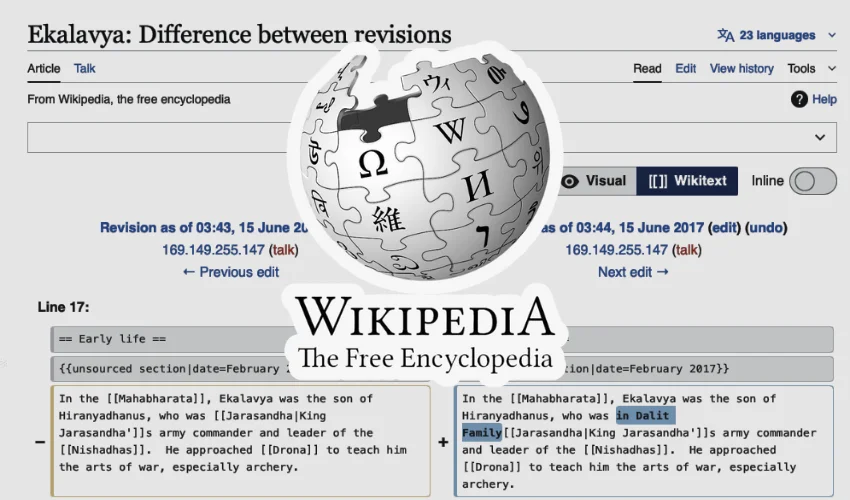
Two illustrative case studies highlight how specific edits can reshape historical and religious understanding. In the Ekalavya entry, edits sought to categorize the Mahabharata figure as belonging to a “Dalit Family,” diverging from traditional accounts that describe him as a descendant of warrior nobles (source). In the Basava entry, revisions appeared to “de-Hinduize” a central Bhakti figure by reframing him predominantly within contemporary caste debates and revisionist narratives (source). These examples illustrate broader tensions between historical nuance and modern ideological overlays.
Beginning in 2017, a noticeable uptick in ideologically inflected edits coincided with well-organized edit-a-thons and workshops. A prominent example was the 2017 Dalit History Month campaign led by Whose Knowledge?, which reported edits to more than 300 pages that later accrued over 132 million views (source). While increasing representation for marginalized communities is an important objective, the downstream effectaccording to critics within Hindu and other dharmic communitieswas that several pages adopted predominantly negative framings of Hindu practice and history.
Further examination found that Whose Knowledge? had partnered extensively with Equality Labs (source), including an edit-a-thon at UC Berkeley (source). Community stakeholders have expressed concern that some outputs of these collaborations framed Hindu and dharmic traditions in ways perceived as reductive, adversarial, or Hinduphobic, potentially shaping public understanding at scale.

Following the funding trail offers additional context. The Wikimedia Foundation awarded Whose Knowledge? approximately $45,000 for a pilot project to expand coverage of marginalized knowledge, including Dalit and LGBTQ+ topics (source). A relevant timeline point is that Anasuya Sengupta, who served as a Wikimedia grantmaker until 2015, co-founded Whose Knowledge? in 2016 and the organization subsequently received Wikimedia funding. This sequence does not by itself imply impropriety; however, it underscores the importance of transparent governance, robust conflict-of-interest safeguards, and clear disclosure standards in grantmaking related to content-influencing activities.
Public conversations at Wikimedia events also brought together advocates such as Thenmozhi Soundararajan and Anasuya Sengupta. Their participation helped mainstream certain critical frameworks that, while valuable to some readers, were viewed by others within Hindu, Buddhist, Jain, and Sikh communities as insufficiently attentive to dharmic plurality, historical complexity, and lived religious experience. This divergence highlights the need for plural perspectives and scholarly rigor when shaping articles that inform global audiences.

Wikipedia maintains explicit policies on neutrality, paid-contribution disclosure, and conflicts of interest (paid edits policy; COI policy). The interplay of grant-backed edit campaigns, partnerships with advocacy organizations, and complex editorial structures can blur the line between open knowledge curation and issue advocacy. Stronger oversight, clearer disclosure, and multi-perspective editorial review would help align practice with policyespecially for topics central to dharmic traditions where nuance and unity are paramount.
Wikimedia’s support for Whose Knowledge? has continued under a 2024–2026 general support grant (reported at 250K+ annually) (source). In parallel, Wikimedia donations total tens of millions of dollars each year. These figures amplify the responsibility to ensure editorial balance, guardrails against systemic bias, and inclusive processes that reflect the diversity of Hindu, Buddhist, Jain, and Sikh knowledge systems.
Volunteers from Hindu and broader dharmic communities have invested significant time in correcting basic factual errors with citations, only to find that well-funded campaigns and sophisticated process expertise can unintentionally sideline their contributions. The asymmetry becomes more consequential as AI systems increasingly rely on Wikipedia and other easily influenced platforms such as Reddit for training data. Without transparent, plural, and academically grounded editorial standards, bias may propagate across both public knowledge repositories and emerging technologies.
The educational impact is immediate: students encountering dharmic traditions deserve historically grounded, context-rich, and respectful coverage. A constructive path forward centers on three principles: rigorous citation to peer-reviewed scholarship; transparent disclosures and COI compliance for funded editing; and editorial pluralism that welcomes dharmic voices across Hinduism, Buddhism, Jainism, and Sikhism. Such measures support unity, reduce polarization, and strengthen the integrity of a resource that shapes global understanding.
Inspired by this post on CoHNA.











