Unveiling Gyan Chaupar: The Dharmic, Karmic Origins of Snakes and Ladders and the Soul’s Ascent
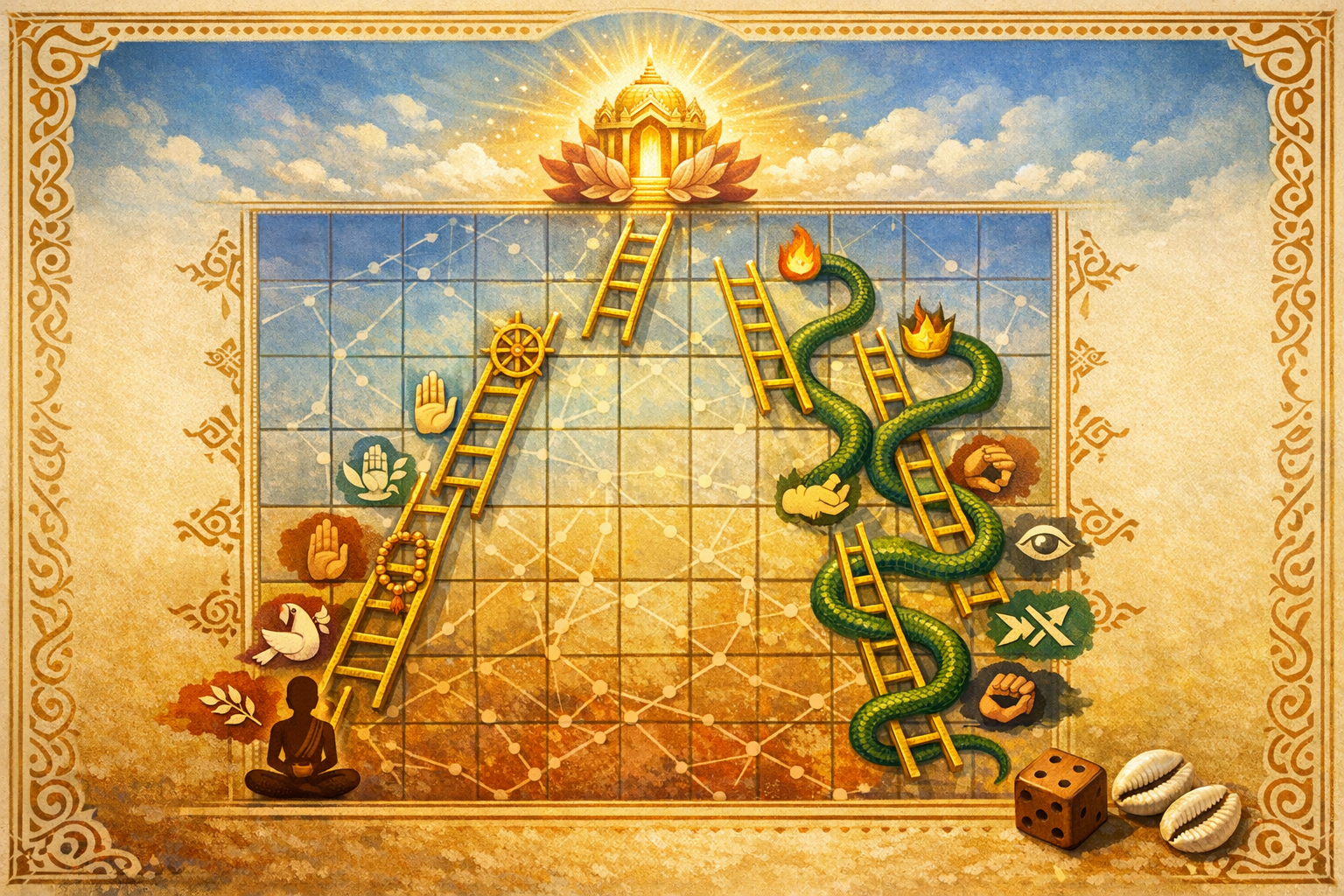
Gyan Chauparliterally the “Game of Knowledge”predates the cheerful parlour pastime known today as Snakes and Ladders. Conceived as a living philosophical text, it offered a vivid map of karma, consciousness, and the soul’s ascent from vice to virtue. Long before colonial adaptation softened its message, Gyan Chaupar modeled how ethical choices, inner discipline, and grace intersect to lift one from the cycle of rebirth toward moksha.
Across regions and languages, the game circulated under allied names and emphases: Moksha Patam in North India, Paramapada Sopanam in Tamil traditions, and Jñana Chaupar in Jain communities. While modern boards typically show a 10×10 grid, earlier Indian exemplars varied widelyfrom 72 to 96 and even 132 squareseach layout encoding a distinctive pedagogy of virtue (ladders) and vice (snakes), and culminating variously in Moksha or Vaikuntha.
Surviving boards, catalogued in museum and private collections, are traced to early modern India (roughly the 17th–19th centuries) in regions such as Rajasthan, Gujarat, and the Deccan. Painted on cloth or paper, annotated in scripts like Devanagari and Gujarati (and, on occasion, Persian), they blend religious iconography, ethical maxims, and cosmological notations. Their meticulous inscriptions confirm that Gyan Chaupar functioned not merely as leisure but as a portable primer in dharma.
Game mechanics are deceptively simple: players advance by throws of dice or cowrie shells; ladders accelerate ascent toward liberation; snakes return the player to states marked by error, delusion, or harm. Most rulesets require an exact throw to enter the final squarean elegant reminder that freedom (moksha) arrives through precise alignment of effort (puruṣārtha) and auspicious conditions (daiva).
The square-by-square architecture is explicitly symbolic. Ladders are inscribed with virtues such as dāna (generosity), satya (truthfulness), ahiṃsā (non-violence), bhakti (devotion), kṣamā (forgiveness), and dhyāna (meditation). Snakes bear the marks of the classic moral hazards: kāma (unbridled desire), krodha (anger), lobha (greed), moha (delusion), mada (pride), and matsarya (envy)the Śaḍripu or “six enemies.” The board, in effect, is a moral topography where choices alter spiritual altitude.
Underpinning every move is the doctrine of karma. Actions, intentions, and attentional habits generate momentumsaṃskārasthat propel beings across births. Gyan Chaupar turns this abstract law into experiential learning: each ascent rewards cultivated virtue; each fall dramatizes the consequences of heedlessness. Chance in the throw does not cancel agency; rather, it calls attention to contingency, responsibility, and preparedness.
Jain iterations of Jñana Chaupar often foreground a technical cartography of spiritual development. Boards allude to the 14 guṇasthānas (stages of the soul), distinguish the four kaṣāyas (anger, pride, deceit, greed), and highlight pivotal disciplines such as saṃvara (stoppage of karmic influx) and nirjarā (shedding of bound karma). Selected ladders commemorate right faith, right knowledge, and right conduct (samyak-darśana, samyak-jñāna, samyak-cāritra), while the apex gestures toward kevala-jñāna (omniscience) and mokṣa. The result is a concise visualization of Jaina soteriology.
Vaishnava and Smārta versionsincluding Paramapada Sopanamretain the same ethical physics while centering devotion. Ladders carry inscriptions like satsanga (holy company), nāma-japa (chanting the divine name), vrata (vows), tīrtha-yātrā (pilgrimage), dāna (generosity), and ahiṃsā. Serpents correspond to the Śaḍripu and allied vices. The final square may be titled Vaikuntha or Paramapada, emphasizing that the highest ascent unites disciplined practice with divine grace (kṛpā). Many Tamil households traditionally unfurl Paramapada Sopanam during Vaikunta Ekadaśi, making pedagogy and festival devotion mutually reinforcing.
Buddhist and Sikh sensibilities align closely with the game’s ethical grammar even where a distinct canonical board is not attested. In a Buddhist frame, snakes mirror the kleśas (afflictions) led by avidyā (ignorance) and taṇhā (craving), while ladders resonate with the pāramitās (perfections) and the Noble Eightfold Path as skillful means that incrementally transform mind and action. Sikh teachings on the “Five Thieves”kām, krodh, lobh, moh, ahaṅkārmap directly onto the serpents, whereas seva (service), saṅgat (holy company), and simran (remembrance) embody the laddered ascent under nadar (divine grace). The shared moral architecture across Hinduism, Jainism, Buddhism, and Sikhism underscores a genuinely Dharmic unity.
Iconographically, Gyan Chaupar boards are didactic paintings. Slender nāgas curl beside named vices; temple spires, sages, or lotuses mark aspirational stations; marginal notes compress philosophy into aphorism. Some boards interleave mappings of lokas (realms), yamas (restraints), and niyamas (observances). The aesthetic is integral to instruction: color, calligraphy, and figure ground emphasize that ethics is not abstract but embodied, relational, and beautiful.
As a household practice, the game excelled at intergenerational teaching. Elders narrated the import of each square; children encountered virtue and vice as lived scenarios. Community play during festivalsespecially in Vaishnava milieusreinforced the lesson that devotion, discipline, and fellowship can quickly raise one’s station, while careless lapses prolong the journey. Many readers who recall childhood Snakes and Ladders find that Gyan Chaupar reframes those memories with philosophical depth.
From a technical standpoint, Gyan Chaupar can be modeled as an absorbing Markov chain with Moksha (or Vaikuntha) as the absorbing state. Each square is a node; dice outcomes define transition probabilities; ladders and snakes create non-local transitions. Expected time to absorption depends on the spatial distribution and magnitude of ladders and snakes: a board dense with short ladders and long serpents yields longer expected paths, whereas rare long ladders and short serpents can dramatically reduce hitting times. Designers in premodern India appear to have tuned these distributions to emphasize how rare but transformative virtues (long ladders) and recurring temptations (frequent serpents) condition spiritual progress.
Colonial-era Snakes and Ladders retained basic mechanics while often stripping overt Dharmic referents. English and later American editions (e.g., Chutes and Ladders) privileged neutral play and child-friendly iconography over explicit karmic pedagogy. What was once an ethical simulator of saṃsāra and moksha became a morally thinned race-to-the-top. Recognizing this transformation clarifies both the continuity of play and the loss of indigenous philosophical content.
For contemporary learning, the original frame is profoundly useful. Educators can restore inscriptions to boards, pair each ladder or serpent with short case studies, and invite learners from Hindu, Jain, Buddhist, and Sikh backgrounds to supply scriptural or historical examples corresponding to each square. Households can adapt rules to include brief reflections upon landingone sentence of gratitude on a ladder, one corrective intention on a serpentaligning playful momentum with ethical mindfulness.
As a shared Dharmic artifact, Gyan Chaupar advances unity without erasing difference. Its grammar of vice and virtue converges with Anekāntavāda’s humility about viewpoints, with Buddhist upāya (skillful means), with Sikh sevā and simran, and with the Hindu synthesis of jñāna, karma, and bhakti. The game thus enacts “Unity in spiritual diversity” not as slogan but as method: many ladders, many falls, one ascent.
Reinstated in this light, Gyan Chaupar is more than a historical curiosity. It is cultural heritage, spiritual pedagogy, and mathematical elegance woven into a single, memorable experience. Preserving, studying, and playing it as intended cultivates ethical clarity and communal harmony, and reconnects everyday leisure with the timeless quest for freedom that animates India’s Dharmic traditions.
Gyan Chaupar, literally the Game of Knowledge, is presented as an older Dharmic form of Snakes and Ladders. The article describes it as a philosophical board game about karma, virtue, vice, and the soul’s ascent toward moksha.
How is Gyan Chaupar connected to Snakes and Ladders?
The article explains that colonial-era Snakes and Ladders retained the basic mechanics of ladders, snakes, dice, and racing to the top. What was reduced was the explicit Dharmic pedagogy about samsara, moksha, virtue, and vice.
What do the ladders and snakes represent in Gyan Chaupar?
Ladders represent virtues such as generosity, truthfulness, non-violence, devotion, forgiveness, and meditation. Snakes represent moral hazards such as desire, anger, greed, delusion, pride, and envy, described as the Shadripu or six enemies.
How do Jain versions of Jnana Chaupar differ?
The article says Jain boards often map spiritual development through ideas such as the 14 gunasthanas, the four kashayas, samvara, and nirjara. They also emphasize right faith, right knowledge, right conduct, kevala-jnana, and moksha.
Why does the article connect Gyan Chaupar with Hindu, Jain, Buddhist, and Sikh teachings?
The article argues that the game’s moral grammar of vice, virtue, discipline, and grace aligns across Dharmic traditions. It connects Hindu, Jain, Buddhist, and Sikh ideas without erasing their distinct teachings.
How can Gyan Chaupar be revived for contemporary learning?
The article suggests restoring inscriptions to boards, pairing ladders and serpents with short case studies, and inviting learners from Dharmic backgrounds to connect squares with scriptural or historical examples. Households can also add brief reflections when players land on ladders or serpents.