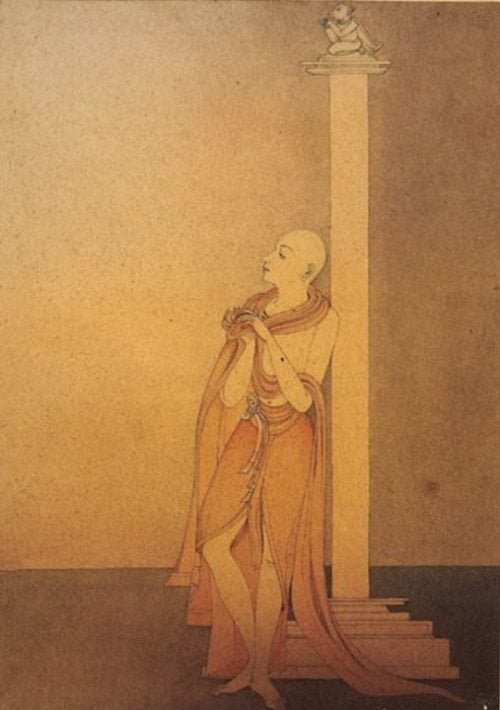
Traditional accounts in the Nath tradition recount the miraculous appearance of Gorakhnath from a heap of cow dung, a motif saturated with spiritual symbolism and yogic insight. Revered across Hindu stories as a master of yogic practices and mysticism, Gorakhnath stands as a figure of inner alchemy, demonstrating how spiritual discipline transforms the ordinary into the sacred. The narrative does not seek historical verification; it invites contemplation on purity, transformation, and the journey of the soul.
Within Indic cultural life, cow dung has long been associated with purification, ecological utility, and auspicious household practices. Used traditionally for fuel, cleansing, and protective plastering, it embodies a paradox: what appears humble and earthly serves as a medium of renewal. In this light, the legend’s setting is not a mark of defilement but an emblem of the earth element—grounding, nourishing, and ready for spiritual transmutation.
Read through a yogic lens, the story operates as an allegory of inner alchemy. The emergence from a seemingly lowly substrate mirrors the ascent of consciousness from the muladhara upward through the sushumna nadi toward higher awareness. Through practices such as pranayama, asana, pratyahara, and dhyana, impulses tied to the gross (sthula) are refined into subtle (sukshma) awareness, culminating in clarity and compassion. The legend thus speaks to the perennial promise of yoga: the transformation of base tendencies into luminous wisdom.
The theme of purity is central. Rather than a rigid social category, purity is framed as an inner state cultivated through discipline, humility, and service. Gorakhnath’s appearance from a humble context signals that spiritual attainment is not constrained by birth, status, or circumstance. It emphasizes that sanctity arises where intention (bhava), effort (tapas), and grace converge.
This symbolism resonates across the broader Dharmic traditions. In Buddhism, the lotus rising unsullied from mud mirrors the idea that awakening can flower from any condition. Jainism’s focus on the purification of karmic accretions aligns with the narrative’s call to refine consciousness. Sikh teachings on Naam, seva, and humility affirm that the Divine may be realized amidst ordinary life. Together, these perspectives underscore a shared ethos: inner transformation, ethical living, and reverence for all beings.
For contemporary practitioners, the legend encourages rethinking conventional notions of impurity and worth. It invites a contemplative practice that recognizes the sacred potential in daily materials, actions, and relationships. When approached with mindfulness and integrity, even life’s most unassuming contexts can become fields of spiritual growth.
On an emotional register, the narrative speaks to those who have felt overlooked or dismissed. It assures that unfavorable conditions need not define a spiritual horizon. Many readers find in this tale a quiet courage—the confidence to begin where they are, to engage steady breath, attentive awareness, and compassionate conduct, trusting that transformation unfolds in its own rhythm.
As a unifying reflection, the story of Gorakhnath affirms the integrity of multiple paths within Hinduism, Buddhism, Jainism, and Sikhism. It encourages mutual respect, dialogue, and shared aspiration, recognizing that diverse methods converge on the same summit of wisdom. In celebrating this plurality, the legend strengthens a cohesive Dharmic vision founded on inner clarity, non-harm, and the upliftment of all.
Ultimately, the tale endures because it frames spiritual life as an accessible, lived reality. Through the Nath tradition’s evocative imagery, it illustrates that purity is not inherited but cultivated, transformation is not abstract but experiential, and unity is not imposed but discovered within the heart of sincere practice.
Inspired by this post on Hindu Blog.