Sankashti Chaturthi, also known as Ganesh Sankashtahara Chaturthi, is observed monthly on the fourth lunar day (Chaturthi/Chavithi) of Krishna Paksha. In April 2026, it falls on Sunday, 5 April 2026. The observance corresponds to Krishna Chaturthi in the Chaitra month and is traditionally identified this cycle as Vikata Sankashti Chaturthi. Moonrise for vrata-parana is noted at 9:50 PM (IST, India-wide reference; local times vary by location and elevation).
The essence of Sankashti Chaturthi lies in a disciplined vrata undertaken with devotion to Shri Ganesha, the remover of obstacles and the harbinger of clarity, courage, and wise action. The Sanskrit term “Sankashtahara” literally denotes the dispelling of difficulties and afflictions. By aligning worship with the lunar rhythm on Krishna Paksha Chaturthi, practitioners attune body and mind to a time traditionally associated with introspection, self-regulation, and the gentle release of accumulated pressures.
Key details for April 2026 are unambiguous. Date: 5 April 2026 (Sunday). Tithi: Krishna Paksha Chaturthi in Chaitra. The thematic identification this month is Vikata Sankashti Chaturthi, invoking the formidable, obstacle-clearing dimension of Ganesha. The operational time for concluding the fast is governed by Chandrodaya (moonrise), recorded for reference at 9:50 PM IST. Households and temples should confirm city-specific moonrise times through a reliable Panchang to ensure accuracy for the local horizon.
In practice, moonrise times are not uniform across geographies. Chandrodaya varies by latitude, longitude, altitude, and atmospheric conditions. The 9:50 PM figure is an India-standard reference; devotees in different regions or those residing outside India should consult a trusted local Panchang or astronomical almanac for their precise location. When tradition requires sighting the moon before breaking the fast, adherence to the local Chandrodaya time safeguards both scriptural intent and practical observance.
“Vikata” is an epithet of Ganesha emphasizing the power to surmount what appears intractable. Within the broader Ganesha tradition, Vikata is also named among the eight celebrated incarnations described in the Mudgala Purana, each associated with dissolving a particular inner impediment. The Vikata perspective frames this observance as a disciplined commitment to transform adversity into insight. Many practitioners find that the month’s Vikata focus encourages renewed resilience, measured responses to complexity, and ethical steadiness—qualities applicable to study, work, family life, and community engagement.
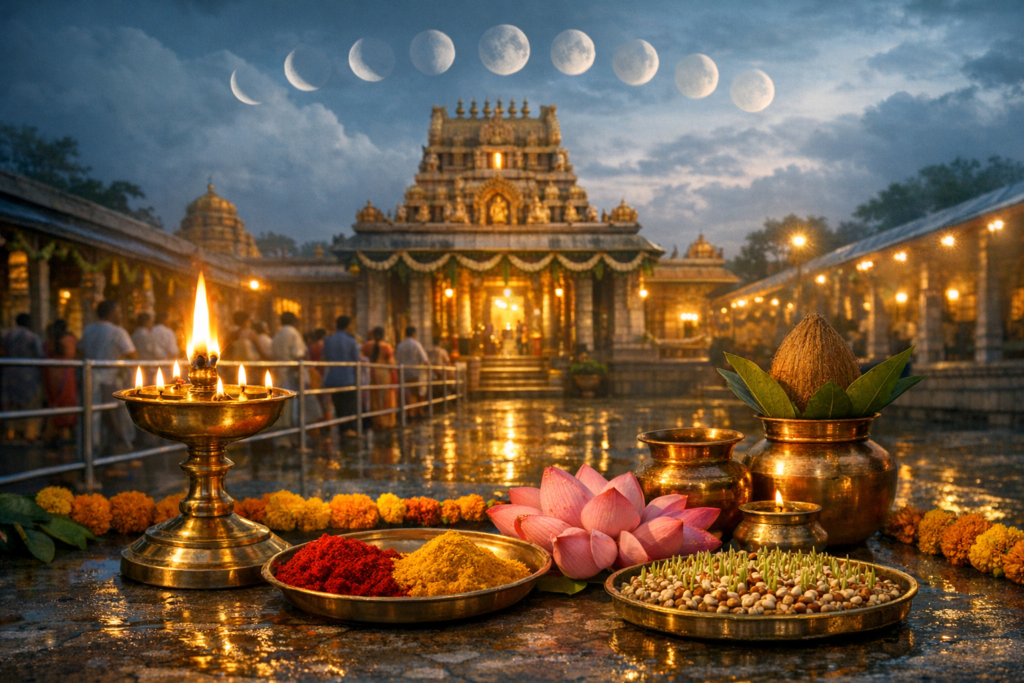
The vrata unfolds across three integral movements: intention, worship, and resolution. Intention begins with a sankalpa to observe the fast on Krishna Chaturthi for removal of obstacles and cultivation of sattva (mental clarity and harmony). Worship centers on Ganesh puja, with offerings such as durva grass, modak or laddu, fresh flowers (often hibiscus or marigold), incense, a lamp, and seasonal fruits. Resolution culminates with moonrise worship and the formal breaking of the fast following darshan of the moon and a closing aarti to Ganesha.
Puja procedure at home is straightforward yet spiritually rigorous. Many begin by creating a clean, peaceful space and situating a murti or image of Shri Ganesha on an east- or north-facing altar. After water offerings, tilak, and naivedya, devotees recite stotras such as the Ganesha Atharvashirsha and Sankashta Nashana Ganesha Stotram, along with simple and potent mantras including Om Gam Ganapataye Namaha and “Vakratunda Mahakaya Suryakoti Samaprabha; Nirvighnam Kuru Me Deva Sarva-Karyeshu Sarvada.” The vrata-katha traditionally associated with Sankashti Chaturthi is then read or heard, reinforcing the ethical and devotional underpinnings of the observance.
Fasting disciplines vary by family tradition and health needs. Common modes include phalahara (fruits and simple sattvic foods), upavasa with restricted grains, or, for some, a more austere fast taken only with water. It is essential to maintain health awareness: those who are pregnant, elderly, managing health conditions, or engaged in physically demanding work often follow moderated rules with guidance from family elders or spiritual mentors. The vrata is a means to cultivate steadiness and compassion; it is not meant to compromise well-being.
Moonrise worship is the decisive marker for vrata-parana. At Chandrodaya, devotees offer arghya to Chandra with water and akshata, take darshan of the moon, and then perform a concluding aarti to Ganesha. The fast is broken thereafter with prasad, often beginning with a piece of naivedya offered to Ganesha (such as a modak) and water. When clouds obstruct visibility, tradition permits concluding the fast by observing the local published Chandrodaya time, performing the moon worship mentally, and completing Ganesha aarti without undue delay or anxiety.
Regional names and practices reflect the breadth of Hindu custom. In Maharashtra and several northern regions, the observance is widely known as Sankashti, while in many southern traditions it is referred to as Sankatahara Chaturthi. When the vrat falls on a Tuesday, it is often called Angaraki Sankashti and is regarded as particularly potent. Despite such regional variations, the shared devotional thread is unmistakable: honoring Ganesha’s wisdom, surrendering restlessness, and recommitting to thoughtful action.
Understanding the lunar framework illuminates why dates and timings matter. In the Hindu calendar, a tithi is defined by the relative angular distance between the Sun and the Moon, segmented into 30 equal parts of 12 degrees each. Krishna Paksha denotes the waning half of the lunar cycle after Purnima. Chaturthi, the fourth tithi, may begin and end at times that cross conventional midnight boundaries, so a calendar “date” and the sacred “tithi” are not always congruent. This is why exact Panchang computations and local Chandrodaya are emphasized for vratas tied to lunar events.
From a spiritual standpoint, Sankashti Chaturthi cultivates qualities that resonate across dharmic traditions. The discipline of mindful fasting, the commitment to non-harm, and the inward turn toward self-scrutiny are upheld in diverse ways in Hinduism, Buddhism, Jainism, and Sikhism. Parallels include the spirit of Uposatha in Buddhist communities, the ethical intent of Poshadha in Jain practice, and the Sikh emphasis on simran, kirtan, and seva. While each tradition maintains its distinct path, the shared pursuit of inner clarity, compassionate conduct, and community uplift underscores a deep civilizational unity.
The April 2026 Vikata Sankashti Chaturthi offers a clear and pragmatic template for practice. Preparations may include assembling 21 blades of durva grass, flowers, fresh fruits, and a simple naivedya of modak or jaggery-based sweets. A steady, unhurried recitation of Ganesha Atharvashirsha and the Sankashta Nashana Ganesha Stotram focuses the mind. Families often conclude with shared prasad, reinforcing bonds of affection and mutual support that echo Ganesha’s own guidance toward harmony in the household and society.
Ethically, the vrata extends beyond ritual to encourage practical virtues. Devotees frequently pair the observance with quiet acts of service, such as sharing food, supporting education, or assisting neighbors. This synthesis of worship and action mirrors the ideal of dharma as lived wisdom—situated not merely in texts but in daily choices that reduce obstacles for oneself and others. The month’s Vikata emphasis poignantly reminds practitioners that burdens can be lightened when courage aligns with right intention and compassionate conduct.
For those seeking precision, the April 2026 markers provide a reliable framework. Sankashti Chaturthi is on Sunday, 5 April 2026. It is Krishna Chaturthi in the Chaitra month and is observed as Vikata Sankashti Chaturthi. Moonrise is recorded at 9:50 PM IST for India-wide reference, with the important note that local Chandrodaya may differ. Consulting a trusted Panchang remains the gold standard for timing and for any regional puja variations that families or temples uphold.
In contemporary settings—whether in Indian cities or the diaspora—the same vrata can be observed with thoughtful adaptations that respect health, work schedules, and community conditions. What matters most is integrity of intention and careful attention to the tithi and moonrise markers. When observed with steadiness, Sankashti becomes not just a monthly commitment but a continuing education in equanimity, a structured opportunity to recalibrate aims, and a shared reminder that obstacles can be reinterpreted as catalysts for growth.
In sum, Vikata Sankashti Chaturthi in April 2026 offers a meaningful convergence of lunar science, ritual discipline, and ethical aspiration. Anchored to 5 April 2026 with moonrise at 9:50 PM IST for reference, the vrata invites practitioners to embrace Ganesha’s guidance, refine habits, and nurture unity—within oneself, across families and communities, and in the broader fabric of dharmic civilization. Through attentive observance and inclusive spirit, the promise of “Sankashtahara”—the quiet removal of difficulties—becomes a lived experience.
Inspired by this post on Hindu Pad.