Mylapore Kapaleeswarar Temple Brahmotsavam 2026 will unfold over ten spiritually charged days in the Tamil month of Panguni, culminating on Panguni Uthiram. For 2026, the festival begins on March 23 and concludes on April 1 with the Panguni Uthiram celebrations, anchoring Chennai’s cultural calendar in an atmosphere of devotion, music, and community participation.
The formal commencement is marked by Dhwajarohanam at 7.30 am on March 23, when the temple’s kodimaram bears the sanctified flag to invoke divine presence. This auspicious rite signals the start of daily processions and intensified worship of Kapaleeswarar and Karpagambal, drawing thousands of devotees to Mylapore’s Mada streets for darshan and seva.
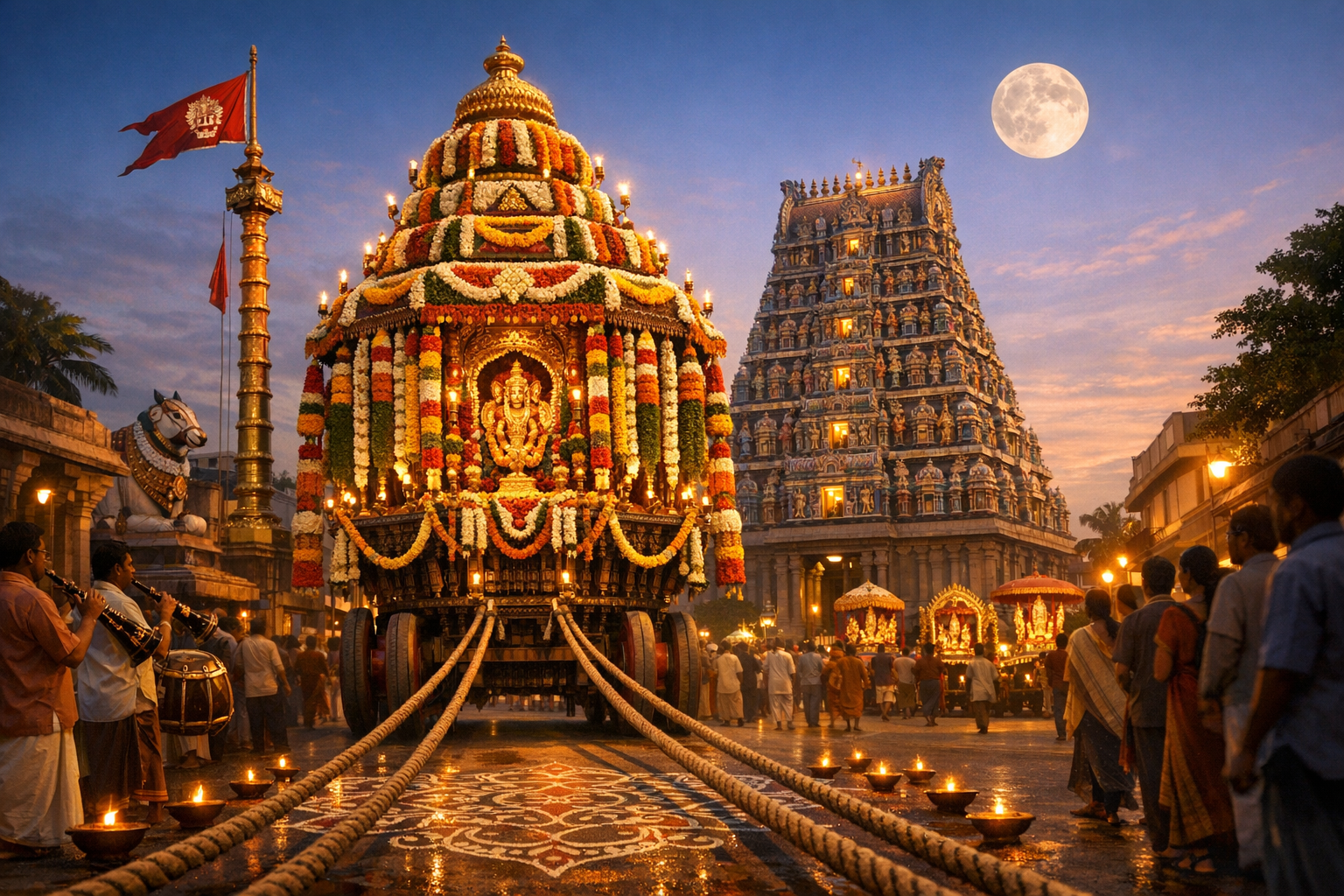
Kapaleeswarar Ratholsavam 2026 date is March 29, the day the grand ther (chariot) is ceremonially drawn by devotees along the four Mada streets. The festival then builds to its liturgical climax with Panguni Uthiram on April 1. Within this window, the much-awaited Arupathmoovar procession dedicated to the 63 Nayanmars is traditionally scheduled and is announced locally by the temple authorities closer to the date, in line with customary practice and the lunar calendar.
Situated in the heritage precincts of Mylapore, Chennai, the Kapaleeswarar Temple stands as one of South India’s most venerated Shaiva temples. Its towering rajagopuram, bustling prakarams, and deeply rooted ritual traditions embody the living continuum of Dravidian temple culture. The Brahmotsavam here not only preserves devotional memory but also reanimates the city’s sacred geography through its daily vahana processions.
Brahmotsavam, etymologically understood as brahma plus utsava, refers to a grand, canonical celebration traditionally believed to be overseen by Brahma. Ritually, the festival is structured around dhwajarohanam, daily vahana sevas, intensified mandala of pujas and homas, and the avabhritha-like closure when the flag is lowered (dhwajavarohanam). Each component embodies precise liturgical symbolisminvocation, procession, guardianship, cosmic travel, and compassionate outreach to the broader community.
Panguni Uthiram holds special theological significance across Tamil Shaiva and Vaishnava traditions as the day of sacred unionsSiva-Parvati, Murugan-Deivayanai, and in Vaishnava lore Sita-Rama and Andal-Ranganatha. In Mylapore, the festival celebrates the divine conjugality of Kapaleeswarar and Karpagambal, underlining dharmic values of fidelity, mutual care, and household harmony that resonate across Hindu, Buddhist, Jain, and Sikh ethical frameworks.
The daily vahana processions typically feature Kapaleeswarar and Karpagambal on a range of mounts symbolizing cosmic and ethical principlesNandi for steadfast dharma, Rishabha for strength and rectitude, Kailasa vahanam for transcendence, and palanquins that emphasize grace and approachability. Morning processions are often contemplative and serene, while the evening rounds are musically vibrant, with nadaswaram and thavil elevating the devotional mood.
Dhwajarohanam functions as the ritual threshold between ordinary time and sacred time. The hoisted flag proclaims an intensified divine presence, signaling to the community that the deities will traverse the mada veedhis to bless households, markets, and bylanes. Those new to the festival often remark on the palpable shift in ambience across the neighborhood from the very moment the flag ascends.
Rathotsavam, among the most visually arresting days, transforms the streets into a moving temple. The ther’s massive wooden superstructure, adorned with floral toranas and iconography, advances slowly to rhythmic chants and resounding drums. Families often station themselves along East and South Mada Streets well before sunrise to secure respectful viewing spots, while volunteers coordinate rope-pulling and crowd safety with notable discipline.
Arupathmoovar centers on the 63 Shaiva Nayanmars whose palanquins, rich with iconographic detail, traverse the same sacred circuit. The procession bridges devotional memory and present practice by publicly honoring the saint-poets whose lives modeled service, humility, and courage. Devotees routinely describe this day as emotionally stirring, with the sight of converging palanquins evoking a moving sense of lineage and belonging.
The festival’s concluding day, Panguni Uthiram, synchronizes the full-moon ambience of Panguni with the Uthiram (Uttara Phalguni) nakshatra, traditionally associated with sacred unions and social bonds. Liturgically, this is experienced through special alankarams, kalyana-themed rituals, and heightened community participation, reaffirming the ideal of grihastha dharma as a noble and spiritually generative path.
From a heritage perspective, the Brahmotsavam revitalizes Chennai’s intangible cultural landscapekolam patterns unfurl at dawn, flower markets extend working hours, classical musicians and nadaswaram vidwans find their art woven organically into worship, and neighborhood shops align their rhythms to the daily processions. The event thus functions as both sacred liturgy and a city-scale cultural convocation.
Devotees planning a visit may find a three-phase daily rhythm helpful: early morning darshan in quieter atmospheres; an afternoon pause for rest and hydration as temperatures rise; and a return during the evening vahana procession when the streets are illuminated and devotional music peaks. Comfortable footwear, modest attire, and adequate hydration are strongly advisable.
Mylapore’s connectivity supports large footfalls. The Thirumayilai MRTS station and the Mylapore bus terminus place visitors within a short walk of the temple’s East Mada Street. Temporary traffic diversions and parking restrictions are typically implemented during Rathotsavam and Arupathmoovar; public transport and rideshares reduce delays and ease movement on crowded days.
Inside the complex, devotees should follow signage, avoid crowding near the sanctum, and heed priestly and volunteer instructions. Elderly pilgrims and families with young children often prefer the early morning slot for darshan, while those seeking the fullest street-procession experience gravitate toward evenings. Respectful conductmaintaining queue decorum, keeping pathways clear, and observing temple normsenhances safety and collective well-being.
Photography guidelines vary by zone. As a rule of thumb, flash and intrusive equipment are discouraged near the sanctum and during tightly packed processions. Content creators and journalists are encouraged to honor local sensibilities, obtain permissions where needed, and foreground the festival’s sacred intent over spectacle.
Environmental stewardship has become an integral part of festival practice. Reusable water bottles, minimizing single-use plastics, and responsible disposal in designated bins support both municipal efforts and dharmic commitments to ahimsa and ecological care. Local volunteers often facilitate waste segregation and first-aid in high-density stretches.
In the spirit of unity across dharmic traditions, the values celebrated during Panguni Uthiramdevotion, fidelity, compassion, self-restraint, and serviceare shared civilizational assets. Visitors from Hindu, Buddhist, Jain, and Sikh backgrounds routinely note the festival’s emphasis on ethical living and communal harmony, reinforcing the broader message that diverse spiritual paths can flourish together with mutual respect.
Schedules for Arupathmoovar and specific vahana sevas are customarily posted on the temple notice boards and disseminated through local media. As all festival timings follow lunar calculations and operational considerations, visitors are advised to verify day-by-day updates released by temple administration before planning precise itineraries.
Key terms used through the celebrations include Dhwajarohanam, the ritual flag hoisting that inaugurates the festival; Rathotsavam, the grand chariot procession; and Panguni Uthiram, the full-moon day of Panguni under the Uthiram star. Together, these rites recast Mylapore’s everyday topography into a mobile sanctuary, bringing Kapaleeswarar and Karpagambal into intimate proximity with devotees from every walk of life.
Brahmotsavam in Mylapore ultimately operates on two interlocking planes: as a meticulous liturgical program rooted in agamic tradition and as a civic celebration that renews social bonds. The 2026 schedulebeginning March 23 with Dhwajarohanam at 7.30 am, spotlighting Kapaleeswarar Ratholsavam on March 29, and culminating on April 1 with Panguni Uthiramoffers a comprehensive arc of worship and community experience that is at once timeless and profoundly contemporary.
Inspired by this post on Hindu Pad.