As I reflect on our civilisational journey, I often return to the story of Parāvartana—better known today as Ghar-Wapsi. As I noted in an earlier episode, this return to the Hindu fold became increasingly difficult as Muslim rule spread across Hindustan. Yet, despite the odds, I find hope in the many sporadic and courageous instances of Parāvartana that flicker through our history. Two stand out sharply in my mind.
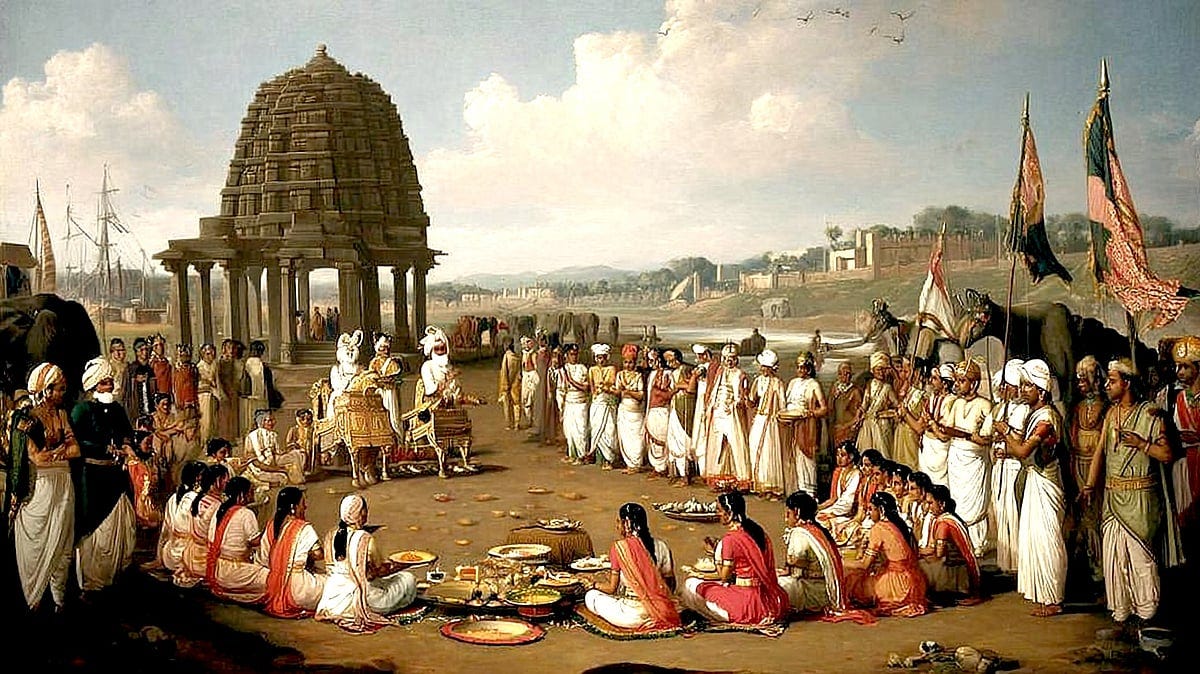
The first unfolded in Vijayanagara after the Bahmani–Vijayanagara war concluded in 1398 CE. The Bahmani ruler Tajuddin Firuz rounded up thousands of Hindus near the grand city, forcibly converted them, raped their women, and held them hostage to pressure Harihara II into surrender. His blackmail worked, and Harihara II agreed to a treaty that secured their release upon payment of ten lakh honnu (gold coins). When these captives returned, a mass Shuddhi ceremony welcomed both men and women back into Hindu society. I’m struck by how rarely this remarkable episode is even mentioned in mainstream accounts of the Vijayanagara Empire, despite its profound social significance.
A century after Vijayanagara’s fall, the Maratha Empire seeded by Chhatrapati Shivaji Maharaja became another arena for Parāvartana. P.V. Kane’s record has stayed with me for its clarity and authority: “…during the time of the Maratha domination, learned Brahmanas of holy places like Paithan, Nasik and Karad were consulted in religious matters by the king or his minister, that the holders of the gadi of Sankaracharya at Sankeshwara and Karavira and other seats were also rarely consulted in these matters…[of] restoring men to their castes…”
Kane further notes, “…Shivaji, the great founder of the Maratha Empire, established a council of eight ministers, viz. Mukhya Pradhana, Amatya, Saciva, Mantri, Senapati, Panditarao, Nyayadhisha and Sumanta. The jurisdiction of the Panditarao extended over all religious matters…There are letters which show that the Panditarao convened meetings of learned brahmanas and with their approval declared prayascitta in the case of a [Hindu] who had been forcibly converted by Mahomedans and who was thereafter restored to [his] caste.” Reading this, I feel a deep respect for the institutional care the Marathas extended to the unity and integrity of Hindu society.
The next great surge of Shuddhi emerged with Swami Dayananda Saraswati and the Arya Samaj. In my own study and lived experience, I’ve seen how transformative their work was—not just as a social force, but as a moral compass. Sita Ram Goel’s words echo my sentiments: “It was years later when I read Sri Aurobindo, Bankim, Tilak, Dayananda that I bowed, in repentance and renewed reverence, before that fearless lion of a man who tried his best to rescue and revive the Vedic vision among the Hindus. A true understanding and appreciation of the crucial cultural role which the Arya Samaj played at a critical juncture in our national life dawned on me simultaneously.”
Swami Dayananda’s most illustrious disciple, Swami Shraddhananda, carried this spirit into mass Shuddhi campaigns that unsettled the Muslim clergy across northern India. The response was brutal: Swami Shraddhananda was assassinated in his own home by a bigot brainwashed by Mullahs. Every time I recount this, I feel both sorrow and steel—sorrow for the loss, and steel for the courage it represents.
Regrettably, no successor of his stature arose to bear the torch with the same intensity. Measured by scale and spread, that was arguably the last mass Shuddhi movement of its kind. His murder sent a blood-soaked warning to others who might have followed in his footsteps.
By then, Mohandas Gandhi’s star had risen. His ascent, as I see it, was steeped in the blood of thousands of Hindus, including Swami Shraddhananda. It must have taken extraordinary detachment for Gandhi to seek remission of the death sentence for Abdul Rashid, Shraddhananda’s killer. To me, the conclusion is inescapable—Muslim appeasement, not the safety of Hindu society, weighed foremost on the phoney Mahatma’s nonviolent mind. In doing so, he halted and undid much of what the Shuddhi movement had achieved.
And yet, despite these setbacks, I remain grateful. The Arya Samaj and other Hindu organisations have kept the spirit of Parāvartana alive, even if its forms have evolved with time. In the face of relentless hostility and institutional resistance, their perseverance is nothing short of heroic.
In the next episode, I will share some recent and inspiring instances of how Parāvartana continues across different realms, led by Hindus working quietly and courageously in various fields.
To be continued