The Birth of a Vision in early twentieth-century India unfolded against a vibrant backdrop of self-reliance and civic courage. As the Swadeshi Movement evolved from a political-economic protest into a civilizational call for intellectual and industrial independence, it encouraged a generation of artisans, engineers, and entrepreneurs to imagine a modern nation rooted in indigenous capacity.
Within this milieu, Bepin Behari Das emerges as a compelling, though under-documented, figureoften remembered as a “forgotten Vishwakarma” credited with building India’s first indigenous motor car. The epithet conveys both technical ingenuity and a cultural ideal: the Vishwakarma archetype that venerates skill, design, and the dignity of labor as sacred pursuits in Indian civilization.
Placing this initiative within the Swadeshi Movement highlights its deeper significance. An indigenous motor car was more than a machine; it was a practical assertion of industrial independence and a confident refusal to accept colonial narratives of technical inferiority. In a period when imported technologies dominated urban life, such a vehicle represented a swadeshi experiment in engineering, design, and manufacturing suited to Indian conditions.
Available records about Bepin Behari Das remain fragmentary, a reminder of how many early innovators fell outside the official archive. This historical ambiguity invites careful, evidence-led inquiry rather than hasty conclusion. It also underscores the urgency of preserving oral histories, workshop records, and regional newspapers that often carried the first signals of indigenous innovation.
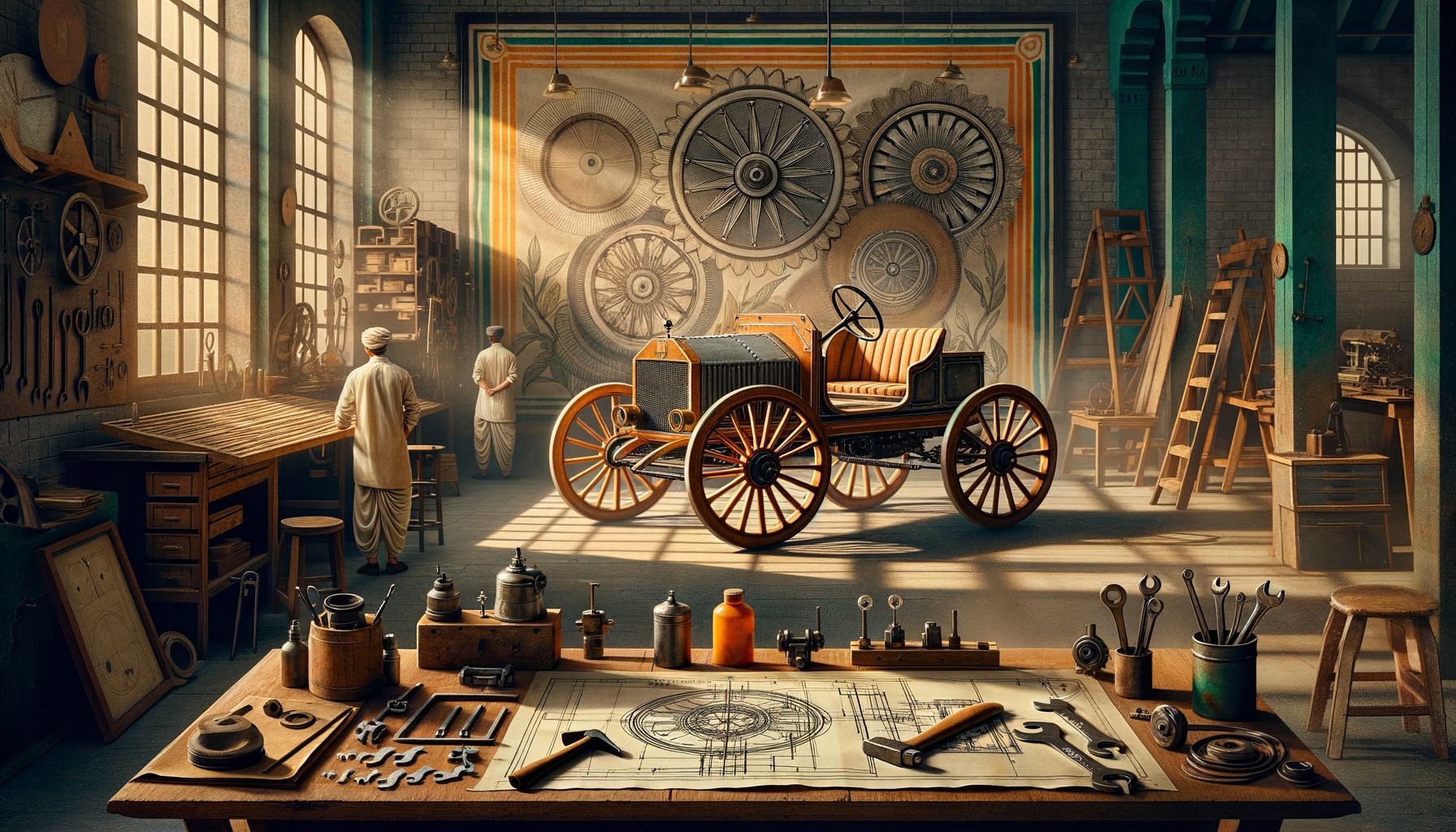
Reconstructing what such a project entailed suggests a disciplined approach to mechanical design: fabricating a chassis suitable for local roads, calibrating powertrain components, and adapting available materials and tools from urban workshops. Whether built entirely from domestic parts or assembled through a hybrid of local and imported elements, the enterprise embodied the swadeshi ethicprioritizing Indian problem-solving, context-aware design, and iterative craftsmanship.
Interpreted through the lens of dharmic unity, this story resonates across Hindu, Buddhist, Jain, and Sikh traditions. Each emphasizes ethical labor, restraint, and service (seva) to the community. The Vishwakarma spirit thus becomes a shared civilizational value, expressing harmony between knowledge and work, and reinforcing that swadeshi was not an exclusionary stance but a constructive pathway toward collective well-being and self-respect.
The symbolic power of such a pioneering automobile lies in how it helped reframe possibility. It reinforced confidence that Indian engineers, mechanics, and artisans could originate modern solutionsa mindset that would later nourish post-independence manufacturing and the broader ecosystem of Indian innovation. In this sense, the car becomes both artifact and argument for indigenous capability.
This legacy continues to inform contemporary aspirations: initiatives promoting indigenous design, sustainable manufacturing, and context-specific engineering carry forward the same intellectual thread. For students and practitioners, the example of Bepin Behari Das offers a model of disciplined creativityproving that rigorous problem definition, patient iteration, and culturally grounded design can yield outcomes of national significance.
Remembering such figures also advances cultural heritage stewardship. It calls for collaboration among historians, archivists, technical institutes, and community organizations to verify claims, digitize sources, and situate early Indian engineers within a global history of technologyon their own terms and with due scholarly care.
In honoring Bepin Behari Das, the narrative ultimately restores a wider circle of contributorsthe machinists, metalworkers, pattern-makers, and mechanics whose hands turned ideas into motion. Their work exemplifies a shared dharmic ethic of skill, integrity, and service, and reminds that India’s first indigenous car is also a story about unity in purpose, cultural confidence, and the enduring power of swadeshi imagination.
Inspired by this post on Hindu Blog.