
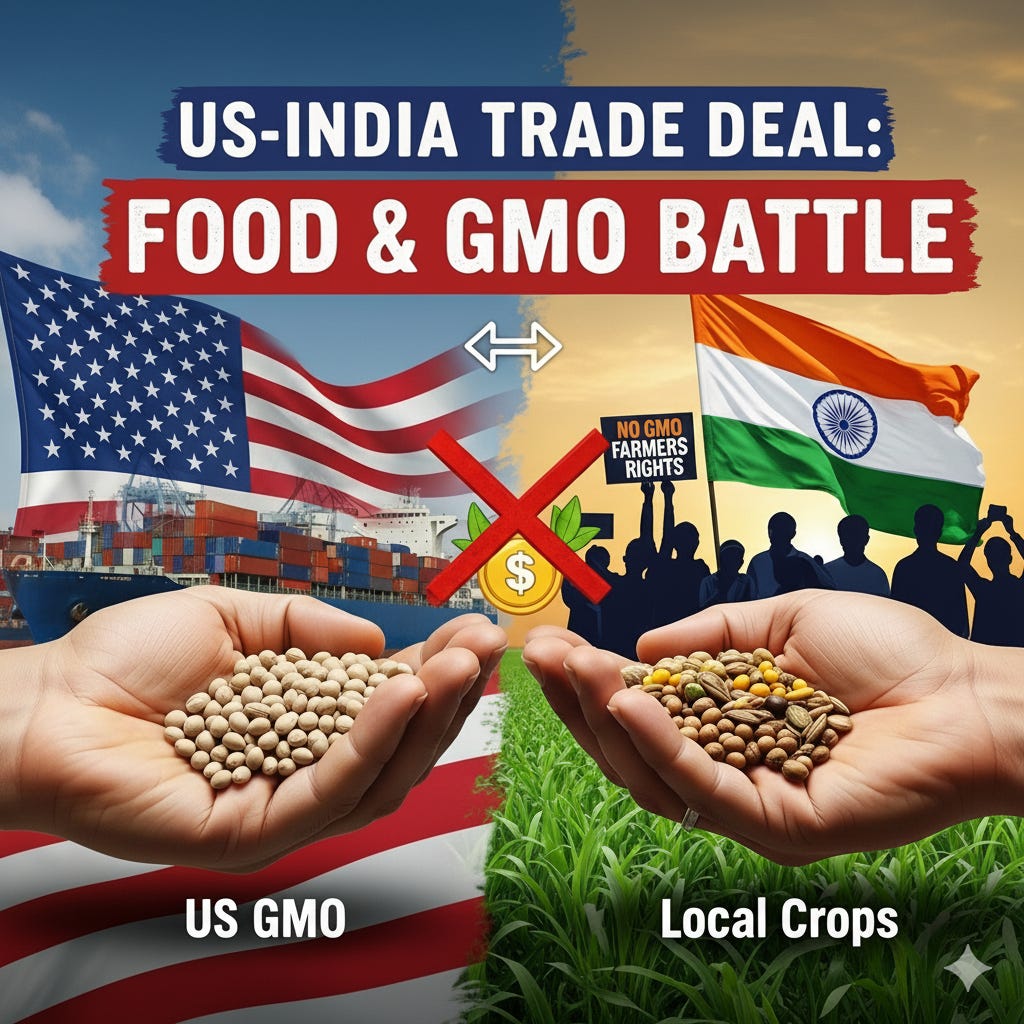
Recent U.S.–India trade discussions have reportedly stumbled over agriculture, particularly calls for India to lower tariffs and ease non-tariff barriers on farm and food products. This friction is unsurprising: India maintains a protective agri-food trade posture to safeguard food security, farmer livelihoods, and public health. In this context, market access, tariff lines, and non-tariff barriers must be understood through India’s historical experience and present development priorities.
Historical memory plays a decisive role. After colonial-era disruptions and famines, India found itself dependent on external food aid, notably under PL 480. Hard-won food securityenabled by domestic production, buffer stocks, and policy supportremains a strategic priority. Accordingly, any rapid liberalization that risks renewed dependence is approached with caution, aligning with the broader principle of food sovereignty.
Socioeconomically, agriculture sustains millions of small and marginal farmers and a large share of India’s rural poor. The policy agenda emphasizes raising farm incomes, strengthening cold-chain infrastructure, and building resilient food processing and allied industries. In such a transition, calibrated protection and smart support policies can help stabilize incomes, crowd in investment, and enable inclusive growth in agri-food value chains.
Market structure and reform are equally pertinent. Long-standing concerns about intermediated markets highlight the need for transparent, farmer-centric trading systems, better logistics, and technology-enabled price discovery. While farm reform laws introduced in 2020 were later withdrawn to preserve social harmony, a Supreme Court-appointed committee reported that many respondents supported reform objectives. The path forward points to consensus-led, state-capacity-backed reforms that protect farmers while improving market efficiency.
Specific sensitivities around imports from the United States include standards, traceability, and labelingespecially for genetically modified organismsalongside Sanitary and Phytosanitary (SPS) measures. India’s earlier dependence under PL 480 serves as a cautionary case study: diversifying domestic production and maintaining robust safety nets are seen as essential to prevent external shocks and safeguard consumer welfare.
Another driver is U.S. domestic change. Initiatives such as Make America Healthy Again reflect a shift toward healthier food systems, potentially affecting large segments of the U.S. food and beverage market. As firms seek to manage revenue impacts by expanding abroad, India will likely face intensified agri-food export pitches. A prudent response is to welcome high-quality, safe, and responsibly produced goodswhile ensuring that products failing stricter domestic benchmarks elsewhere do not enter Indian markets.
Public health priorities are central. Policy momentum increasingly favors natural, minimally processed, and organic foods; reduced dependence on Palm oil; and tighter scrutiny of “flavour enhancers”, “additives”, “emulsifiers”, and “food grade colouring agents”. These shifts align with global best practices and India’s nutrition and non-communicable disease agendas, reinforcing the case for robust standards, inspection, and compliance frameworks.
These choices resonate with shared values across dharmic traditionsHinduism, Buddhism, Jainism, and Sikhismwhich foreground ecological balance, ahimsa, aparigraha, mindfulness, and seva. A food system that protects soil, water, biodiversity, and community health supports social harmony and interfaith unity, strengthening the ethical foundation for sustainable agriculture and responsible consumption.
A balanced trade strategy can reconcile openness with resilience. Key elements include phased tariff adjustments tied to domestic capacity building; clear, science-based SPS and Technical Barriers to Trade (TBT) frameworks; stringent quality, safety, and labeling norms (including for GMOs); credible traceability and organic certification; and targeted support for cold-chain, logistics, and agro-processing. With these guardrails, India can negotiate mutual recognition and expand market access without compromising food security or farmer welfare.
Ultimately, India’s stance is not anti-trade; it is pro-stability, pro-health, and pro-farmer. Constructive U.S.–India dialogueanchored in evidence, public health protections, and fair competitioncan unlock win–win outcomes. By combining principled openness with strong domestic systems, both countries can expand agri-food trade while safeguarding sovereignty, consumer safety, and sustainable development.
Inspired by this post on RightViews.











