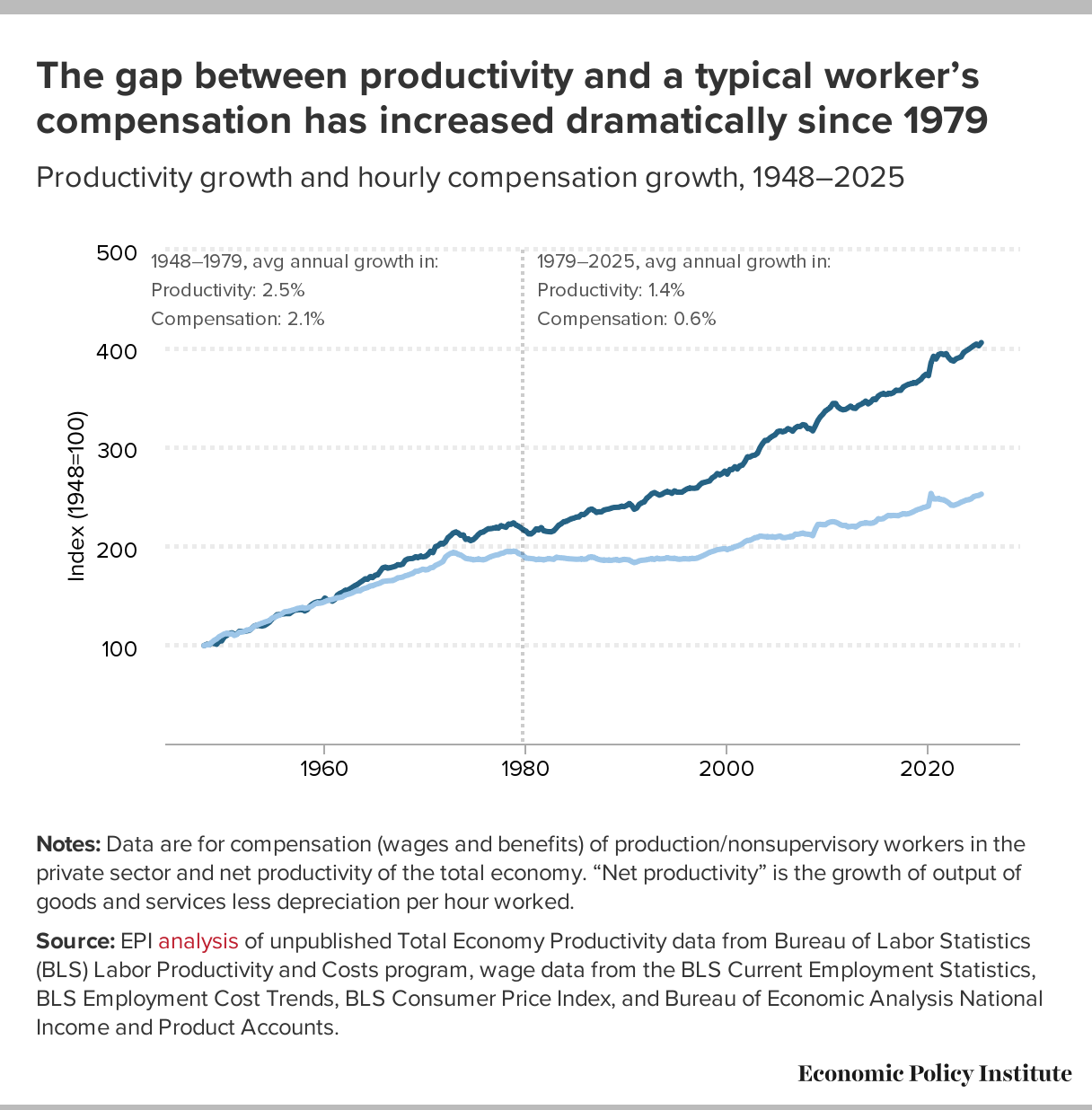
Recent updates to the Productivity–Pay Tracker by the Economic Policy Institute highlight a persistent productivity–pay gap: output per worker has risen steadily while typical wages have not kept pace. This divergence raises important questions about how value is created, who captures it, and why many workers experience wage stagnation despite higher overall productivity.
The relationship between labor productivity and wages is not as straightforward as it appears. Productivity can rise due to capital deepening and process innovation even when the skill requirements of individual roles fall or remain unchanged. In such cases, firms become more efficient through technology and organizational shifts, but the gains do not automatically translate into broadly shared wage growth.
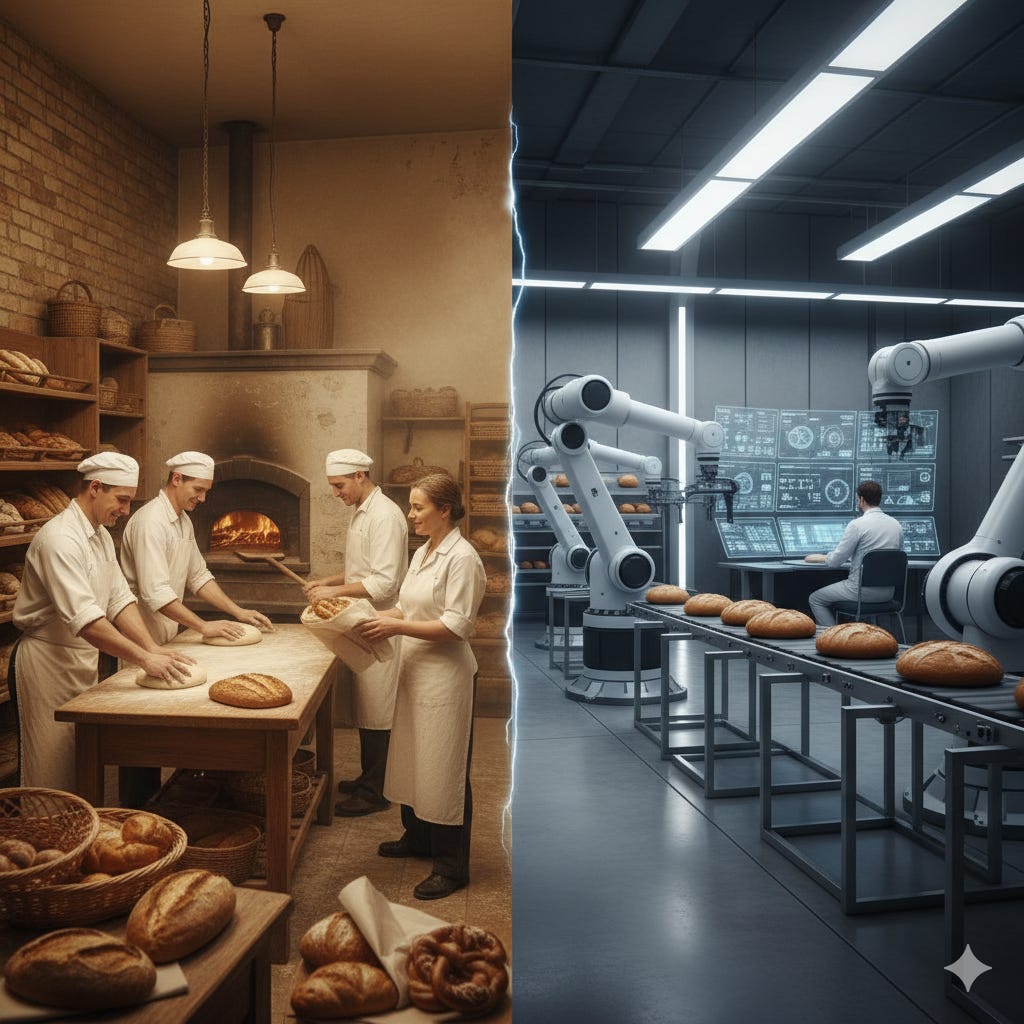
Consider a familiar, relatable setting: a neighborhood bakery. In its traditional form, the bakery depends on skilled bakers, supported by sales, cleaning, and accounting staff. When a highly automated bread-making machine is introduced, the production process changes fundamentally. The bakery still needs the support staff, but the skilled baker’s role may be replaced by a lower-cost attendant who operates the machine, while expert maintenance shifts to the manufacturer or a specialized service provider.
This transformation reduces the number of workers required to produce the same output and reallocates income toward those who design, maintain, and continually improve the technology. As a higher-order economy of scale emerges, the specialized knowledge embedded in the machineand in the experts behind itcommands premium returns. A consulting baker working for the machine manufacturer may earn far more than an average baker who formerly depended on artisanal skill alone.
The result is a clear pattern of income polarization. Productivity rises at the enterprise level, yet the employment profile becomes more capital intensive and more unequal. Those with distinctive, hard-to-replicate knowledge benefit disproportionately, while task requirements in many frontline roles are simplified, reducing the expected wage premium for those positions.
In practical terms, this reflects a structural shift from an effort-based economy to a knowledge-based economy. The value of physical effortas in routine or manual tasksdeclines relative to the value of specialized knowledge, systems design, data fluency, and problem-solving. Without pathways to develop these capabilities, workers without college degrees or access to “knowledge work” face wage stagnation despite rising aggregate productivity.
Many readers will recognize the emotions embedded in such transitions: the pride of craftsmanship, the anxiety of displacement, and the hope that skill-building can restore dignity and security. These experiences underscore that economic change is not merely statistical; it is profoundly human. Effective labor market policy must therefore blend analytical clarity with empathy and opportunity.
To better analyze these shifts, new measurement tools are needed alongside traditional labor productivity. One useful concept is the “wage content of a job,” an index that tracks how compensation evolves for a standardized basket of occupations over timeanalogous to how a consumption basket underpins inflation metrics. Such an index would reveal whether specific roles are gaining or losing value as technologies and business models evolve.
A complementary measurethe “job content of a wage”would assess how much and what kind of work a given wage can command over time, controlling for skill and responsibility. Together, these metrics would illuminate where value is accruing in the production process, which segments of the workforce are being left behind, and how policy can target reskilling and mobility more precisely.
These insights align with a broader vision of social cohesion informed by dharmic traditions across Hinduism, Buddhism, Jainism, and Sikhism. Shared values such as dignity of labor, karuṇā (compassion), ahiṁsā (non-harm), dāna (generosity), and sevā (service) emphasize fairness, responsibility, and the ethical distribution of opportunity. A knowledge economy guided by these principles seeks inclusive skill development, equitable access to education, and respect for every contributor in the value chain.
Ultimately, a well-functioning market system aligns a country’s job profile and knowledge profile with its income profile. When these are in sync, the benefits of innovation are more broadly shared, social trust is strengthened, and the productivity–pay gap narrows. When they diverge, inequality rises and social cohesion weakens. Building a fair, knowledge-driven economy therefore requires both precise measurementthrough tools like wage-content and job-content indicesand policies that expand access to high-value skills while honoring the dignity of all forms of work.
Inspired by this post on RightViews.