
A focused guide to Śrīmad-Bhāgavatam 4.24.49
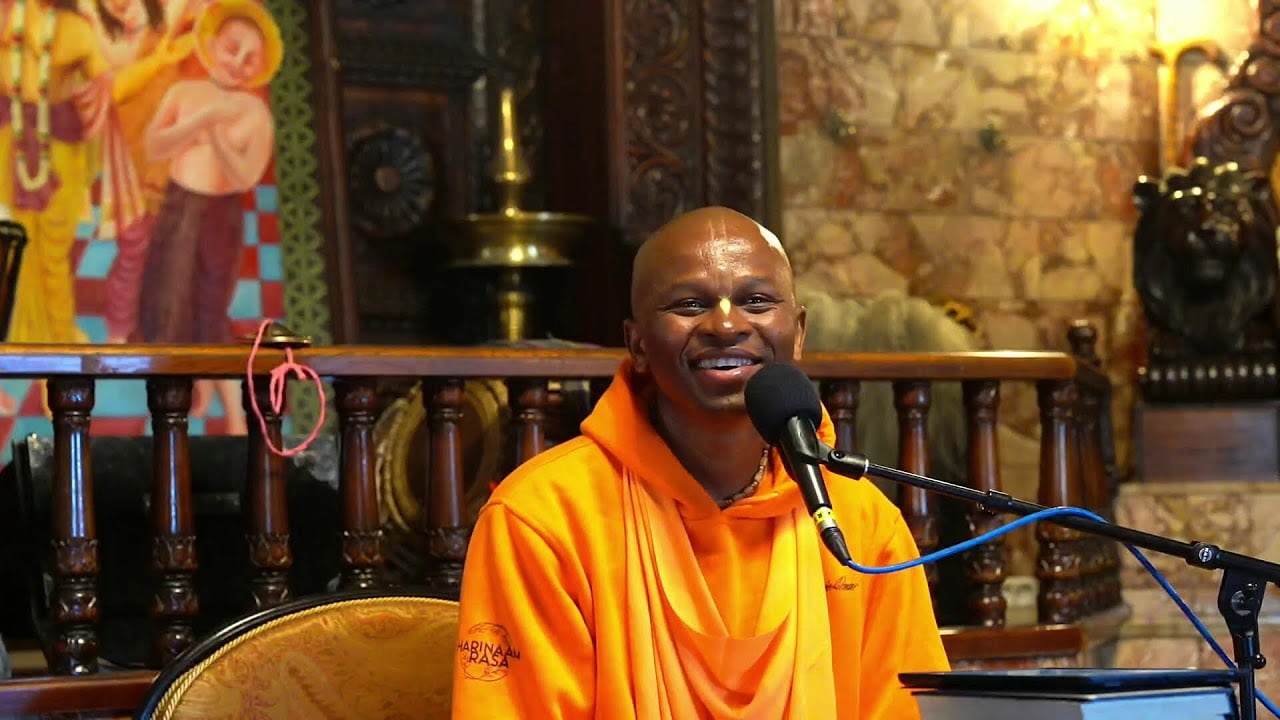
HH Bhakti Sarvajna Gauranga Swami’s presentation on Śrīmad-Bhāgavatam 4.24.49 opens a compact but remarkably rich passage from the Rudra-gīta, the prayer spoken by Lord Śiva in the Fourth Canto of the Bhāgavata Purāṇa. The verse directs attention to the divine form: lionlike shoulders, the Kaustubha jewel, the association of Śrī, and a radiant chest whose beauty surpasses gold traced across a dark testing stone. Its imagery is visual, but its purpose is contemplative. It trains perception to move beyond casual looking toward disciplined remembrance, reverence, and ethical transformation.
The supplied post contains an embedded recording rather than a written transcript. Consequently, this study is anchored in the Sanskrit verse, its immediate literary setting, and the published Gauḍīya Vaiṣṇava translation and commentary. It functions as an academically structured companion to the lecture, not as a word-for-word record of every statement made in the video.
Lecture: HH Bhakti Sarvajna Gauranga Swami – Srimad Bhagavatam 4.24.49
Channel: Simhachalam LIVE
The source post also preserves the following German channel notice:
Herzlich willkommen!
Wir streamen jeden Tag von 08:00 bis 09:00 Uhr einen Vortrag zum Srimad-Bhagavatam und …
According to his official profile, HH Bhakti Sarvajna Gauranga Swami is a disciple of HH Bhakti Charu Swami, entered ISKCON Pretoria in 2002, and received formal Bhakti-śāstrī and Bhakti-vaibhava training in Śrī Māyāpur Dhāma. That combination of textual study and public teaching provides useful context for a lecture devoted to the close reading of a single Bhāgavata verse.
The narrative setting: the Pracetas and the Rudra-gīta
Śrīmad-Bhāgavatam 4.24 belongs to the account of the Pracetas, the ten sons of King Prācīnabarhiṣat. Charged with continuing the population, the brothers first undertake spiritual discipline. Their story establishes a recurring Bhāgavata principle: responsibility in the world should be preceded and governed by purification of intention. Action is not rejected, but it is placed under the guidance of tapas, prayer, and knowledge.
During their journey, the Pracetas encounter a beautiful body of water and behold Lord Śiva emerging with his associates. Śiva recognizes their spiritual sincerity, expresses affection for devotees of the Supreme, and gives them a prayer through which their consciousness may become properly directed. This hymn is traditionally called the Rudra-gīta, the song or prayer of Rudra.
The narrative structure is significant. Śiva does not appear as a sectarian rival protecting an isolated domain. He appears as a teacher who transmits contemplative knowledge and directs qualified seekers toward the divine. Within the Vaiṣṇava framing of the chapter, his greatness is shown through devotion, wisdom, generosity, and the ability to recognize devotion in others.
Verse 4.24.49 occurs within an extended visualization of the Lord’s personal form. The preceding verses describe a merciful smile, curling hair, luminous garments, earrings, ornaments, and the conch, disc, club, and lotus. The following verse turns to the abdomen and navel. Text 49 therefore occupies the visual center of a deliberate progression: contemplation moves from the face and upper ornaments to the shoulders, neck, jewel, chest, and then downward through the rest of the form.
The primary Sanskrit text
सिंहस्कन्धत्विषो बिभ्रत्सौभगग्रीवकौस्तुभम् ।
श्रियानपायिन्या क्षिप्तनिकषाश्मोरसोल्लसत् ॥ ४९ ॥
siṁha-skandha-tviṣo bibhrat
saubhaga-grīva-kaustubham
śriyānapāyinyā kṣipta-
nikaṣāśmorasollasat
In a close paraphrase, the verse portrays the Lord as bearing the splendor of lionlike shoulders, a beautiful neck adorned by the Kaustubha jewel, and a dark, radiant chest inseparably associated with Śrī. Its golden or auspicious markings surpass the beauty of streaks left when gold is rubbed upon a testing stone. The comparison joins majesty, tenderness, wealth, color, texture, and light in a single concentrated image.
The complete received translation and purport may be consulted in the Bhaktivedanta Vedabase edition of Śrīmad-Bhāgavatam 4.24.49. A careful study benefits from distinguishing the Sanskrit wording, the translator’s syntactic expansion, and the theological explanation supplied by the commentary.
The compressed architecture of the Sanskrit
Sanskrit compounds allow several relationships to be compressed into very little space. English prose usually has to unfold those relationships with prepositions, relative clauses, and explanatory nouns. This is one reason a translation of the verse is considerably longer than the original. Expansion does not necessarily represent embellishment; it can be required to make implicit grammatical and cultural relationships intelligible.
The opening elements siṁha and skandha mean lion and shoulder. Together they evoke shoulders comparable to those of a lion. The image suggests breadth, strength, balance, and royal bearing. The term tviṣ belongs to the semantic field of radiance or splendor, while the received Vaiṣṇava gloss also draws attention to the beautiful curling hair or ornamentation around the shoulders. The compound therefore communicates more than physical size; it presents strength made luminous and aesthetically ordered.
Bibhrat is a present active participial form conveying the sense of bearing, wearing, carrying, or manifesting. The word gives the description movement. The Lord is not presented as an inert object assembled from symbolic parts. He actively bears the features and ornaments through which the prayer apprehends his presence.
The cluster saubhaga-grīva-kaustubham links auspicious beauty, the neck, and the Kaustubha jewel. Saubhaga can convey good fortune, excellence, loveliness, or auspicious distinction; grīva denotes the neck; and Kaustubha names the celebrated jewel associated with Viṣṇu. The grammatical compression allows the neck, the jewel, and the auspicious beauty created by their relationship to be perceived simultaneously.
Śriyā anapāyinyā is especially important. Śrī can signify beauty, radiance, prosperity, auspiciousness, or the goddess Śrī-Lakṣmī. Anapāyinī conveys the sense of not departing, not diminishing, or remaining inseparably present. The phrase therefore supports both an aesthetic reading and a personal theological reading: beauty never leaves the Lord, and Śrī is never separated from him.
The final cluster brings together kṣipta, indicating surpassing or defeating; nikaṣa-aśma, a stone used for testing gold; uras, the chest; and ullasat, shining or gleaming forth. The syntax culminates in comparison. The Lord’s chest does not merely resemble a dark touchstone marked with gold; its radiance exceeds the most beautiful version of that familiar material image.
This philological structure reveals why isolated word substitution is insufficient. The verse depends upon compound relations, cultural knowledge, visual contrast, and the sequence of the surrounding verses. A responsible translation must therefore remain close to the lexical data while also making the scene coherent for readers who have never seen traditional gold testing or Vaiṣṇava iconography.
Lionlike shoulders: power held in composure
The lion is a widespread emblem of sovereignty, courage, physical excellence, and protective authority. In this verse, the comparison does not reduce the divine form to zoological anatomy. It selects a recognizable quality—the impressive breadth and beauty of a lion’s shoulders—and intensifies it through ornaments, garlands, hair, and radiance.
The image also carries an ethical possibility. Strength becomes spiritually meaningful when it supports rather than intimidates. A person entrusted with family, institutional, educational, or community responsibility may read the lionlike shoulders as an image of dependable capacity: the ability to bear weight without turning responsibility into domination.
Such a reading remains an application rather than a literal translation. The textual statement concerns divine beauty; the moral inference arises when contemplation of that beauty reshapes conduct. Maintaining this distinction protects both philological accuracy and practical relevance.
The Kaustubha jewel as identity, radiance, and sacred memory
In Purāṇic tradition, the Kaustubha is the pre-eminent jewel associated with Viṣṇu and is commonly linked with the treasures produced during the churning of the cosmic ocean. In Vaiṣṇava visual culture, it is not a random luxury object. It serves as an identifying mark and places material brilliance within a theological hierarchy: the jewel is precious, yet its beauty derives from its relationship with the divine bearer.
The location of the Kaustubha near the neck and chest is contemplatively important. The eye is guided toward the heart region, where jewel, garland, Śrī, and bodily radiance converge. In ordinary life, ornaments are expected to beautify the wearer. Devotional poetry reverses that relation: the ornament becomes more glorious because it rests upon the Lord.
This reversal challenges a consumer understanding of beauty. Value does not arise solely from rarity, price, or display. It arises from relationship, purpose, and the quality of consciousness with which something is held. The verse can therefore foster an aesthetic of stewardship rather than possession.
Śrīvatsa, Śrī, and an important interpretive distinction
The published Gauḍīya Vaiṣṇava translation identifies radiant streaks on the chest as Śrīvatsa, the auspicious mark traditionally seen on Viṣṇu and associated with the presence of the goddess of fortune. The Sanskrit line itself uses śriyā anapāyinyā rather than explicitly naming Śrīvatsa. The translation therefore incorporates a traditional iconographic interpretation that connects the verse’s inseparable Śrī with the recognized chest mark.
This distinction does not invalidate the traditional reading. It clarifies its level. The lexical statement, the iconographic identification, and the theological meaning support one another, but they are not identical operations. Academic study becomes stronger when these layers are named instead of being blended without explanation.
Śrī’s inseparability also prevents the image of divine sovereignty from becoming narrowly masculine or solitary. Majesty is joined with grace, prosperity with responsibility, and power with relational fullness. Vaiṣṇava theology preserves distinct identities while presenting divine energies in an inseparable relationship.
The gold-testing stone: technical knowledge transformed into sacred poetry
A traditional touchstone is a dark, fine-grained stone across which a gold object is rubbed. The object leaves a visible streak whose color and behavior can be compared with known standards, sometimes with additional chemical testing. The method depends upon contrast: a bright metallic trace becomes clearly visible against the dark surface.
The verse draws upon that practical technology. A listener familiar with gold testing would immediately recognize blackness crossed by luminous lines. The comparison is therefore neither abstract nor decorative. It converts a scene from commerce and craft into an instrument of sacred visualization.
The metaphor then exceeds its material source. A touchstone assesses the apparent quality of gold, but the Lord’s chest surpasses the touchstone itself. The instrument that normally evaluates value becomes inadequate before transcendent beauty. The poem thus performs a theological inversion: the divine is not measured by the world’s standards; familiar standards become provisional aids for approaching the divine.
The dark-and-gold contrast also demonstrates how devotional aesthetics uses difference rather than uniform brightness. Radiance becomes perceptible because it appears against depth. For a practitioner passing through grief, uncertainty, or spiritual dryness, this image can be emotionally resonant without romanticizing suffering. Darkness is not declared good in itself, yet it need not make luminosity impossible.
From visual description to contemplative practice
The sequence surrounding verse 49 can function as an attention map. The mind first encounters the Lord’s expression, hair, garments, ornaments, and emblems; it then settles upon the shoulders, neck, jewel, and chest before proceeding to the abdomen and navel. Such ordered movement gives distracted attention a stable path.
Within bhakti-yoga, remembrance of the divine form is not intended as detached aesthetic consumption. Hearing, recitation, visualization, and service reinforce one another. The form is heard through scripture, held in memory, contemplated with reverence, and allowed to influence conduct. Beauty becomes spiritually effective when it awakens relationship and service.
A practical contemplation of this verse may begin with slow recitation, followed by attention to four visual anchors: the shoulders, Kaustubha, Śrī or Śrīvatsa, and the touchstone-like chest. Each anchor can then be joined with a quality: strength, sacred identity, inseparable grace, and discernment. The exercise remains rooted in the text while preventing visualization from becoming vague fantasy.
The bodily imagery should be understood within the personal theology and poetic conventions of the Bhāgavata Purāṇa. It is not an anatomical report, an archaeological description, or a claim that material measurements can capture transcendence. Its language is analogical: known forms are employed and then surpassed.
Lord Śiva and Lord Viṣṇu: a model of devotional harmony
The speaker of the Rudra-gīta is Lord Śiva, while the contemplated four-armed form is identified in the chapter’s Vaiṣṇava framework with the Supreme Lord, Viṣṇu or Vāsudeva. This literary relationship is central to the passage. Śiva’s stature is expressed not through hostility but through clear spiritual vision and generous instruction.
Different Hindu sampradāyas articulate the relationships among Śiva, Viṣṇu, Śakti, and the Absolute in different ways. A Gauḍīya Vaiṣṇava reading has its own defined theology, while Śaiva, Śākta, Smārta, and other traditions preserve distinct interpretive frameworks. Intellectual honesty requires acknowledging those differences. Dharmic unity does not depend upon erasing them.
The chapter nevertheless offers a powerful basis for mutual respect. A revered deity teaches devotion to another divine form, recognizes sincere seekers, and shares a prayer rather than guarding knowledge as private property. This pattern discourages the use of scripture as a weapon of contempt. Conviction can remain deep while dialogue remains generous.
The same principle can support respectful relations among Hinduism, Buddhism, Jainism, and Sikhism. These traditions do not teach identical metaphysics, scriptures, or devotional practices, and their differences should not be flattened. Yet disciplined remembrance, ethical self-examination, compassion, restraint, reverence, and transformation of consciousness provide meaningful areas for dialogue.
Functional parallels may be observed between Vaiṣṇava smaraṇa, Buddhist recollective or visualization practices, Jain contemplative reflection, and Sikh nām-simran. Such parallels are not claims of theological equivalence. They show that sustained attention can become a bridge between doctrine and conduct across several dharmic paths.
Ethical insights carried by the imagery
The lionlike shoulders suggest strength, but the surrounding prayer places strength under devotion. The practical implication is disciplined responsibility. Authority is tested by what it can protect, sustain, and uplift—not merely by what it can control.
The Kaustubha suggests distinction, yet its glory is relational. A corresponding ethical insight concerns identity. Education, status, wealth, lineage, and talent acquire enduring value when they are integrated with service and character rather than used as isolated claims to superiority.
The touchstone image suggests discernment. Gold is not evaluated by wishful thinking; it is tested. Spiritual maturity likewise requires criteria. A teaching may be examined through scripture, reasoned interpretation, the conduct of trustworthy teachers, and its effects upon humility, compassion, self-control, and truthfulness.
The inseparable presence of Śrī suggests that prosperity cannot be separated from responsibility. Fortune that produces arrogance or disregard for others has not been integrated spiritually. Fortune becomes auspicious when it nourishes dignity, learning, hospitality, ecological care, and community well-being.
These applications give the verse emotional proximity. A reader burdened by responsibility may find reassurance in the image of shoulders capable of bearing weight. Someone struggling with self-worth may discover that beauty is presented as relational and sacred rather than competitive. Someone facing uncertainty may recognize that discernment, like testing gold, requires patience and repeated examination.
A rigorous method for studying the verse
A productive study sequence contains five stages. First, the Sanskrit is heard or recited without rushing. Second, the principal compounds are separated. Third, the verse is read with the immediately preceding and following texts. Fourth, translation is distinguished from commentary and contemporary application. Fifth, one practical quality is selected for deliberate cultivation.
Pronunciation benefits from attention to vowel length and consonantal distinctions. In Śrī, the long vowel should not be clipped. In siṁha, the anusvāra nasalizes the sound before h. Retroflex and dental consonants should not be treated as interchangeable. Perfect phonetic mastery is not a prerequisite for devotion, but careful pronunciation expresses respect for the received text.
Contextual reading prevents symbolic excess. The verse should not be interpreted as an independent code in which every color or ornament can mean anything a reader desires. The surrounding Rudra-gīta, the established meanings of Kaustubha and Śrīvatsa, and the chapter’s devotional purpose set reasonable boundaries.
Reflective practice can then connect the verse with daily conduct. One useful exercise is to identify a present responsibility that requires lionlike steadiness, an attachment that requires touchstone-like discernment, and a resource that can be placed in service. This keeps reflection specific and testable.
Community discussion adds another safeguard. Sanskrit specialists, temple practitioners, artists, and readers from different sampradāyas may notice different dimensions of the same image. Dialogue becomes fruitful when participants identify the basis of each claim and distinguish inherited teaching from personal inference.
Academic cautions for responsible interpretation
Three textual layers should remain visible: the Sanskrit verse, the traditional translation and purport, and the contemporary lecture or application. Each has value, but each answers a different question. The verse supplies the primary poetic statement; commentary unfolds a lineage-specific theology; a lecture connects those materials with the needs of a particular audience.
The title of the embedded recording confirms its focus on Śrīmad-Bhāgavatam 4.24.49, but the supplied post does not include a transcript. Specific interpretive points should therefore not be attributed to HH Bhakti Sarvajna Gauranga Swami unless they can be verified directly from the recording. The present analysis remains a textual companion rather than a reconstructed quotation.
Translation plurality should also be expected. Sanskrit compounds can permit more than one defensible English arrangement, and traditional schools may emphasize different theological implications. Comparison is most useful when it clarifies grammar, context, and doctrinal assumptions rather than being used to declare that one community lacks sincerity.
Core insight
Śrīmad-Bhāgavatam 4.24.49 joins strength, beauty, sacred identity, relational abundance, and discernment in one visual meditation. Lionlike shoulders communicate majestic capacity; the Kaustubha marks divine distinction; inseparable Śrī communicates undiminishing grace; and the gold-testing stone supplies a concrete image of radiance against depth.
The verse’s deepest benefit lies in the movement it invites—from seeing to remembering, from remembering to valuing, and from valuing to serving. Its beauty is not an escape from responsibility. Properly contemplated, it refines responsibility by placing strength under compassion, prosperity under stewardship, learning under humility, and devotion within respectful relationships.
Lord Śiva’s role as the teacher of this prayer gives the passage special relevance for dharmic harmony. The scene demonstrates that reverence for one’s own path need not require hostility toward another. Profound conviction and genuine respect can coexist when knowledge is offered for purification rather than competition.
Research basis: The Sanskrit text, traditional translation, and immediate context were checked against the Bhaktivedanta Vedabase. Biographical context was checked against the official profile of HH Bhakti Sarvajna Gauranga Swami. No promotional or donation material from either source has been reproduced.
Inspired by this post on Dandavats.









Leave a Reply
You must be logged in to post a comment.