
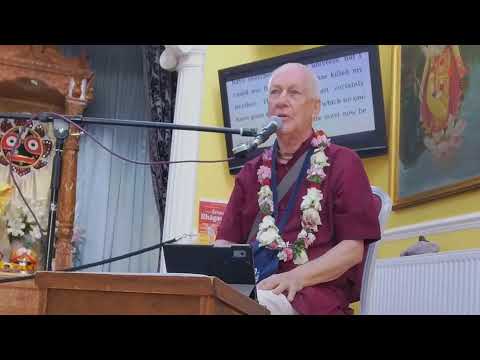
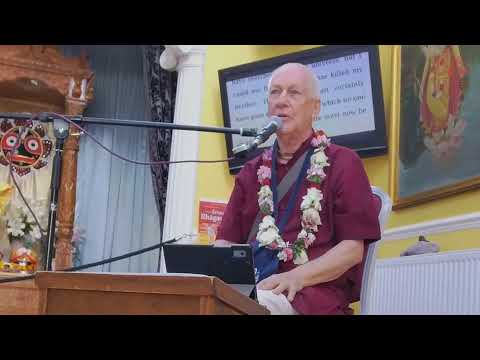
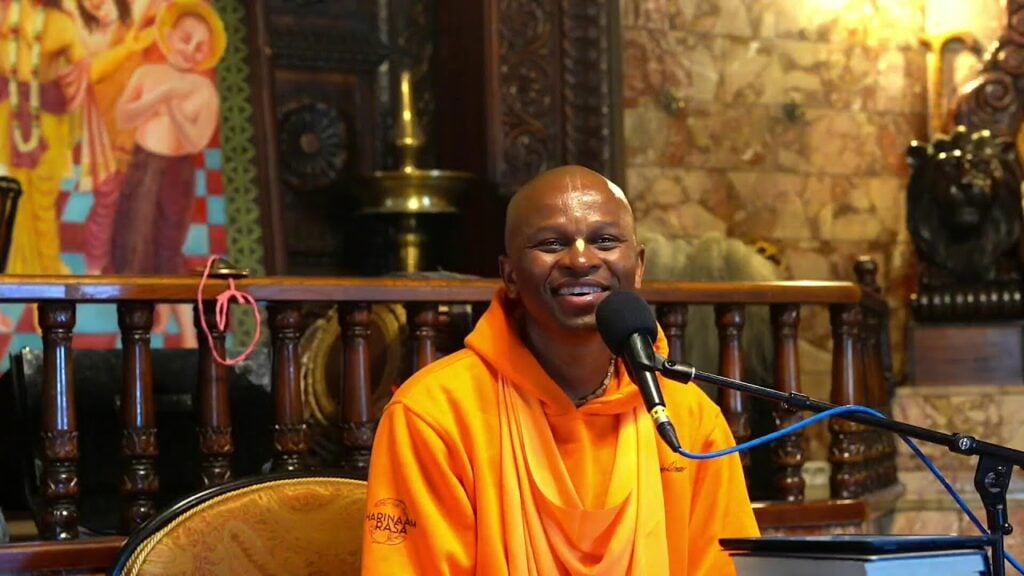
Featured class: Śrīmad-Bhāgavatam 8.19.11–12 with HG Vaiyasaki dasa. The recording is the primary feature; the study below supplies the narrative, linguistic, philosophical, and contemplative context needed for a careful hearing.
Two compact verses in the Eighth Canto of the Śrīmad-Bhāgavatam stage a striking paradox. Hiraṇyakaśipu possesses extraordinary force, searches across an immense cosmic landscape, and still fails to perceive Viṣṇu. The narrative does not present his failure as a shortage of energy. It presents a more demanding problem: a search can be vast in scale and still be misdirected in method.
Reference clarification: the supplied video title identifies ŚB 8.19.11 and ŚB 8.19.12, whereas the appended reading link points to ŚB 8.18.11. These are different passages. This study follows the verses named in the class title and treats 8.18.11—Aditi and Kaśyapa’s astonishment at Vāmanadeva’s appearance through His own spiritual potency—as a thematically relevant prelude.
Why these two verses matter
ŚB 8.19.11–12 brings together narrative drama, devotional theology, psychology, and epistemology. At the narrative level, an enraged ruler hunts for the divine figure he blames for his brother’s death. At the theological level, Viṣṇu remains present while escaping an outwardly fixated gaze. At the psychological level, anger turns an unsuccessful search into a confident but unwarranted conclusion. At the contemplative level, the episode asks whether reality can be known when the seeker’s habits of attention exclude the very dimension in which the sought reality is said to be present.
The passage is therefore more than a story about a powerful antagonist. It is a study of perception under the pressure of grief, pride, and vengeance. Most readers will never search caves and oceans for an enemy, yet many will recognize the underlying movement: an emotionally charged mind searches only where it expects an answer, interprets silence as confirmation, and mistakes the limits of its method for the limits of reality.
Narrative setting: Vāmanadeva speaks to Bali Mahārāja
Canto Eight, Chapter Nineteen is titled “Lord Vāmanadeva Begs Charity from Bali Mahārāja.” The chapter opens after Bali has welcomed Vāmanadeva and invited the young brahmacārī to request a gift. Within the text’s Vaiṣṇava framework, Vāmanadeva is Viṣṇu appearing in a deliberately modest form. Bali sees a young brāhmaṇa mendicant; the audience knows that the visitor’s identity and purpose exceed that appearance.
Vāmanadeva first praises Bali’s lineage, its generosity, its adherence to promises, and its martial courage. Prahlāda Mahārāja, Bali’s grandfather, is singled out as a peaceful and venerable guide. The family sequence is important: Hiraṇyakaśipu is Prahlāda’s father, Virocana is Prahlāda’s son, and Bali is Virocana’s son. The story of Hiraṇyakaśipu thus forms part of the dynastic memory through which Vāmanadeva addresses Bali.
In verses 5–7, the speech recalls Hiraṇyākṣa’s prowess, his death at the hands of Viṣṇu in the Varāha form, and Hiraṇyakaśipu’s furious response to his brother’s death. In verses 8–10, Viṣṇu anticipates that Hiraṇyakaśipu will follow wherever He goes. The narrative then states that Viṣṇu enters Hiraṇyakaśipu’s body in an inconceivably subtle manner, through the breath, while the pursuer remains able to see only externally. Verses 11–12 describe the result of that mismatch between presence and perception.
This setting prevents a common interpretive error. Hiraṇyakaśipu’s search is not an isolated anecdote, and Vāmanadeva is not simply recounting an enemy’s embarrassment. The episode belongs to a larger act of praise directed toward Bali’s heroic ancestry. It establishes the scale of that ancestry while quietly exposing the difference between physical power and spiritual vision. It also prepares for Vāmanadeva’s apparently small request for three paces of land, a request that will reveal the true measure of both the giver and the recipient.
ŚB 8.19.11: an immense search with a concealed limitation
स तन्निकेतं परिमृश्य शून्य-
मपश्यमान: कुपितो ननाद ।
क्ष्मां द्यां दिश: खं विवरान्समुद्रान्
विष्णुं विचिन्वन् न ददर्श वीर: ॥ ११ ॥
sa tan-niketaṁ parimṛśya śūnyam
apaśyamānaḥ kupito nanāda
kṣmāṁ dyāṁ diśaḥ khaṁ vivarān samudrān
viṣṇuṁ vicinvan na dadarśa vīraḥ
In close paraphrase, Hiraṇyakaśipu finds Viṣṇu’s residence empty, becomes angry, cries out, and searches the earth, the higher regions, every direction, the sky, caves, and oceans. Although described as a formidable hero, he does not see Viṣṇu. The repeated spatial terms create an impression of exhaustive movement, but the preceding verses have already disclosed the unsearched location: the divine presence is said to be within the seeker himself.
The verse’s vocabulary makes the scene unusually vivid. Śūnyam marks the residence as vacant; apaśyamānaḥ emphasizes not seeing; kupitaḥ identifies anger; nanāda conveys a loud cry; and vicinvan describes active searching. The closing expression na dadarśa returns to the failure of sight. The verse is thus organized around a contrast between intense action and absent perception.
Its geography also has a literary function. Kṣmām, dyām, diśaḥ, kham, vivarān, and samudrān move from earth and celestial space to directions, sky, hidden cavities, and oceans. The list should be read within the text’s Purāṇic cosmological imagination rather than forced into the categories of a modern astronomical survey. Its purpose is totalizing: no external region appears to have been ignored.
The final word vīraḥ, “hero” or “powerful warrior,” sharpens the irony. Heroism is not denied. Hiraṇyakaśipu has courage, reach, determination, and command. Yet none of those capacities automatically yields knowledge of Viṣṇu. The verse distinguishes operational power—the ability to travel, threaten, and investigate—from epistemic fitness—the ability to recognize what is present.
Anger is not a decorative detail. It supplies the emotional atmosphere in which the search occurs. Hiraṇyakaśipu is not conducting a disinterested inquiry; he is pursuing the being he identifies as bhrātṛ-hā, the killer of his brother. Bereavement has become vengeance, and vengeance governs attention. The result is a search rich in force but poor in openness.
ŚB 8.19.12: when non-perception becomes a false conclusion
अपश्यन्निति होवाच मयान्विष्टमिदं जगत् ।
भ्रातृहा मे गतो नूनं यतो नावर्तते पुमान् ॥ १२ ॥
apaśyann iti hovāca
mayānviṣṭam idaṁ jagat
bhrātṛ-hā me gato nūnaṁ
yato nāvartate pumān
In close paraphrase, Hiraṇyakaśipu declares that he has searched the whole universe without finding Viṣṇu. He therefore concludes that the one who killed his brother must have gone to a place from which no person returns; in his understanding, Viṣṇu must be dead. The speech is concise, but its reasoning is the central issue: an inability to see is converted into a claim about nonexistence.
The phrase mayānviṣṭam idaṁ jagat expresses the confidence behind the inference: “this universe has been searched by me.” The first-person emphasis belongs to Hiraṇyakaśipu’s speech and reveals the scope of his self-assurance. Yet the audience knows that the survey is incomplete. The hidden variable is not another distant region; it is the inward dimension that his externally trained vision cannot register.
Bhrātṛ-hā also preserves the emotional framing of the inquiry. Viṣṇu is not named neutrally but relationally, as the slayer of Hiraṇyakaśipu’s brother. This label determines what the pursuer expects to find: an external enemy who can be located, confronted, and destroyed. A prior judgment has therefore been built into the search criterion.
The line yato nāvartate pumān contains the verse’s deepest irony. Hiraṇyakaśipu uses “a place from which a person does not return” as a euphemism for death. The Vaiṣṇava commentary hears in the same words an unintended reference to the supreme abode, described elsewhere as a destination from which the liberated being does not return to conditioned existence. One phrase consequently carries two horizons: the antagonist’s material conclusion and the devotional tradition’s account of liberation.
Theological cross-references: self, divine manifestation, and the place of no return
The traditional purport to verse 12 connects the episode with Bhagavad-gītā 2.20, whose central claim is that the self is not born and does not die when the body is destroyed. Within this theological argument, Hiraṇyakaśipu’s conclusion fails twice: his senses have not found Viṣṇu, and his concept of death is being applied to a divine reality held to be unborn and imperishable.
A second connection concerns divine embodiment. ŚB 8.18.11, the verse in the supplied reading link, depicts Aditi and Kaśyapa marveling that the Supreme has appeared from Aditi’s womb through nija-yoga-māyayā, His own spiritual potency. Bhagavad-gītā 4.6 presents a related doctrine: the divine is unborn and inexhaustible yet manifests through its own potency. The tradition therefore distinguishes divine appearance from a material organism’s compulsory birth.
A third connection clarifies “no return.” Bhagavad-gītā 4.9 associates knowledge of Kṛṣṇa’s divine birth and activity with freedom from renewed material birth, while Bhagavad-gītā 15.6 describes the supreme abode as a realm from which those who reach it do not return to the material world. Verse 12’s phrase is thus read not as proof that God has died but as an unintended pointer toward transcendence.
Academic precision requires preserving levels of discourse. The narrative character makes one claim; the Vaiṣṇava commentator refutes it through a specific theology of jīva, Bhagavān, rebirth, and liberation; a comparative scholar may then examine the logic and intertextual links. These levels can inform one another without being collapsed. The passage’s spiritual force does not depend upon pretending that a character’s mistaken inference is a neutral philosophical demonstration.
The distinction between the individual self and the Supreme is equally important. The cited commentary describes both as unborn in the relevant spiritual sense, but it does not make them numerically identical. In this Vaiṣṇava account, the jīva is dependent and finite, whereas Bhagavān is the supreme source and indwelling knower. The comparison establishes continuity of spiritual existence while maintaining an ontological difference.
External vision and the indwelling presence
Verses 9–10 supply the interpretive key to verse 11. Viṣṇu resolves to enter the core of Hiraṇyakaśipu’s heart because the pursuer sees only outwardly. The subsequent reference to entry with the breath intensifies the motif of intimacy: the sought presence is nearer than the places being searched. This is theological narration, not a claim that divinity can be detected as an anatomical object in the respiratory tract.
Within Vedāntic language, the episode resonates with the idea of the indwelling divine witness, often discussed through such terms as Paramātmā or antaryāmin. The point is not that every passing impulse should be treated as divine instruction. It is that the ultimate ground and witness of experience cannot be approached solely as one more object placed before the senses. Ethical discipline, contemplative attention, scriptural reasoning, and guidance within a living tradition become part of the method of knowing.
This distinction can be expressed through the classical language of pramāṇa, or a means of knowledge. Indian philosophical schools disagree about how many valid means of knowledge exist and how they relate, but perception, inference, and authoritative testimony are recurrent categories. Hiraṇyakaśipu relies on a narrow form of perception and then overextends inference. The devotional reading introduces scriptural testimony and purified consciousness as necessary correctives.
The logical error can be stated carefully. “The object was not perceived under these conditions” does not entail “the object does not exist” unless the conditions were adequate for detecting it and the search domain was genuinely complete. The narrative explicitly denies both assumptions: Hiraṇyakaśipu’s mode of seeing is externally restricted, and Viṣṇu occupies the very location he overlooks. The passage therefore dramatizes a problem of method rather than dismissing disciplined observation itself.
A contemplative reading turns that analysis inward without abandoning reason. When a person reports that meaning, hope, or the sacred cannot be found, the first question need not be a rebuke. It can be methodological: What was counted as evidence? Which modes of attention were used? Did anger, fear, or prior expectation narrow the field? Such questions do not guarantee a preferred answer, but they make inquiry more honest.
Anger, grief, and the architecture of confirmation
Hiraṇyakaśipu’s rage grows from a real relationship: his brother has been killed. The text does not require the reader to approve his response in order to understand its emotional energy. Grief often demands an explanation, and injured pride often demands an adversary. When those forces combine, searching can cease to be an attempt to learn and become an attempt to confirm a verdict already reached.
His power compounds the problem. A less powerful person may encounter limits early; an imperial figure can enlarge the same mistaken strategy across a vast domain. The verse therefore offers a durable lesson for leaders, institutions, and individuals: greater capacity magnifies the value of a sound method, but it also magnifies the cost of an unexamined assumption. Resources cannot compensate for a category error.
The repeated movement through earth, sky, directions, caves, and oceans resembles a self-reinforcing investigation. Each failed location appears to justify trying another location of the same kind. The possibility that the search itself is wrongly framed never becomes visible. This is why the inward turn is not merely mystical ornamentation; it interrupts the pattern by questioning the seeker’s standpoint.
A relatable parallel appears whenever a person repeatedly checks messages, conversations, achievements, or possessions for reassurance that none of them can provide. The effort may be sincere and exhausting. The passage’s challenge is compassionate but exacting: intensity is not the same as insight, and exhaustion is not proof that every relevant path has been explored.
Vāmanadeva’s rhetoric and Bali’s approaching test
Vāmanadeva tells this story while praising Bali’s family. That rhetorical frame matters. The speech honors courage and generosity, but its ironies also refine the meaning of greatness. Hiraṇyakaśipu can traverse the universe and remain unable to see what is nearest. Bali will soon face a different test: whether he can recognize the sacred claim hidden within a request that appears materially insignificant.
After recounting the dynasty, Vāmanadeva asks for only three paces of land. Bali initially regards the request as too small for a sovereign donor, while Vāmanadeva develops a teaching on contentment and the danger of desire without limit. The chapter thereby moves from Hiraṇyakaśipu’s limitless search to Vāmanadeva’s measured request. One figure seeks everywhere and finds nothing; the other asks for little while possessing a capacity that will encompass the cosmos.
The contrast reveals why scale is morally ambiguous. Vast territory can coexist with dissatisfaction, and a small request can carry immeasurable significance. Bali’s generosity is not ultimately tested by the market value of three steps of land. It is tested by truthfulness, discernment, humility, and willingness to surrender control when the identity of the recipient becomes clear.
Verses 11–12 therefore anticipate the larger Vāmana narrative. Hiraṇyakaśipu misjudges Viṣṇu because he cannot see inwardly; Bali initially misjudges Vāmanadeva because he sees only a diminutive mendicant. The difference is that Bali’s disposition allows recognition and transformation. The chapter contrasts a hostile search governed by possession with a gift that gradually becomes surrender.
Dharmic unity and responsible comparative reading
The traditional purport to verse 12 includes a polemical comparison with a “Bauddha philosophical conclusion.” A contemporary academic presentation should not turn that intratraditional polemic into a caricature of Buddhism. Buddhist traditions generally reject an eternal, independent ātman, but their teachings on dependent origination, karma, rebirth, and nirvāṇa cannot accurately be reduced to the simple claim that death makes everything meaningless or that ethical causation ends.
The core lesson of the passage can be stated without disparaging another Dharmic path: Hiraṇyakaśipu mistakes non-perception for nonexistence and interprets death through anger and material identification. Vaiṣṇava Vedānta answers through the immortality of the jīva, the imperishability of Bhagavān, and loving devotion. Buddhist schools, Jain traditions, Sikh teachings, and other Hindu darśanas articulate selfhood, continuity, bondage, and liberation differently; those differences deserve accurate study rather than forced agreement.
Shared ethical and contemplative concerns nevertheless create a meaningful field of dialogue. Hindu bhakti traditions examine ego, attachment, and remembrance of the divine. Buddhist traditions analyze craving, aversion, ignorance, and dependent arising. Jain traditions emphasize the reality of jīva, karmic bondage, disciplined perception, and ahiṃsā. Sikh teachings address haumai, remembrance of the One, truthful living, and grace. Each can challenge the presumption that domination or sensory possession exhausts the possibilities of knowledge.
Unity among Dharmic traditions is strongest when it does not erase metaphysical distinctions. Respect grows through precise description, charitable interpretation, and refusal to use one tradition merely as a negative example for another. Read in that spirit, the class becomes an invitation to deeper Vaiṣṇava study and to a wider culture of disciplined, non-hostile inquiry.
How to study the featured class
A first hearing can focus on narrative sequence. The listener can identify who is speaking, who is being addressed, why Hiraṇyakaśipu is searching, what the audience knows that he does not know, and how the story serves Vāmanadeva’s praise of Bali. This prevents isolated slogans from replacing the chapter’s dramatic structure.
A second hearing can focus on key words. Attention to śūnyam, apaśyamānaḥ, kupitaḥ, vicinvan, vīraḥ, mayānviṣṭam, bhrātṛ-hā, and yato nāvartate pumān reveals how vacancy, sight, anger, search, heroism, self-certainty, grievance, and non-return are woven together. Even without advanced Sanskrit, tracking repeated semantic fields makes the argument easier to hear.
A third hearing can compare text, translation, and purport. Translation communicates the immediate narrative; the purport supplies a Gauḍīya Vaiṣṇava theological reading and links the verse to the Bhagavad-gītā. Distinguishing those layers does not weaken devotion. It clarifies how a tradition moves from story to doctrine and from doctrine to practice.
A fourth hearing can become contemplative. The most productive questions are not accusations directed at a distant villain but inquiries into ordinary experience: Where does anger define the object before the search begins? Where does social or material power create false confidence? What is continually sought outside that may require ethical, relational, or contemplative work within? Which conclusion is being treated as certain even though the method could never have detected the alternative?
A compact glossary for careful readers
Hiraṇyakaśipu: the powerful daitya ruler, brother of Hiraṇyākṣa, father of Prahlāda, and great-grandfather of Bali. In this episode he searches for Viṣṇu in anger after Hiraṇyākṣa’s death.
Vāmanadeva: Viṣṇu’s dwarf or brahmacārī manifestation in the Eighth Canto. He approaches Bali’s sacrificial arena and asks for three paces of land.
Bali Mahārāja: the generous ruler addressed by Vāmanadeva. His promise, discernment, and eventual surrender form the larger dramatic arc of Chapters Nineteen through Twenty-Two.
Viṣṇu: within this text’s theology, the Supreme who appears in multiple forms, remains imperishable, and is present beyond the reach of merely external vision.
Jīva: the individual living self. Gauḍīya Vaiṣṇava interpretation regards the jīva as eternal yet finite and dependent upon the Supreme.
Yato nāvartate pumān: “from where a person does not return.” Hiraṇyakaśipu intends death; the devotional commentary connects the words with the liberated destination beyond renewed material birth.
A practical contemplative framework
The passage can be applied through four disciplined movements. First comes observation: the person notices the emotion driving the search, whether anger, grief, fear, envy, or humiliation. Naming the emotion does not invalidate the inquiry; it identifies one of its operating conditions.
Second comes examination: the person asks what would count as evidence and whether the chosen method could actually encounter the reality in question. This step guards against both credulity and premature denial. It also exposes searches designed so that only one conclusion can ever appear.
Third comes reorientation: attention is widened to include character, motive, conscience, contemplative practice, trusted guidance, and the testimony of a tradition. In a bhakti setting, this may include hearing śāstra, chanting, prayer, service, and remembrance of Viṣṇu or Kṛṣṇa. The inward turn is joined to accountability; it is not permission to sanctify every private feeling.
Fourth comes action: insight is tested through conduct. A person who claims to perceive the sacred but becomes more deceitful, cruel, or self-absorbed has reason to reassess the claim. In the Vāmana narrative, spiritual recognition is inseparable from truthfulness, generosity, humility, and surrender. Ethical fruit is therefore part of contemplative verification.
What the passage does—and does not—establish
The verses establish, within their narrative and theological world, that Hiraṇyakaśipu’s external search fails because Viṣṇu is subtly present where he does not look. They also expose an invalid inference from “not seen” to “does not exist.” They do not establish that every unobserved claim is true, nor do they make careful empirical investigation spiritually inferior. The lesson concerns fitness of method and freedom from prejudgment.
The cosmic list is likewise not a technical map to be compared point by point with modern astrophysics. It is a Purāṇic totality formula that magnifies the scale of the search. Treating it as literary theology respects the text more fully than either forcing it into modern scientific categories or dismissing it for not using them.
Nor is “looking within” a complete spiritual program by itself. Hiraṇyakaśipu’s inward blindness is corrected in the tradition through revelation, disciplined practice, devotion, ethical formation, and grace. Interior experience remains capable of distortion. The passage argues for a transformed mode of seeing, not for untested subjectivism.
The enduring lesson
ŚB 8.19.11–12 presents a seeker whose reach is cosmic but whose field of awareness is narrow. Hiraṇyakaśipu’s tragedy is not that he lacks determination; it is that determination serves anger, and anger protects a faulty model of reality. The more completely he searches outside, the more certain he becomes that nothing has been missed. The narrative audience sees the opposite: the essential location was excluded from the beginning.
For the bhakti practitioner, the corrective is receptive hearing, inward purification, remembrance, service, and recognition of the Lord’s presence. For the philosophical reader, it is humility about inference and careful attention to the conditions of knowledge. For anyone living through grief or frustration, it is a humane warning that emotional certainty can feel like evidence while closing the path to discovery.
The featured class with HG Vaiyasaki dasa offers an opportunity to hear these verses within a living devotional setting. Read alongside the full chapter, the passage becomes both a precise critique of outwardly fixated power and a hopeful invitation: the failure of one mode of searching does not mean that reality is empty. It may mean that the seeker, the method, and the direction of attention must be transformed.
Primary reading: Śrīmad-Bhāgavatam, Canto 8, Chapter 19; Text 11; Text 12. Contextual prelude: ŚB 8.18.11.
Inspired by this post on Dandavats.








Leave a Reply
You must be logged in to post a comment.