
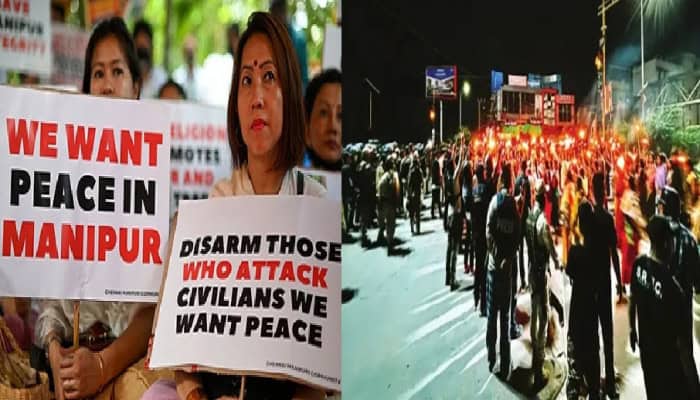
A state can appear stable in an administrative report and still feel like an endless battleground to a family living behind a security buffer, a student cut off from a campus, or a farmer unable to reach a field. That contradiction defines Manipur in July 2026. More than three years after violence erupted on 3 May 2023, the state has passed through mass displacement, communal segregation, armed mobilisation, disrupted highways, changes of government and repeated attempts at dialogue. Yet insecurity has not disappeared, and the language of normalcy remains painfully distant from the experience of many residents.
The crisis is often reduced to a contest between the Meitei and Kuki-Zo communities or to a dispute over Scheduled Tribe status. Both are central to the immediate history, but neither is a complete explanation. Land law, hill-valley governance, competing territorial projects, the legacy of insurgency, arms proliferation, the instability in neighbouring Myanmar, illicit narcotics, uneven development, political mistrust and failures of policing all interact. An academically credible account must hold these factors together without turning any entire ethnic or religious community into a suspect population.
That distinction is not merely ethical; it is operational. Security policy fails when it confuses civilians with militants, refugees with traffickers, customary institutions with armed organisations, or religious identity with criminal responsibility. Manipur requires a firm response to violence and organised crime, but firmness must be evidence-led, community-neutral and bounded by constitutional rights. Collective blame may mobilise anger, yet it cannot produce durable peace.
A shared homeland of many peoples
Manipur is the historic homeland of a remarkably diverse population. The Meiteis are the largest single community and are concentrated principally in the Imphal Valley. Meitei Pangals, or Manipuri Muslims, are also integral to the state’s social history. The surrounding hills are home to numerous communities whose identities cannot be compressed neatly into a few labels. Anal, Angami, Chiru, Chothe, Inpui, Kabui, Lamkang, Liangmei, Mao, Maram, Maring, Monsang, Moyon, Poumei, Rongmei, Sema/Sumi, Tangkhul, Tarao, Thangal and Zeme communities are commonly associated with Naga social or political formations. Gangte, Mate, Paite, Ralte, Simte, Suhte, Thadou and several related groups are commonly associated with Kuki, Zo or cognate formations. Mizo, Hmar and Zou identities retain their own histories, while Aimol, Kharam, Koireng, Kom, Purum and other smaller communities have at times resisted or shifted broader organisational classifications.
These umbrella terms are politically important, but they are not timeless scientific boxes. Clan, village, language, church, customary law, political organisation and self-identification do not always align. Even official nomenclature changes over time. The current Constitution (Scheduled Tribes) Order records 34 entries for Manipur, including several entries that combine related names or use broad formulations such as “Any Kuki tribes.” The Meitei community is not presently included in that list. The legal fact is clear; the political meaning assigned to it remains deeply contested.
The phrase “People of Manipur” therefore has to be more than a ceremonial slogan. It must include valley and hill residents, Scheduled Tribes and non-Scheduled Tribes, long-established communities and lawful newer residents, and people of Sanamahi, Hindu, Christian, Muslim and other traditions. Unity does not require cultural sameness. It requires a shared assurance that no community’s safety, dignity or future depends upon another community’s disappearance.
History is layered, not linear
Manipur’s pre-colonial history included warfare, raids, tribute, competition for resources and fluctuating political authority. It also included trade, military alliances, negotiated access, ritual relationships and long periods of coexistence. Describing the past only as tribal feuding is as misleading as romanticising it as uninterrupted harmony. The central valley kingdom and the many hill societies interacted through both conflict and accommodation, while the frontier with Burma connected the region to wider movements of people and goods.
Colonial rule hardened some distinctions by administering the valley and hills through different institutional arrangements. After the 1949 merger with India and the attainment of statehood in 1972, older differences were incorporated into a new constitutional and electoral order. Insurgent movements developed among valley-based and hill-based constituencies, often advancing incompatible ideas of sovereignty, autonomy or territorial integration. The result was not one continuous war but a succession of overlapping conflicts involving the state, armed organisations and rival community projects.
The Naga-Kuki violence of 1992–1997 and the Kuki-Paite conflict of 1997–1998 demonstrated how territorial claims, control of routes, armed mobilisation and fear could produce severe intra-tribal and inter-community bloodshed. Other episodes, including Meitei-Pangal violence in 1993, showed that no community combination was immune to rupture. These histories matter because trauma can be reactivated by contemporary propaganda. They also matter because earlier conflicts eventually receded through civic pressure, negotiation, security intervention and a recognition that permanent war was intolerable.
Manipur is equally known for classical and folk performance, handloom traditions, indigenous knowledge, polo, boxing, weightlifting, football and a record of sporting excellence far larger than its population would suggest. The state’s cultural life is not a decorative contrast to its security crisis; it is evidence of the dense social capital that violence has damaged and that reconciliation must rebuild. A peace process that treats culture merely as entertainment will miss one of the strongest foundations for a renewed common life.
The hill-valley divide is geographic, legal and psychological
The Imphal Valley contains a high concentration of population, government institutions, educational facilities and economic activity. The hills cover most of the state’s territory but have lower population density, difficult connectivity and distinct customary systems of landholding. Each side can therefore describe itself as disadvantaged: hill communities point to weaker infrastructure and valley-dominated state power, while many Meiteis point to population pressure, limited land and restrictions on access to hill land. These grievances are not mutually exclusive, even though political movements often present them as if only one can be true.
The legal architecture reinforces this difference. The Manipur Land Revenue and Land Reforms Act, 1960 extends to the state except its notified hill areas, while the Manipur (Hill Areas) District Councils Act, 1971 establishes district-level institutions for the hills. Article 371C and the Hill Areas Committee add another protective layer. These arrangements were designed to safeguard distinctive conditions, but gaps in authority, delayed elections, disputed jurisdiction and unequal administrative capacity have also generated frustration.
Land is consequently never just property. It represents ancestry, political representation, control over natural resources, village authority, security and the imagined map of a future homeland. Any reform framed as “equal access” may be read by a protected community as a plan for dispossession; any defence of restriction may be read in the valley as permanent exclusion. A viable settlement must protect tribal land from alienation while addressing genuine valley congestion and creating lawful, negotiated avenues for infrastructure, housing and economic exchange.
Scheduled Tribe status: trigger, symbol and constitutional question
The Meitei demand for Scheduled Tribe recognition combines claims about indigeneity, cultural protection, demographic anxiety and access to constitutional safeguards. Opponents fear that inclusion of a numerically and institutionally influential community would dilute existing reservations and weaken protections over hill land. These are serious claims on both sides, and neither can be resolved through street power or judicial shortcuts.
In March 2023, a Manipur High Court direction asked the state to consider the Meitei petition on an expedited timetable. The order became a powerful symbol in an already charged environment. The Supreme Court later emphasised that courts cannot themselves alter the Scheduled Tribes list, and the High Court removed the contested portion of its direction in February 2024. Under Article 342, inclusion requires a prescribed constitutional process involving evidence, executive scrutiny and legislation by Parliament. The current legal position is therefore neither automatic inclusion nor a prohibition on making the claim; it is a requirement that the claim proceed through the competent institutions.
The Supreme Court’s August 2023 judgment records that large-scale violence followed a Tribal Solidarity March organised on 3 May in opposition to the demand, followed by a Meitei counter-response. That chronology identifies the immediate ignition point; it does not prove that a single legal dispute caused everything that followed. The speed and scale of the escalation reveal that weapons, rumours, accumulated grievances and institutional weakness were already present.
How the 2023 rupture became protracted
The first phase combined mob attacks, arson, killings, sexual violence, destruction of homes and places of worship, and the movement of frightened residents toward areas controlled by their own communities. Police armouries were looted, armed groups and village-defence formations expanded, and security forces created buffer arrangements to prevent direct clashes. Measures intended as emergency protection then helped solidify an ethnic geography in which ordinary people could no longer cross places they had once lived, studied, traded or worked.
The early collapse of impartial law enforcement was decisive. In the material placed before it, the Supreme Court noted 6,523 registered First Information Reports as of 25 July 2023, 150 reported deaths during the initial period, 502 injuries and 5,101 arson cases. Those figures were an early, date-bound snapshot rather than a final total. More important than the numbers was the Court’s finding of serious delays in registering cases, recording statements, conducting medical examinations and making arrests. When victims believe that the police or prosecution system is aligned against them, every security incident becomes evidence for a larger narrative of abandonment.
Gender-based violence became one of the conflict’s most horrifying features. Women’s bodies were used to humiliate communities and circulate terror far beyond the scene of the crime. A rights-based response requires survivor-centred medical care, privacy, witness protection, legal aid, timely investigation and trials insulated from local intimidation. It also requires rejecting the selective outrage that condemns an offence only when the victim belongs to one’s own community.
The conflict is frequently described as “civil-war-like.” That phrase communicates the intensity of armed segregation, but it is not a precise legal classification. Manipur remains within India’s constitutional order, with Union and state institutions, courts, police and security forces continuing to operate. The analytical danger is that the civil-war label can make partition seem inevitable. The lived danger, however, is real: parallel checkpoints, armed territorial control, inaccessible neighbourhoods and mass displacement can create civil-war conditions even without formal belligerent status.
Information disorder has prolonged the crisis. Old images are recirculated as new attacks, casualty claims are inflated or selectively counted, unverified allegations are presented as established conspiracies, and social media accounts reward the most dehumanising interpretation. Each community possesses authentic experiences of victimisation, but authentic pain can still be recruited into inaccurate narratives. Independent verification is therefore not a luxury; it is part of civilian protection.
The human cost cannot be reduced to a statistic
By late 2024, widely reported estimates placed the death toll above 250 and displacement at 60,000 or more. Later totals vary by source and date, which is itself a reason to publish an audited, disaggregated casualty and displacement register. The impact has reached Meitei, Kuki-Zo, Naga and other families in different ways. The decisive fact is that tens of thousands have lost the ordinary security of home, livelihood, school and neighbourhood.
For a displaced family, conflict is measured in details that official summaries rarely capture: documents lost in a burned house, medicines interrupted by a roadblock, a harvest missed, a child studying in a temporary shelter, an elderly person separated from a familiar place of worship, and the humiliation of depending on relief for years. Prolonged camp life can generate malnutrition, preventable illness, gendered insecurity, interrupted education, unemployment and deep psychological distress. Return cannot be defined as transporting people back to an unsafe location; it must restore rights, services and confidence.
The Union Ministry of Home Affairs reported special assistance of ₹247.26 crore in 2023–24 and ₹349.48 crore in 2024–25 for relief camps, temporary shelters, farmer compensation, nutrition, hygiene and rehabilitation. The official relief statement demonstrates substantial expenditure, but expenditure is an input rather than proof of recovery. Evaluation must ask whether families obtained safe housing, title or tenancy restoration, schooling, health care, livelihood support and a meaningful choice among return, local integration and lawful relocation.
The economic effects extend well beyond relief camps. Highway disruption and extortion increase freight costs and consumer prices. Tourism, hospitality and small retail suffer when travel is unsafe. Farmers lose access to fields; construction projects stall; banks become cautious; and young people leave in search of security. Conflict also creates a predatory economy in which armed taxation, smuggling, protection payments and control of scarce transport can become profitable. Ending violence therefore requires dismantling the financial incentives that allow it to reproduce itself.
Border insecurity, migration and the danger of collective accusation
Manipur shares a sensitive international frontier with Myanmar, where conflict since the 2021 military coup has displaced large populations and weakened state control. Cross-border kinship networks long predate modern borders, while contemporary movement can include refugees, family visitors, traders, militants and criminal traffickers. These categories must not be collapsed. A person’s language, tribe or Christian faith is not proof of foreign nationality, and foreign nationality is not proof of militancy.
Unregulated entry, forged documents, weapons trafficking and militant movement are legitimate national-security concerns. The answer is professional border management: biometric and documentary screening under law, interoperable databases, accountable checkpoints, better staffing at official crossings, intelligence cooperation and judicially reviewable procedures. Detection and deportation cannot be delegated to mobs or inferred from surnames. Refugees and vulnerable civilians must receive humanitarian safeguards even while the state investigates identity and security risk.
The Inner Line Permit system, extended to Manipur in December 2019, is intended to regulate entry by Indian citizens from outside the protected area; it is not a substitute for nationality law or border enforcement. Proposals for a state-level population register or an NRC-like exercise would be politically explosive unless they use a clearly legislated cut-off, accessible documentation rules, notice and appeal, legal assistance, data protection and special procedures for people whose papers were destroyed or never formally issued. An error-prone register could deepen statelessness fears and communal profiling without identifying sophisticated criminal networks.
Border fencing can reduce some forms of unauthorised movement, but terrain, village ties and the Myanmar conflict make it only one layer of security. Fencing must be paired with lawful gates, local consultation, compensation, surveillance, road access and bilateral coordination where possible. Proposals for indiscriminate “shoot-at-sight” authority or broad no-settlement zones are incompatible with a rights-based democratic response and risk killing civilians without dismantling trafficking networks. Lethal force must remain necessary, proportionate and accountable.
Narcotics are a real threat, but evidence must govern attribution
Manipur’s proximity to the Golden Triangle makes narcotics a serious concern. The regional pressure is measurable: the UN Office on Drugs and Crime’s World Drug Report 2026 states that opium-poppy cultivation in Myanmar increased in 2025 and had more than doubled since 2020. Within India, the Central Bureau of Narcotics reported destroying 1,825 hectares of illicit opium poppy in Manipur during its 2023 Operation “PRAHAAR.” These facts justify sustained enforcement and financial investigation.
They do not justify attributing the narcotics economy to an entire tribe, church network or migrant population. Drug markets typically connect cultivators, financiers, transporters, corrupt officials, armed protectors and buyers across communal lines. Allegations of institutional collusion require bank records, communications, witness evidence and prosecutable cases. Generalised accusations may allow actual organisers to hide behind ethnic polarisation while innocent civilians bear the stigma.
Crop destruction alone can also be counterproductive when poor farmers have no viable alternative. A durable programme needs geospatial crop monitoring, prosecution focused on financiers and repeat organisers, asset tracing, treatment for people with substance-use disorders, and multi-year livelihood substitution. Coffee, horticulture, bamboo, medicinal plants, livestock, forest produce and food processing can work only when farmers receive secure market access, credit, extension services, crop insurance and protection from armed coercion. Environmental restoration should address deforestation, soil erosion, polluted water and damaged watersheds without presuming communal guilt.
Manipur’s strategic value raises the cost of instability
Manipur is not peripheral to India’s future engagement with Southeast Asia. Moreh sits on the route of the India–Myanmar–Thailand Trilateral Highway, and NH-102 links Imphal to the international border. A June 2026 Government of India overview of the Act East Policy again identified the Moreh-to-Mae Sot corridor as a flagship connectivity project. When Manipur’s highways are insecure, the damage affects local food prices and mobility immediately, but it also weakens India’s wider trade, tourism and diplomatic ambitions.
Strategic importance should not, however, turn residents into instruments of a corridor. Connectivity succeeds only when local communities gain employment, logistics services, border markets, skills, digital access and reliable public infrastructure. A highway guarded by troops but disconnected from local prosperity can intensify competition over rents and checkpoints. The peace dividend must therefore be visible in both hill and valley economies.
Political transition did not automatically end the conflict
President’s Rule was imposed in February 2025 after the resignation of Chief Minister N. Biren Singh. It was revoked on 4 February 2026, when Yumnam Khemchand Singh was sworn in as chief minister and an elected government returned. The official public-broadcast report records that transition. The restoration of elected government was institutionally important, but constitutional form by itself could not erase armed separation or accumulated mistrust.
Dialogue resumed cautiously. In March 2026, the chief minister described talks with the Kuki-Zo Council as a first step toward bridging the trust deficit, and later outreach included Naga representatives and conflict-affected villages. These contacts matter because a political process cannot be built entirely through intermediaries or security agencies. Yet later violence showed the fragility of progress. By June 2026, Amnesty International reported unresolved hostage-taking, Kuki-Naga tension and highway disruption in the hill districts. The crisis had demonstrated an ability to mutate beyond its original Meitei–Kuki-Zo axis.
This development carries a clear warning. Tactical alignment between communities cannot be mistaken for reconciliation, and hostility toward a third group cannot create stable unity between two others. Every hostage must be released unconditionally. No civic organisation or armed formation should be permitted to use civilians, roads, food or medical access as bargaining instruments.
A constitutional road map for lasting peace
No single measure—military operations, border fencing, Scheduled Tribe recognition, separate administration, land-law amendment or economic aid—can resolve Manipur. A workable strategy must be sequenced across immediate security, justice, humanitarian recovery, political negotiation and long-term institutional reform. It must also be judged by outcomes experienced by civilians rather than announcements made by governments or armed organisations.
1. Establish neutral civilian security. Security forces should protect vulnerable settlements and transport corridors under a unified command structure with published areas of responsibility. Operations must target unlawful weapons and violent actors across all communities. Armoury audits, ballistic tracing, time-bound surrender windows, compensation for lawful information and prosecution for continued possession can support disarmament. Community defence cannot become a permanent parallel police system.
2. Reopen highways and dismantle the conflict economy. National highways and essential-service routes must remain free from blockades, extortion and unauthorised taxation. Convoy protection may be necessary temporarily, but the durable solution is reliable policing, electronic freight tracking, complaint channels for drivers and financial investigations into those collecting or laundering illegal levies. Humanitarian access must never depend upon ethnic permission.
3. Make justice visible and even-handed. Cases involving murder, sexual violence, arson, abduction, torture, destruction of places of worship and theft of arms require specialised investigation teams insulated from local pressure. A public dashboard can report cases registered, charge sheets filed, trials begun and compensation delivered without exposing survivors. Witness relocation, translation, video testimony and trials outside a threatened district may be necessary. Accountability must reach organisers, financiers and negligent officials, not only easily arrested foot soldiers.
4. Guarantee safe, voluntary and dignified solutions for displaced people. Every displaced household should receive documented housing and property claims, replacement identity papers, school continuity, health coverage and livelihood assistance. Return must follow independent security assessment and consultation with both returnees and receiving communities. Where return is not yet safe, families should have meaningful options for temporary local integration or consensual relocation without losing title, compensation or the right to return later.
5. Create an inclusive political negotiation. A standing, professionally mediated forum should include elected representatives, recognised Meitei, Kuki-Zo and Naga bodies, smaller tribes, Meitei Pangals, women’s organisations, displaced people, youth, business groups and local-government institutions. It should separate negotiable subjects—security, mobility, rehabilitation, local autonomy, development and land administration—rather than forcing every dispute into an all-or-nothing argument over territorial division.
6. Refer land, representation and Scheduled Tribe questions to credible institutions. A multidisciplinary commission should map the actual operation of land laws, customary tenure, demographic pressure, district-council capacity and development gaps. Any proposal affecting the Scheduled Tribes list must follow Article 342 and assess cultural distinctiveness, socio-economic evidence and the effect on existing beneficiaries. Any land reform must include anti-alienation safeguards, transparent records, community consent and accessible dispute resolution. Constitutional claims should be decided through evidence, not as rewards or punishments in a conflict.
7. Reform customary and local governance through consultation. Concerns about hereditary chieftainship, village creation, individual rights and land concentration deserve examination, but abolition imposed on one community would be read as collective subjugation. Reform should be co-designed with affected villages, women, tenants, landless residents and customary leaders. Democratic auditing, written records, term limits where appropriate, appeal mechanisms and protection of legitimate customary autonomy can coexist.
8. Review ceasefire and Suspension of Operations arrangements transparently. Agreements with armed groups should contain verified cadre lists, geofenced camps, weapon inventories, movement rules, independent inspection, financial audits and automatic consequences for violations. Abrogation may appear decisive, but an unmanaged collapse can release armed cadres without monitoring. Renewal without enforcement is equally dangerous. The standard must be measurable reduction of civilian harm and movement toward demobilisation.
9. Combine border enforcement with humanitarian law and local knowledge. The state should complete priority fencing and surveillance where technically useful, strengthen legal crossings and document verification, and investigate forged papers through specialised units. Local residents can provide intelligence, but ethnicity cannot become an evidentiary shortcut. Procedures for refugees, trafficking victims, children and people with disputed nationality must include screening, care and review.
10. Replace narcotics income with lawful opportunity. Enforcement should follow money upward toward financiers and corrupt protection rather than concentrating punishment on poor cultivators. Alternative-crop programmes need guaranteed procurement, transport, processing, credit and a transition income. Community-based addiction treatment and youth employment should accompany crop monitoring. Success should be measured by sustained reductions in cultivation and trafficking, not only hectares destroyed in a single season.
11. Rebuild education, health and mental well-being. Students need safe transport, bridge courses, transferable records, scholarships and examination centres accessible across conflict lines. Health systems require mobile clinics, referral corridors and uninterrupted medicine supply. Trauma care should be culturally and linguistically appropriate, with particular attention to survivors of sexual violence, bereaved children, former child recruits, frontline workers and families living in camps.
12. Build an information-integrity system. A multilingual verification centre involving professional journalists, universities, civil-society monitors and government data officers could rapidly assess viral claims. Authorities should publish incident logs, corrections, missing-person information and relief data in accessible formats. Prosecution should focus on direct incitement, threats and coordinated fabrication, while legitimate criticism and documentation remain protected.
13. Make cultural and religious institutions partners in peace. Temples, churches, Sanamahi institutions, mosques and community halls should never be treated as legitimate targets or presumed fronts for militancy. Religious and cultural leaders can jointly condemn attacks, verify local rumours, support displaced families and organise memorial practices that recognise victims across community lines. India’s dharmic traditions teach plural paths and restraint, but their public value is realised only when that generosity extends to neighbours of every faith. Coexistence cannot be built by replacing one supremacy with another.
14. Design an economic peace dividend. Reconstruction contracts, road work, border logistics, handloom clusters, sports facilities, tourism and agro-processing should employ mixed-community teams where security permits. Transparent district-wise spending can reduce perceptions of favouritism. Special support is needed for women-led markets, small traders, farmers and artisans whose networks once crossed the present lines of separation. The goal is not merely to restore the pre-2023 economy, but to create incentives for cooperation stronger than the profits of blockade and extortion.
Measuring whether peace is real
A peace process should publish quarterly benchmarks: civilian deaths and injuries; abductions and unresolved missing-person cases; weapons surrendered or recovered; highway closure hours; extortion complaints; displaced households safely returned or resettled; schools and health centres fully operating; compensation and property claims resolved; prosecutions completed; hectares shifting from illicit to lawful crops; and the number of voluntary inter-community journeys restored. Data should be independently audited and disaggregated without being used to stigmatise a community.
The most meaningful indicator will be freedom of ordinary movement. Peace becomes credible when a student can attend a college outside an ethnic enclave, a patient can reach the nearest hospital, a trader can cross a district without paying an armed levy, and a displaced family can inspect a home without an escort. Elections, festivals and official visits are positive signals, but they cannot substitute for these everyday freedoms.
From interminable battleground to shared future
Manipur has suffered a profound failure of security and political trust, but it should not be described as a people incapable of coexistence. Such fatalism erases long histories of exchange and makes armed separation appear natural. Nor should the conflict be narrated as a civilisational struggle between a righteous community and alien enemies. Militants, traffickers, corrupt officials and inciters must be confronted as responsible actors; communities must be engaged as rights-bearing citizens.
Lasting peace will require both strength and restraint: strength to disarm unlawful formations, secure borders, reopen roads and prosecute grave crimes; restraint to reject collective punishment, fabricated certainty and revenge. It will require constitutional patience on Scheduled Tribe status, land and autonomy, but urgency on hostage release, relief, justice and civilian protection. Above all, it will require every institution to recognise that the dignity of a Meitei, Kuki-Zo, Naga, Pangal or smaller tribal community is not a concession granted by another group.
Manipur’s future depends on transforming a shared territory into a shared political home. That work is slower than a military operation and less dramatic than a slogan, yet it is the only route out of an interminable battleground. Security can stop an attack; justice can limit impunity; development can reduce predatory incentives; and sustained dialogue can make coexistence imaginable again. None is sufficient alone. Together, they offer a realistic path from armed separation toward a durable and honourable peace.
Research context: This analysis expands and critically reframes the concerns raised in “Manipur: The Interminable Battleground,” published on 9 July 2026, using court records, legislation, government releases and current human-rights reporting. Contentious allegations have been treated as claims requiring evidence rather than as established facts.
Inspired by this post on Hindu Post.







Leave a Reply
You must be logged in to post a comment.