
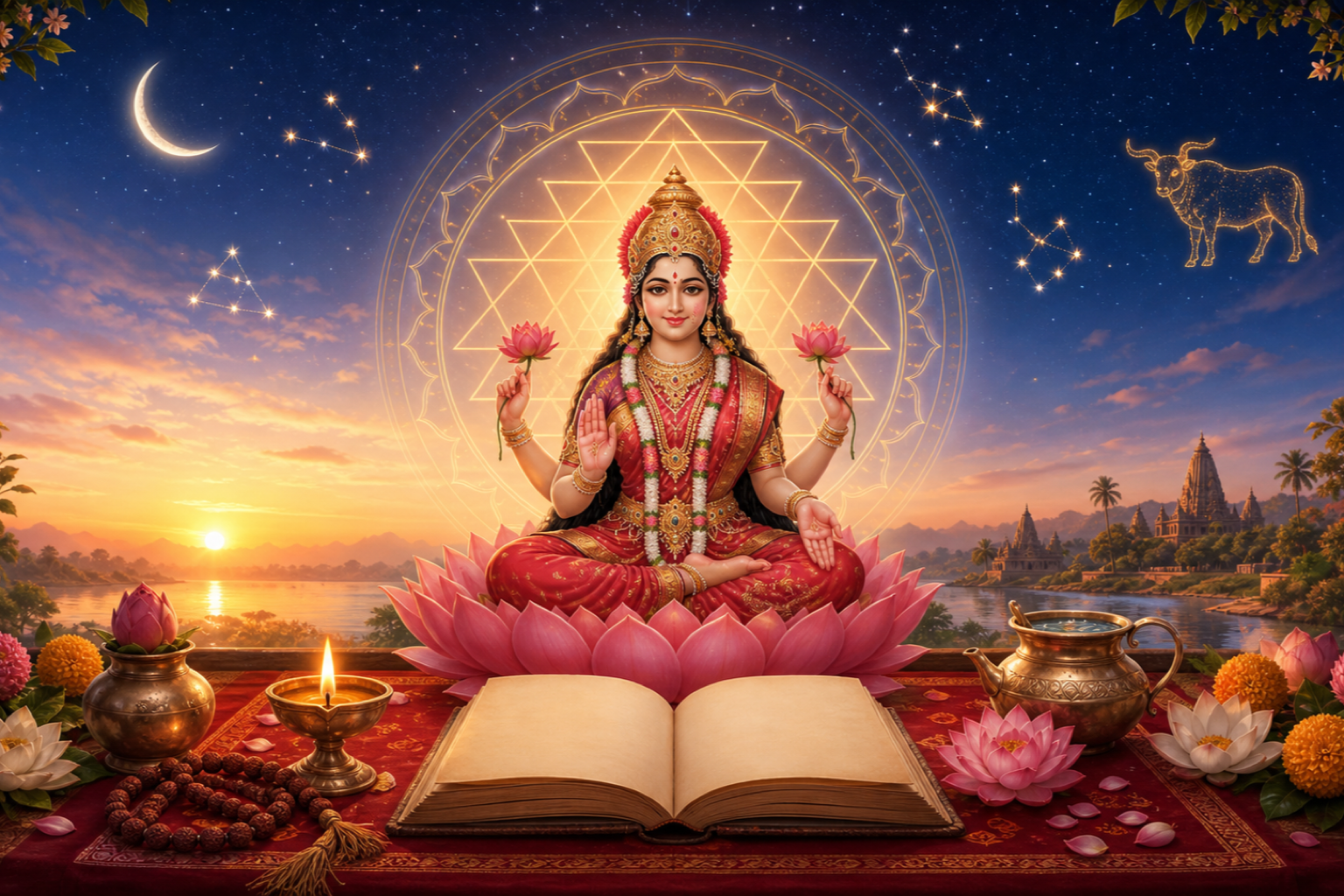
Vrishabha Rashi Stotram: purpose, sacred text, meaning, and daily practice
Vrishabha Rashi Stotram is presented in contemporary Hindu devotional astrology as a Nitya Parayana stotram, or daily prayer, for people whose birth Moon occupies Vrishabha Rashi. Vrishabha is commonly rendered as Taurus in English and is the second of the twelve rashi divisions used in Jyotisha. The prayer invokes the Divine Mother through names associated with Lalita, Parvathi, Shambhavi, Sharwani, and Narayani, placing its spiritual emphasis on devotion, compassion, protection from fear, moral clarity, and liberation from bondage.
The transmitted tradition states that regular recitation may help a devotee feel less burdened by sorrow and may pacify adverse astrological influences. Such benefits belong to the language of faith, sadhana, and lived religious experience; they are not scientifically established guarantees. The geometrical structure of the rashi and nakshatra system can be described precisely, while claims about destiny and astrological remedies should be understood as traditional interpretations.
This guide preserves the prayer exactly as it appears on the detailed Vrishabha Rashi Stotram source page. Promotional material, commercial horoscope offers, tracking images, and unrelated comments have been omitted. Explanations have been added to clarify the astronomical framework, textual background, devotional meaning, pronunciation, and responsible method of recitation.
What Vrishabha Rashi means in Hindu astrology
A rashi is a 30-degree division of the zodiacal belt. Twelve equal rashis therefore complete the 360-degree ecliptic. Vrishabha Rashi occupies the second 30-degree segment of the standard sidereal zodiac and corresponds broadly to Taurus. Its Sanskrit name evokes the bull, a long-standing symbol of steadiness, strength, cultivation, patience, and material support. These are symbolic associations rather than fixed psychological descriptions of every person born under the sign.
The phrase “Taurus native” can create confusion when Western and Indian astrology are treated as identical. Popular Western horoscopes usually identify a person through the tropical Sun sign. In many Jyotisha contexts, however, “Vrishabha Rashi native” refers to the sidereal sign occupied by the Moon at birth, also called the Chandra Rashi. A person with a tropical Taurus Sun does not automatically have a Vrishabha Moon, and a person with a Vrishabha Moon may have a different tropical Sun sign.
An accurate identification normally requires the birth date, time, and place, followed by a calculation using a recognized sidereal ayanamsha. Different Jyotisha schools may select different ayanamshas, so a Moon positioned very close to a boundary deserves careful verification. A family panchanga, a properly calculated birth chart, or a qualified practitioner can help resolve uncertainty.
The technical relationship between rashi, nakshatra, and pada
The commonly used nakshatra system divides the ecliptic into 27 lunar mansions. Each nakshatra covers 13 degrees and 20 minutes, and each is subdivided into four padas of 3 degrees and 20 minutes. The resulting 108 padas fit exactly into the twelve rashis. Because a rashi contains 30 degrees, each rashi encompasses two complete nakshatras and one additional quarter of a nakshatra on average.
Krittika Nakshatram: Only padas 2, 3, and 4 fall in Vrishabha, covering 0°00′ through 10°00′ of the sign. Krittika pada 1 lies in the closing portion of Mesha Rashi. Consequently, not every person born under Krittika Nakshatram belongs to Vrishabha Rashi.
Rohini Nakshatram: All four padas fall within Vrishabha, extending from 10°00′ to 23°20′. Rohini is therefore the only complete nakshatra contained in this rashi.
Mrigasira Nakshatram: Only padas 1 and 2 occupy Vrishabha, spanning 23°20′ through 30°00′. Padas 3 and 4 belong to Mithuna Rashi. The spellings Mrigasira, Mrigashira, and Mrigashirsha reflect regional and transliteration differences, but they refer to the same nakshatra.
This arrangement explains the source statement that part of Krittika Nakshatram, all of Rohini Nakshatram, and part of Mrigasira Nakshatram are associated with Vrishabha Rashi. It is a mathematical consequence of placing the twelve 30-degree rashis over the twenty-seven 13°20′ nakshatras. A general introduction to the distinction between the twelve rashis and twenty-seven lunar mansions is available in Hindu Astrology’s Lunar Mansions.
What Nitya Parayana signifies
Nitya Parayana denotes regular, often daily, devotional recitation. Its purpose is not merely to complete a prescribed quantity of words. Parayana joins vocal discipline, remembrance, contemplation, and reverence. A brief prayer repeated attentively can become a stable point in the day, especially when uncertainty, grief, or mental agitation makes sustained concentration difficult.
No universal Hindu authority imposes one mandatory rashi stotram, time of day, or repetition count on every practitioner. The present prayer represents a transmitted devotional association with Vrishabha Rashi. Family custom, sampradaya, temple practice, and guidance received from a guru may prescribe a different form of worship. Such differences should be approached as expressions of Hindu plurality rather than as reasons for sectarian dispute.
Textual and theological background
The source presents two related liturgical units. The first is identified as the Vrishabha Rashi Stotram. Its opening invokes the Goddess with sacred seed syllables, and its central lines arrange a series of Divine Mother epithets found in the Lalita Sahasranama tradition. Its concluding stanza corresponds to verse 11.11 of the Devi Mahatmya’s Narayani praise, where the Goddess is revered as the eternal power behind creation, preservation, and dissolution.
The second unit is a namavali of twenty invocations explicitly presented as a selection from the Lalita Sahasranama Stotram. A sahasranama is a litany of one thousand names, while a namavali recites selected names individually, usually with Om and Namaha. The label “Vrishabha Rashi Stotram” therefore describes a later devotional arrangement of established Goddess names; it should not be mistaken for a separate Vedic Samhita or an astronomical formula.
The Divine Mother is addressed through Shaiva, Shakta, and Vaishnava theological vocabulary. Shambhavi, Sharwani, and Parvathi connect the hymn with Shiva; Lalita and the Sri Chakra locate it within Sri Vidya and Shakta devotion; Narayani expresses the Goddess as universal divine power associated with Narayana. Rather than enforcing a narrow sectarian identity, these names illustrate the interconnected language through which Hindu traditions frequently contemplate the sacred.
Complete Vrishabha Rashi Stotram
Om eim hreem shreem akulayai namaha
Bhaktipriya bhaktigamya bhaktivashya bhayapahaa !
Shambhavi sharadaradhya sharwani sharmadayini !!
Dushtadoora duraachaarashamani doshavarjitha !
Sarvagna sandrakaruna samanadhika varjitha !!
Charaachara jagannatha chakraraja nikethana !
Parvathi padmanayana padmaraga samaprabha !!
Srushtisthithi vinashanaam shaktibhoothe sanathani !
Gunaashraye gunamaye Narayani namosthuthe !!
Meaning of the opening invocation
“Om eim hreem shreem akulayai namaha” begins with Om and three bija-like sacred syllables. Such syllables function as condensed sonic symbols in mantra traditions and are not adequately translated as ordinary vocabulary. Eim is commonly associated with knowledge and sacred speech, hreem with the power of the Divine Mother and inward transformation, and shreem with auspiciousness, beauty, and abundance. These associations vary by lineage and should not be reduced to mechanical promises.
Akula can signify the transcendent principle beyond the manifest aggregate described as kula, although Shakta and Tantric commentaries develop the term in more specialized ways. The closing expression namaha establishes an attitude of reverence, surrender, and freedom from possessiveness. The invocation consequently prepares the practitioner to approach the hymn as an offering rather than as a transaction with the divine.
Thematic meaning of the principal stotram
“Bhaktipriya bhaktigamya bhaktivashya bhayapahaa” praises the Goddess as one who loves devotion, is approached through devotion, responds to sincere devotion, and removes fear. The sequence places bhakti above social status, intellectual display, or elaborate ritual possession. Its emotional center is accessibility: a devotee who feels vulnerable is invited to approach through sincerity.
“Shambhavi sharadaradhya sharwani sharmadayini” invokes the Goddess as Shambhavi and Sharwani, names connected with Shiva, as one worshipped by Sharada, and as the giver of well-being. The line brings together power, wisdom, and benevolence. It suggests that spiritual strength is not mere force but a force guided by knowledge and directed toward welfare.
“Dushtadoora duraachaarashamani doshavarjitha” describes the Divine Mother as remote from wickedness, as one who calms harmful conduct, and as free from defect. Read ethically, this is not an invitation to condemn other people. It directs attention toward the practitioner’s own dishonesty, cruelty, negligence, or undisciplined habit and asks that such tendencies be pacified.
“Sarvagna sandrakaruna samanadhika varjitha” praises omniscience, concentrated compassion, and incomparable sovereignty. The important conjunction is knowledge with compassion. Knowledge without empathy can become cold, while compassion without discernment may become ineffective. The Goddess is contemplated as the fullness in which both qualities are inseparable.
“Charaachara jagannatha chakraraja nikethana” venerates the Goddess as sovereign of everything moving and unmoving and as the indwelling presence of the supreme sacred diagram, commonly understood as the Sri Chakra. Chara and achara together encompass living beings, apparently stationary forms, and the whole field of manifestation. The Sri Chakra reference shifts the vision from an external deity alone toward a sacred order permeating cosmos, body, and consciousness.
“Parvathi padmanayana padmaraga samaprabha” identifies the Goddess as Parvathi, lotus-eyed, and radiant like the red padmaraga gemstone. The lotus suggests beauty and purity that remain possible amid difficult conditions. The gemstone image conveys luminosity and concentrated presence rather than a promise of material wealth.
“Srushtisthithi vinashanaam shaktibhoothe sanathani” and “Gunaashraye gunamaye Narayani namosthuthe” salute Narayani as the eternal power of creation, maintenance, and dissolution and as both the ground and embodiment of qualities. The stanza widens the prayer beyond a personal horoscope. Birth, continuity, change, and ending are understood as dimensions of one sacred reality. A transliterated edition of the Devi Mahatmyam identifies this passage as chapter 11, verse 11.
These explanations are thematic glosses rather than a critical Sanskrit translation. The source uses an accessible Roman transliteration without standardized diacritical marks, and several words can carry layered philosophical meanings. A practitioner seeking precise grammar or lineage-specific interpretation should consult the Sanskrit text and a competent teacher.
Vrishabha Rashi namavali from Lalita Sahasranama Stotram
Om Sahasrasheersha vadanayai Namaha
Om Abrahmakeeta jananyai Namaha
Om Varnashrama vidhayinyai Namaha
Om Nijagnarupa nigamayai Namaha
Om punyapunya phala pradayai Namaha
Om Haribrahmendra sevitayai Namaha
Om namarupa vivarjitayai Namaha
Om Heyopadeya varjitayai Namaha
Om Ranatkinkini mekalayai Namaha
Om Kadamba kusuma priyayai Namaha
Om Karunarasa sagarayai Namaha
Om Varunimada vihwalayai Namaha
Om Vindhyachala nivasinyai Namaha
Om Kshetra Kshetragna palinyai Namaha
Om Kshayavruddhi vinirmuktayai Namaha
Om Kshetrapala samarchitayai Namaha
Om Vandarujana vatsalayai Namaha
Om Vahnimandala vasinyai Namaha
Om Bhaktimatkalpa lathikayai Namaha
Om Pashupasha vimochinyai Namaha
How the namavali is grammatically structured
Each invocation begins with Om and ends with Namaha. The name between them generally appears in a feminine dative form, often represented by the ending “yai” in this transliteration. The practical sense is “salutations to her who is…” followed by a divine quality. Namavali recitation therefore moves through a sequence of contemplative attributes rather than presenting a continuous narrative.
Names 1–5: cosmic motherhood, sacred order, and moral consequence. Sahasrasheersha vadanayai presents the Goddess with a thousand heads and faces, symbolizing presence through innumerable beings. Abrahmakeeta jananyai identifies her as mother of all, from Brahma to the smallest creature. Varnashrama vidhayinyai refers to the ordering of duties and stages of life within classical dharmic thought. Nijagnarupa nigamayai associates sacred revelation with her own command, while punyapunya phala pradayai presents her as the giver of consequences arising from meritorious and unmeritorious action.
Varnashrama vidhayinyai belongs to a historical theological vocabulary that has received different interpretations across schools and periods. Its recitation should never be used to justify humiliation, inherited superiority, exclusion, or denial of equal human dignity. An ethically responsible reading emphasizes disciplined duty, stages of life, accountability, and social responsibility while rejecting discrimination.
Names 6–10: transcendence joined with sacred beauty. Haribrahmendra sevitayai describes the Goddess as worshipped by Hari, Brahma, and Indra. Namarupa vivarjitayai places ultimate reality beyond limiting name and form. Heyopadeya varjitayai indicates what is beyond rejection and acquisition. Ranatkinkini mekalayai evokes a girdle of sounding bells, and Kadamba kusuma priyayai celebrates her delight in kadamba flowers. Transcendence is therefore not separated from embodied beauty, sound, fragrance, and ritual imagination.
Names 11–15: compassion, sacred presence, and freedom from change. Karunarasa sagarayai praises an ocean of compassion. Varunimada vihwalayai is often interpreted through the image of divine exhilaration associated with Varuni, although its esoteric significance varies by commentary. Vindhyachala nivasinyai locates the Goddess in the Vindhya mountains. Kshetra Kshetragna palinyai invokes her as protector of both the field and the knower of the field, while Kshayavruddhi vinirmuktayai describes her as free from decrease and increase.
Names 16–20: guardianship, devotion, fire, and liberation. Kshetrapala samarchitayai describes the Goddess as worshipped by guardian powers. Vandarujana vatsalayai emphasizes tenderness toward those who bow in reverence. Vahnimandala vasinyai places her within the circle of sacred fire. Bhaktimatkalpa lathikayai compares her grace to a wish-fulfilling vine for the devoted, and Pashupasha vimochinyai praises her as the liberator of the bound being from bondage.
In Shaiva and Shakta philosophical language, pashu can signify the individual consciousness limited by ignorance, while pasha signifies the bonds that constrain it. The final name is therefore more profound than a literal image of releasing an animal from a rope. It points toward freedom from ignorance, possessiveness, fear, and misidentification. A Sanskrit text of the larger hymn can be consulted through the Sri Lalita Sahasranama archive edition.
Pronunciation and textual fidelity
The preserved text uses popular English transliteration rather than the International Alphabet of Sanskrit Transliteration. It does not consistently distinguish sounds represented in scholarly editions by ś, ṣ, ṛ, ṭ, ḍ, ṇ, or ḥ. This does not make the text unusable, but it limits the precision available from spelling alone. Regional recitation styles may also produce legitimate differences in vowel length and consonant articulation.
As a general aid, “aa” indicates a longer vowel, while combinations such as bh, dh, kh, and th normally represent aspirated consonants rather than the English sounds in “this” or “thin.” The syllable r is commonly tapped rather than heavily prolonged. Namaha corresponds to a form often written namaḥ in standardized Sanskrit, but the supplied wording should remain unchanged when following this version.
Eim, hreem, and shreem are sacred syllables, not ordinary lexical words. Some Shakta and mantra lineages require initiation or direct guidance for specific bija practices, while other communities publicly recite stotras containing them. No universal ruling should be imposed across all sampradayas. A practitioner with lineage-based concerns should follow a trusted guru, family tradition, or temple authority rather than relying on an improvised pronunciation guide.
Accuracy should be pursued without anxiety. Careful listening, modest pacing, and gradual correction are more constructive than fear of divine punishment for an honest mistake. A beginner who cannot yet chant fluently may first read the prayer slowly, learn one line at a time, and study its meaning. Devotion and disciplined learning can develop together.
A practical daily recitation method
Confirm the intended astrological association. A practitioner using the hymn specifically as a Vrishabha Rashi prayer should verify the sidereal Moon sign and nakshatra pada. Krittika padas 2–4, all four Rohini padas, and Mrigasira padas 1–2 qualify under the standard mapping. The prayer may still be approached devotionally by others, subject to the customs of their tradition.
Select a sustainable time. Morning after bathing or evening before rest are common choices, but the source prescribes no compulsory hour. Regularity matters more than choosing an elaborate time that cannot be maintained. A short, attentive recitation performed consistently is preferable to an exhausting routine undertaken through fear.
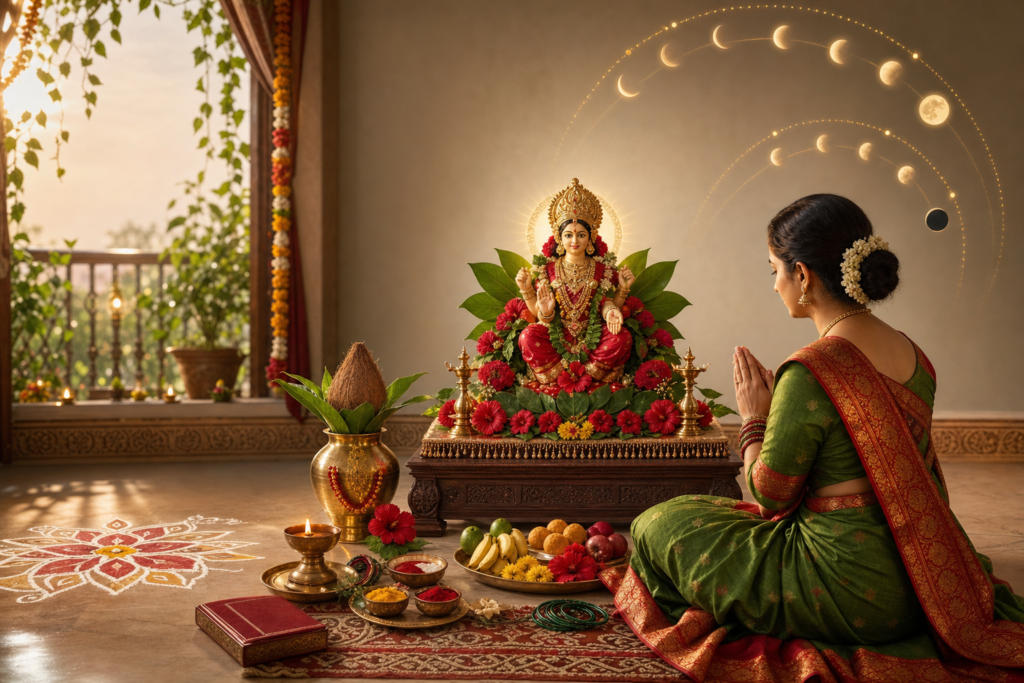
Prepare a simple, safe space. The practitioner may sit in a clean and quiet place before an image or symbol of the Divine Mother. A flower, water offering, or safely placed lamp may be used according to household custom, but none should be presented as a universal requirement. The body can remain upright and relaxed, with natural breathing and minimal distraction.
Establish a clear intention. A brief sankalpa may dedicate the recitation to clarity, courage, ethical conduct, family welfare, or peace for all beings. An intention framed around inner steadiness is generally healthier than an anxious demand for guaranteed control over an uncertain event. Prayer can accompany responsible action rather than replace it.
Recite without rushing. The opening invocation may be followed by the eight lines of the principal stotram and then the twenty-name namavali. The source does not specify 11, 21, or 108 repetitions, so such counts should not be invented as mandatory rules. One careful recitation is a coherent daily practice unless a recognized tradition gives different guidance.
Reflect on one quality. After recitation, the practitioner may contemplate compassion, fearlessness, moral correction, sacred order, or liberation from bondage. This step turns the prayer from vocal repetition into ethical sadhana. For example, contemplation of Karunarasa sagarayai can be followed by one concrete act of patience or kindness during the day.
Close with silence and dedication. A minute of quiet allows the rhythm of the recitation to settle. Its merit may then be dedicated to family, community, teachers, ancestors, or the welfare of all beings. If a day is missed, the practice can simply resume without guilt, superstition, or fear of retaliation.
Traditional benefits and responsible expectations
The source attributes two principal benefits to the Vrishabha Rashi Nitya Parayana stotram: relief from the felt burden of sorrow and pacification of some adverse influences. Within Jyotisha, such prayer may be understood as shanti or upasana—a devotional means of cultivating harmony, grace, and a more stable response to circumstances. It should not be interpreted as a contractual guarantee that every difficulty will disappear.
Repetition can also have ordinary human value independent of astrological claims. A familiar prayer organizes attention, slows hurried speech, creates a dependable routine, and gives emotionally meaningful language to fear and hope. A person carrying grief may experience the daily return to sacred words as an anchor. Such an experience is significant without proving that a mantra directly changed an external planetary influence.
The most durable benefits are likely to appear when recitation supports ethical and practical conduct. Prayer for freedom from fear can accompany a difficult but necessary conversation. Prayer for correction of harmful conduct can accompany apology and restitution. Prayer for compassion can accompany service. Spiritual discipline becomes more credible when its values become visible in conduct.
The stotram should not replace medical care, mental-health support, legal advice, financial planning, or appropriate action during danger. It should also not be used to frighten a person with claims of unavoidable dosha, expensive remedies, or guaranteed misfortune. A responsible practice reduces fear and exploitation rather than intensifying them.
Common misunderstandings to avoid
Confusing the Sun sign with the Moon sign: A Western Taurus horoscope does not by itself establish Vrishabha Rashi in the Jyotisha sense. The intended association normally depends on the sidereal Moon.
Assigning all of Krittika or Mrigasira to Vrishabha: Only Krittika padas 2–4 and Mrigasira padas 1–2 lie in this rashi. Rohini alone is entirely contained within Vrishabha.
Treating the prayer as a guaranteed remedy: The traditional language of pacification expresses religious hope and trust. It does not establish a measurable promise that every adverse event will be prevented.
Inventing mandatory repetition counts: The detailed source supplies the text but does not prescribe a universal numerical count. A specific count should come from an identifiable tradition rather than from internet repetition.
Ignoring textual context: The prayer draws upon Lalita Sahasranama names and the Narayani praise of the Devi Mahatmya. Understanding this Goddess-centered context is more accurate than treating the words as a generic Taurus affirmation.
Using astrology to define character rigidly: No rashi or nakshatra can exhaust the complexity of a person. Even within Jyotisha, interpretation considers a complete chart rather than one sign alone. Outside astrology, personality and life outcomes are influenced by family, culture, choices, education, health, opportunity, and many other factors.
Dharmic unity without erasing distinct traditions
This stotram belongs specifically to Hindu Goddess devotion and should be identified honestly as such. Buddhism, Jainism, and Sikhism possess their own scriptures, contemplative disciplines, ethical vocabularies, and forms of sacred recitation. Respectful unity does not require presenting these traditions as interchangeable. It requires accurate representation, freedom of practice, mutual dignity, and rejection of hostility.
Within Hinduism itself, the names Shambhavi, Parvathi, Lalita, and Narayani demonstrate how Shaiva, Shakta, and Vaishnava symbols can coexist in one devotional field. The prayer can therefore encourage an inclusive disposition: the chosen form of worship may be cherished deeply without demeaning another person’s path. Devotion becomes a basis for compassion rather than a contest for superiority.
Frequently asked questions
Is Vrishabha Rashi exactly the same as the Western Taurus sign? The names correspond at the level of the twelve-sign sequence, but the systems usually employ different reference points. Jyotisha commonly uses a sidereal zodiac, while modern Western astrology commonly uses a tropical zodiac. The relevant planet may also differ: this prayer is generally associated with the Moon sign rather than a newspaper-style Sun sign.
Who falls under Vrishabha Rashi for this prayer? Under the standard nakshatra mapping, the group includes people with the Moon in Krittika padas 2–4, Rohini padas 1–4, or Mrigasira padas 1–2. A boundary position should be checked through an accurately calculated chart.
Why does the guide contain two prayer sections? The source first supplies a compact Vrishabha Rashi Stotram and then a separate twenty-name namavali identified with Lalita Sahasranama Stotram. They can be recited consecutively, although the source does not declare a universal rule about how they must be combined.
Can someone outside Vrishabha Rashi recite it? The rashi association identifies the intended devotional use, but the underlying names praise the universal Divine Mother. Many stotras are recited beyond astrological boundaries. Where initiation, bija syllables, or lineage discipline is relevant, the practitioner should follow competent traditional guidance.
Must the prayer be chanted every day? Nitya Parayana favors regular practice, but the source does not threaten punishment for a missed day. A sustainable rhythm grounded in devotion is preferable to compulsive recitation driven by fear.
What happens if the pronunciation is imperfect? Honest errors can be corrected through study and listening. The preserved Roman spelling is only an aid and cannot represent every Sanskrit sound precisely. A careful pace, humility, and guidance from a knowledgeable reciter are appropriate.
Does the stotram guarantee wealth, marriage, health, or removal of every dosha? No such guarantee is supported by the supplied text. The traditional claim is limited to devotional relief from sorrow and pacification of some adverse effects. Responsible recitation should cultivate courage and discernment while remaining compatible with practical action.
A balanced conclusion
Vrishabha Rashi Stotram is best approached as a disciplined Goddess prayer situated at the meeting point of Jyotisha, Lalita devotion, and the Narayani theology of the Devi Mahatmya. Its astrological setting can be stated precisely: Vrishabha contains Krittika padas 2–4, all of Rohini, and Mrigasira padas 1–2. Its spiritual setting is broader, directing attention toward devotion, fearlessness, compassion, ethical correction, cosmic change, and release from bondage.
For a practitioner, the deepest value need not depend on dramatic predictions. A few minutes of careful recitation can create a recurring space for humility and reflection. When the words praising compassion lead to compassionate conduct, when prayer for fearlessness supports responsible action, and when reverence for one form of the divine strengthens respect for other paths, Nitya Parayana becomes more than repetition: it becomes a lived spiritual discipline.
Inspired by this post on Hindu Pad.








Leave a Reply
You must be logged in to post a comment.