

Monday, 3 August 2026 is the first Shravan Somvar in the Purnimanta calendars commonly followed across much of North India. It is not, however, the first Shravan Monday in every regional calendar. Marathi, Gujarati, Telugu and Kannada traditions generally begin their 2026 Shravan Somvar observances on Monday, 17 August, while the first Monday of the solar Saun month in the Nepali calendar falls on 20 July. These dates are not competing answers. Each belongs to a legitimate system of Indian timekeeping, and understanding those systems turns an apparently confusing calendar question into a clear example of regional diversity within Hindu tradition.
Key dates at a glance. For Purnimanta North Indian calendars, Shravan runs from 30 July to 28 August 2026, and the four Shravan Somvar vrat dates are 3, 10, 17 and 24 August. For Amanta or Amavasyanta calendars used in much of western and southern India, Shravan runs from 13 August to 11 September, and the Mondays are 17, 24 and 31 August and 7 September. Under the solar calendar observed in Nepal and some Himalayan communities, the four relevant Mondays are 20 and 27 July and 3 and 10 August.
Why several spellings appear. Shravan, Shravana, Sawan, Saavan and Sravana are regional or transliterated forms of the same month name. Somvar and Somwar likewise refer to Monday. Consequently, searches for the first Sawan Somwar 2026, first Shravan Somvar 2026 or first Sravana Somavaram 2026 may lead to different-looking pages even when they describe related observances. The decisive question is not the English spelling but the calendar tradition and location for which a date has been calculated.
The central calendar distinction. Most of the difference arises from two lunar month conventions: Purnimanta and Amanta. Both observe the same Moon, the same astronomical phases and the same sequence of tithis. They differ in where the boundary between named months is placed. The result is a shift of approximately one fortnight in the stated beginning and end of Shravan, even though the underlying lunar days continue without interruption.
How a tithi is calculated. A tithi is defined by each successive 12-degree increase in the angular separation between the Moon and the Sun. Thirty tithis make a synodic lunar month: fifteen in Shukla Paksha, when the illuminated portion of the Moon generally increases, and fifteen in Krishna Paksha, when it generally decreases. A tithi is not identical to a civil date and can begin or end at any hour. Its duration also varies, which is why a festival date must be established through a panchang rather than by assigning fixed Gregorian dates to lunar observances.
The Purnimanta system. In this convention, widely used in the Hindi-speaking north, a named lunar month ends with Purnima, the full-moon tithi. Shravan therefore begins with Krishna Paksha immediately after Ashadha Purnima and continues through the following Shukla Paksha until Shravan Purnima. In 2026, this places the beginning of Purnimanta Shravan on Thursday, 30 July and its first Monday on 3 August.
The Amanta system. In the Amanta or Amavasyanta convention, a named month ends with Amavasya, the new-moon tithi. The month begins with Shukla Pratipada after that new moon, proceeds through the waxing and waning fortnights, and concludes at the next Amavasya. This convention is prominent in Maharashtra, Gujarat, Goa, Andhra Pradesh, Telangana and Karnataka, among other regions. In 2026, Amanta Shravan begins on Thursday, 13 August, making 17 August its first Monday.
What 3 August represents astronomically. For New Delhi, the panchang for Monday, 3 August 2026 identifies Krishna Paksha Panchami at sunrise, with Panchami continuing until approximately 10:54 p.m. local time. The Purnimanta month name is Shravana, whereas the Amanta month name on the same day is Ashadha. The date is therefore Shravan Krishna Panchami in the North Indian Purnimanta calendar but Ashadha Krishna Panchami in the Amanta calendar. This single example explains why 3 August is the first Shravan Somvar in one system but not in the other.
Why 17 August unites the two lunar systems. By Monday, 17 August, the new moon has passed and Shukla Paksha is underway. Both Purnimanta and Amanta calendars identify the month as Shravana on this date. For New Delhi, Shukla Panchami continues until approximately 5:00 p.m., and many 2026 panchangs also mark Nag Panchami. Thus, 17 August is the third Shravan Monday in the North Indian sequence but the first Shravan Monday in the Marathi, Gujarati, Telugu and Kannada sequence.
The Nepali solar convention. Nepal commonly identifies Saun through a solar month rather than either of these lunar month boundaries. Its first Monday in 2026 is 20 July, corresponding to Shrawan 4 in Bikram Sambat 2083. The following Mondays are 27 July, 3 August and 10 August. Some communities in Uttarakhand and Himachal Pradesh also preserve solar-calendar practices, so a Himalayan household may follow dates that differ from the more familiar Hindi Purnimanta schedule.
Why location remains important. A traditional panchang day is generally evaluated from local sunrise, while tithis are determined by the local astronomical calculation. Sunrise differs by longitude and latitude, and a tithi near a boundary can produce a one-day difference between distant cities. Devotees living outside India should therefore avoid copying an India-based time mechanically. A panchang configured for the actual city, together with the household’s inherited calendar convention, provides the most reliable basis for observance.
Complete North Indian schedule. In the Purnimanta tradition, the first Shravan Somvar vrat is Monday, 3 August; the second is 10 August; the third is 17 August; and the fourth is 24 August. Shravan begins on 30 July and concludes with Shravan Purnima on 28 August. This sequence is broadly relevant to devotees following Hindi panchangs in regions such as Delhi, Uttar Pradesh, Rajasthan, Madhya Pradesh, Bihar, Jharkhand, Punjab, Haryana, Chhattisgarh, Uttarakhand and parts of Himachal Pradesh, although local and family conventions should still be checked.
Complete western and southern schedule. In the Amanta tradition, the first Shravan Somvar is Monday, 17 August; the second is 24 August; the third is 31 August; and the fourth is 7 September. The month extends from 13 August through 11 September. This schedule is commonly used in Marathi, Gujarati, Telugu and Kannada panchangs and is also relevant in Goa and several other communities that reckon the lunar month from Amavasya.
Complete Nepali schedule. The solar Saun sequence begins with Monday, 20 July, followed by 27 July, 3 August and 10 August. A Nepali devotee can therefore correctly describe 20 July as the first Shravan Somvar, while a North Indian devotee identifies 3 August and a Maharashtrian devotee identifies 17 August. The difference reflects calendar structure, not a disagreement about the sanctity of Monday or devotion to Lord Shiva.
The religious significance of Somvar. Monday is Somavara, the day associated with Soma, a term connected with the Moon. Shiva’s iconography includes the crescent Moon, and names such as Somnatha reinforce the ritual relationship between Shiva and Monday. Weekly Monday worship occurs throughout the year, but the Mondays falling within Shravan acquire heightened importance in many Shaiva and broader Hindu devotional communities.
Why Shravan is associated with Shiva. Puranic and regional narratives connect the month with Shiva’s protection, austerity and compassionate containment of destructive forces. The well-known Samudra Manthan narrative, in which Shiva contains the halahala poison, is frequently recalled during the season, although local explanations and ritual emphases vary. Shravan is also a monsoon month across much of the subcontinent, and the repeated offering of water to a Shiva Linga resonates with seasonal ideas of cooling, renewal, fertility and purification.
A month shaped by landscape and community. The emotional character of Shravan is inseparable from rain-darkened skies, renewed vegetation, flowing rivers and the movement of pilgrims. In North India, the Kanwar Yatra is one visible expression of this devotional geography. Elsewhere, households may emphasize temple abhisheka, Mangal Gauri observances, family vows, singing, recitation or quiet home worship. These practices differ in form but share the effort to place ordinary life within a disciplined sacred rhythm.
What makes the first Monday distinctive. The first Shravan Somvar is often treated as the formal beginning of a month-long discipline. Its importance lies less in a claim that later Mondays are inferior and more in the psychological and ritual force of beginning well. A clear sankalpa made on the first Monday can organize the following weeks around regular worship, ethical restraint, study, service and mindful consumption.
Vrat as disciplined intention. The Sanskrit concept of vrata signifies a chosen observance, vow or rule of conduct. Food restriction may be part of it, but fasting alone does not exhaust its meaning. A Shravan Somvar vrat can include controlled speech, non-harm, truthful conduct, reduced distraction, mantra japa, scriptural reflection, charity and service. This broader understanding prevents the observance from becoming a mechanical exchange in which physical deprivation is expected to guarantee a particular worldly result.
Preparing for the first Shravan Somvar. Preparation begins by confirming the correct regional date and deciding on a realistic form of observance. A devotee may clean the worship space, arrange an image or Shiva Linga according to family practice, obtain clean water, a lamp, incense if suitable, flowers, bilva leaves and simple food for later in the day. Temples may regulate which offerings are accepted, so their instructions should be checked before milk, honey, flowers or leaves are carried to the premises.
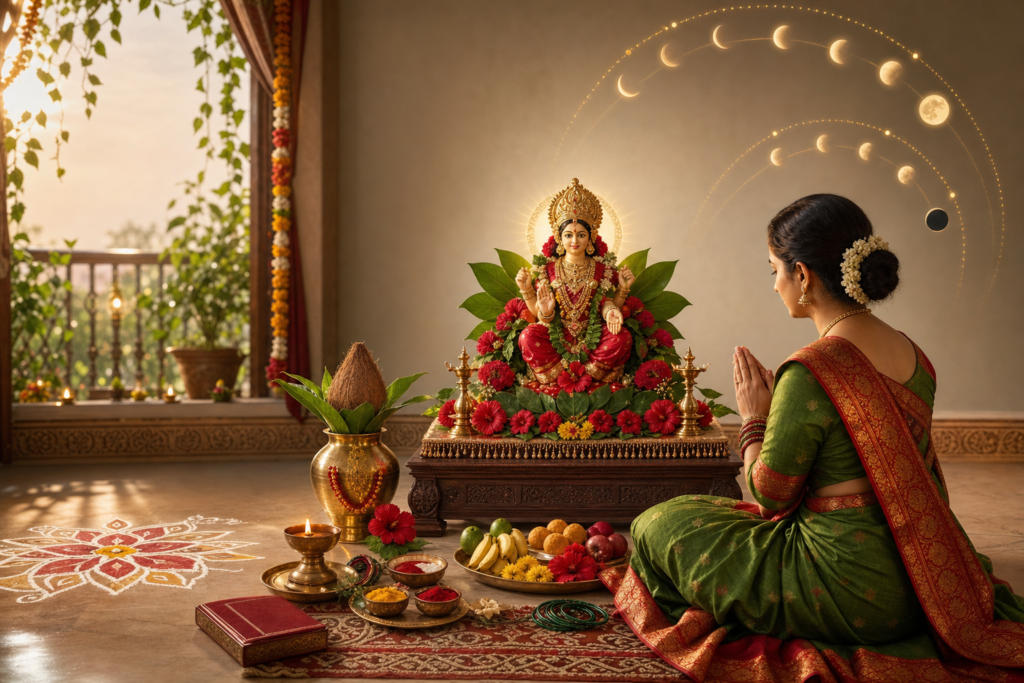
Beginning the day. A common home observance starts with bathing, clean clothing and the orderly preparation of the puja space. The lamp may then be lit, followed by a brief invocation and a clearly stated sankalpa. The intention can identify the day, the chosen duration of the vrat and a spiritually appropriate purpose such as steadiness, clarity, gratitude, family welfare or dedication to the well-being of all beings.
A practical puja sequence. There is no single universal Shravan Somvar puja vidhi, but a simple sequence can include purification of the space, invocation, an offering of water, bilva leaves or flowers, mantra japa, reading or listening to a Shiva hymn, silent meditation, arati and distribution of prasada. Family sampradaya and guidance from a qualified priest take precedence where a more formal ritual has been inherited. Simplicity does not diminish devotion when attention and ethical intention remain sincere.
Abhisheka and its meaning. Pouring clean water over a Shiva Linga is among the most recognizable Shravan practices. Some households perform panchamrita abhisheka with substances such as milk, curd, ghee, honey and sugar before rinsing with water, while others use water alone. The action is traditionally understood as an expression of reverence, purification and inward cooling. It should be performed without waste, without damaging a temple installation and in accordance with local rules governing ritual materials and drainage.
Bilva leaves and other offerings. Bilva leaves have a longstanding place in Shiva worship and are commonly offered during Shravan. Clean, naturally obtained leaves are preferable to excessive or commercially wasteful quantities. Flowers, fruit, a lamp and incense may also be used according to custom. The devotional meaning rests in respectful offering rather than display, expense or competition.
Mantra, recitation and silence. Om Namah Shivaya is the most widely accessible mantra associated with Shiva and may be repeated in a fixed count or for a chosen period. Devotees may also recite the Mahamrityunjaya mantra, Shiva Chalisa, Shiva Mahimna Stotra or passages from the Rudram where pronunciation, training and lineage permit. Silent meditation is equally valuable, especially when recitation would otherwise become hurried or performative. The measured repetition of a sacred name gives the observance an inward structure that food restriction alone cannot provide.
Home worship and temple worship. A temple visit can create a powerful sense of shared devotion, especially on the first Monday when bells, mantra and the sight of continuous abhisheka shape a collective atmosphere. Home worship offers a different strength: quietness, accessibility and the ability to include children, older relatives or anyone unable to travel. Neither setting is inherently superior. The suitable setting is the one that supports reverence without disregarding health, mobility, work or caregiving responsibilities.
Common forms of fasting. Shravan Somvar fasting ranges from nirjala observance without food or water to phalahara with fruit and permitted liquids, a milk-based fast, or a single simple vegetarian meal. Some families exclude grains, pulses, onion, garlic or ordinary salt, while others apply a less restrictive rule. These are customary variations rather than one universally binding standard. A sustainable discipline aligned with health and inherited practice is preferable to an extreme form adopted through social pressure.
Food choices during the vrat. Depending on regional custom, permitted foods may include fruit, nuts, milk or plant-based alternatives, yogurt, coconut water, makhana, potato, sweet potato, sabudana, kuttu, singhara flour and sendha namak. Not every item is appropriate for every person, and packaged vrat foods can contain substantial sugar, salt or fat. Moderation remains part of the observance. A fasting menu that becomes an elaborate feast can obscure the intended qualities of simplicity and restraint.
Concluding the fast. Many devotees complete evening worship and then take water, fruit, prasada or a simple meal. Others follow a family rule tied to sunset, the appearance of the Moon, completion of a specific recitation or the next morning. Shravan Somvar does not have one universal parana time comparable to every formally timed vrata. The local panchang and household tradition should guide the conclusion, particularly when another tithi-based observance coincides with the Monday.
Health and fasting safety. A vrat should not place life or health at avoidable risk. Children, older adults, pregnant or breastfeeding people, individuals with diabetes, kidney disease, eating disorders or other medical conditions, and anyone taking medicines with food may need a modified observance or no food fast at all. Appropriate medical guidance takes priority over an austere regimen. Prayer, japa, charity, study and self-restraint remain meaningful forms of vrata when dietary fasting is unsafe.
The ethical dimension. Traditional fasting is weakened when hunger is accompanied by anger, humiliation of others or careless speech. Patience, truthfulness, compassion and control of harmful impulses form the interior discipline of the day. A devotee may reduce unnecessary media consumption, resolve to speak gently, feed another person, support animal welfare or perform quiet service. Such practices extend Shiva worship from the shrine into daily relationships.
Environmentally responsible worship. Shravan’s association with water makes ecological responsibility especially relevant. Large quantities of milk, plastic packaging, synthetic decorations and non-biodegradable offerings can burden drainage systems and waterways. Modest quantities, reusable vessels, natural materials and compliance with temple disposal rules preserve the symbolic dignity of abhisheka. Ritual care and environmental care need not be separated.
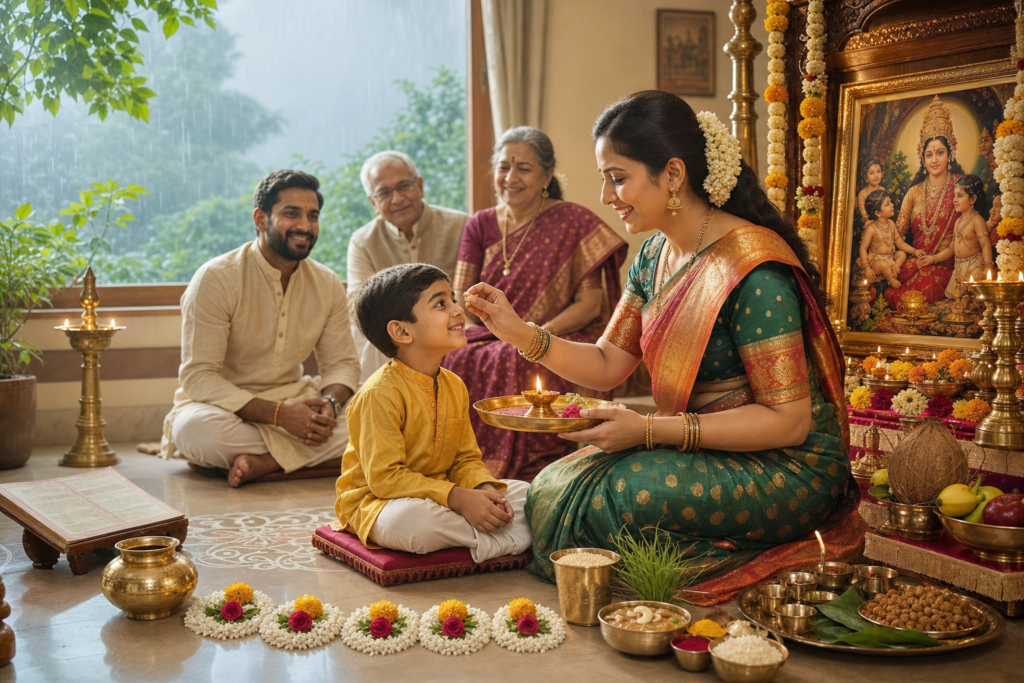
Observing as a family. The first Monday can become a gentle household rhythm rather than an exhausting production. One person may prepare the lamp, another arrange flowers, children may offer water, and older relatives may share a hymn or family memory. A brief, attentive puja is often more sustainable than a complicated ceremony that generates tension. The repeated Mondays then become points of continuity through which knowledge passes between generations.
Respecting differences within Hindu practice. Some devotees undertake all four Mondays, some observe only the first or last, and others begin Solah Somvar, a separate sequence of sixteen Monday fasts. Shaiva, Smarta, Shakta and Vaishnava households may frame the month differently, and several South Indian communities place additional emphasis on Kartika Mondays. No single regional custom should be used to dismiss another. Calendar plurality has long functioned alongside shared sacred narratives, pilgrimage networks and devotional values.
Dharmic unity without erasing distinction. Shravan Somvar is specifically a Hindu observance centered on Shiva, and that identity should be described accurately. Its disciplines of restraint, contemplation, compassion and service can nevertheless be appreciated alongside distinct practices cultivated within Buddhist, Jain and Sikh communities. Respectful unity does not require combining different rites or treating their teachings as interchangeable; it grows through accurate representation, mutual dignity and recognition of ethical concerns that can be shared across Dharmic traditions.
Which date should a devotee choose? A person connected to a North Indian Hindi panchang would generally begin on 3 August 2026. A person following a Marathi, Gujarati, Telugu or Kannada Amanta calendar would generally begin on 17 August. A person following the Nepali solar calendar would begin on 20 July. When family origin, temple affiliation and present residence point in different directions, the most coherent approach is to select one established convention and follow it consistently.
How many Shravan Mondays are there in 2026? Each of the three principal schedules discussed here contains four Mondays. The Purnimanta list is 3, 10, 17 and 24 August. The Amanta list is 17, 24 and 31 August and 7 September. The Nepali solar list is 20 and 27 July and 3 and 10 August. Confusion about four or five Mondays often arises when dates from different calendars are combined into one list.
Can 17 August be both the first and third Shravan Somvar? Yes. It is the third Monday after the beginning of Purnimanta Shravan but the first Monday after the beginning of Amanta Shravan. On this date both lunar conventions call the month Shravana because Shukla Paksha follows the new moon. The ordinal number changes with the month boundary used, even though the Gregorian date is identical.
What happens if the first Monday is missed? Missing one date does not invalidate sincere devotion. A person may begin on the next regional Shravan Monday, undertake a simpler Monday practice or seek guidance from the family priest where a formal sankalpa has already been made. The response should be proportionate and constructive rather than governed by fear. Vrata is intended to cultivate steadiness, not despair over circumstances beyond a person’s control.
Is a complete food fast mandatory? No single dietary rule applies to every devotee. Some lineages prescribe specific restrictions, while many people observe through fruit, one meal, mantra, temple worship or ethical restraint. Health limitations can justify a modified or non-dietary vrata. The seriousness of an observance is not measured solely by the severity of hunger.
Is there one universal puja muhurta? Shravan Somvar is defined primarily by the Monday falling within the locally reckoned month. Morning worship after bathing is common, and evening worship is also widespread, but sunrise, tithi boundaries and temple schedules differ. The New Delhi timings cited for Panchami on 3 and 17 August are technical examples, not worldwide muhurta instructions. A city-specific panchang should be consulted when an exact time is required.
How should diaspora households proceed? A household outside South Asia should first identify the calendar convention it intends to preserve and then use astronomical data for its present city. The Gregorian Monday may remain the same in many locations, but tithi and sunrise data can cross a civil-date boundary in distant time zones. Local temples can also clarify whether their community follows a North Indian, Amanta, Nepali or another regional calendar.
A suitable observance for beginners. A newcomer can keep the first Shravan Somvar with a manageable practice: bathe, clean the worship space, light a lamp safely, offer water and a bilva leaf or flower, repeat Om Namah Shivaya, sit quietly for several minutes, eat simply and perform one act of service. This sequence is intentionally modest. Regular attention, humility and kindness provide a stronger foundation than complexity undertaken without understanding.
Practices best avoided. Calendar differences should not become grounds for ridicule, sectarian argument or claims that another region’s date is false. Worship should also avoid food waste, unsafe fasting, coercion of family members, overcrowding that disregards temple instructions and commercial promises of guaranteed supernatural results. Academic and devotional honesty both require a distinction between established calendar data, customary belief and personal interpretation.
The enduring meaning of the date. The first Shravan Somvar of 2026 is 3 August for the North Indian Purnimanta calendar, 17 August for major Amanta traditions and 20 July for the Nepali solar calendar. Once these systems are distinguished, the dates form a coherent pattern rather than a contradiction. More importantly, the observance invites a movement from calculation to practice: from identifying the correct Monday to cultivating steadiness, reverence, compassion and responsible participation in a living tradition.
Calendar verification. The 2026 regional date ranges and Monday lists were cross-checked against Drik Panchang’s 2026 Sawan Somwar calendar. The location-specific panchang entries for 3 and 17 August were used for the New Delhi tithi examples, while the Nepal date was compared with the 2083 Saun Nepali calendar. Since sunrise and tithi boundaries vary by place, a locally configured panchang remains the appropriate final authority for exact observance times.
Inspired by this post on Hindu Pad.





Leave a Reply
You must be logged in to post a comment.