
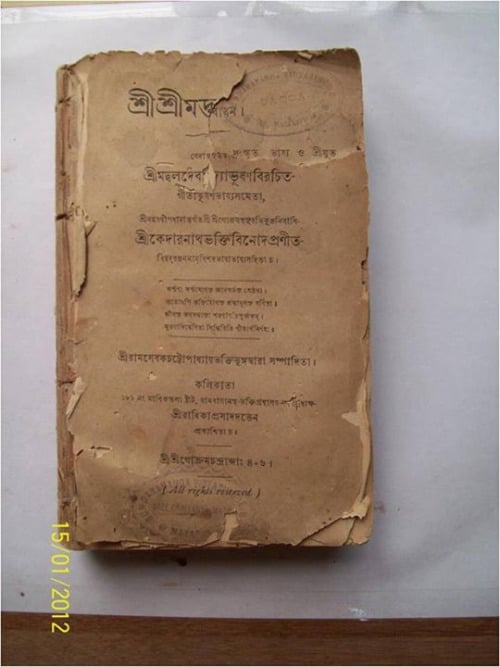

A page written by hand can create an immediacy that a modern printed edition rarely reproduces. The formation of individual letters, the spacing between lines, an altered word, or the pressure of a pen can bring a historical personality into view as a working human being rather than a distant name. That sense of proximity gives the photographs of Srila Bhaktivinoda Thakura’s original handwriting unusual emotional force. At the same time, these documents are more than devotional keepsakes: they are primary sources for the study of Gaudiya Vaishnavism, Bengali intellectual history, manuscript culture, religious publishing, and the transmission of spiritual knowledge in colonial India.
An album created as an act of remembrance
The Bhaktivedanta Research Centre assembled the original image album in observance of Srila Bhaktivinoda Thakura’s disappearance day. Within Vaishnava traditions, such an observance is not simply a biographical anniversary. It is an occasion for remembering a spiritual teacher’s service, teachings, and continuing influence. Presenting archival photographs on that day therefore joined commemoration with documentary preservation: remembrance was grounded in the surviving evidence of a life devoted to scholarship, publication, devotional music, and religious renewal.
The album can be approached on several levels. Devotees may encounter it as a tangible connection with a revered acharya. Historians may examine the images as evidence of nineteenth- and early twentieth-century Bengali literary activity. Linguists and palaeographers may study handwriting, orthography, abbreviations, and scribal habits. Archivists may ask how the documents were identified, arranged, photographed, described, and preserved. These perspectives need not compete. When their distinct methods are respected, devotional memory and critical scholarship can illuminate different dimensions of the same material heritage.
Srila Bhaktivinoda Thakura in historical context
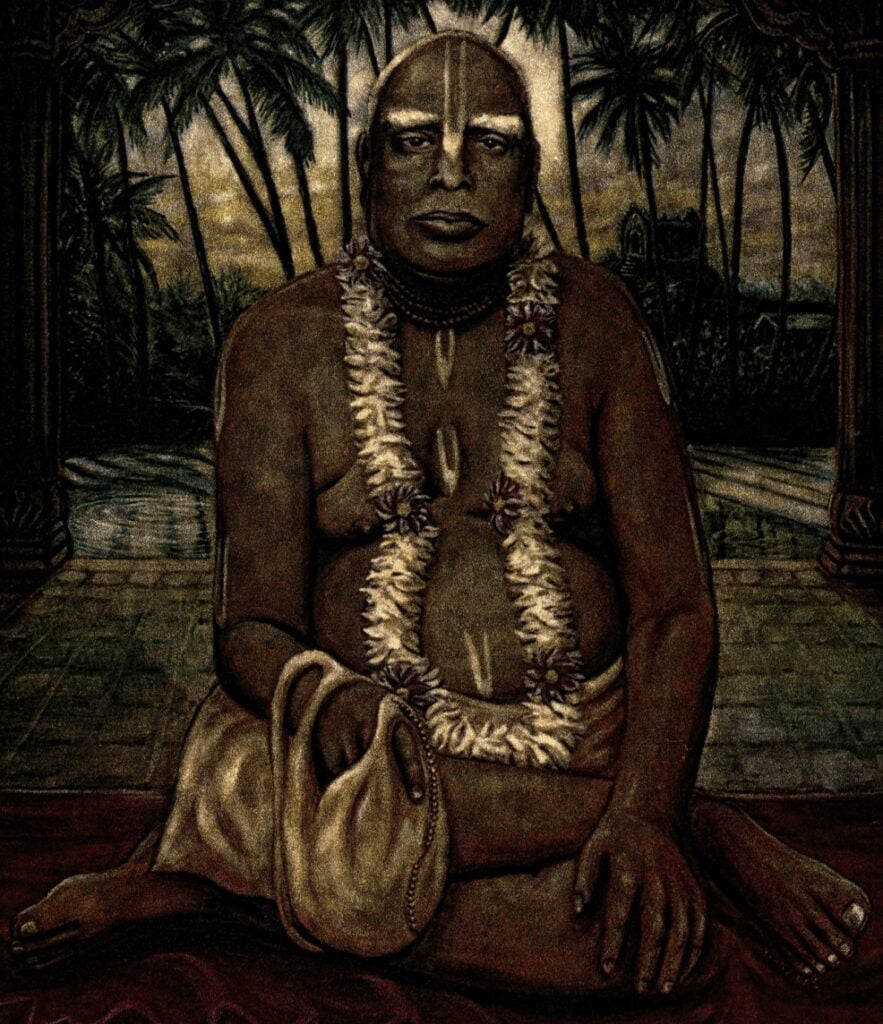
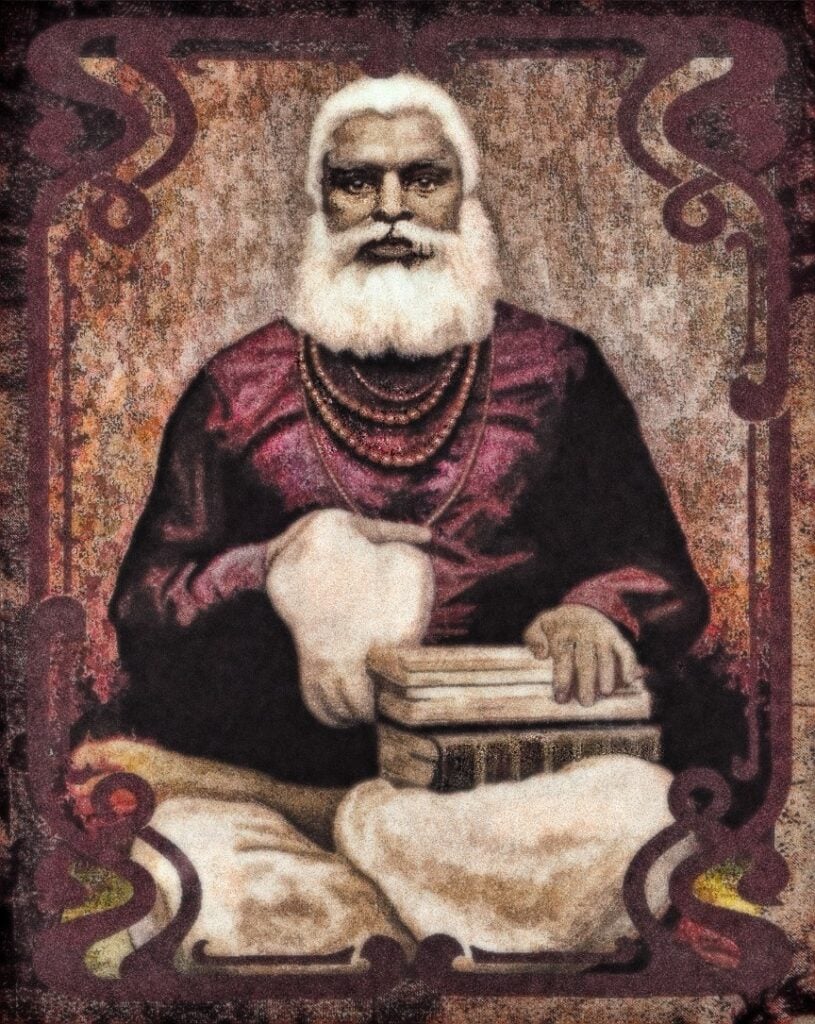
Srila Bhaktivinoda Thakura, born Kedarnath Datta in 1838, lived during a period of intense intellectual, administrative, and technological change in Bengal. He served in the colonial administration while developing an extensive body of devotional, philosophical, autobiographical, and interpretive writing. His career placed him at an important intersection: he was conversant with the institutions and debates of colonial modernity, yet his central religious work sought to articulate and renew the theology and practice of Gaudiya Vaishnavism. Academic research has consequently examined him not only as a devotional figure but also as a Bengali intellectual responding to questions of history, textual authority, reason, sacred geography, and religious identity.
His manuscripts are especially valuable because they precede the editorial filtering that occurs when handwritten texts become printed books. Typesetting regularizes spelling, punctuation, lineation, and page design. Editors may silently correct errors, resolve abbreviations, or choose among variant readings. A manuscript can preserve an earlier state of composition, including revisions and unresolved alternatives. Even when a manuscript closely matches a printed edition, that agreement is historically important because it helps establish how a text moved from private composition into public circulation.
What the documented collection contains
The Bhaktivedanta Research Centre’s exhibit descriptions identify several kinds of material associated with Srila Bhaktivinoda Thakura. These include a signature dated 16 February 1895 and a handwritten letter dated 22 October 1910 to his son Srila Lalita Prasada Thakura, affectionately addressed as “Lolu.” A signature can assist comparative handwriting analysis, while a dated letter supplies a richer combination of script, language, chronology, relationship, and documentary context. The address, salutation, paper, writing direction, corrections, and closing formula may all contribute evidence beyond the literal content of the letter.
The documented holdings also include an original handwritten songbook. A published account of the collection describes it as containing 26 songs and poems, including the Gaura Arati composition beginning “jaya jaya goracandera arati ko sobha.” BRC exhibit records additionally identify handwritten versions of “Nārada Muṇi Bājāye Vīṇā,” the prayer honoring Mahaprasada known as “Sarira Avidya Jala,” and the Hare Krishna Mahamantra. These pages are significant because devotional songs often have several simultaneous lives: they are written compositions, performed works, memorized prayers, printed texts, and elements of communal worship.
A manuscript connected with a sung tradition allows researchers to ask questions that an audio performance or modern songbook cannot answer alone. Line breaks may indicate poetic organization; punctuation may suggest phrasing; repeated words may show emphasis; and corrections may reveal how a verse reached its received form. Such evidence should be interpreted cautiously, because written layout does not always prescribe melody or rhythm. Nevertheless, the pages can help trace the relationship among composition, oral transmission, congregational kirtan, and later publication.
Another major item is the handwritten autobiography “Svalikhita Jivani.” The work was composed in 1896 in the form of a letter to Srila Lalita Prasada Thakura and was first printed posthumously in 1916. When the Bengali text was republished in 2023, its preparation included comparison with a scan of the original manuscript. That process demonstrates why preservation images matter: they allow an editor to test the wording of an earlier printed edition against surviving documentary evidence, identify typographical changes, and make editorial decisions more transparent.
The BRC’s description of the Birnagar Collection further lists original handwritten materials by Srila Bhaktivinoda Thakura and Srila Lalita Prasada Thakura, including “Nabadwip Dham Mahatmya” and other Vaishnava texts. The collection context is crucial. A manuscript kept with related correspondence, notebooks, family papers, or early editions can retain relationships that disappear when a single page circulates online without its archival neighbors. Preserving those relationships is a core principle of archival arrangement.
How original handwriting becomes historical evidence
Handwriting is not merely decorative. Palaeography studies the forms and development of writing, while codicology examines the manuscript as a physical object. Diplomatics evaluates how documents were created, transmitted, and authenticated. Applied together, these methods can examine letter shapes, habitual joins, numeral forms, margins, paper dimensions, foliation, bindings, seals, and patterns of correction. A secure interpretation normally depends on several converging features rather than one visually distinctive signature.
The physical page can also preserve a sequence of thought. Ink density may distinguish an original passage from a later addition, although color differences in a photograph can also result from lighting or image processing. A word inserted above a line may indicate revision; a canceled sentence may reveal an abandoned formulation; and a change in pen or paper may mark a separate writing session. These clues are valuable, but conclusions should be based on examination of the preservation master or physical object whenever possible. A compressed social-media image is rarely sufficient for technical judgments about ink, paper, or writing order.
There is also a human dimension to such evidence. A typeset hymn can appear complete and timeless, whereas a handwritten version records the physical labor through which it entered the world. Uneven alignment, deliberate corrections, or crowded additions do not diminish a sacred composition. They show disciplined attention in action. For many viewers, this is the album’s most relatable insight: an influential spiritual legacy was carried through ordinary acts of writing, revising, preserving, teaching, singing, and sharing.
Attribution requires evidence, not appearance alone
A photograph labeled as original handwriting should be read together with its catalogue record. Responsible attribution asks where the item came from, who maintained custody, whether earlier inventories mention it, how its handwriting compares with securely dated examples, and whether the text corresponds to known works. Paper composition, watermarks, binding methods, ink characteristics, postal marks, and associated envelopes can supply additional chronological evidence. When necessary and ethically appropriate, conservators may employ transmitted light, ultraviolet or infrared photography, Raman spectroscopy, X-ray fluorescence, or other non-destructive techniques. No single test automatically establishes authorship; authenticity is a cumulative historical argument.
The distinction between an original, a photographic copy, a facsimile, and a later handwritten transcription must also remain explicit. Each can possess research value, but they answer different questions. An original carries material evidence of its production. A contemporary photographic copy preserves an earlier physical state. A facsimile supports access and comparison. A later transcript may document reception or editorial practice. Clear cataloguing prevents the understandable emotional power of an image from being mistaken for proof of its documentary status.
The technical work behind manuscript preservation
Physical conservation begins before photography. A trained conservator assesses tears, brittle edges, loose media, insect activity, mold risk, staining, folds, and the stability of inks. Surface cleaning or repair should never be improvised, particularly when iron-gall ink, fragile coatings, or water-sensitive pigments may be present. Safe housing generally uses chemically stable, acid-free enclosures sized to support the object without abrasion. Environmental management seeks stable temperature and relative humidity, limited light exposure, clean storage, pest monitoring, emergency planning, and minimal handling. Digitization reduces routine handling only when the resulting files remain reliably accessible.
A preservation-grade imaging workflow records the complete intellectual and physical object rather than cropping immediately to the written lines. Covers, blank pages, edges, versos, attachments, and existing page numbers can all carry evidence. A calibrated overhead camera or conservation scanner should minimize pressure on the document. Even illumination, a stable copy stand, an appropriate page support, a measurement scale, a color target, controlled focus, and consistent file naming make the images comparable. The goal is not to beautify the manuscript but to represent its condition faithfully and repeatably.
Current cultural-heritage guidance distinguishes a high-quality preservation master from smaller access derivatives. An uncompressed TIFF with an embedded color profile is commonly used for the master, while JPEG, WebP, or another efficient format may serve routine web access. Original camera files may also be retained according to institutional policy. Cryptographic checksums, such as SHA-256 values, permit regular fixity checks that reveal accidental alteration or corruption. Multiple verified copies should be maintained on independent systems and in geographically separated locations. The FADGI technical guidelines and IFLA guidance for rare books and manuscripts provide useful frameworks for this work.
Metadata gives those image files meaning. Descriptive metadata identifies the person, title, date, language, genre, and subject. Structural metadata preserves page order and relationships among a cover, folios, inserts, rectos, and versos. Technical metadata records the camera or scanner, pixel dimensions, color space, exposure, and processing history. Preservation metadata documents file creation, migrations, checksums, rights, and conservation events. Authority records should connect variant names—including Srila Bhaktivinoda Thakura, Bhaktivinod Thakur, and Kedarnath Datta—without erasing the historical reasons for those variations.
Handwritten Bengali presents additional computational challenges. Conventional optical character recognition is designed mainly for regular printed type, whereas handwritten text recognition must accommodate individual letterforms, conjunct characters, historical spelling, inconsistent baselines, corrections, show-through, stains, and page curvature. Machine-generated text can accelerate discovery only when trained readers verify it against the image. A responsible edition should preserve uncertainty through explicit markers rather than silently guessing at an unclear word.
Transcription is most useful when several layers remain available. A diplomatic transcription preserves original spelling, punctuation, line breaks, insertions, and deletions as closely as possible. A normalized reading text improves accessibility while recording every editorial intervention. Romanization assists readers who do not read Bengali script, and a translation makes the semantic content available in another language. Standards such as TEI XML can encode uncertain readings, additions, deletions, names, dates, and links to image regions. None of these layers should replace the manuscript image; together they create an auditable path from page to interpretation.
Translation requires particular care with theological vocabulary. Terms embedded in Gaudiya Vaishnava practice may carry doctrinal, poetic, performative, and emotional meanings at once. A fluent English equivalent can improve readability while narrowing those associations. Parallel display of the original script, a scholarly transliteration, a literal translation, and explanatory notes allows readers to see where interpretation has occurred. This method respects both the source language and the needs of a wider audience.
Digital access expands study but does not replace the object
Online photographs allow a dispersed community of devotees, students, and researchers to encounter materials that might otherwise remain inaccessible. High-resolution delivery through a framework such as the International Image Interoperability Framework, commonly known as IIIF, can support deep zoom, stable page identifiers, annotation, and side-by-side comparison across institutions. Yet even an excellent digital surrogate cannot fully reproduce paper thickness, texture, binding structure, watermarks, ink reflectance, scale, or three-dimensional damage. The physical manuscript and its digital representation therefore require complementary preservation strategies.
Access also carries ethical responsibilities. Public files should include accurate attribution, rights information, persistent links, and guidance on citation. Institutions may need to balance openness with the physical safety of vulnerable originals, privacy in unpublished correspondence, the cultural sensitivity of sacred material, and the risk of detached images circulating with misleading captions. Watermarks placed across handwriting may obstruct research; when ownership marking is necessary, less intrusive delivery methods and clearly licensed derivatives are preferable.
Research possibilities opened by the photographs
A properly described digital corpus could support several lines of inquiry. Textual scholars could compare manuscripts with first editions and later reprints. Musicologists could study how written song texts relate to transmitted kirtan repertoires. Historians could reconstruct networks among family members, printers, devotees, editors, and religious institutions. Linguists could examine changes in Bengali orthography and register. Scholars of religion could investigate how autobiography, correspondence, devotional poetry, and sacred geography contributed to a modern Gaudiya Vaishnava public.
Digital-humanities methods could extend this work without displacing close reading. Named-entity annotation could map people and places mentioned in correspondence. Version comparison could display revisions among manuscript, first edition, and later edition. Handwriting models could suggest matches across uncatalogued pages, subject to expert confirmation. Network analysis could identify patterns of communication, while geographic visualization could connect documents with Birnagar, Kolkata, Nabadwip, Puri, and other relevant locations. Every computational output would remain an interpretation dependent on the quality of cataloguing and transcription.
The album also highlights the importance of preserving collections as networks rather than isolated celebrity objects. Srila Bhaktivinoda Thakura’s manuscripts are connected with the papers of Srila Lalita Prasada Thakura, the publications of Srila Bhaktisiddhanta Sarasvati Thakura, later Gaudiya periodicals, and the global transmission of Vaishnava literature. Catalogues that record these relationships enable researchers to follow ideas across generations and formats. A single page becomes more intelligible when situated within that wider documentary ecology.
A shared lesson for Dharmic heritage
These documents belong specifically to the history of Gaudiya Vaishnavism, and their identity should not be diluted. Their preservation nevertheless carries a broader lesson for Hindu, Buddhist, Jain, and Sikh heritage. Manuscript collections across Dharmic traditions face many comparable challenges: fragile organic materials, dispersed custodianship, multilingual cataloguing, uncertain provenance, limited conservation resources, and the loss of knowledge when elder readers or traditional specialists pass away. Shared conservation training, interoperable catalogues, digitization standards, emergency planning, and respectful scholarly exchange can strengthen every tradition while preserving genuine theological and historical differences.
This approach supports unity through informed respect rather than forced sameness. A Vaishnava songbook, a Jain manuscript, a Buddhist folio, and a Sikh hukamnama should each be described according to its own textual and ritual context. At the same time, institutions responsible for them can cooperate in paper conservation, script expertise, digital preservation, terminology development, and public education. Cultural heritage becomes a meeting ground where distinct communities can protect knowledge together.
How to view the album critically and appreciatively
The original announcement directs readers to the Bhaktivedanta Research Centre image album. Each image is best approached by first reading its caption, then noting whether it is identified as an original, copy, facsimile, or scan. Useful observations include the page identifier, apparent sequence, presence of a date or signature, writing material, marginal additions, corrections, and any relationship to a published work. Apparent readings should remain provisional until they can be checked against a high-resolution image, catalogue record, or verified transcription.
Viewers should also resist judging historical handwriting primarily by modern standards of neatness. Speed, writing surface, pen type, lighting, health, purpose, and intended audience all influence a page. A private letter, a fair copy prepared for publication, and a working notebook may look markedly different even when written by the same person. Variation can therefore be evidence of genre or circumstance rather than a reason to doubt attribution.
A living legacy preserved in ink and pixels
The enduring value of these photographs lies in the union of devotion, history, and responsible preservation. Srila Bhaktivinoda Thakura’s influence is usually encountered through ideas, books, songs, and institutions. His surviving handwriting reveals the material work beneath that legacy: words were placed on paper, reconsidered, copied, printed, sung, inherited, and eventually digitized. The emotional response created by an original page becomes most meaningful when joined with careful documentation and intellectual honesty.
Preserving such manuscripts is therefore neither nostalgia nor image collecting. It is a technical and ethical commitment to provenance, conservation, accurate description, high-quality imaging, verifiable files, careful transcription, responsible translation, and sustainable access. When these practices are followed, the photographs do more than recall a remarkable life. They allow future generations to study how Gaudiya Vaishnava thought moved from a nineteenth-century handwritten page into a spiritual and intellectual tradition with global reach.
Research sources. Documentary details may be compared with the BRC rare-exhibits catalogue, the BRC library-collections description, the publication history of “Svalikhita Jivani”, and academic research on Srila Bhaktivinoda Thakura in colonial Bengal. These records provide essential context for interpreting the publicly circulated images while preserving the distinction between documented facts, institutional attributions, and further scholarly inference.
Inspired by this post on Dandavats.






Leave a Reply
You must be logged in to post a comment.