
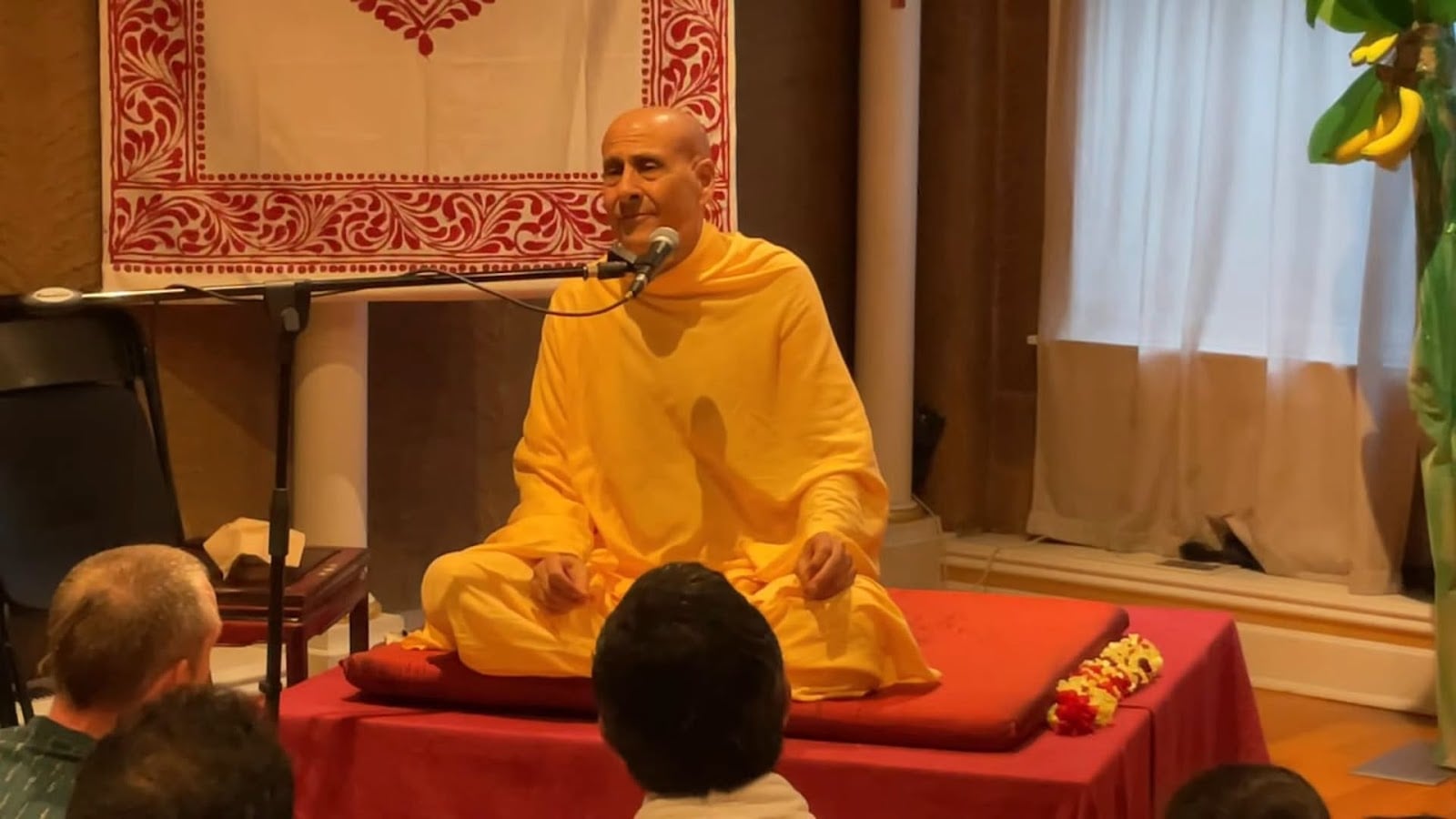
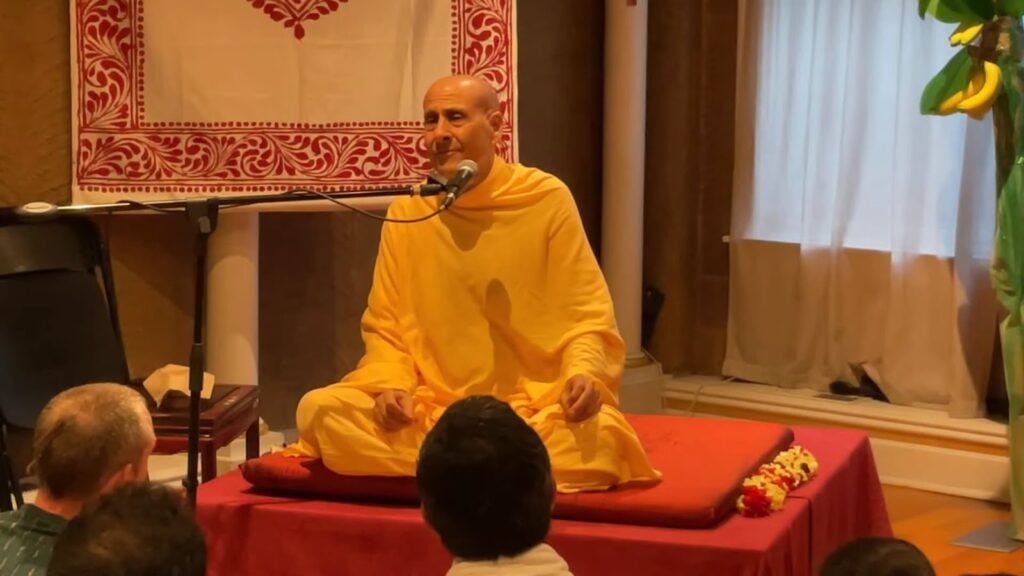
Day 6 of ISKCON’s 60th Anniversary Week placed the movement’s institutional origin at the center of a contemporary devotional gathering. Held on Saturday, July 11, 2026, the evening brought together HH Radhanath Swami and Yadunath Das for a program built around an Incorporation of ISKCON play. The subject was particularly appropriate: a historical account of ISKCON’s formation places the gathering for trustee signatures on July 11, 1966, exactly sixty years earlier. The evening therefore connected living spiritual practice with the fragile, consequential moment when a small Lower East Side community began acquiring a durable public form. The official program is documented in the ISKCON News anniversary schedule.
A geographical clarification is important. Although the recording was published by ISKCON 26 2nd Avenue @Matchless Gifts, the Day 6 evening program was scheduled from 6:00 to 9:00 p.m. at the Bhakti Center, 25 First Avenue. Most other anniversary sessions were centered at Matchless Gifts, the historic storefront at 26 Second Avenue. Moving this larger Saturday gathering a short distance did not sever it from the founding site; it created a dialogue between the original room and a later Manhattan institution shaped by the same bhakti tradition.
Recorded program: ISKCON 60th Anniversary Week – Day 6, published by ISKCON 26 2nd Avenue @Matchless Gifts.
The source post supplies the video, an event image, and the channel name, but it does not include a transcript. Accordingly, this study does not present unverified sentences as quotations or attribute particular arguments to Radhanath Swami. It instead establishes the program’s documented setting and explains its historical, theological, institutional, and cultural significance through official schedules, constitutional materials, and institutional histories.
Sixty years, two dates, and one founding process
ISKCON’s origin is inseparable from the journey of A.C. Bhaktivedanta Swami Prabhupada. At the age of sixty-nine, he traveled from India aboard the cargo ship Jaladuta and arrived in the United States in September 1965. He possessed limited material resources, had no established American institution behind him, and initially taught wherever circumstances permitted. By the summer of 1966, a small circle had begun gathering around his classes, kirtan, and explanations of the Bhagavad-gita. The official ISKCON history identifies the Lower East Side storefront as the setting from which the International Society for Krishna Consciousness emerged.
The storefront had previously housed a curio shop whose sign read “Matchless Gifts.” That inherited name eventually became an unexpectedly fitting designation for the site. The room itself was narrow and materially modest, but it provided a stable place for lectures, congregational chanting, scriptural study, interpersonal guidance, and the distribution of sanctified food. The history maintained by Matchless Gifts records that the original space was recovered, renovated, and reopened in July 1991 for ISKCON’s twenty-fifth anniversary. It subsequently developed into a pilgrimage destination and a center for remembering Prabhupada’s early New York ministry.
The dates July 11 and July 13 describe related stages rather than competing versions of the founding. The historical narrative preserved by Krishna.com places attorney Stephen Goldsmith’s visit to collect the trustees’ signatures on July 11, 1966, while Prabhupada was conducting a lecture at 26 Second Avenue. ISKCON’s 2026 Constitution identifies July 13, 1966, as the date on which the certificate of incorporation and its objectives were registered with the State of New York. Day 6 commemorated the human act of signing; the final day of the anniversary week marked the formal incorporation date. This distinction between execution and registration gives the anniversary a more precise chronology. The signature episode is described in We Shall Call Our Society ISKCON.
Legal incorporation did not generate Gaudiya Vaishnava theology, nor did it replace the guru-disciple relationship, scripture, or devotional practice. It supplied a juridical structure through which a religious community could act continuously in public life. Such a structure can enter agreements, maintain facilities, coordinate responsibilities, preserve assets, publish materials, and survive changes in individual leadership. Theologically, the mission preceded the corporation; institutionally, incorporation gave that mission a recognizable and potentially enduring vehicle.
This distinction matters because religious history is often narrated only through inspiration and charisma. Inspiration can initiate a movement, but continuity also requires names, purposes, records, procedures, trustees, places, and defined responsibilities. The anniversary play therefore addressed more than administrative history. It dramatized the moment when spiritual aspiration accepted the disciplines of collective stewardship.
The seven purposes as an operating architecture
The incorporation charter summarized ISKCON’s mission through seven purposes, which remain reproduced in Article 6 of the 2026 ISKCON Constitution. The first three concern systematic spiritual education, the presentation of Krishna consciousness through the Bhagavad-gita and Srimad-Bhagavatam, and the formation of a community whose members grow closer to Krishna and to one another. These purposes join intellectual transmission to relational formation: knowledge is intended to influence conduct, identity, and community life rather than remain an abstract collection of propositions.
The remaining purposes concern the teaching and encouragement of saṅkīrtana, the creation of sacred places dedicated to Krishna, the cultivation of a simpler and more natural way of life, and the publication and distribution of books and other writings. Together they encompass sound, space, lifestyle, and media. They also explain why an ISKCON anniversary naturally includes kirtan, historical locations, communal food, teaching, performance, books, and digital broadcasting instead of relying on speeches alone.
Viewed as an institutional system, the seven purposes possess a notable internal logic. Scripture provides the principal knowledge base; education and publication transmit it; chanting creates participatory practice; community turns individual interest into durable association; sacred places anchor memory; and a disciplined way of life translates ideals into everyday conduct. No single element is sufficient by itself. Text without community can become remote, community without education can become unreflective, and public enthusiasm without governance can prove temporary.
The purposes can also function as criteria for institutional self-assessment. A sixtieth anniversary invites questions that are more demanding than numerical growth. Does education produce understanding rather than mere familiarity? Does collective chanting deepen humility and care? Do sacred sites remain accessible as places of learning? Do publications preserve intellectual seriousness? Does communal life embody ethical responsibility? Such questions convert a commemorative charter into a continuing standard of accountability.
How the Day 6 program turned history into experience
The anniversary week combined several modes of remembrance. Matchless Gifts was opened for visits, senior devotees shared memories, daily harināma connected the storefront with Tompkins Square Park, evening programs included classes and kirtan, and prasadam followed the sessions. Day 6 added dramatic performance at the Bhakti Center. The resulting sequence moved from site to street, from street to assembly, from spoken memory to enacted history, and from formal programming to a shared meal.
This design gave Manhattan itself a pedagogical role. The distance between 26 Second Avenue, the Bhakti Center, and Tompkins Square Park is geographically small, yet each location represents a different dimension of the tradition. Matchless Gifts preserves the founding room; the park recalls early public chanting; and the Bhakti Center represents a later form of urban community development. Traversing these locations allows history to be encountered spatially rather than only read chronologically.
Drama is especially effective in this setting because incorporation documents are necessary but emotionally restrained artifacts. A certificate records names, dates, and purposes; a play can restore uncertainty, dialogue, personality, environmental pressure, and the vulnerability of a small community making commitments whose consequences it cannot yet see. Dramatic reconstruction is not identical to archival evidence, but when clearly presented as interpretation, it can help an audience understand why an administrative act mattered.
Yadunath Das brought a relevant performance background to this task. A profile published by ISKCON News describes his work in professional improvisational theatre, acting, directing, and devotional performance, including an acting role in the television series Abhay Charan about Prabhupada’s life. His involvement illustrates how artistic training can become a form of seva: technique is not discarded but redirected toward education, community reflection, and historical memory.
Radhanath Swami’s presence supplied another form of continuity. His official biography describes more than five decades in the bhakti tradition and emphasizes the connection between inner development, humility, service, and social responsibility. In the anniversary context, his role can be understood as interpretive rather than merely ceremonial: a founding narrative becomes meaningful when later generations relate its principles to current forms of community, leadership, and care.
The venue reinforced that interpretation. The Bhakti Center’s institutional account describes a Manhattan community organized around spiritual learning, meditation, yoga, devotional culture, and service initiatives. Hosting the incorporation play there created a visible line between the 1966 storefront and a contemporary urban center. The relationship was not one of simple replication: traditions remain alive by preserving their governing principles while adapting their forms to new populations and circumstances.
The pairing of discourse and theatre also joined two kinds of religious intelligence. Discursive teaching can define concepts, distinguish claims, and explain ethical implications. Theatre can convey contingency, sacrifice, humor, and interpersonal trust. When responsibly combined, the two forms prevent history from becoming either a dry chronology or an unexamined devotional legend.
A technical guide to the devotional vocabulary
Bhakti-yoga is often translated as the yoga of devotion, but the term denotes more than devotional feeling. Within Gaudiya Vaishnavism, it is a disciplined relational path in which the individual conscious self, or jīva, directs attention, action, speech, and affection toward Krishna. Its practices include hearing sacred teachings, chanting divine names, remembering Krishna, worship, prayer, service, and association with practitioners. Emotion is important, but it is cultivated through repeated practices and ethical formation rather than treated as a passing mood.
Kīrtana refers to vocal glorification or recitation, while saṅkīrtana emphasizes collective participation. In ISKCON settings, kirtan commonly takes a call-and-response form in which a leader sings a sacred mantra and the assembly answers. Repetition, melody, rhythm, breathing, clapping, and bodily coordination make it an embodied practice of attention. Authority remains present in the leader’s role, but participation is distributed through the response of the whole gathering.
Harināma designates the public chanting of divine names. During the anniversary week, the route between Matchless Gifts and Tompkins Square Park linked contemporary practice to the geography of ISKCON’s early New York history. Harināma moves devotion beyond an interior sanctuary and places it within the soundscape of the city. It is simultaneously worship, public presence, collective discipline, and an invitation to encounter the mantra.
Prasādam is not simply vegetarian catering. Food is prepared and offered to Krishna according to devotional practice and is then received as sanctified grace. Its distribution integrates theology with hospitality: an abstract claim about divine relationship becomes a shared material experience. Eating together can also reduce social distance, allowing newcomers, senior members, families, and monastics to participate in a common act without requiring identical levels of prior knowledge.
The terms dhāma and tīrtha express sacred geography. A place becomes religiously significant not merely because an event once occurred there, but because communities remember, narrate, visit, preserve, and practice within it. Matchless Gifts is therefore both an address and a site of transmitted memory. Its small scale intensifies the historical contrast: a visitor can perceive how a worldwide aspiration once depended on rent, volunteer signatures, floor seating, repeated classes, and ordinary acts of assistance.
Seva, or service, connects these elements. Teaching, cooking, cleaning, maintaining archives, acting in a play, welcoming visitors, operating a camera, and preserving a historic room can all be interpreted as service when performed with devotional intention and accountable care. This breadth helps explain how bhakti becomes institutional without being confined to administration. The institution is sustained through many forms of specialized and often inconspicuous labor.
How a spiritual movement preserves continuity
Day 6 reveals at least four systems of religious memory. Archival memory resides in incorporation papers, photographs, recordings, letters, and published histories. Spatial memory resides at 26 Second Avenue and other historically associated locations. Ritual memory is renewed through chanting, teaching, worship, prasadam, and pilgrimage. Performative memory appears when actors, speakers, musicians, and participants embody the story before a living audience. A resilient tradition normally requires interaction among all four.
Institutional continuity also requires the transition from a founder’s personal initiative to repeatable structures. This process can introduce bureaucracy, but the absence of structure creates other risks: fragmented authority, loss of records, inconsistent teaching, neglected properties, and uncertainty about responsibility. The historical importance of incorporation lies in its attempt to preserve purpose beyond the lifespan or immediate presence of any one participant.
The sixtieth anniversary was organized as part of a broader international commemoration rather than an isolated New York observance. ISKCON’s governing bodies established a coordinated 60–50 framework for the society’s sixtieth anniversary in 2026 and the fiftieth anniversary of Prabhupada’s tirobhava in 2027. The planning account emphasizes global coordination, education, local initiatives, and a renewed connection with the Founder-Acharya. This future-oriented structure shows that commemoration is being used as a mechanism of transmission.
Transmission, however, is not mechanical repetition. A movement operating across languages, nations, generations, and social conditions must distinguish enduring principles from historically contingent methods. It must preserve theological clarity while cultivating ethical leadership, cooperation, accessibility, historical honesty, and care for participants. The seven purposes provide direction, but each generation remains responsible for interpreting them through competent institutions and observable conduct.
The emotional force of the anniversary arises from the contrast between scale and vulnerability. In 1966, a few people signed papers in a rented storefront while city noise entered the room. They could not rely on established prestige or large resources. Six decades later, participants could look back on a global devotional network. That contrast can inspire gratitude, but it also warns against complacency: the original achievement depended on disciplined daily work, personal trust, intellectual conviction, and willingness to serve under uncertain conditions.
Dharmic unity without erasing real differences
ISKCON belongs to the Gaudiya Vaishnava current of Hindu tradition, with a distinctive theology centered on Krishna, the teachings of Sri Caitanya Mahaprabhu, devotional scripture, and congregational chanting. Respectful Dharmic unity does not require Buddhism, Jainism, Sikhism, and the many Hindu sampradayas to be described as interchangeable. Their accounts of selfhood, liberation, revelation, authority, ritual, and ultimate reality contain substantial differences that deserve accurate study.
At the same time, these traditions display meaningful family resemblances in disciplined self-cultivation, the formation of ethical communities, reverence for teachers and transmitted wisdom, compassion, restraint, service, and practices that challenge narrow egoism. Kirtan has particular resonances in both Vaishnava and Sikh devotional cultures, while monastic discipline, non-harm, meditation, generosity, and communal responsibility appear in differing forms across Hindu, Buddhist, Jain, and Sikh life. Recognizing such resonances can encourage solidarity without flattening doctrine.
The first purpose of ISKCON explicitly associates spiritual education with unity and peace. Read constructively, this objective supports non-coercive dialogue, careful representation of other traditions, protection of human dignity, and cooperation in service. Unity is most credible when it is practiced as intellectual fairness and shared responsibility rather than asserted through slogans. The anniversary’s emphasis on memory can therefore extend outward: fidelity to one lineage need not produce hostility toward another.
How to watch Day 6 with greater understanding
A historically attentive viewer can follow four questions. First, which elements derive from documents, remembered experience, or dramatic reconstruction? Second, how do kirtan, discourse, theatre, and prasadam communicate differently? Third, which of the seven purposes is being expressed through each part of the program? Fourth, how is the 1966 founding vision interpreted for a community living in 2026? These questions preserve devotional openness while encouraging analytical precision.
The recording itself is a primary source for the 2026 event, while the linked anniversary pages, histories, Constitution, and biographical profiles are institutional sources. They are especially valuable for schedules, official terminology, self-understanding, and documentary chronology. Academic care still requires distinguishing such sources from independent historical scholarship when disputed or evaluative questions arise. This distinction does not diminish devotional testimony; it identifies the type of evidence each source can responsibly provide.
For newcomers, the principal benefit of Day 6 is orientation. It explains why a small storefront matters, why incorporation is discussed at a religious festival, why public chanting belongs to the founding charter, why food distribution carries theological meaning, and why a play can serve as historical education. For established practitioners, the same material invites institutional reflection: gratitude for a legacy is strongest when accompanied by ethical stewardship of that legacy.
The enduring image is not simply that a small movement became large. It is that spiritual intention was joined to practical form. A rented room became a teaching space; a group of listeners became trustees; devotional aims became stated purposes; chanting entered public streets; teachings entered print; and memory became a responsibility carried across generations. Day 6 returns attention to that decisive relationship between inspiration and structure.
ISKCON’s sixtieth anniversary is therefore most meaningful when treated as more than a retrospective celebration. It offers a disciplined question for the future: can the courage, hospitality, study, service, and clarity associated with the founding period be renewed under present conditions? The answer cannot be supplied by nostalgia alone. It must be demonstrated through communities that preserve knowledge, welcome sincere inquiry, practice compassion, cooperate across differences, and keep spiritual purpose visible within institutional life.
Inspired by this post on Dandavats.





Leave a Reply
You must be logged in to post a comment.