


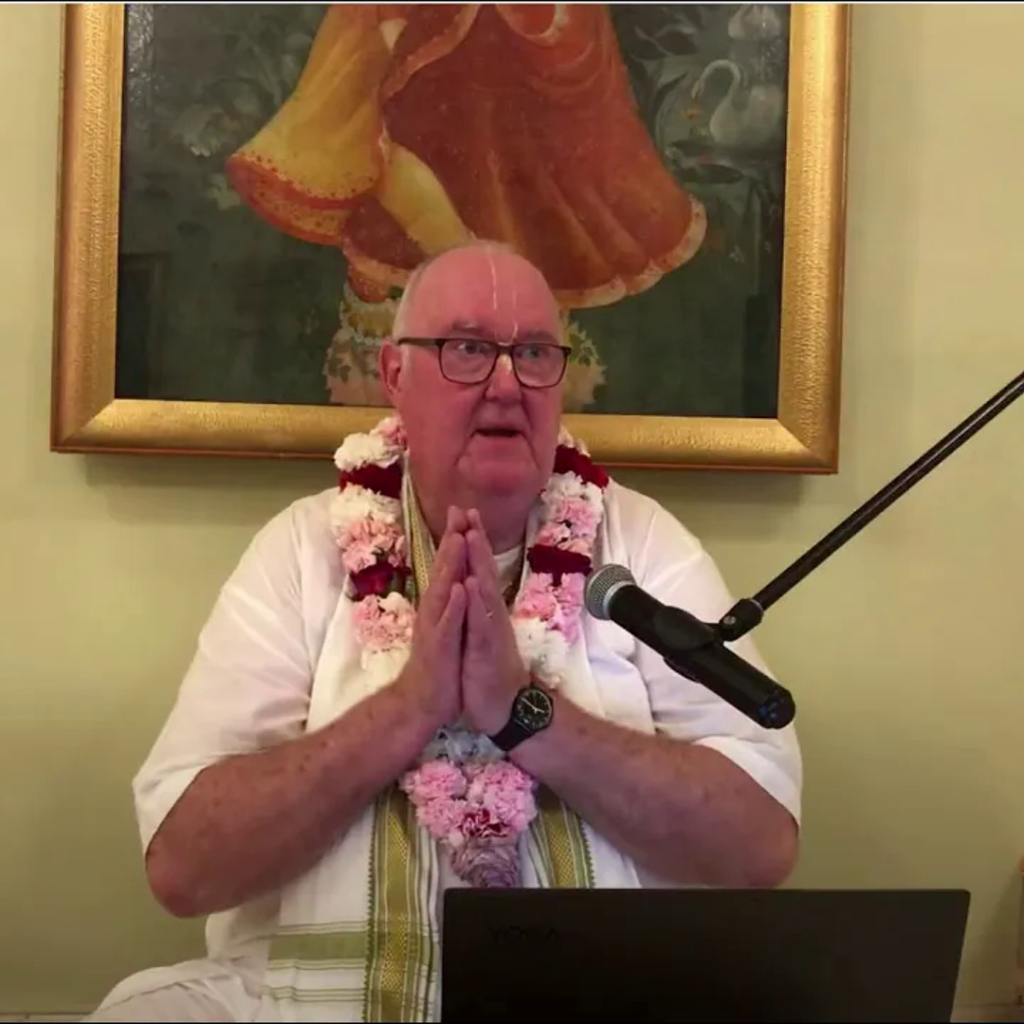
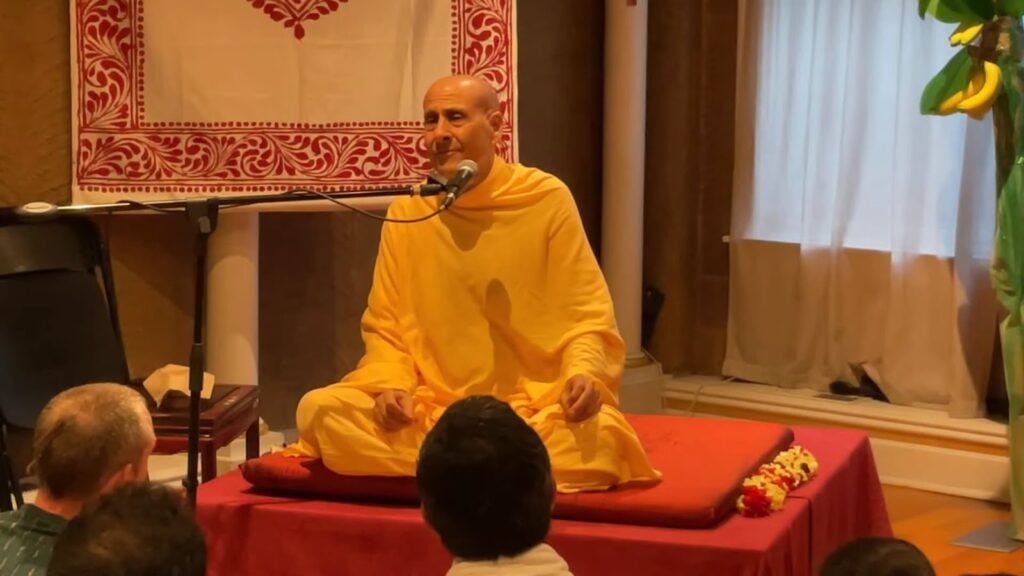
“Srila Prabhupada As He Is” is presented as the second day of a special evening class by HG Srutakirti Das, dated 11 July 2026. The event is significant because Srutakirti Das did not encounter Srila Prabhupada merely as a distant public figure. He served him personally during the formative years of the Hare Krishna movement and observed the daily conduct through which Prabhupada translated Gaudiya Vaishnava principles into practical spiritual leadership.
Source and method note: the supplied source record contains a title, date and video thumbnail but no transcript. Consequently, this article does not attribute unverified statements to the Day 2 class or claim to reproduce its precise sequence. It provides a historically grounded interpretive guide to the subject, drawing a careful distinction between the recorded event, established biographical context and themes documented in Srutakirti Das’s publicly available recollections. Readers seeking the speaker’s exact words should consult the original video recording.
The meaning of “as he is”: the phrase points toward a disciplined effort to encounter Srila Prabhupada without reducing him to a slogan, institutional symbol or idealized abstraction. A spiritual teacher is understood more adequately when formal teachings are studied alongside habits, decisions, relationships and responses to ordinary circumstances. Personal testimony becomes valuable in this context because it can show how philosophical convictions appeared in actual conduct. It must nevertheless be handled critically, with attention to memory, context and corroboration.
His Divine Grace A. C. Bhaktivedanta Swami Prabhupada was born Abhay Charan De in Calcutta in 1896. He travelled to the United States aboard the Jaladuta in 1965 and established the International Society for Krishna Consciousness in New York in July 1966. During the following eleven years, he developed an international Gaudiya Vaishnava community, established temples and educational projects, and produced an extensive body of translations and commentaries. These basic milestones are documented in the official history of ISKCON and the Governing Body Commission’s biographical record.
Prabhupada’s historical importance cannot be measured only by the number of institutions associated with him. His larger contribution lay in presenting bhakti-yoga as a coherent way of knowing, acting and forming community. He connected philosophical study with mantra meditation, congregational kirtan, ethical discipline, care for sacred literature, devotional worship, hospitality and service. The resulting movement offered participants not simply a set of propositions but a demanding spiritual culture organized around remembrance of Krishna.
Why Srutakirti Das’s perspective matters: a personal servant sees dimensions of leadership that a public audience rarely observes. Public lectures display doctrine and rhetorical skill; daily service reveals punctuality, patience, physical vulnerability, standards of cleanliness, patterns of work and the manner in which authority is exercised. Srutakirti Das’s testimony is therefore relevant to both devotional history and the academic study of lived religion. It illuminates the meeting point between charismatic leadership, routine discipline and intimate service.
Srutakirti Das first entered Prabhupada’s circle as a young disciple and later served him during the early 1970s. His responsibilities required availability, alertness and close attention to practical needs. Such service was not merely logistical. Within the guru-shishya tradition, seva functions as a method of education: the disciple learns through listening, observation, correction and repeated action. The servant’s proximity does not automatically produce understanding, but it creates an unusually concentrated field of experience.
Archival recollections collected in Vanipedia’s Srutakirti Das remembrance series depict an environment in which ordinary duties carried pedagogical weight. Reading aloud, answering a bell, preparing for travel or arranging a massage could become occasions for instruction. The underlying lesson is technically important: spiritual formation in bhakti is embodied and relational. It is not confined to conceptual agreement with theology.
Seva as disciplined attention: personal service demands the ability to notice another person’s needs without turning that attention into self-importance. It requires memory, timing, restraint and emotional steadiness. From a contemporary perspective, these capacities resemble forms of attentive care, but seva adds a theological orientation. The action is offered as devotional service, and its value lies not only in efficiency but also in the consciousness with which it is performed.
This understanding corrects a common misconception that devotion is primarily a matter of strong feeling. Emotion has an important place in bhakti, yet sustainable devotion depends upon practice. Rising at a regulated time, chanting, studying, preparing food, serving guests and completing assigned work give devotional intention a stable form. Affection becomes trustworthy when it matures into responsibility.
Authority joined with personal courtesy: Srutakirti Das’s recollections repeatedly emphasize the effect of Prabhupada’s personal manner. A teacher carrying considerable spiritual and institutional authority could still phrase a request gently, explain a practical decision or recognize the limitations of a young disciple. Such details matter because spiritual authority is most credible when conduct supports doctrine. Humility does not erase responsibility, and firmness need not eliminate care.
This combination offers a useful model for modern religious leadership. Institutions require standards, accountability and decisive action, yet authority becomes hazardous when it is insulated from empathy or critical reflection. The recollected Prabhupada is compelling precisely where principle and attentiveness appear together. Leadership is then understood as stewardship rather than possession: influence is exercised in service to a teaching, a community and a spiritual purpose.
The place of correction: close service inevitably includes mistakes. A young assistant may misunderstand an instruction, arrive late, become distracted or interpret a question as a test. In a healthy educational relationship, correction clarifies duty without defining the whole person by a single failure. This principle is highly relatable. Families, schools, monasteries and workplaces all depend upon forms of correction, but their moral quality is determined by whether correction develops responsibility or merely produces fear.
Srutakirti Das’s memories are especially valuable when they preserve his own uncertainty. Such moments resist the temptation to portray spiritual life as a continuous state of certainty. A disciple may trust a teacher while still struggling to understand a particular decision. Mature faith does not always eliminate questions; it can provide the patience and intellectual humility required to examine them carefully.
Principles and details: one of the central technical challenges in any enduring religious tradition is distinguishing permanent principles from changeable applications. The principle may remain stable while its practical expression responds to age, health, location, social conditions or individual capacity. Confusing a contextual detail with an absolute principle can produce rigidity. Treating every principle as negotiable produces the opposite problem: a tradition loses coherence.
Prabhupada’s global mission required continual navigation between these levels. He communicated Sanskritic Vaishnava concepts to audiences unfamiliar with Indian religious vocabulary while retaining a defined theological framework. Translation was therefore more than replacing one language with another. It required decisions about explanation, ritual adaptation, institutional form and the minimum disciplines necessary to sustain a recognizable path of bhakti-yoga.
Scripture as a living discipline: Prabhupada’s translations and commentaries placed the Bhagavad-gita, Srimad Bhagavatam and Caitanya-caritamrta at the intellectual center of the movement. His approach joined textual study with devotional practice. Scripture was not treated merely as an artifact of Indian history; it was presented as guidance to be heard, discussed, remembered and enacted. This explains why reading aloud, publishing books and holding regular classes acquired such importance in ISKCON communities.
The familiar expression “as it is” signals fidelity to disciplic interpretation rather than an imagined absence of interpretation. Every translation involves choices of vocabulary, syntax and explanatory framework. In Gaudiya Vaishnavism, authority is situated within parampara, the transmission of teaching through a recognized succession. Prabhupada’s commentarial method must therefore be understood within that confessional and philosophical setting, even when it is studied through historical or comparative methods.
Hearing before speaking: Srutakirti Das’s role also highlights shravana, disciplined hearing, as a foundation of bhakti. Personal service required him to listen not only to formal lectures but also to brief instructions, questions and changes in circumstance. Listening of this kind is active. It involves retaining meaning, recognizing context and responding appropriately. The lesson extends beyond monastic life: many conflicts arise because people prepare replies before they have accurately heard what another person is communicating.
Oral testimony adds another layer to this practice of hearing. A recollection is neither a stenographic transcript nor a useless subjective impression. It is a historically situated account shaped by the witness’s perspective and the passage of time. Responsible readers can receive its emotional and spiritual force while asking careful questions: When did the event occur? Who else was present? Does a letter, diary, recording or parallel testimony support it? Which parts are direct memory, and which are later interpretation?
Memory and the preservation of sacred history: communities remember founders because memory helps define present identity. Stories communicate values with an immediacy that administrative records cannot provide. A brief account of kindness, humor or correction can reveal what a community admires and hopes to reproduce. Yet reverence should strengthen historical care rather than weaken it. Accurate dates, transparent sourcing and distinctions between quotation and paraphrase protect both the teacher and the tradition from careless mythmaking.
This is particularly important in the digital age, where isolated sayings circulate rapidly without context. A claim repeated across many websites may still originate from a single unsourced post. The safest method is to begin with dated recordings, published correspondence, contemporaneous documents and clearly identified eyewitness accounts. Devotional respect and evidence-based scholarship need not be adversaries; both can be expressions of truthfulness.
The human scale of a global mission: Prabhupada’s achievements can appear almost impersonal when summarized through numbers of books, journeys, temples or disciples. Personal recollections restore the human scale. They show an elderly teacher working through demanding schedules, depending upon assistants and teaching young followers who were often inexperienced. This dimension creates emotional proximity without diminishing spiritual stature. It demonstrates that large historical transformations are carried by repeated acts of endurance, cooperation and care.
For listeners facing fatigue, uncertainty or a sense of inadequacy, this human scale can be consoling. Spiritual progress rarely arrives as a dramatic, uninterrupted ascent. It is more often built through small acts completed faithfully: another period of attentive chanting, another passage studied, another meal shared, another mistake acknowledged and corrected. The remembered relationship between Prabhupada and his servant makes these ordinary disciplines visible.
Humility as an epistemic virtue: humility in spiritual life is not self-erasure or refusal to think. It is an accurate recognition of one’s limits and dependence upon sources of knowledge beyond the isolated ego. A disciple asks questions because understanding is incomplete. A teacher cites scripture and previous acharyas because wisdom is received through a tradition. A historian qualifies claims because the available evidence has boundaries. In each case, humility makes knowledge more reliable.
At the same time, humility must not be confused with avoiding accountability. Devotional communities preserve trust by maintaining ethical safeguards, transparent governance and appropriate boundaries. Reverence for a guru does not require indifference to evidence or institutional responsibility. Rather, the ideal of service should deepen concern for the dignity and spiritual welfare of every participant.
Bhakti and unity among dharmic traditions: the class belongs specifically to the Gaudiya Vaishnava tradition, and its distinctive theology should be represented accurately. Respectful particularity, however, need not produce hostility toward Hindu, Buddhist, Jain or Sikh paths. These traditions differ substantially in metaphysics, authority, ritual and understandings of liberation, yet they also sustain disciplined practices of self-transformation, ethical responsibility, community and reverence for realized teachers.
Constructive dharmic unity does not flatten those differences into a vague sameness. It protects each tradition’s right to explain itself while cultivating cooperation around nonviolence, compassion, truthfulness, service, spiritual education and preservation of sacred heritage. Prabhupada’s own project was firmly Krishna-centered; it can be studied and appreciated without requiring the denigration of other sincere paths.
A practical framework for viewing the class: the recording can be approached through four complementary questions. First, what historical information does Srutakirti Das provide about time, place and circumstance? Second, what characteristic of Prabhupada is illustrated by each recollection? Third, which broader Gaudiya Vaishnava principle gives that memory theological significance? Fourth, how might the principle be applied responsibly today without copying a contextual detail mechanically?
Viewers may also distinguish three levels of material in the presentation: direct quotation, eyewitness description and retrospective interpretation. A direct quotation should ideally be compared with recordings or contemporaneous records when available. An eyewitness description communicates observed behavior. Retrospective interpretation explains what the witness later came to believe the event meant. All three can be valuable, but they answer different historical questions.
From admiration to practice: the deepest benefit of remembrance is not nostalgia. A memory of a spiritual teacher becomes transformative when it encourages disciplined action. The relevant questions are therefore concrete: Is listening becoming more attentive? Is study becoming more regular? Is service performed with less demand for recognition? Are disagreements handled with greater patience? Is authority exercised with both clarity and compassion?
These questions prevent personality-centered devotion from becoming passive idealization. Prabhupada’s legacy is preserved not only through portraits, anniversaries and narratives but also through serious engagement with his books, ethical conduct, thoughtful community life and care for others. Srutakirti Das’s proximity gives his recollections emotional force, while the listener’s responsibility is to translate inspiration into character.
Enduring significance: “Srila Prabhupada As He Is” invites a meeting between history and devotion. It directs attention toward the founder-acharya as a teacher whose public mission was sustained by private discipline, intellectual labor and innumerable relationships of service. Srutakirti Das’s testimony helps preserve the texture of that life, including moments too ordinary to appear in institutional chronologies but too meaningful to be lost.
The second evening class is therefore best received with affection, analytical care and a willingness to learn. Its central value lies in making spiritual leadership tangible. Behind a worldwide movement stood daily choices about hearing, teaching, correcting, travelling, writing and caring. Behind the disciple’s memories stands a continuing invitation: to approach sacred tradition honestly, serve without unnecessary self-display and allow knowledge to mature into compassionate practice.
Inspired by this post on Dandavats.







Leave a Reply
You must be logged in to post a comment.