
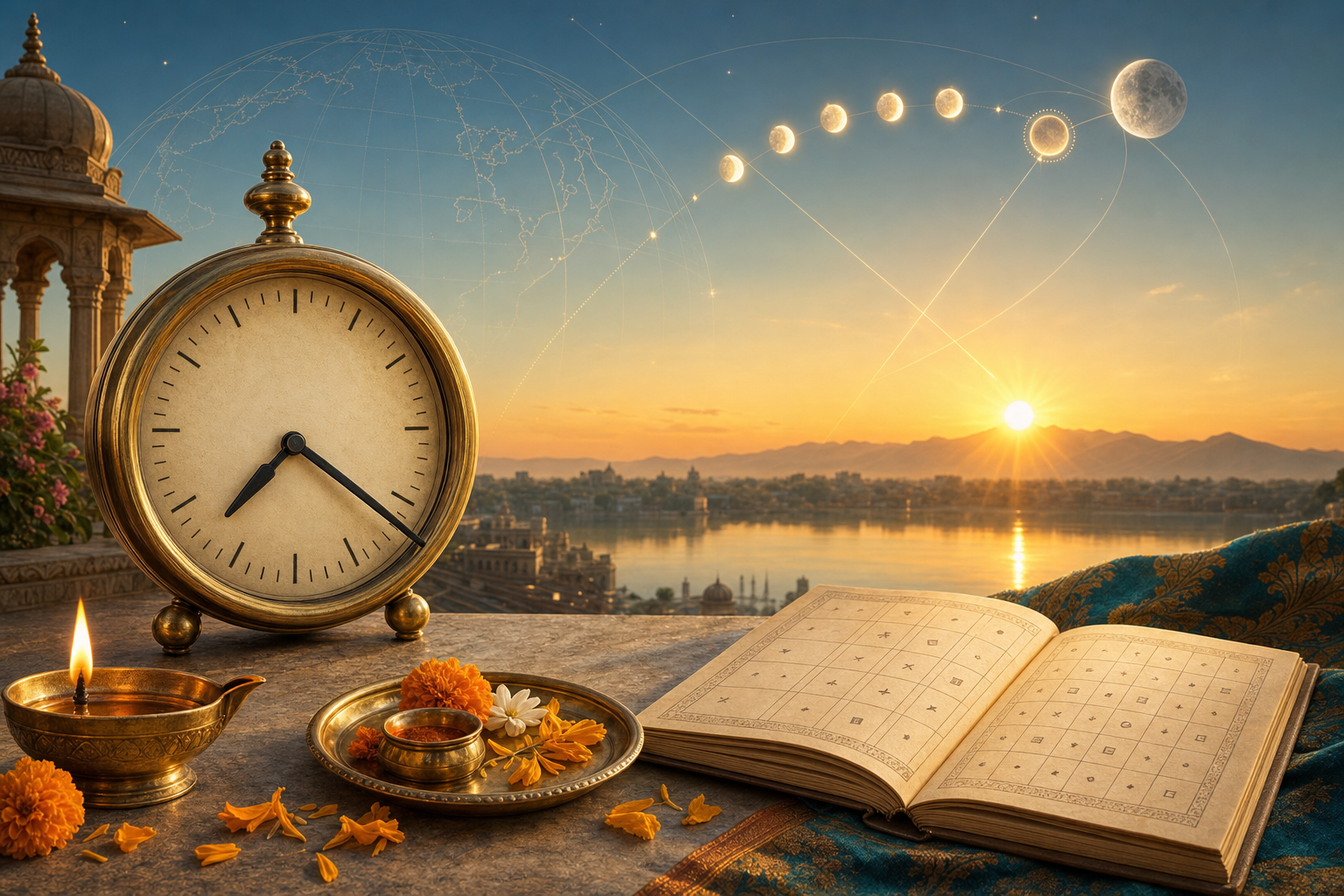
July 19, 2026 Panchang overview: Sunday, July 19, 2026, begins under Shukla Paksha Panchami, the fifth tithi of the Moon’s waxing phase, according to the supplied Hindu calendar entry. Panchami continues until 7:22 AM, after which Shukla Paksha Sashti, the sixth waxing tithi, begins. This transition is the most important calendar detail for anyone determining which tithi governs a prayer, vrata, temple visit, journey, or family observance that morning.
Essential timing at a glance: Shukla Paksha Panchami remains in effect until 7:22 AM on July 19. Shukla Paksha Sashti begins at 7:22 AM and continues thereafter, subject to the ending time reported for the following tithi in a complete regional Panchang. The stated transition should be interpreted in the context of the location and time standard used by the original calendar, because Panchang timings are calculated astronomically and are not automatically identical throughout the world.
Why a tithi does not follow the midnight-to-midnight day: A civil date is defined by the clock, but a tithi is determined by the changing angular relationship between the Sun and the Moon. Each tithi corresponds to approximately 12 degrees of increase in their longitudinal separation. The lunar month therefore contains 30 tithis: 15 in Shukla Paksha, when the visible Moon is generally waxing, and 15 in Krishna Paksha, when it is generally waning.
Because the relative motions of the Sun and Moon are not uniform from one civil day to the next, a tithi does not have a fixed duration of exactly 24 hours. It may begin or end at any hour, including shortly after sunrise. That principle explains why July 19 contains portions of two tithis and why the 7:22 AM transition is more useful for ritual planning than the date alone.
Meaning of Shukla Paksha Panchami: Shukla Paksha is the bright or waxing half of the lunar month, extending from the period after Amavasya toward Purnima. Panchami is its fifth tithi. The growing illumination of the Moon gives this half of the month a recognizable rhythm in Hindu calendar practice, although the religious use of any particular tithi varies among regions, temples, sampradayas, and family traditions.
Transition to Shukla Paksha Sashti: At 7:22 AM, the calendar moves from Panchami to Sashti, also transliterated as Shashthi. Sashti is the sixth tithi of Shukla Paksha. An activity performed before the transition falls within Panchami at the tithi level, while an activity begun afterward falls within Sashti; however, that distinction alone does not settle every ritual question.
Traditional observances may be assigned according to the tithi present at sunrise, the tithi prevailing during a prescribed part of the day, or the period in which a tithi has the required ritual prevalence. Consequently, the simple rule “before 7:22 AM means Panchami and after 7:22 AM means Sashti” is useful for general orientation but should not replace the specific vrata, festival, or temple rule applicable to an observance.
How the day may be identified in a calendar: Many daily Hindu calendars associate a civil day with the tithi present at local sunrise. If Panchami is still operating at sunrise in the relevant city, the date may be listed primarily as Panchami even though Sashti occupies most of the later day. This convention helps explain why two calendars can emphasize different information without necessarily contradicting each other.
The five limbs of the Panchang: The term Panchang refers to five principal calendrical factors: tithi, vara, nakshatra, yoga, and karana. On July 19, 2026, the vara is Sunday. The supplied entry provides the tithi transition, but it does not provide dependable values or transition times for the day’s nakshatra, yoga, or karana. Those elements should not be guessed, because each can change during the date and each depends on precise astronomical calculations.
Nakshatra and the Moon’s position: A nakshatra is one of the 27 divisions of the ecliptic commonly used to describe the Moon’s position. Each division spans 13 degrees and 20 minutes. Nakshatra is relevant to many forms of muhurta assessment, naming traditions, samskaras, temple observances, and personal astrology, but the nakshatra for July 19 must be taken from a Panchang calculated for the intended location.
Rashi in a daily Panchang: Rashi divides the zodiac into 12 signs of 30 degrees each. In a daily calendar, “Rashi” often refers to the Moon’s current sign, although some presentations also display the solar sign separately. Nakshatra and Rashi are related to the Moon’s longitude but are not interchangeable: a single Rashi contains portions of more than one nakshatra, and a nakshatra may cross a Rashi boundary.
How to determine a good time on July 19: An auspicious period cannot be established from tithi alone. A responsible muhurta assessment considers the local sunrise and sunset, the prevailing tithi, nakshatra, yoga, karana, weekday, and the nature of the proposed activity. Regional Panchangs may additionally present Choghadiya, Abhijit Muhurta, Hora, Amrit Kalam, or other customary periods.
Periods such as Rahu Kaal, Yamaganda, and Gulika are commonly reviewed when selecting daytime timings, but their clock times are derived from the interval between local sunrise and sunset. They therefore shift with latitude, longitude, season, and time zone. A Rahu Kaal value published for one city should not be copied into a schedule for another city, particularly when the locations are in different countries.
A practical morning example: A household planning a puja near the 7:22 AM boundary should first confirm whether that time belongs to its local Panchang. It should then establish whether the observance specifically requires Panchami, Sashti, the sunrise tithi, or another form of tithi prevalence. This careful sequence prevents a familiar problem in which a correct astronomical time is applied to the wrong location or interpreted under the wrong ritual rule.
Location is not a minor detail: Panchang data is based on celestial positions, yet its clock presentation is local. Sunrise can differ substantially even between cities using the same official time zone, and calendrical boundaries near sunrise can therefore produce different practical conclusions. Readers in India, Canada, the United Kingdom, the United States, or elsewhere should consult a city-specific Hindu calendar instead of treating 7:22 AM as a universal worldwide transition.
Regional calendar differences: Hindu calendars may follow amanta or purnimanta month reckoning, and regional naming conventions can differ. These systems may label the lunar month differently while still agreeing on the astronomical tithi operating at a given instant. Variations in transliteration—such as Sashti and Shashthi—also represent linguistic practice rather than a difference in the underlying sixth tithi.
Responsible spiritual use: The Panchang offers a structured way to connect daily life with lunar and solar cycles. For many practitioners, checking the tithi before prayer or a significant activity creates a sense of continuity with family and community practice. Its value is strongest when astronomical precision is combined with respect for the diversity of Hindu traditions rather than presented as a single rigid custom binding every community.
This inclusive approach also supports harmony across dharmic traditions. Hindu, Buddhist, Jain, and Sikh communities preserve distinct calendars, disciplines, and sacred observances, even where historical or cultural points of contact exist. Accurate calendar writing should acknowledge those differences respectfully while recognizing the shared importance that many dharmic communities place on disciplined timekeeping, seasonal awareness, remembrance, and ethical spiritual practice.
Planning checklist for July 19, 2026: The date is Sunday; Panchami is stated to last until 7:22 AM; and Sashti follows from 7:22 AM. Before selecting a good time, the reader should confirm the city, time zone, local sunrise, nakshatra, yoga, karana, Rahu Kaal, and any observance-specific rule. If the activity is a major samskara, wedding, Griha Pravesh, or another consequential ceremony, a complete location-specific muhurta assessment is more appropriate than reliance on a general daily calendar.
Summary: The central Panchang event on Sunday, July 19, 2026, is the morning transition from Shukla Paksha Panchami to Shukla Paksha Sashti at 7:22 AM in the supplied calendar. The time clarifies which tithi occupies a particular part of the morning, but it does not by itself establish a universal auspicious muhurta. A reliable decision requires the remaining Panchang factors, the local astronomical context, and the traditional rule governing the intended activity.
Inspired by this post on Hindu Blog.



Leave a Reply
You must be logged in to post a comment.