
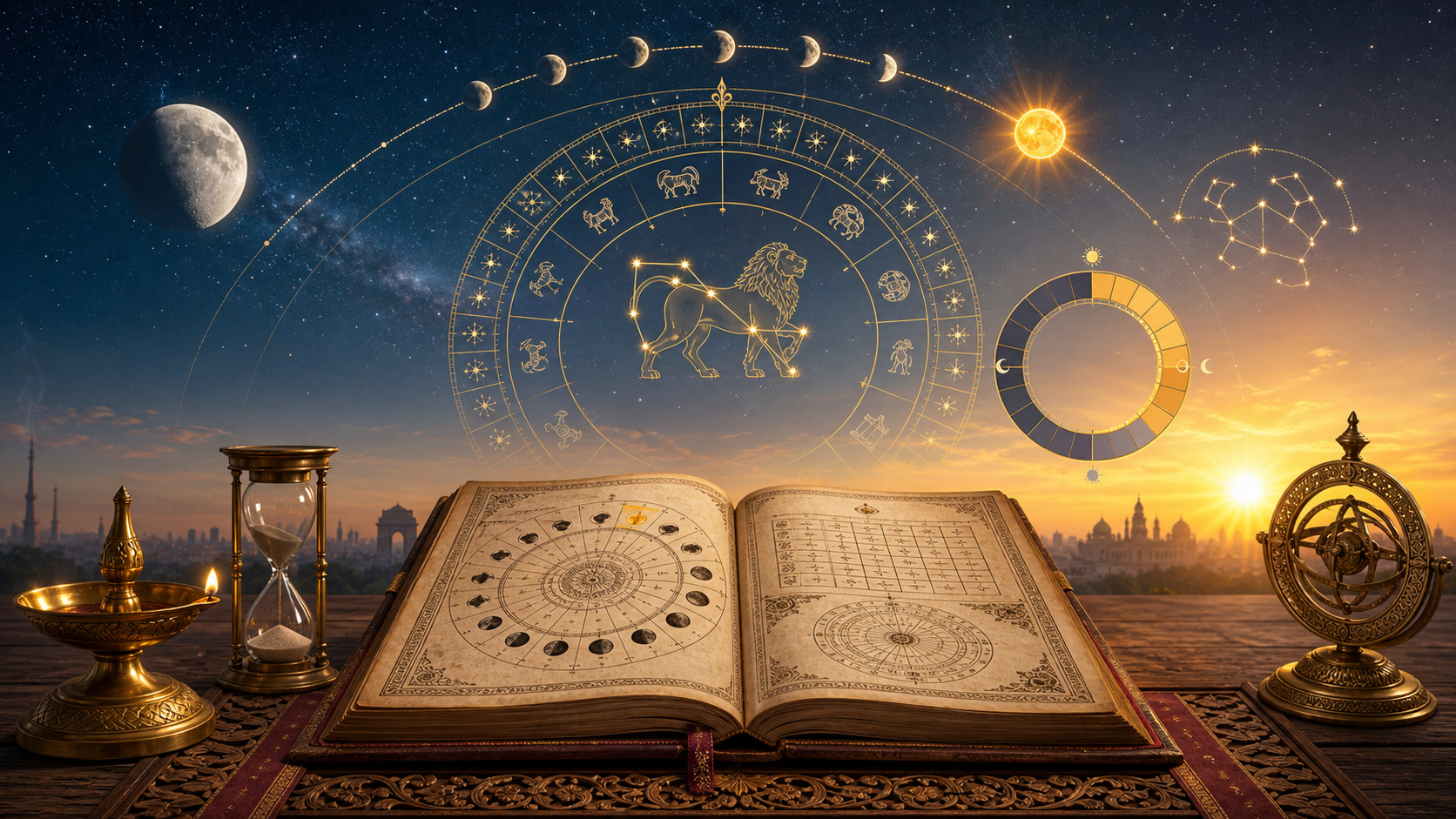
July 18, 2026 Panchang at a glance: Saturday, July 18, 2026 falls within Shukla Paksha, the waxing phase of the lunar month. The supplied calendar fragment describes a transition from Shukla Paksha Chaturthi, the fourth lunar day, to Shukla Paksha Panchami, the fifth lunar day, at 8:18 AM. That timing should be treated as specific to the calendar source from which it was taken because the fragment does not identify a location, time zone, calculation method, or complete sequence of Panchang data.
An important accuracy note: Independent Panchang calculations prepared for New Delhi differ from the supplied fragment. They place Shukla Panchami at sunrise on July 18 and show it continuing until approximately 3:43 AM on July 19. They also identify Purva Phalguni as the principal nakshatra and Simha, or Leo, as the Moon sign. These independently calculated details are available in the [New Delhi Panchang for July 18, 2026](https://www.91astrology.com/panchang/2026-07-18) and a [second New Delhi Panchang calculation](https://kundligpt.com/panchang/july-18-2026/). The difference is too substantial to ignore, so the 8:18 AM statement should be verified against a trusted local Panchang before it is used for a vrata, puja, samskara, journey, or muhurta.
Why Panchang entries can appear to disagree: A Panchang is not merely a translation of a Gregorian date. Its results depend on astronomical longitudes, the chosen ayanamsa, the underlying ephemeris or traditional siddhanta, the observer’s time zone, and regional rules about which tithi prevails at sunrise. Tithi transition instants are astronomical events, but the local clock time and the civil date on which they are reported vary across the world. Sunrise-based festival rules can also assign an observance to a different date even when two calendars calculate nearly the same transition instant.
What the five limbs of Panchang represent: The Sanskrit term Panchang refers to five interconnected calendrical factors: vara, or weekday; tithi, or lunar day; nakshatra, or lunar mansion; yoga, an angular combination of the Sun and Moon; and karana, one half of a tithi. Rashi, sunrise, sunset, Rahu Kaal, Yamagandam, Gulika, Abhijit Muhurta, and other practical timings are commonly presented alongside these five limbs. A responsible interpretation considers the complete pattern rather than declaring an entire day favorable or unfavorable on the strength of a single factor.
How a tithi is calculated: A tithi is determined by the angular separation between the geocentric longitudes of the Moon and the Sun. Each increase of 12 degrees marks a new tithi, producing 30 tithis during a synodic lunar month. The first 15 belong to Shukla Paksha, when the illuminated portion of the Moon generally increases, while the next 15 belong to Krishna Paksha, when it generally decreases. Because the relative motion of the Sun and Moon is not uniform, a tithi is not a fixed 24-hour interval. It may begin or end at any local clock time.
In mathematical terms, the active tithi can be obtained by normalizing the difference between the Moon’s longitude and the Sun’s longitude to a range of 0 to 360 degrees, dividing that value by 12 degrees, and identifying the resulting segment. This astronomical basis explains why a Gregorian date can contain portions of two tithis. It also explains why a tithi may be present at sunrise, end later in the day, or occasionally fail to occur at sunrise on any civil date.
Understanding Shukla Paksha: Shukla Paksha begins after Amavasya and develops toward Purnima. It is commonly described as the bright or waxing fortnight. Many Hindu traditions associate this visible increase in lunar light with growth, renewal, disciplined beginnings, learning, and devotional expansion. Such associations provide a cultural and spiritual framework, but they do not replace the more detailed analysis required for selecting a formal muhurta.
Meaning of Shukla Paksha Chaturthi: Chaturthi is the fourth tithi of a lunar fortnight. It has a particularly strong devotional association with Ganesha in many Hindu communities. Practices may include simple prayer, recitation, meditation, temple worship, or the offering of durva grass and other customary items according to family and sampradaya. The presence of Chaturthi does not automatically establish the date of a major festival; festival observance depends on the relevant lunar month, whether the tithi belongs to Shukla or Krishna Paksha, its relationship to sunrise or moonrise, and regional dharmic rules.
The supplied source states that Shukla Paksha Chaturthi continues until 8:18 AM on July 18, after which Shukla Paksha Panchami begins. Since the source fragment ends before giving the Panchami completion time and does not identify the applicable region, that statement cannot safely be expanded into a universal schedule. It remains useful as a record of the source’s stated sequence, but not as a substitute for a location-specific calculation.
Meaning of Shukla Paksha Panchami: Panchami is the fifth tithi of the waxing fortnight. Its ritual significance changes with the lunar month, deity, region, and inherited tradition. Some Panchami observances emphasize learning, purification, healing, serpent reverence, household worship, or a particular form of the Divine. On an ordinary daily Panchang, however, Panchami should first be understood as an astronomical lunar division. Any special vrata or festival designation requires separate confirmation.
The movement from Chaturthi to Panchami offers a practical reminder of the dynamic character of the Hindu calendar. A person may awaken expecting the day to carry one familiar designation, only to find that the active tithi changes during breakfast, a morning puja, or the journey to work. This is not a contradiction within the calendar. It reflects a system that follows celestial motion rather than forcing lunar events into midnight-to-midnight civil dates.
Saturday and Shani: July 18, 2026 is a Saturday, or Shanivara. Saturday is traditionally associated with Shani. Depending on family practice, the day may be marked by restraint, service, prayer, disciplined work, charity, or reflection on responsibility and the consequences of action. These practices are devotional and ethical frameworks rather than guarantees of a particular worldly outcome. An academic reading therefore distinguishes traditional symbolism from deterministic prediction.
Nakshatra for July 18, 2026: Widely used New Delhi calculations place the Moon in Purva Phalguni for most of the day, with the transition to Uttara Phalguni occurring at approximately 6:00 PM. Purva Phalguni and Uttara Phalguni form a related pair, but each has its own traditional attributes and electional applications. The exact transition time must be recalculated for the user’s location and preferred Panchang system.
A nakshatra is determined by dividing the sidereal ecliptic into 27 equal sectors of 13 degrees and 20 minutes. The Moon’s position within those sectors identifies the prevailing nakshatra. Since the Moon moves through approximately one nakshatra each day, a civil date often contains a nakshatra transition. This is why the correct response to “What is today’s nakshatra?” may require both a name and an ending time.
Rashi, or Moon sign: New Delhi-based calculations place the Moon in Simha Rashi, corresponding to sidereal Leo, during the principal portion of July 18. The Sun is shown in Karka Rashi, corresponding to sidereal Cancer. Rashi divides the sidereal zodiac into 12 sectors of 30 degrees each, while nakshatra uses 27 smaller sectors. The Moon can therefore remain in one rashi while moving from one nakshatra to another.
Rashi information in a daily Panchang describes the Moon’s current transit and should not be confused with a person’s complete birth chart. A natal interpretation requires an accurate birth date, time, and place, followed by consideration of the ascendant, planets, houses, aspects, dashas, and other factors. A daily Moon sign alone is insufficient for making major medical, financial, legal, or personal decisions.
Yoga and karana: A complete New Delhi Panchang identifies Variyan Yoga during much of July 18 and shows the karana progressing through Bava and Balava. Yoga is calculated from the combined sidereal longitudes of the Sun and Moon, divided into 27 segments of 13 degrees and 20 minutes. Karana represents six degrees of angular separation between the Sun and Moon, making it one half of a tithi. These factors add precision to electional analysis and demonstrate why tithi alone cannot define the quality of every hour.
Auspicious time for New Delhi: As a location-specific reference rather than a universal prescription, one New Delhi calculation gives Abhijit Muhurta as approximately 11:59 AM to 12:54 PM on July 18, 2026. Abhijit Muhurta is a midday interval derived from local sunrise and sunset. Its clock time changes with latitude, longitude, season, and local time conventions. It should therefore be recalculated rather than copied for another city.
Rahu Kaal for New Delhi: The same calculation places Rahu Kaal at approximately 9:02 AM to 10:44 AM. Rahu Kaal is traditionally avoided for initiating important undertakings, although routine activities already in progress generally continue. It is calculated by dividing the daylight interval from sunrise to sunset into eight equal portions and assigning one portion according to the weekday. For Saturday, the relevant portion falls in the morning, but its exact clock boundaries depend on local sunrise and sunset.
Yamagandam, Gulika, Durmuhurta, Varjyam, Amrita Kalam, Choghadiya, Ravi Yoga, Sarvartha Siddhi Yoga, and related periods may also appear in regional almanacs. These systems do not all answer the same question, and their rules should not be blended casually. A time labeled favorable in one system may overlap a period treated cautiously in another. Formal ceremonies therefore benefit from the guidance of a knowledgeable priest or qualified Panchang practitioner familiar with the family’s tradition and location.
How to use the July 18 Panchang responsibly: The first step is to select the actual city where the activity will occur. The next step is to confirm the time zone and whether daylight-saving time applies. The local sunrise, active tithi, nakshatra, yoga, karana, and Moon sign should then be checked. Only after these foundations are established should favorable and cautionary periods be compared with the nature of the proposed activity.
For an ordinary day, the Panchang can support a simple rhythm of awareness without creating anxiety. A household may use it to identify the lunar phase, plan a brief prayer, remember a family vrata, or explain the traditional calendar to younger generations. Such use preserves living knowledge while avoiding the mistaken belief that every routine action requires an elaborate electional calculation.
For a wedding, Griha Pravesh, major business opening, initiation, property registration, or complex samskara, a generic daily page is not sufficient. Those events may require examination of the participants’ birth details, tara bala, chandra bala, lagna, planetary strength, prohibited combinations, regional customs, and the ritual rule attached to the event. “Good time” is therefore a technical conclusion, not merely a decorative label placed beside a clock interval.
The importance of sunrise: The civil day begins at midnight, but many Panchang observances are organized around sunrise. A tithi prevailing at sunrise may lend its name to the religious day even if it ends soon afterward. Other observances depend on moonrise, sunset, midday, or a specific portion of the night. This event-specific logic is essential when determining vrata and festival dates.
Regional calendar context: The name of the lunar month can vary according to whether a community follows the amanta system, in which the month ends at Amavasya, or the purnimanta system, in which it ends at Purnima. Solar calendars used in Tamil Nadu, Kerala, Bengal, Odisha, Assam, and other regions add further layers of terminology. Different month names do not necessarily indicate different skies; they often represent distinct but internally coherent methods of organizing the same astronomical cycles.
This regional diversity is a strength of the broader Dharmic world. Hindu, Buddhist, Jain, and Sikh communities have each preserved sophisticated ways of relating sacred observance to lunar, solar, seasonal, and historical cycles. Their calendars are not interchangeable, yet they can be studied with mutual respect. Careful comparison encourages unity through understanding rather than erasing the distinctive discipline of any tradition.
Practical conclusion: The supplied entry records Shukla Paksha Chaturthi until 8:18 AM and Panchami afterward, but current independent India-based calculations identify Shukla Panchami as the sunrise tithi for July 18, 2026. Purva Phalguni, Simha Rashi, Variyan Yoga, and a transition toward Uttara Phalguni provide the broader astronomical setting in commonly used New Delhi calculations. Because the original fragment lacks a location and appears inconsistent with those calculations, the safest course is to verify every exact time in a local Panchang before ritual use.
The enduring value of Panchang lies not in fear of an unfavorable minute, but in attentive participation in time. It connects daily life with the measured relationship of the Sun, Moon, horizon, season, and inherited tradition. When read carefully, the July 18, 2026 Panchang becomes more than a table of timings: it becomes a disciplined guide to cultural memory, astronomical awareness, and thoughtful spiritual practice.
Inspired by this post on Hindu Blog.


Leave a Reply
You must be logged in to post a comment.