
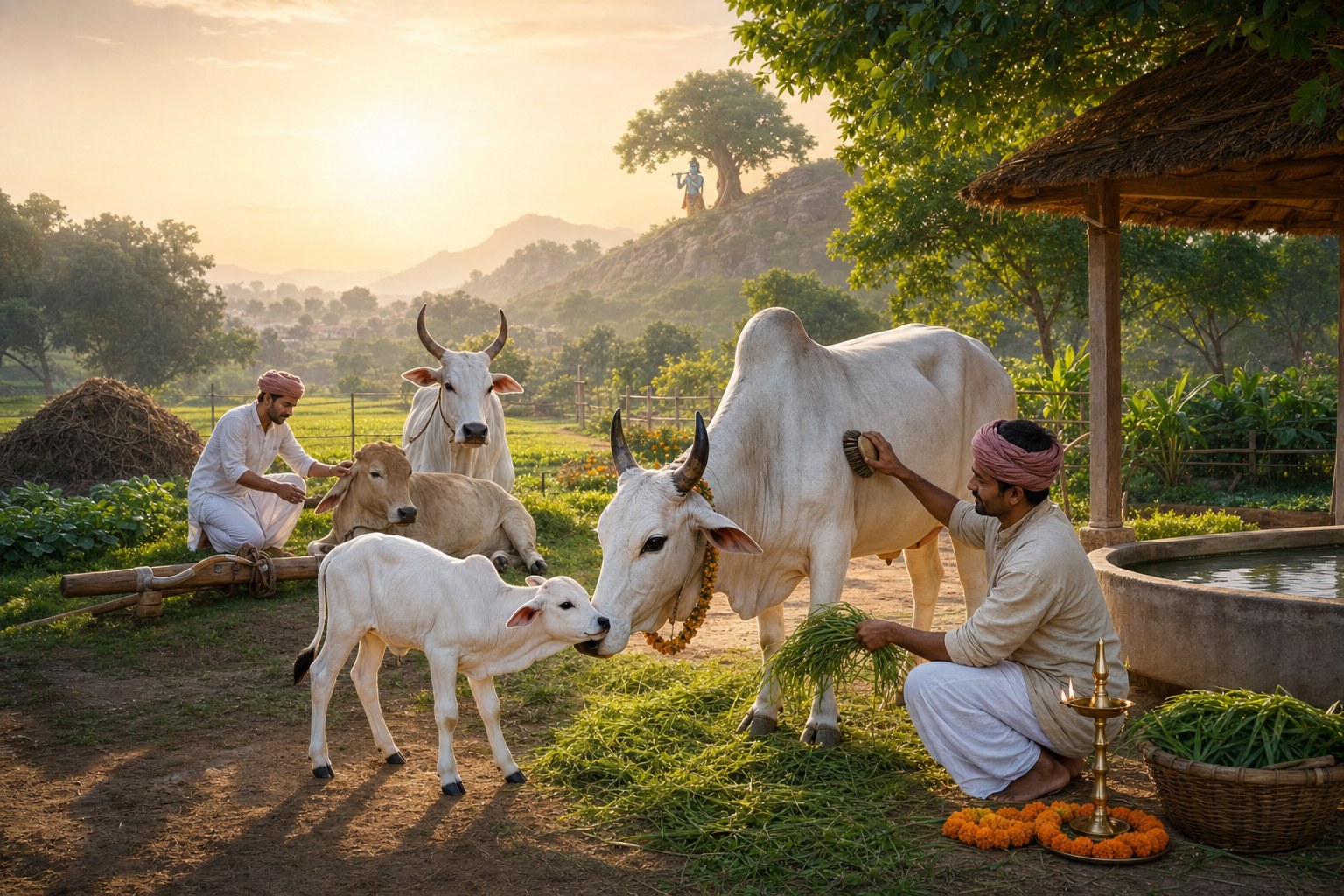
The Vedic description of the cow as go-mata, or mother cow, presents more than an affectionate religious metaphor. It expresses a moral relationship founded on nourishment, agricultural cooperation, gratitude, and responsibility. Within this framework, benefits received from an animal create corresponding duties toward that animal. Cow protection is therefore not adequately understood as a slogan or isolated ritual; it is an integrated discipline of service, worship, and lifelong care.
This discussion develops themes presented by Advaita Acarya Dasa in Back to Godhead while placing them in a broader theological, agricultural, nutritional, and animal-welfare context. Its primary perspective is the Gaudiya Vaishnava tradition associated with Lord Sri Krsna, the Srimad-Bhagavatam, and the teachings of Srila Prabhupada. Hindu traditions are internally diverse, so not every community explains cow veneration in precisely the same terms. Academic clarity requires that devotional convictions be represented faithfully without presenting every theological statement as a universally accepted scientific proposition.
Why the cow is addressed as mother
The maternal designation arises principally from the cow’s traditional role as a provider of milk. In pastoral and agrarian societies, milk and foods prepared from it could nourish children and adults, supplement grain-based diets, and be transformed into yogurt, butter, ghee, buttermilk, and other products with different storage and culinary properties. Calling the cow go-mata converts this material contribution into an ethical claim: a being that nourishes human life should receive care rather than exploitation.
The metaphor does not mean that milk is available without biological limits or competing obligations. A cow produces milk after giving birth, and her calf has a direct claim upon that nourishment. Responsible cow service consequently begins with the health of the mother and calf, sufficient colostrum for the newborn, appropriate veterinary observation, humane milking, and protection from hunger, fear, injury, and forced overproduction. The devotional ideal is strongest when maternal language is matched by maternal care.
Srila Prabhupada wrote, “Foods such as milk, milk products, sugar, rice, wheat, fruits, and vegetables are the foods that best aid health and increase life’s duration.” He also called milk “the most wonderful of all foods.” These statements reflect a Vaishnava dietary culture in which milk is valued as nourishing, suitable for devotional cooking, and compatible with a non-meat diet when obtained without cruelty. They also belong to a particular religious and historical understanding of food.
Contemporary nutrition adds necessary qualifications. Dairy foods can supply protein, calcium, vitamin B12, iodine, and other nutrients, but their nutritional value depends on the product, the wider diet, and individual health. Lactose intolerance, milk allergy, access, cultural practice, and ethical concern make dairy unsuitable or undesirable for some people. A nutritionally adequate diet does not universally require milk, and neither devotion nor compassion should be measured by a person’s ability to consume it. The durable principle is responsible nourishment, not an inflexible medical claim.
The cow and ox in an agrarian economy
The original vision joins the cow with the ox. Before mechanized agriculture became widespread, trained oxen supplied draft power for plowing, hauling, irrigation, and transportation. Their labor helped households cultivate grains, fruits, vegetables, pulses, oilseeds, and fodder. Cattle manure could return organic matter and plant nutrients to the soil, while crop residues could become animal feed. This created a partially circular farm economy in which animals, fields, and human communities supported one another.
The traditional statement that the cow and ox provide complete food is best understood at the level of the whole agricultural system. Milk alone is not a complete diet for every person, and cattle do not directly produce grains or vegetables. Rather, bovine nourishment, draft power, manure, and cultivated crops were combined within a diversified subsistence model. The claim concerns interdependence: human nutrition emerged from an agricultural network rather than from a single commodity.
This historical model should not be romanticized. Oxen can be overworked, poorly yoked, beaten, deprived of water, or required to pull unsafe loads. Manure can enrich soil when composted and applied according to crop needs, but it can also contaminate water and release air pollutants when badly managed. Grazing can support some landscapes, yet excessive stocking can degrade vegetation and compact soil. Vedic ethics becomes technically credible only when reverence is translated into careful husbandry, appropriate land use, and measurable welfare.
The three connected duties
Vedic and later devotional teachings commonly organize human responsibility toward the cow under three related duties. The first is serving the cow, or go-seva. The second is worshiping the cow, or go-puja. The third is protecting the cow, or go-raksya. These duties are not interchangeable. Service attends to daily needs, worship cultivates gratitude and sacred regard, and protection establishes a durable commitment against abandonment, abuse, and avoidable killing.
Placed together, the three duties correct one another. Worship without service can become ceremonial sentiment. Service without protection can end when an animal ceases to be economically productive. Protection without competent husbandry can preserve life while permitting chronic pain, malnutrition, or disease. The integrated ideal requires affection, knowledge, resources, and accountability throughout the animal’s life.
Go-seva: service as attentive care
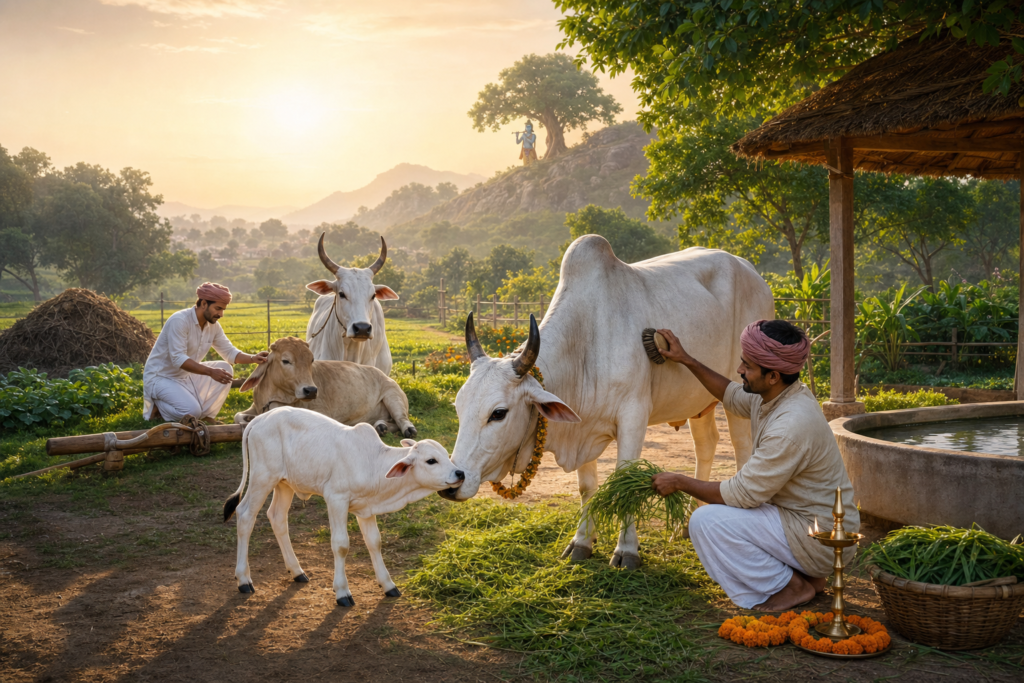
The Srimad-Bhagavatam portrays Lord Krsna as a cowherd in Vrndavana. He accompanies cows and calves to pasture, moves through the landscape around Govardhana Hill, plays His flute, and relates to the animals individually. Devotional retellings emphasize that the cows of Nanda Maharaja have names and respond when Krsna calls them. The image communicates intimacy: the animals are known subjects within a community, not anonymous units of production.
That detail has practical ethical force. Naming an animal does not by itself guarantee good treatment, but individual recognition encourages observation. A caretaker who knows a cow’s normal gait, appetite, temperament, rumination pattern, and social behavior is more likely to notice lameness, illness, distress, or injury early. Affection becomes a form of attention, and attention is indispensable to competent animal husbandry.
Traditional teaching places the cow’s basic needs before the caretaker’s convenience. In contemporary terms, those needs include abundant clean water, suitable forage, balanced minerals, protection from dangerous weather, dry resting space, adequate shade and ventilation, social contact, safe walking surfaces, and prompt veterinary care. Lactating cows, calves, elderly animals, working oxen, and animals recovering from illness require different management. Genuine go-seva must respond to those differences rather than applying one routine to every animal.
Good welfare is assessed through outcomes as well as intentions. Useful indicators include body condition, lameness, wounds, swelling, hoof health, coat condition, mastitis, hygiene, calf growth, disease frequency, mortality, rumination, resting time, and avoidance behavior around people. Records of treatment, births, feeding, and health events help caretakers identify recurring problems. A sanctuary or farm may possess a sacred vocabulary, but observable animal condition remains the decisive test of whether care is effective.
Calf care deserves particular emphasis. The newborn calf requires timely access to adequate colostrum, a clean environment, appropriate nutrition, disease monitoring, and social development. Male calves and animals with low commercial value cannot be treated as disposable consequences of milk production. A system that celebrates the cow while neglecting her calf contradicts the relational meaning of go-mata.
Service also governs the treatment of oxen. Humane training relies on patience rather than fear. Yokes must fit properly, loads must suit the animal’s size and condition, footing must be safe, and work must be interrupted by rest, water, and relief from excessive heat. Injured, sick, very young, or elderly animals should not be worked. Draft power becomes ethically defensible only when the animal’s well-being takes priority over the task.
The term Aryans appears in some devotional explanations to describe civilized people who accept these obligations. In that context, the term denotes ethical cultivation rather than a modern racial classification. Civilization is measured by restraint, gratitude, and care for dependent beings. The essential question is not ancestry but conduct.
Go-puja: worship as a discipline of gratitude
Within Hindu ritual culture, go-puja may include respectful bathing or grooming, decorations that do not distress the animal, offerings of suitable food, circumambulation, prayers, and gestures of reverence. The ceremony recognizes the cow’s place in household nourishment, agriculture, and sacred imagination. At its best, it trains participants to see dependence where ordinary consumption often hides it.
Vedic and Puranic devotional language sometimes states that the demigods and demigoddesses reside in the body of the cow. This is a theological claim about sacred presence and cosmic interconnection, not a proposition in veterinary anatomy. It presents the cow as a concentrated symbol of a universe sustained by mutually dependent powers. Worship directed toward Mother Cow is therefore understood by devotees as honoring a wider sacred order.
The Garuda Purana is traditionally cited to affirm the spiritual merit of worshiping Mother Cow and protection from suffering in Naraka. Such passages operate within a moral and eschatological worldview in which actions toward vulnerable beings carry consequences beyond immediate utility. Academic treatment can identify this as a scriptural belief while still recognizing its practical effect: it seeks to make cruelty spiritually serious.
The Govardhana narrative provides another important context. In the Srimad-Bhagavatam, Lord Krsna redirects attention from a conventional offering to Indra toward Govardhana Hill, the cows, and the local community whose lives depend upon the surrounding ecology. Govardhana Puja continues to unite devotion, food offerings, pastoral memory, and gratitude for the land. The episode does not merely establish a ritual preference; it emphasizes the sacred significance of immediate relationships among community, animals, and environment.
Ritual reverence must remain compatible with animal welfare. Loud crowds, slippery surfaces, toxic pigments, forced postures, excessive feeding, tight restraints, or stressful transport cannot be justified by ceremonial intention. Suitable offerings must match bovine digestion, and decorations should be non-toxic and minimally intrusive. A cow does not benefit from worship that causes fear or physical discomfort.
A visitor to a well-managed cowshed may encounter the ethical content of go-puja before any formal ceremony begins: clean water troughs, quiet handling, calves resting near their mothers, elderly animals receiving patient care, and workers who recognize individual temperaments. Such ordinary details make sacred regard visible. They also reveal why worship cannot be confined to one annual observance.
Go-raksya: protection as a lifelong promise
If the cow is accepted as mother, protection follows logically from gratitude. In traditional political thought, rulers were expected to defend cows, agricultural communities, and other dependents whose security sustained social order. This obligation belongs to the wider concept of dharma: power is legitimate when it protects life, restrains predation, and safeguards the conditions under which communities can flourish.
Protection cannot end when milk yield declines, fertility changes, an ox becomes unable to work, or veterinary expenses rise. Lifelong care requires planning for old age from the beginning. Breeding decisions must be connected to land capacity, labor, feed reserves, medical resources, and retirement costs. Producing more animals than a community can responsibly maintain transfers suffering into the future.
The story of Emperor Dalip dramatizes this responsibility. Remembered as an ancestor of Lord Ramacandra in the Sun Dynasty, Emperor Dalip encounters a lion threatening a cow in the forest. He refuses to preserve his own safety by abandoning the dependent animal. When the lion argues that it too must eat, the emperor offers his own body in place of the cow.
In the devotional retelling, the apparent conflict is revealed as a test. The lion and cow manifest a divine significance associated with Dharma and Mother Earth, and Emperor Dalip’s willingness to sacrifice himself demonstrates the depth of his commitment. Variations of the narrative differ in literary detail, but its ethical center remains consistent: a protector accepts personal cost rather than shifting danger onto the vulnerable.
The story should not be read as a routine instruction to seek death or attack predators. Its setting is symbolic and royal. The lion’s hunger also prevents the moral problem from being reduced to hatred of a supposedly evil animal. Two forms of life appear in conflict, and the king answers by offering himself rather than casually deciding that another being is expendable. This is an elevated literary expression of responsibility, not a practical wildlife-management protocol.
Modern protection operates through less dramatic but equally demanding choices: limiting breeding to sustainable numbers, maintaining traceable custody, refusing abandonment, funding routine and emergency veterinary care, growing or purchasing adequate fodder, training skilled caretakers, and creating plans for drought, disease, fire, and severe weather. A credible institution must know where every animal came from, where every animal is, and who remains responsible for that animal throughout life.
End-of-life care requires both fidelity and compassion. Lifelong protection should never become an excuse to prolong severe, untreatable suffering. Palliative treatment, pain control, professional diagnosis, and ethically serious veterinary decisions belong within go-raksya. The principle of ahimsa calls for the minimization of harm; it does not require indifference to agony when recovery is no longer possible.
The contemporary challenge of slaughter and dairy production
Older devotional discussions sometimes cite a single annual estimate for the number of cattle slaughtered in the United States. Any such figure is time-sensitive and varies according to whether it includes cows, calves, bulls, steers, commercial slaughter, or other categories. It should not be repeated as a current statistic without a defined year and a verifiable dataset. The enduring factual point is that industrial meat and dairy systems involve cattle on a very large scale, making individual welfare and final disposition central ethical questions.
Abstaining from beef directly reduces personal participation in the market for cow flesh, but a complete cow-protection ethic examines more than the final product. Dairy supply chains may involve repeated breeding, calf separation, disposal or sale of male calves, selection for extreme milk yield, painful procedures, confinement, long-distance transport, and slaughter when production declines. Practices differ substantially among farms, yet the possibility of these harms means that ethical evaluation cannot stop at the word vegetarian.
For those who consume dairy, meaningful questions include whether calves receive adequate colostrum and nutrition, whether male calves are protected, whether cows are allowed suitable social contact and movement, whether painful procedures use veterinary pain control, whether disease and lameness are monitored, and what happens when an animal is no longer productive. Labels and devotional imagery cannot substitute for transparent answers.
Those who avoid dairy can still honor the underlying principles through nonviolence, careful nutrition, support for responsible agriculture, and respect for animals. This point is especially important for unity among dharmic traditions. Jain approaches may apply ahimsa to dairy with particular strictness, Buddhist communities differ by lineage and region, and Sikh practice emphasizes seva, compassion, and vegetarian food in the communal langar without requiring a single cattle theology. Hindu traditions themselves contain varied pastoral, ritual, regional, and philosophical perspectives.
Unity does not require those distinctions to disappear. It requires a shared refusal to turn difference into contempt. Non-harming, self-restraint, service, gratitude, and care for dependent beings provide strong points of cooperation among Hinduism, Buddhism, Jainism, and Sikhism. Cow veneration can retain its specifically Hindu and Vaishnava meanings while contributing to a broader dharmic conversation about humane food systems.
Technical foundations of a responsible cow-protection project
A sustainable project begins with carrying capacity. Land, rainfall, forage yield, purchased feed, storage, labor, and water availability place real limits on herd size. Managers must estimate needs across seasons rather than relying on ideal conditions. Drought plans, fodder reserves, quarantine areas, isolation facilities for sick animals, and emergency transport arrangements should exist before a crisis develops.
Preventive health management should be designed with qualified veterinary guidance appropriate to local disease risks. It commonly includes observation, vaccination where indicated, parasite control based on evidence, hoof care, reproductive monitoring, mastitis prevention, safe calving facilities, and rapid treatment of injury. Quarantine for incoming animals protects both the newcomer and the resident herd. Medication records and withdrawal periods are necessary wherever milk enters the food supply.
Nutrition must be based on the animal’s age, body condition, physiological state, workload, and available forage. Ruminants require a stable digestive environment, adequate fiber, suitable energy and protein, minerals, and continuous access to clean water. Abrupt dietary changes can cause serious illness. Feeding sweets, bread, or ceremonial leftovers in large quantities may express affection but can damage health; trained caretakers should control what visitors offer.
Housing should permit comfortable lying, rising, walking, feeding, and social interaction. Floors need drainage and traction without becoming excessively abrasive. Bedding should remain dry, manure should be removed on an appropriate schedule, and ventilation should reduce heat and respiratory stress. Shade is essential in hot climates, while cold and wet conditions require protection suited to breed, age, and health. Tethering, when used at all, should not prevent normal movement for prolonged periods.
Humane handling depends on an understanding of cattle behavior. Cattle have wide fields of vision, respond strongly to contrast and sudden movement, and can become fearful when isolated or chased. Quiet movement, predictable routines, non-slip pathways, and well-designed gates reduce stress for animals and injury risk for people. Staff training should include both religious values and practical stockmanship.
Financial design is equally important. Feed, land, fencing, staff, veterinary treatment, shelter maintenance, and care for nonproductive animals create continuing costs. Income from milk, crops, compost, education, or draft work may contribute, but optimistic revenue projections should not determine herd size. A retirement reserve and transparent accounting help prevent economic pressure from being transferred onto animals.
Breeding is one of the most consequential decisions. Every calf represents a possible commitment of many years. Breeding should therefore be limited by future capacity, genetic health, maternal welfare, and a clear plan for both female and male offspring. Selection solely for maximum milk yield can increase metabolic stress and health problems. A protection-centered model values robustness, longevity, temperament, and suitability to local conditions.
Environmental management also requires balance. Cattle can convert grasses and some agricultural by-products that humans cannot digest, and well-managed manure can support soil fertility. At the same time, cattle emit methane, and poorly managed herds can contribute to nutrient runoff, habitat pressure, and land degradation. Claims that cattle are either universally regenerative or universally destructive are too simple. Outcomes depend on herd size, feed source, land type, manure handling, displaced production, and the timeframe used for assessment.
A well-designed mixed farm may integrate cattle with crop rotations, composting, pasture management, and locally appropriate draft work. Yet integration should be evaluated rather than assumed. Soil organic matter, vegetation cover, erosion, water quality, animal condition, purchased feed, and labor demands provide evidence of whether the system is genuinely sustainable. Spiritual intention and ecological measurement can reinforce one another.
From symbolic reverence to public ethics
Cow protection is most persuasive when it demonstrates care rather than hostility. Aggression toward people of different dietary, cultural, or religious backgrounds contradicts the virtues of compassion and self-control that protection is meant to cultivate. Education should communicate theological convictions clearly, acknowledge plural societies, and invite voluntary ethical reflection. Violence committed in the name of nonviolence is an internal contradiction.
Public policy must likewise distinguish animal welfare from communal antagonism. Legitimate concerns include transport conditions, illegal cruelty, traceability, food safety, shelter standards, abandonment, and enforcement of applicable law. These issues should be addressed through evidence, due process, competent institutions, and equal protection. Cows do not benefit when their welfare is reduced to a pretext for fear or social division.
Urban reverence presents a further challenge. Feeding stray cattle without responsibility for shelter, health, reproduction, or traffic safety can create injury, disease, plastic ingestion, and conflict. Compassionate action requires coordinated custody, waste management, veterinary services, and prevention of abandonment. An occasional offering is not equivalent to go-seva when the animal remains exposed to danger afterward.
Communities evaluating a cowshed, farm, or sanctuary can ask five practical questions. Are the animals visibly healthy and able to behave normally? Are calves, males, elderly animals, and animals with disabilities protected as carefully as productive cows? Are breeding and admissions limited by long-term capacity? Are veterinary, financial, and custody records transparent? Is ritual activity arranged around the animals’ welfare rather than institutional display?
These questions convert a lofty ideal into accountable practice. They also protect sincere institutions from preventable failure. Good intentions can be overwhelmed by uncontrolled breeding, inadequate land, unstable finances, untrained labor, or delayed medical care. Transparency allows devotion to learn from evidence without surrendering its spiritual purpose.
A daily practice of gratitude and restraint
The three duties remain practicable in contemporary life even for people who do not own cattle. Go-seva can inform careful consumption, opposition to cruelty, and respect for those who perform demanding husbandry work. Go-puja can cultivate gratitude for animals, soil, water, farmers, and the many hidden relationships behind food. Go-raksya can guide choices toward systems that accept responsibility for animals beyond their commercially productive years.
The deepest lesson is reciprocity. Human beings regularly receive benefits from animals and ecosystems while remaining distant from the conditions of production. The image of Mother Cow interrupts that distance. It asks whether nourishment is being received with gratitude, whether dependence is acknowledged, and whether the cost of convenience is being imposed upon beings unable to negotiate their treatment.
Within Krishna consciousness, the cow is especially dear to Lord Krsna, and care for her becomes a form of devotional service. Within a broader ethical vocabulary, the same practice expresses compassion, responsible stewardship, and limits on human power. These interpretations need not be collapsed into one another. Together, they show how sacred tradition can generate concrete standards for animal welfare and sustainable agriculture.
Service, worship, and protection ultimately form one moral movement. Service asks what the animal needs today. Worship asks whether those needs are approached with gratitude and reverence. Protection asks whether responsibility will endure tomorrow, after productivity declines and sentiment is tested by cost. When all three remain connected, go-mata becomes not merely a title of affection but a demanding ethic of lifelong care.
Inspired by this post on Dandavats.







Leave a Reply
You must be logged in to post a comment.