


Editorial note: The available source contains the program title and thumbnail but no lecture transcript. No quotation, biographical detail, or specific argument is therefore attributed to Venkat Bhatta Prabhu. This article provides a historically grounded framework for understanding the Srila Prabhupada Katha series and the significance of ISKCON’s 60th anniversary.
A diamond jubilee with spiritual and historical significance
ISKCON’s 60th anniversary in 2026 marks far more than the passage of six decades. It offers an opportunity to examine how a small devotional community established in New York in 1966 developed into an international network of temples, congregations, educational initiatives, publishing projects, rural communities, festivals, and food-relief programs. The anniversary also invites a deeper question: how did Srila Prabhupada translate the teachings and practices of Gaudiya Vaishnavism for a global audience without separating them from their Indian spiritual foundations?
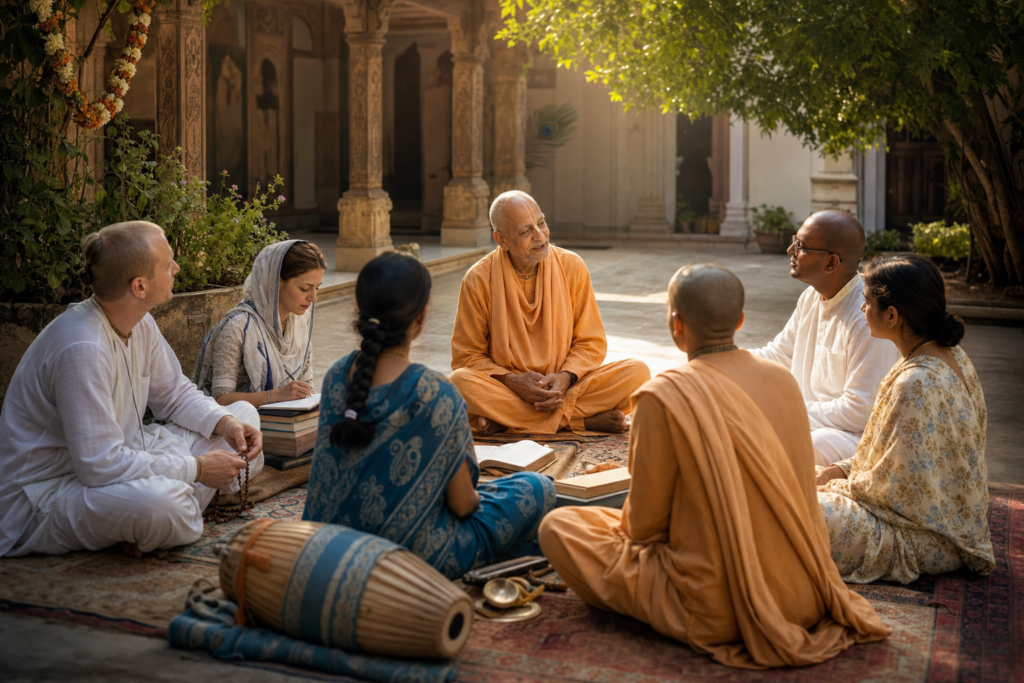
The Srila Prabhupada Katha series, represented in this program by Venkat Bhatta Prabhu, belongs to a long-standing culture of sacred remembrance. Within bhakti traditions, remembrance is not merely an exercise in nostalgia. It is a disciplined way of studying character, teachings, decisions, relationships, institutions, and service. A katha about a spiritual teacher is valuable when it moves beyond praise and helps listeners understand how principles were embodied under demanding historical conditions.
What katha means in the Gaudiya Vaishnava tradition
The Sanskrit term katha can refer to narration, conversation, exposition, or a spiritually meaningful account. In Vaishnava practice, katha generally brings together scriptural teaching, remembered events, philosophical explanation, and practical reflection. Its purpose is not simply to entertain. It enables a community to hear sacred ideas repeatedly, examine them from different perspectives, and apply them within changing social circumstances.
Srila Prabhupada Katha therefore occupies a space between history, theology, oral memory, and ethical education. Historical claims should be distinguished from devotional interpretations, and personal recollections should be considered in relation to documentary evidence. At the same time, an exclusively institutional chronology would miss the emotional force of the movement. For many devotees, the history of ISKCON is inseparable from transformative encounters with chanting, sacred literature, prasadam, temple worship, spiritual friendship, and opportunities for seva.
From Calcutta to a global mission
Srila Prabhupada was born Abhay Charan De in Calcutta in 1896. His formative world included Bengali Vaishnava devotion, family worship of Krishna, colonial rule, the Indian independence movement, and the intellectual culture of modern Bengal. In 1922, he met Bhaktisiddhanta Sarasvati, the influential Gaudiya Vaishnava teacher who urged him to communicate the teachings of Sri Caitanya in the English language. That instruction gradually became the defining direction of his life.
After decades of household responsibilities, business efforts, writing, and devotional service, he accepted the renounced order of sannyasa in 1959. He worked on an English translation and commentary of the Srimad-Bhagavatam, publishing the first volumes in India before attempting his journey to the United States. In 1965, at the age of sixty-nine, he travelled aboard the cargo ship Jaladuta. The voyage was physically severe, and his arrival offered no institutional security, wealthy patronage, or guaranteed audience.
This phase of the story often creates the strongest emotional connection because it reveals a mission beginning under conditions of vulnerability. The later visibility of ISKCON can make its origins appear inevitable, but they were not. Prabhupada entered an unfamiliar cultural environment with limited resources and relied on teaching, translation, personal relationships, public chanting, and hospitality. The movement’s beginnings consequently demonstrate how institutional history can emerge from small, repeated acts of conviction.
The founding of ISKCON in 1966
After an initial period in the United States, Srila Prabhupada established a base at 26 Second Avenue in New York City. There he conducted classes on the Bhagavad Gita, led kirtan, prepared prasadam, and trained a small group of students. The International Society for Krishna Consciousness was formally incorporated in New York on 13 July 1966. This legal step provided an organizational structure for a mission that articulated theological, educational, communal, and cultural aims.
Public chanting in locations such as Tompkins Square Park gave the emerging Hare Krishna Movement a recognizable presence. Yet its substance was not reducible to music or countercultural spectacle. Chanting was connected to a complete discipline of bhakti-yoga that included philosophical study, ethical commitments, worship, service, spiritual association, and regulation of daily life. Understanding that integrated system is essential to understanding why ISKCON survived beyond the social environment of the 1960s.
During the eleven years between ISKCON’s incorporation and Srila Prabhupada’s death in 1977, the movement expanded across North America, Europe, India, and other regions. More than one hundred temples and centers were established, major works of Gaudiya Vaishnava literature appeared in English and other languages, and public festivals introduced large audiences to kirtan, Krishna consciousness, and prasadam. The speed of this development remains one of the most consequential features of Prabhupada’s institutional legacy.
The theological foundation: acintya-bhedabheda
ISKCON belongs to the Gaudiya Vaishnava tradition associated with Sri Caitanya, who lived in Bengal and Odisha during the late fifteenth and early sixteenth centuries. Its Vedantic framework is commonly described as acintya-bhedabheda-tattva, the doctrine of inconceivable simultaneous difference and non-difference. The individual self and the material cosmos depend upon the Supreme and share a relationship with the Supreme, yet neither is simply identical with the complete divine reality.
This formulation preserves both intimacy and transcendence. Krishna can be approached through loving devotion, but Krishna is not reduced to a psychological symbol or impersonal abstraction. The living being is understood as an enduring spiritual self with agency and responsibility, while the Supreme remains the source and sustaining ground of existence. Bhakti consequently involves a real relationship between the devotee and the divine rather than the dissolution of every distinction.
Bhakti-yoga as disciplined practice
Bhakti is sometimes translated simply as devotion, but that translation can obscure its technical depth. In Gaudiya Vaishnavism, bhakti is a cultivated orientation of consciousness expressed through hearing, chanting, remembering, serving, worshipping, praying, developing a relationship of service, cultivating spiritual friendship, and offering the self. These practices correspond to the nine classical forms of bhakti described in the Srimad-Bhagavatam.
Such practice joins emotion to knowledge and conduct. Affection for Krishna is nourished through scripture, guided by guru-parampara, tested through ethical behaviour, and expressed through service. This structure explains why Srila Prabhupada repeatedly connected philosophy with daily routine. Inspiration might begin a spiritual journey, but sustained transformation requires habits capable of carrying that inspiration through distraction, disappointment, responsibility, and change.
The Hare Krishna maha-mantra and the theology of sacred sound
The most visible practice associated with ISKCON is the chanting of the Hare Krishna maha-mantra: Hare Krishna, Hare Krishna, Krishna Krishna, Hare Hare / Hare Rama, Hare Rama, Rama Rama, Hare Hare. The mantra contains sixteen names and thirty-two syllables. It may be chanted privately on beads as japa or collectively with music as sankirtana.
Gaudiya Vaishnava theology treats divine names as spiritually potent rather than merely descriptive. Attentive chanting is understood to purify consciousness by redirecting awareness from habitual self-centredness toward loving service. At a practical level, repetition steadies attention, creates a shared contemplative rhythm, and makes spiritual practice accessible without requiring elaborate material arrangements. The simplicity of the method contributed significantly to its transmission across linguistic and cultural boundaries.
Guru-parampara and responsible spiritual authority
Srila Prabhupada presented himself as a representative of a disciplic succession rather than as the inventor of a new doctrine. Guru-parampara refers to the transmission of teaching through an authorized lineage of teachers and students. Within this framework, a guru’s authority is expected to remain accountable to sadhu and sastra—to respected spiritual exemplars and revealed texts—rather than resting solely on charisma.
This principle has lasting institutional relevance. Reverence for a spiritual teacher should deepen discernment, humility, service, and ethical responsibility. It should not eliminate careful inquiry or excuse harmful behaviour. A mature commemoration of Srila Prabhupada therefore studies both his teachings and the standards by which spiritual leadership is meant to operate. The integrity of a lineage depends not only on preserving vocabulary but also on preserving conduct worthy of trust.
Books as the movement’s intellectual infrastructure
Translation and commentary were central to Srila Prabhupada’s mission. His principal works include Bhagavad-gita As It Is, multi-volume translations and commentaries on the Srimad-Bhagavatam, and an English presentation of the Caitanya-caritamrta. These works combined Sanskrit or Bengali source texts, transliteration, word-for-word meanings, translation, and extended commentary. This layered format enabled readers with different levels of preparation to enter the texts.
The Bhaktivedanta Book Trust, established in 1972, gave publishing a durable institutional form. Translation teams subsequently carried the literature into numerous languages. Book distribution became both an educational practice and a form of public outreach. Its enduring value, however, depends on serious reading. A book may travel widely, but its deepest influence begins only when readers examine its arguments, compare passages, ask informed questions, and connect doctrine with responsible practice.
The temple as a multifunctional institution
An ISKCON temple functions simultaneously as a place of worship, a school of practice, a residential community, a cultural centre, and an organizational hub. Deity worship establishes a daily rhythm through offerings, arati, music, cleanliness, decoration, and sacred hospitality. Classes create a forum for scriptural learning, while festivals connect theology with food, performance, pilgrimage, memory, and collective participation.
This multifunctional design helped Krishna consciousness take root in places far removed from its Bengali and Braj cultural settings. It also created demanding responsibilities. Priestly standards, financial administration, safeguarding, property management, education, pastoral care, volunteer coordination, and public communication all require competence. Spiritual aspiration does not remove the need for sound governance; it increases the obligation to govern transparently and compassionately.
Daily sadhana and the formation of character
ISKCON’s standard devotional program integrates early-morning worship, mantra meditation, scriptural hearing, congregational chanting, service, and regulated conduct. Initiated practitioners traditionally undertake a daily commitment to chant sixteen rounds of the maha-mantra on beads. The discipline is intended to move spirituality from occasional inspiration into the structure of ordinary life.
Members also undertake four regulative principles: abstaining from meat, fish, and eggs; intoxicants; gambling; and illicit sexual activity. These commitments are presented as supports for clarity, compassion, self-control, and spiritual concentration. Their significance is best understood not as a checklist of prohibitions but as an ethical ecology in which attention, diet, relationships, and responsibility influence one another.
Kirtan, prasadam, and public culture
Kirtan became one of ISKCON’s most effective forms of cultural communication because it permits participation before complete intellectual familiarity. A newcomer may hear the mantra, follow a melody, observe the community, and gradually ask deeper questions. This sequence often produces an immediate sense of welcome, but the strongest programs connect that experience to clear philosophical education rather than leaving it as an isolated performance.
Prasadam performs a similarly integrative role. Food prepared and offered to Krishna becomes sanctified food that is received with gratitude and shared without unnecessary social distinction. The practice links theology to agriculture, cooking, hospitality, nutrition, nonviolence, and service. ISKCON’s later food-distribution initiatives expanded this principle into organized humanitarian work, demonstrating how devotion can become materially beneficial to communities beyond formal membership.
Public festivals have provided another bridge between tradition and contemporary urban life. Rathayatra celebrations, inspired by the ancient Jagannath festival of Puri, are now held in cities around the world. Janmashtami, Gaura Purnima, Govardhan Puja, and other observances create opportunities for worship, education, music, drama, and community service. Their durability depends on preserving spiritual meaning while communicating it intelligibly to diverse audiences.
Institutional design and continuity after the founder
Srila Prabhupada created the Governing Body Commission in 1970 to provide collective oversight for the expanding society. The model sought to prevent the international mission from depending entirely on a single administrative centre or personality. Temples could respond to local conditions while remaining connected to common teachings, practices, and institutional standards.
Prabhupada’s death in 1977 introduced the difficult transition faced by every founder-led movement: how to preserve spiritual continuity when direct personal leadership is no longer available. ISKCON’s subsequent history includes substantial growth as well as periods of conflict, reform, institutional learning, and reassessment. An academically responsible anniversary narrative recognizes both dimensions. Resilience becomes meaningful not when difficulties are concealed, but when communities learn from them and strengthen systems of accountability.
Why remembrance must include ethical reflection
A sixty-year celebration can easily become a sequence of achievements, dates, and personalities. Katha offers a more demanding possibility. It can ask how humility operates when an institution becomes prominent, how spiritual authority remains accountable, how vulnerable people are protected, how resources are administered, and how disagreement is handled without sacrificing dignity or truth.
These questions do not weaken devotion. They protect it from sentimentality and institutional complacency. Child protection, pastoral care, financial transparency, fair processes, responsible leadership, and respectful treatment of women and men are not external additions to spiritual life. They are practical tests of whether teachings about compassion, truthfulness, self-control, and service are being embodied.
Venkat Bhatta Prabhu and the role of the contemporary speaker
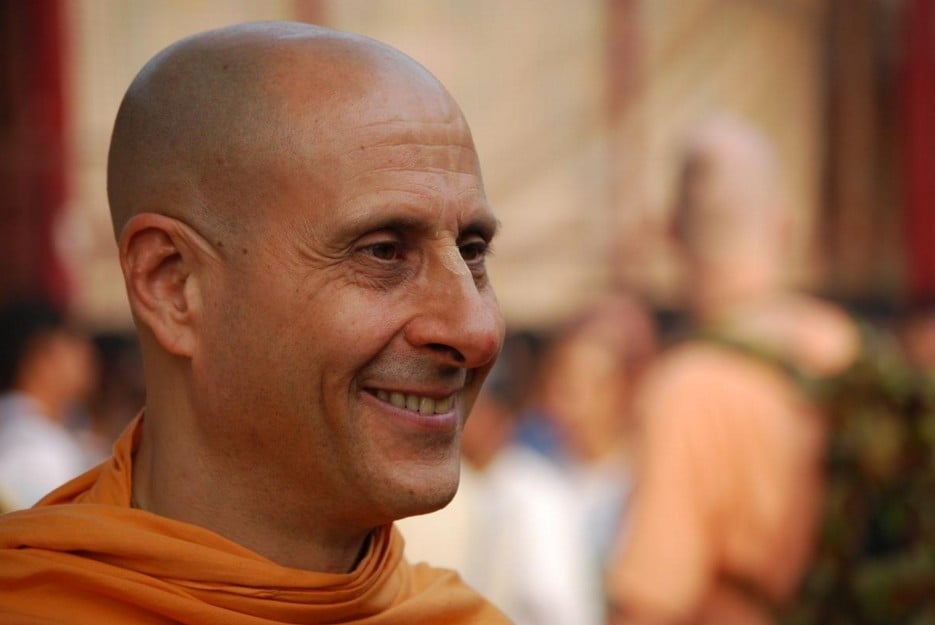
The program title identifies Venkat Bhatta Prabhu as the speaker in this instalment of the Srila Prabhupada Katha series. In such a setting, the contemporary speaker serves as a bridge between inherited memory and present-day understanding. The task involves selecting meaningful episodes, locating them within a reliable historical framework, explaining their theological relevance, and enabling listeners to consider how the underlying principles apply today.
The strongest katha does not ask the audience merely to admire the past. It invites disciplined listening and thoughtful self-examination. A listener may be moved by Prabhupada’s courage in crossing the ocean late in life, but the deeper question concerns what perseverance looks like within that listener’s own responsibilities. Another may admire the international expansion of ISKCON, while being challenged to consider whether growth is being matched by education, integrity, care, and spiritual depth.
Global adaptation without cultural erasure
ISKCON’s global expansion required continual decisions about translation and adaptation. Music, architecture, clothing, food, language, teaching methods, and community organization could not be reproduced identically in every location. Prabhupada permitted practical adaptation while insisting that central theological teachings and devotional disciplines should remain recognizable. This distinction between principle and detail became one of the movement’s most important interpretive tools.
Adaptation nevertheless requires caution. Accessibility should not become decontextualization, and cultural respect should not become rigid gatekeeping. Indian communities preserve indispensable memories, languages, ritual competencies, and historical connections. Local converts and second-generation practitioners bring other forms of knowledge and experience. A healthy global community creates room for both inheritance and responsible creativity.
ISKCON within the wider dharmic family
Gaudiya Vaishnavism is a distinct Hindu sampradaya with its own theology, texts, lineage, and forms of worship. Its identity becomes clearer—not weaker—when it engages other dharmic traditions with knowledge and respect. Hindu, Buddhist, Jain, and Sikh traditions differ on foundational questions concerning the self, ultimate reality, divine personality, scriptural authority, ritual, and liberation. Responsible dialogue acknowledges these differences rather than manufacturing a superficial sameness.
At the same time, the traditions possess important grounds for cooperation. They have cultivated disciplined spiritual practice, ethical self-restraint, compassion, service, sacred learning, community responsibility, and resistance to reducing human life to material consumption. Their institutions also share contemporary concerns involving education, cultural preservation, ecological responsibility, youth formation, social harmony, and freedom of religious practice.
ISKCON’s anniversary can therefore contribute to dharmic unity by combining confidence with humility. Krishna consciousness need not be diluted for respectful dialogue to occur, and dialogue need not become competition. The most constructive approach allows each tradition to speak in its own voice while encouraging cooperation wherever shared ethical and civilizational responsibilities make cooperation possible.
Education for a new generation
The movement’s future will depend heavily on the quality of its education. Earlier generations often encountered ISKCON through temples, printed books, street sankirtana, or festivals. Younger audiences may first encounter it through short videos, podcasts, social platforms, university groups, wellness culture, or diaspora family networks. These entry points can widen access, but they can also fragment complex teachings into slogans.
Effective education must therefore operate at several levels. Introductory material should explain unfamiliar concepts in clear language. Intermediate study should connect practices to the Bhagavad Gita, Srimad-Bhagavatam, and the life and teachings of Sri Caitanya. Advanced learning should include Sanskrit terminology, philosophical comparison, historical method, textual interpretation, institutional ethics, and engagement with serious questions. Faith becomes more resilient when inquiry is welcomed and evidence is handled responsibly.
Digital reach and the discipline of attention
Digital media gives the Srila Prabhupada Katha series potential access to audiences far beyond a single temple or festival. Archival recordings, searchable texts, online classes, and multilingual resources can preserve and distribute knowledge at unprecedented scale. Digital access is especially valuable for people who live far from a temple, have limited mobility, or seek instruction in a particular language.
Yet the digital environment rewards speed, emotional intensity, and abbreviated claims. Katha loses depth when complex history becomes a collection of dramatic anecdotes or when spiritual teaching is shaped primarily for engagement metrics. Careful sourcing, contextual explanation, accurate captions, accessible archives, and clear distinctions between memory and documented fact are therefore forms of devotional responsibility.
Simple living, ecological responsibility, and rural communities
Srila Prabhupada frequently emphasized the ideal of simple living and high thinking. ISKCON’s rural projects attempted to connect spiritual practice with land, agriculture, cow protection, local production, and community life. The ideal challenges societies in which escalating consumption is treated as the primary measure of progress.
Contemporary application requires more than repeating the slogan. Responsible land stewardship, animal welfare, soil health, water use, fair labour, economic viability, and scientific assessment must accompany spiritual intention. When these elements are integrated, rural communities can become laboratories for examining how devotion, sustainability, and social responsibility support one another.
Service as the measure of a living legacy
Srila Prabhupada’s legacy cannot be measured only by the number of buildings, publications, ceremonies, or followers associated with his name. Those achievements matter, but their purpose is to facilitate transformation and service. The more searching measures concern whether people receive meaningful spiritual education, whether hungry people are fed with dignity, whether communities protect the vulnerable, whether leaders remain accountable, and whether practice develops humility rather than status.
This service-centred measure also protects commemoration from becoming self-congratulatory. A diamond jubilee is most faithful to its founder when gratitude produces renewed responsibility. Historical memory then becomes active: books are studied rather than displayed, mantras are chanted attentively rather than mechanically, festivals welcome and educate, and institutions continually examine whether their conduct reflects their stated values.
Four questions for approaching the Katha series
The Srila Prabhupada Katha series can be approached through four practical questions. First, what historically verifiable event or teaching is being discussed? Second, which Gaudiya Vaishnava principle gives that account spiritual significance? Third, how was the principle expressed within Prabhupada’s particular twentieth-century circumstances? Fourth, how might the same principle be applied responsibly in a different time, place, or institution?
These questions prevent two common errors. The first is imitation without context, in which every historical detail is treated as universally prescriptive. The second is admiration without application, in which inspiring accounts produce no change in understanding or conduct. Thoughtful katha identifies enduring principles while recognizing that their implementation may require knowledge, consultation, and ethical judgment.
Sixty years as a beginning rather than a conclusion
ISKCON’s 60 years reveal a remarkable history of transmission. A Gaudiya Vaishnava teacher travelled from India with limited material support, established a society in New York, translated a substantial body of sacred literature, trained disciples, and created institutions capable of continuing beyond his lifetime. The result brought Krishna consciousness into sustained contact with cultures, languages, and communities across the world.
The diamond jubilee is therefore both a celebration and an examination. It honours courage, scholarship, devotion, kirtan, prasadam, temple culture, and global community. It also calls for deeper learning, ethical leadership, transparent governance, intergenerational care, responsible adaptation, and respectful cooperation throughout the dharmic family.
Within that larger task, a Srila Prabhupada Katha presented by Venkat Bhatta Prabhu offers a setting in which history can become living reflection. The enduring power of such remembrance lies not in preserving the past behind glass, but in allowing tested principles to illuminate present responsibilities. Sixty years after ISKCON’s founding, Srila Prabhupada’s legacy remains most alive wherever knowledge becomes practice, devotion becomes service, and remembrance becomes renewed commitment.
Inspired by this post on Dandavats.







Leave a Reply
You must be logged in to post a comment.