
The July 2026 analysis published by Swarajya provides a valuable starting point for examining Bharat’s energy security. Its central conclusion is unsettling but technically sound: surviving a temporary interruption in imported fuel is not the same as achieving energy independence. Bharat may diversify suppliers, expand strategic reserves and protect shipping routes, yet it will remain exposed until it can design and manufacture the technologies required to replace imported hydrocarbons with domestically generated electricity.
That distinction became visible during the 2026 West Asian conflict involving the United States and Iran, alongside Israeli military operations. Commercial movement through the Strait of Hormuz was severely disrupted for approximately three-and-a-half months. This narrow waterway ordinarily carries about one-fifth of the world’s traded oil and a substantial share of globally traded natural gas and liquefied petroleum gas. For Bharat, the danger was particularly acute because roughly 60 per cent of domestic LPG consumption had depended on imports, and about 90 per cent of those imports normally passed through Hormuz.
The immediate crisis was managed with considerable institutional competence. Petrol was not rationed, household LPG distribution continued, refineries increased domestic cooking-gas output, and alternative cargoes were arranged from the United States, Australia, Russia, Latin America, West Africa and other regions. Maritime coordination helped Indian-flagged vessels move through dangerous waters, while the government absorbed a significant portion of the international price increase instead of transferring it directly to households. The Indian crude basket reportedly climbed to about $157 per barrel before retreating, and the rupee recovered after touching a record low.
Supplier diversification undertaken over the preceding decade was critical. Bharat had expanded the number of countries supplying crude oil, LNG and LPG from 27 to more than 41. By May 2026, an official inter-ministerial assessment reported inventories sufficient for more than 60 days of crude oil, petrol, diesel and aviation turbine fuel consumption, alongside approximately 50 days of LNG and 40 days of LPG when domestic production was included. These measures created time for suppliers, refiners, ports and distributors to adjust.
For an ordinary household, resilience was experienced in a simple and emotionally significant form: the cooking flame remained lit. For a commuter, it meant that fuel remained available despite alarming international headlines. For industry, it meant that production schedules were not immediately overturned by widespread shortages. Those outcomes deserve recognition. Nevertheless, they should not obscure the narrow margin within which the system operated. A disruption lasting six months or a year, especially if accompanied by simultaneous shipping, insurance and currency shocks, would impose a much harder test.
Energy security is not the same as energy independence
Energy security concerns the ability to obtain adequate energy at tolerable prices during normal conditions and emergencies. Energy independence is a more demanding objective: it requires the economy to reduce the quantity of strategically vulnerable fuel that must be imported in the first place. Technology sovereignty goes deeper still. It describes the ability to understand, modify, manufacture and improve the equipment that produces, stores and distributes energy without remaining permanently dependent on a foreign licensor, machine supplier or processed-material producer.
Total autarky would be neither realistic nor economically desirable. No major industrial economy produces every mineral, machine and component within its borders. The practical goal is strategic optionality: multiple suppliers for non-critical inputs, domestic capacity for components that could stop the entire system, control over essential process knowledge, and enough research capability to adapt when foreign technology changes. A resilient Bharat should participate confidently in global trade while ensuring that another country cannot disable its energy transition by withholding one indispensable product.
The strategic route away from Hormuz dependence is broad electrification. Road transport consumes a large portion of imported petroleum, while household cooking accounts for a major share of LPG demand. Electric two-wheelers, cars, buses and progressively heavier commercial vehicles can substitute electricity for liquid fuel. Induction and other efficient electric cooking systems can perform a similar substitution in homes and commercial kitchens. Electricity can be generated from domestic coal, solar energy, wind, hydroelectricity, nuclear power and biomass rather than being physically transported through a contested maritime chokepoint.
Electrification, however, is not an automatic synonym for either energy independence or decarbonisation. A coal-heavy grid may reduce exposure to imported oil while retaining environmental costs, and some Indian power stations also consume imported coal. Electric vehicles reduce oil demand but require battery cells, power electronics, charging infrastructure and stronger distribution networks. Induction cooking can reduce LPG use, but only where electricity is reliable, affordable and capable of meeting the additional evening peak. The strategic benefit therefore depends on cleaner generation, dependable grids, domestic manufacturing and thoughtful demand management advancing together.
The scale of the opportunity is nevertheless substantial. Official data placed crude-oil import dependence at approximately 88.6 per cent during April–January of financial year 2025–26. The cited analysis estimates that crude imports cost about $137 billion in the preceding financial year, an amount comparable with national defence expenditure. It also places annual LPG imports near $12 billion. These figures show why even a gradual shift in transport and cooking can improve the trade balance, reduce exposure to exchange-rate depreciation and limit the fiscal burden created when the state protects consumers from international price spikes.
The comparison with the current-account deficit is illustrative rather than predictive. Imported LPG used for household cooking was estimated at roughly $10.4 billion against a prior-year current-account deficit of about $23.3 billion. Replacing only part of that fuel with domestic electricity would not reduce the deficit rupee for rupee, because additional generating equipment, grid infrastructure and battery materials may themselves be imported. Even so, the calculation reveals the economic magnitude of the transition and the importance of shifting value creation into Bharatiya factories.
The central constraint is no longer simply the number of solar farms, battery announcements or transformer factories. It is the depth of domestic capability within each value chain. Four connected technology gaps remain especially important: advanced solar cells, electrochemical battery cells, electrical steel, and the production machinery and processed materials beneath all three industries.
Technology gap one: advanced solar cells and their upstream chain
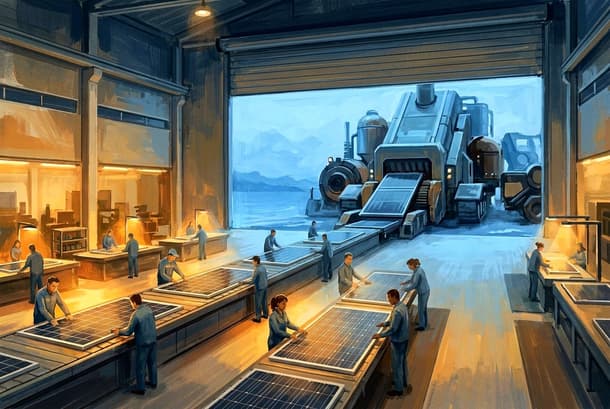
Solar manufacturing is often described as though a photovoltaic module were a single product. It is actually the final stage of a demanding sequence. Quartz must be converted into metallurgical silicon and then purified into solar-grade polysilicon. The polysilicon is melted and grown into ingots, which are sliced into thin wafers. Wafers are textured, doped, passivated and metallised to become cells. Cells are electrically connected, laminated between glass and protective layers, framed and fitted with junction boxes to become modules.
Module assembly is important, but it is the least technologically difficult part of the chain. A modern module line can be established comparatively quickly by purchasing proven equipment. Cell production demands much tighter control of surface chemistry, contamination, temperature, film thickness, contact resistance, optical loss and manufacturing yield. Polysilicon, ingot and wafer production impose additional requirements involving chemical purification, crystal growth, precision sawing and energy-intensive process control. The further upstream the chain moves, the greater the accumulated know-how and capital risk.
Bharat has achieved rapid growth in downstream capacity. An official renewable-energy review for 2025 reported approximately 144 GW per year of solar-module manufacturing capacity enlisted under the Approved List of Models and Manufacturers, compared with about 24 GW of enlisted cell capacity. The July 2026 assessment places actual cell capacity at roughly 27 GW and gives a broader module-capacity range of 144–210 GW. Domestic module demand was approximately 40 GW annually, demonstrating how sharply capacity peaks at the assembly stage and narrows upstream.
The Production Linked Incentive scheme for high-efficiency photovoltaic modules has played a constructive role. With an outlay of ₹24,000 crore, it has encouraged large plants and greater domestic value addition. Yet awarded or announced capacity should not be confused with commissioned, qualified and consistently productive capacity. A line that exists on paper, a line undergoing trials and a line producing bankable cells at high yield are economically different assets. Policy evaluation must distinguish between them.
Technology ownership presents a deeper concern than capacity alone. Much of Bharat’s high-efficiency cell production relies on process platforms developed abroad, including passivated emitter and rear contact, tunnel oxide passivated contact and heterojunction technologies. A licence allows a factory to operate a known process, but it does not necessarily transfer the tacit knowledge required to improve that process or invent its successor. Recipes, equipment settings, defect libraries, yield-improvement methods and reliability data may remain concentrated with the original technology provider.
This dependence becomes more serious because solar technology does not stand still. PERC has been displaced by higher-efficiency TOPCon and heterojunction architectures in many new plants, while silicon–perovskite tandem cells are approaching commercial relevance. When a new generation becomes competitive, a licensed factory may require new intellectual property, redesigned tools and extensive process requalification. If those assets remain foreign-controlled, domestic assembly capacity can become technologically obsolete even while the physical factory is relatively new.
Bharatiya research has demonstrated genuine promise. The source analysis notes that an IIT-incubated enterprise achieved a reported silicon–perovskite tandem-cell efficiency of 29.8 per cent, close to the international research frontier. The missing bridge lies between laboratory performance and stable mass production. A record cell may be measured on a small area under controlled conditions; commercial success requires large-area uniformity, high throughput, low degradation, safe encapsulation, reliable field performance and competitive cost over millions of units.
The funding imbalance is therefore consequential. The cited assessment estimates that a principal solar-research centre at IIT Bombay received about ₹200 crore over 15 years, while deployment programmes can spend a comparable sum within weeks. Deployment creates immediate capacity and should continue, but without sustained research it mainly expands demand for technology developed elsewhere. A credible sovereignty programme requires national pilot lines, shared metrology facilities, accelerated ageing laboratories, industry–university engineering teams and long-duration funding that survives annual budget cycles.
Closing the solar gap means building competence across selected portions of the entire chain rather than attempting every activity simultaneously. Priorities should include domestic cell-process development, high-quality wafers, commercially viable polysilicon, silver-saving metallisation, advanced encapsulants, power electronics and the equipment used for deposition, diffusion, annealing, printing and inspection. Success should be measured not only in gigawatts but also in efficiency, yield, degradation, domestic intellectual property, equipment localisation and the ability to upgrade a production line without waiting for a foreign licensor.
Technology gap two: battery cells, chemistry and process knowledge
The distinction between a battery pack and a battery cell is as important as the distinction between a solar module and a solar cell. A pack combines cells with structural components, cooling, wiring, sensors, contactors, safety devices and a battery-management system. These activities can create significant domestic value. The electrochemical cell, however, contains the core technology that determines energy density, cycle life, charging speed, temperature behaviour, safety and much of the final cost.
Cell production begins with precisely engineered cathode and anode materials. Powders are mixed with conductive additives and binders, coated onto metal foils, dried, compressed, cut and assembled with separators. Electrolyte is introduced under tightly controlled moisture conditions. The cells then undergo formation and ageing cycles that create the solid-electrolyte interface and reveal early defects. Minor variations in coating uniformity, contamination, porosity or formation protocol can produce major differences in safety and service life.
Bharat has historically imported almost all lithium-ion cells used in electric vehicles, electronics and stationary storage. The ₹18,100-crore Advanced Chemistry Cell PLI programme targets 50 GWh of domestic capacity. An official year-end review reported that 40 GWh had been awarded to four beneficiaries by late 2025, but only one beneficiary had established a 1 GWh plant and was still stabilising pilot production. The source assessment uses a broader measure equivalent to approximately 2.8 per cent of the target. The precise percentage depends on whether installed, commissioned or scheme-qualified output is counted, but every measure confirms that large-scale commercial production remained at an early stage.
Patent statistics also indicate a large knowledge asymmetry, although raw counts must be interpreted carefully because patent families, jurisdictions and defensive filings can inflate comparisons. The source contrasts single-digit lithium-ion holdings at two major Bharatiya battery firms with tens of thousands associated with China’s CATL. The exact totals matter less than the underlying pattern: global leaders have spent decades combining chemistry research, manufacturing data, supplier relationships and field feedback, whereas many domestic projects begin with a licensed design and imported equipment.
A factory built under licence can still be strategically useful. It trains workers, develops suppliers, creates quality systems and introduces production discipline. The danger arises when licensing becomes a permanent ceiling. Without the capacity to alter electrodes, electrolytes, separators, formation cycles and machine settings, the manufacturer cannot respond independently to a mineral shortage, a safety problem or a new vehicle requirement. The facility then represents manufacturing located in Bharat but technology controlled elsewhere.
Battery sovereignty should not be reduced to a single chemistry. Lithium iron phosphate offers thermal stability, long life and freedom from nickel and cobalt, making it attractive for mass-market mobility and stationary storage. Nickel-rich chemistries retain advantages where high energy density is essential. Sodium-ion cells may eventually serve cost-sensitive vehicles and grid storage while reducing lithium dependence. Solid-state systems remain a longer-term prospect. Bharat should build adaptable scientific and manufacturing capability capable of evaluating these pathways rather than committing the entire ecosystem to one imported recipe.
Raw-material strategy is equally important. Domestic cell production can still depend on imported lithium compounds, purified graphite, cathode-active material, separators, electrolyte salts and specialised additives. Overseas mineral partnerships can reduce concentration risk, but they should be accompanied by domestic refining, precursor production and recycling. Used electric-vehicle and stationary-storage batteries will eventually become a significant urban resource containing lithium, nickel, cobalt, copper, aluminium and graphite. Collection standards, second-life assessment and high-recovery recycling can convert waste management into strategic supply.
Safety and reliability must remain non-negotiable. Rapid localisation pursued without rigorous testing could produce fires, recalls and a public loss of confidence in electric mobility. National laboratories and accredited private facilities should test cells for thermal propagation, vibration, crush, overcharge, fast charging, calendar ageing and performance under Bharatiya temperature conditions. Domestic technology should compete by being safer and better suited to local roads and climate, not merely by satisfying a local-content percentage.
Technology gap three: electrical steel for transformers and motors
Electrical steel attracts less public attention than solar panels or batteries, yet it may be the most immediate physical bottleneck. Cold-rolled grain-oriented steel, commonly called CRGO, is engineered so that its magnetic grains align in a preferred direction. This reduces energy loss inside transformer cores. Non-grain-oriented electrical steel has more uniform magnetic properties in different directions and is used in rotating machines, including electric motors, generators and compressors.
The strategic contradiction is striking. Bharat is the world’s second-largest steel producer and produced approximately 168 million tonnes in the year cited by the source. It nevertheless imported an estimated $8–10 billion of specialised grades that domestic industry could not supply in sufficient quality or quantity. For CRGO alone, annual demand was around 400,000 tonnes, while domestic production was only about 50,000 tonnes. Imports from Japan, South Korea, China and Russia filled most of the gap at a cost approaching $1 billion annually.
The Ministry of Steel has acknowledged the depth of the problem. A government statement on the specialty-steel PLI programme noted that CRGO production technology was not available with Indian steelmakers. This does not mean that Bharat lacks metallurgical expertise; research institutions and steel companies have pursued indigenous process development for years. It means that commercially proven, fully integrated and competitive capability has not yet reached the scale required by the transformer industry.
The manufacturing challenge extends far beyond adding silicon to steel. Producers must control chemistry, inclusions, slab preparation, hot rolling, repeated cold reduction, decarburisation, inhibitors, primary recrystallisation, high-temperature annealing, secondary recrystallisation, domain refinement and insulation coatings. The result must meet stringent limits for core loss, permeability, thickness variation and surface quality. A process that is almost correct can still create a transformer that wastes substantial electricity throughout decades of operation.
A major joint-venture expansion in Nashik is expected to raise combined domestic CRGO capacity to roughly 350,000 tonnes by financial year 2027–28. This is an important industrial step, but it would approximately match demand from several years earlier. If demand continues growing at the estimated rate of 10–12 per cent annually, the market could exceed 500,000 tonnes by the time the new capacity is fully operational. The import gap may therefore narrow without disappearing.
Non-grain-oriented steel creates a parallel challenge. High-speed traction motors need thin, low-loss grades with carefully controlled magnetic and mechanical properties. As electric-vehicle production rises, dependence on imported motor steel can limit localisation even when the vehicle body, battery pack and final motor assembly are domestic. Energy independence therefore depends on metallurgical capabilities that are nearly invisible to the consumer.
This bottleneck affects the entire electrification plan. More renewable generation requires more transformers. Electric cooking and air-conditioning increase distribution loads. Charging depots for buses and trucks may require substantial local network reinforcement. Industrial electrification adds high-capacity substations and motors. If transformer steel, motor steel or qualified manufacturing capacity is unavailable, gigawatts of generating capacity cannot be converted into dependable electricity at the point of use.
Technology gap four: production machinery and processed materials
The fourth deficiency lies beneath the first three and helps explain their persistence. A domestic factory may contain imported production equipment, rely on imported control software and consume imported processed materials. In that situation, the location of assembly has changed but the strategic point of control has not. Export restrictions, geopolitical pressure or the withdrawal of technical support can still interrupt production.
Solar-cell lines require crystal-growth systems, diamond-wire saws, wet-chemistry tools, diffusion furnaces, plasma-enhanced chemical-vapour-deposition equipment, atomic-layer-deposition tools, screen printers, laser systems and automated optical inspection. Battery plants require mixers, precision coaters, dryers, calenders, slitters, winding or stacking machines, electrolyte-filling systems and formation equipment. Electrical-steel facilities require specialised rolling mills, annealing furnaces, coating lines, sensors and magnetic-quality laboratories. These are not generic machines that can be substituted overnight.
Equipment ownership matters because manufacturing improvement occurs through continuous interaction between product and process. A cell designer may need a new coating profile, furnace atmosphere or laser pattern. If the machine builder is domestic, that modification can become a collaborative engineering project. If the tool is a closed imported platform, the manufacturer may have to wait for an overseas supplier, disclose proprietary information or accept that the desired modification is unavailable.
Processed materials create another layer of dependence. Bharat has only limited upstream polysilicon capacity relative to its very large module base. Battery plants depend on imported active materials, separators, electrolytes and graphite. Transformer and motor manufacturers depend on specialised steel, coatings and insulation. Even where the underlying mineral exists domestically, refining it to battery, solar or electrical grade may demand technologies that have not yet been industrialised.
Supply-chain depth should consequently be measured through a map of critical functions rather than a simple percentage of local expenditure. A domestically purchased aluminium frame may raise local value addition without reducing strategic vulnerability. By contrast, a small quantity of imported separator film, electrolyte salt or transformer steel may stop an entire factory. Policy should identify inputs according to substitutability, supplier concentration, lead time and system-wide consequence.
Why production capacity can remain technologically hollow
Existing industrial policy should not be dismissed as a failure. Production incentives, tariffs, procurement rules and the Approved List of Models and Manufacturers have created factories, employment and supplier networks at a speed that market forces alone may not have delivered. Starting with modules before polysilicon, battery packs before cells and conventional steel before specialised grades is a defensible sequence. Complex industrial capability is normally accumulated in stages.
The weakness lies in treating production volume as the final objective. A scheme may reward every eligible unit produced without asking whether efficiency improved, process intellectual property became domestic, imported tools were replaced, engineering capability deepened or the beneficiary advanced from licensee to co-developer. Under such rules, a factory operating mature foreign technology can receive the same support as one taking the greater risk of developing a Bharatiya process.
Domestic value-addition formulas can also be misleading. They generally measure the monetary value of local inputs, not the strategic importance of the technology. Labour, land, glass, packaging and structural components may account for a respectable domestic share while the cell design, machine tools, processed materials and upgrade pathway remain external. A more meaningful framework would combine value addition with measures of intellectual property, process control, engineering autonomy and supply-chain criticality.
The objective should not be compulsory invention of every component. International licensing and joint ventures can accelerate learning when contracts include training, source access, co-development, domestic engineering teams and the freedom to improve the process. The relevant question is whether imported knowledge is being absorbed and extended. A temporary licence can be a bridge; an indefinitely renewed licence with no domestic learning becomes a structural dependency.
A performance staircase for industrial incentives
Public support should be tied to a rising sequence of engineering outcomes. Each stage should be demanding but achievable, announced far enough in advance for firms to invest, and reviewed at fixed intervals. The next tranche of assistance should depend on verified progress rather than the passage of time. Protection that never expires can preserve inefficiency, while targets without research support can become bureaucratic paperwork. The two instruments must operate together.
For solar manufacturing, performance indicators could include module efficiency, cell efficiency, production yield, temperature coefficient, long-term degradation, domestic process ownership and the share of critical production equipment made or co-developed in Bharat. Targets should evolve with global technology. A plant should not receive indefinite protection for producing an architecture that is falling behind the international frontier.
Battery support should evaluate gravimetric and volumetric energy density, cycle life, fast-charging performance, safety, production yield, domestic material processing, recycled content and the ability to alter chemistry. Different thresholds would be appropriate for buses, two-wheelers, passenger cars and stationary storage because their engineering priorities differ. A lower-energy but safer and longer-lived cell may be superior for the grid even if it would be unsuitable for a premium automobile.
Electrical-steel incentives should be linked to core loss at specified magnetic flux, permeability, thickness, consistency, customer qualification and the localisation of critical process stages. Transformer and motor manufacturers should participate in target design because a nominally domestic grade has little value if users cannot qualify it for efficient equipment. Support should encourage joint development between steelmakers, utilities, motor producers, research laboratories and equipment suppliers.
Research funding must be large enough to survive technical failure. The source proposes a dedicated solar-research fund of approximately ₹2,000 crore annually, separated from deployment expenditure. A broader energy-technology mission could support solar, batteries, electrical steel, power electronics, grid software and manufacturing equipment through multi-year competitive programmes. Funding should cover laboratories, pilot production, reliability testing and demonstration—not only academic publications or factory construction.
Public pilot lines would be particularly valuable. Startups and university groups often cannot afford industrial-scale tools, while established manufacturers are reluctant to interrupt commercial lines for experimental processes. Shared facilities would allow new cells, coatings, electrodes and steel treatments to be tested at meaningful scale. Clear rules for intellectual-property ownership and confidential access would enable collaboration without forcing innovators to surrender their core advantage.
Smaller firms also require a route into industrial policy. Schemes designed around very large investment thresholds naturally favour established conglomerates. Yet disruptive technology frequently emerges from specialised enterprises that initially lack a large balance sheet. Milestone-based grants, credit guarantees, patient equity, challenge competitions and government-backed first orders can help technically credible firms cross the gap between prototype and bankable production.
Government procurement can become a disciplined first customer without becoming a captive buyer. Utilities, public transport agencies and public buildings could reserve limited demonstration volumes for products that meet rigorous safety and performance standards. Field data should be shared with manufacturers under appropriate confidentiality rules. Successful products could then graduate into competitive procurement, while unsuccessful trials would produce engineering knowledge rather than permanent subsidy entitlement.
Patient finance is equally necessary. Solar modules can produce revenue soon after installation, but a new cell chemistry or metallurgical process may require years of qualification. Commercial lenders are poorly positioned to absorb that uncertainty. Development-finance institutions, sovereign funds, pension capital and strategic corporate investors can provide longer-duration funding, provided that milestones are technically audited and failure is treated as an expected feature of innovation rather than automatic evidence of misconduct.
Human capital completes the system. Bharat needs more electrochemists, metallurgists, process engineers, tool designers, reliability specialists, technicians and manufacturing-data experts. Academic curricula should incorporate pilot-scale work, while industry fellowships should allow researchers and factory engineers to move between institutions. Technology is not transferred merely by purchasing drawings; it is absorbed by people who understand why a process behaves as it does and can diagnose unexpected failure.
Electrification must remain practical for households and industry
Cooking electrification should proceed through consumer choice, reliable supply and economic incentives rather than abrupt withdrawal of LPG. Induction appliances, compatible cookware, wiring upgrades and affordable tariffs create upfront costs. Some regions also need a backup cooking option during outages. Targeted financing, time-of-use tariffs and appliance-efficiency standards can reduce these barriers. The objective is a steady decline in imported LPG exposure without transferring risk to low-income families.
Transport requires a similarly differentiated approach. Two-wheelers, three-wheelers, urban buses and predictable commercial fleets often offer the clearest early opportunities because their routes and charging needs are manageable. Long-distance freight presents more demanding requirements involving battery weight, charging power and depot infrastructure. Rail electrification, public transport, biofuels and efficiency improvements should therefore complement battery-electric vehicles rather than being treated as competing ideologies.
The grid must expand before additional demand becomes a reliability problem. Distribution transformers, substations, conductors, smart meters, storage and digital control systems need coordinated investment. Flexible tariffs can shift vehicle charging and some cooking loads away from the evening peak. Pumped hydro, batteries, thermal storage, demand response and stronger interstate transmission can help integrate variable renewable generation. The transition is a system-engineering project, not a collection of isolated factories.
Bharat’s renewable foundation is already substantial. The Ministry of New and Renewable Energy reported 157.05 GW of installed solar capacity and 56.81 GW of wind capacity by 31 May 2026. This scale creates a large domestic market through which technology can improve. It also raises the cost of continued dependence: every new gigawatt installed with imported critical components expands exposure unless domestic knowledge and supply chains grow at the same time.
A ten-year national technology mission
During the first three years, the priority should be measurement and institutional construction. The government should publish critical-supply-chain maps, distinguish announced capacity from qualified output, establish pilot lines and reliability laboratories, fund competitive research programmes, and introduce rising technology conditions into new incentive contracts. Strategic reserves and supplier diversification should continue because domestic technology cannot mature instantly.
Between years three and seven, successful prototypes should move into commercial demonstration. Domestic cell processes, battery materials, recycling systems, electrical-steel grades and selected machine tools should receive first-customer support subject to transparent performance tests. Industrial clusters should connect research institutes, equipment makers, material suppliers and end users. Joint ventures should be evaluated according to the knowledge absorbed by Bharatiya teams, not merely the capital invested.
Between years seven and ten, support should shift toward international competitiveness. Firms that have achieved scale and technological maturity should face declining protection and stronger export discipline. Public funds should move toward the next generation of technology rather than preserving the previous one. The desired outcome is not a permanently subsidised domestic market but a group of Bharatiya companies capable of licensing technology, exporting equipment and competing on quality.
Conventional resilience tools will remain necessary throughout this transition. Strategic petroleum reserves, diversified crude and LPG contracts, naval capacity, shipping insurance, port infrastructure and emergency allocation mechanisms are indispensable safeguards. Technology sovereignty does not replace them. It reduces the frequency and scale at which they must be used by lowering the economy’s structural demand for vulnerable imported fuel.
The 2026 Hormuz disruption demonstrated that Bharat can manage a severe but finite emergency. The deeper lesson is that successful crisis management should create space for structural reform, not complacency. Replacing a Gulf cargo with one from the Americas changes the route of dependence. Replacing imported fuel with electricity generated at home changes its nature. Designing and manufacturing the solar cells, battery cells, electrical steel, machinery and processed materials behind that electricity begins to remove the dependence itself.
Bharat’s energy independence will ultimately be determined as much in laboratories, pilot plants and precision factories as in oilfields, ports and naval corridors. Production volume remains essential, but technological ownership determines whether that production can survive the next embargo, export restriction or generational shift. Closing the four gaps is therefore not a narrow manufacturing agenda. It is a national project linking economic resilience, household welfare, clean energy, scientific capability and strategic autonomy.
Inspired by this post on Hindu Post.
