

Priyank Kharge’s reported remark, “Ninety percent of the kesar (saffron) comes from Islamic countries. If I say this, will people stop applying the tilak?”, has drawn attention because it connects two very different subjects: the global trade in saffron and the religious practice of applying tilak. The remark may have been framed as political rhetoric, but its cultural premise requires careful examination. In Hindu practice, tilak is not a single substance, nor is it uniformly made from saffron. It is a sacred mark shaped by sampradaya, region, family tradition, temple custom, personal vrata, and the deity being worshipped.
The controversy illustrates a wider problem in public discourse: religious symbols are often discussed through simplified political categories rather than through their ritual, historical, and cultural contexts. A tilak seen on the forehead of a devotee may be kumkum, turmeric, sandalwood paste, vibhuti, gopi chandan, sindoor, raksha from a yajna, or a mixture prepared in a temple. The meaning of the mark does not come merely from colour. It comes from its ritual use, the tradition that transmits it, and the devotional intention with which it is applied.
In many Hindu homes, the daily tilak is prepared from materials that are far more common than saffron. Kumkum is widely used in Devi worship and household puja. Vibhuti is central to many Shaiva traditions. Gopi chandan is important in several Vaishnava sampradayas. Sandalwood paste is used across temples and homes because of its cooling quality, fragrance, and ritual association with purity. Turmeric is used in auspicious ceremonies, vrata observances, and Devi-related practices. Saffron has sacred value, but it is not the everyday base of most Hindu forehead marks.
The distinction matters because Hindu Dharma preserves meaning through precise ritual categories. Saffron, kumkum, turmeric, sandalwood, vibhuti, and chandan are not interchangeable simply because some of them may appear red, orange, yellow, or ochre. Each material carries a different history of preparation and symbolism. Collapsing them into one category creates confusion about Hindu religious practice and weakens public understanding of India’s cultural traditions.
Saffron, or kesar, is a precious botanical spice. It is obtained from the dried stigmas of Crocus sativus, commonly known as the saffron crocus. Each flower produces only a small number of usable stigmas, which explains why saffron is expensive and labour-intensive. It is cultivated in regions such as Iran, Afghanistan, Kashmir, Spain, Greece, and Morocco. Reports and agricultural references commonly identify Iran as the dominant producer in global saffron production, though Kashmir retains a distinct place in Bharat’s saffron heritage.
In Hindu traditions, saffron is valued for fragrance, colour, purity, and sanctity. It may be used in temple rituals, abhishekam, prasad preparation, Ayurvedic formulations, festive offerings, and special mixtures of chandana. The colour bhagwa, associated with saffron and ochre, has a separate symbolic life in Hindu civilization. It evokes renunciation, tapas, courage, sacrifice, spiritual discipline, and the pursuit of knowledge. Sannyasis and many Hindu monks wear saffron or ochre robes not because the cloth is literally made of saffron, but because the colour communicates a life dedicated to transcendence and self-restraint.
Kumkum is a ritual powder, not saffron. Traditional kumkum is commonly prepared from turmeric processed with slaked lime. Turmeric contains curcumin, and when it reacts in an alkaline medium, its yellow colour changes toward red. This simple but culturally rich preparation has long been used in Hindu homes and temples. Kumkum is offered to deities, applied as tilak or bindi, distributed after puja, and used in ceremonies connected with auspiciousness, prosperity, and Devi Shakti.
The word kumkum itself has a sacred resonance in Hindu religious life. It is not merely cosmetic powder. In puja, it is connected with mangala, or auspiciousness. In Devi worship, it is associated with shakti, fertility, protection, and the living presence of the Divine Feminine. Married Hindu women apply kumkum in many regional traditions as a sign of saubhagya and continuity of family dharma. In temples, kumkum received after darshan is often treated as prasada because it has been ritually offered and blessed.
The theological meaning of kumkum becomes clearer when its place on the body is considered. The forehead, especially the area between the eyebrows, is traditionally associated with the Ajna Chakra, concentration, insight, and spiritual awareness. Applying tilak there is not a random decorative act. It becomes a reminder that daily life should remain connected to dharma, self-discipline, reverence, and the Divine. Even when devotees differ in philosophy, region, language, or sampradaya, the act of applying a sacred mark often expresses the same inner orientation: the body is not separate from worship.
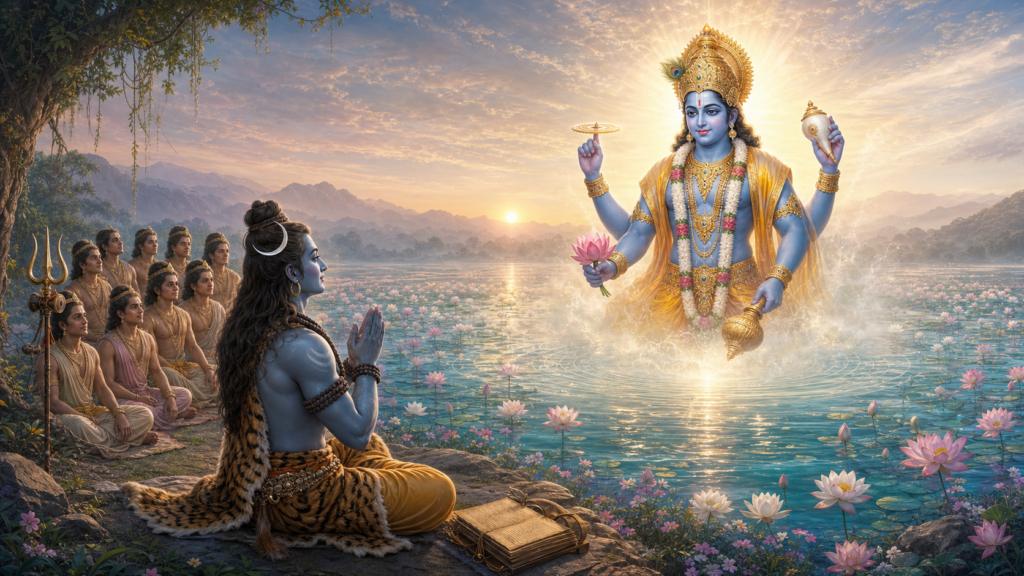
Hindu traditions also demonstrate remarkable diversity in tilak forms. Shaiva devotees may use vibhuti in horizontal lines, recalling the transient nature of the body and the purifying power of Shiva. Vaishnava devotees may apply urdhva pundra with gopi chandan, signifying surrender at the feet of Vishnu or Krishna. Shakta devotees may apply kumkum as a mark of Devi’s grace. Smarta households may use sandalwood, turmeric, kumkum, or sacred ash depending on the occasion. Regional customs add further variety, from Maharashtra’s kunku to South Indian kumkumam and temple-specific prasada marks.
This plurality is not confusion. It is one of the defining strengths of Hindu Dharma. A single civilization can honour Shiva, Vishnu, Devi, Surya, Ganesha, Skanda, village deities, kula devatas, gurus, and sacred rivers while maintaining shared values of reverence, self-discipline, purity, and devotion. The tilak is therefore both personal and civilizational. It may identify a lineage, but it also participates in a broader Dharmic grammar of sacred embodiment.
For this reason, reducing tilak to a question of imported saffron misunderstands both material practice and religious meaning. Even if a large share of saffron in global markets comes from Muslim-majority countries, that fact does not determine whether Hindus apply tilak. Most tilaks are not made from saffron. Where saffron is used, it is used as a sacred ingredient within a ritual framework, not as a political endorsement of any country’s religious identity. Trade routes, agricultural production, and devotional symbolism operate in different categories.
Historically, Bharatiya civilization has never treated all cultural exchange as religious surrender. Spices, textiles, ideas, scripts, philosophical arguments, artistic forms, and trade goods have moved across regions for centuries. Hindu, Buddhist, Jain, and Sikh traditions all emerged in a civilizational space that understood exchange without erasing identity. A material may travel through commerce, but its ritual meaning is shaped by the tradition that receives, sanctifies, and uses it.
There is also an important difference between saffron as a spice and bhagwa as a sacred colour. Bhagwa does not depend on the market origin of saffron threads. The colour is embedded in the vocabulary of renunciation, tapasya, knowledge, and sacrifice. It appears in robes, flags, temple aesthetics, festival imagery, and the memory of saints and warriors. Its symbolic force comes from centuries of religious and cultural association, not from the import statistics of a spice commodity.
Public representatives have a special responsibility when speaking about religious practices. Political debate may be sharp, but claims about living traditions should be historically informed and culturally literate. Hindu practices such as tilak, kumkum, vibhuti, chandan, and gopi chandan are not marginal habits; they are part of the everyday devotional vocabulary of millions. For many devotees, the tilak placed after morning puja, temple darshan, a family ceremony, or a festival is emotionally intimate. It connects the individual to home, elders, deities, lineage, and memory.
The issue, therefore, is not whether political leaders may criticise religious organisations or ideological movements. In a democracy, criticism is legitimate. The issue is whether criticism should rest on an accurate understanding of the practices being invoked. When a sacred symbol is used as a rhetorical device without adequate knowledge, it risks turning a complex tradition into a caricature. Such simplification does not contribute to social harmony or serious public reasoning.
A more constructive approach would distinguish between politics and religious literacy. If the discussion concerns the RSS, Congress, Karnataka politics, or public ideology, it should be argued on those grounds. If the discussion invokes tilak, kumkum, kesar, or Hindu rituals, it should respect the technical and devotional meanings those practices carry. Academic honesty requires that religious customs be examined as they are lived, not as convenient metaphors in partisan exchanges.
The broader Dharmic perspective also encourages unity rather than unnecessary antagonism. Hinduism, Buddhism, Jainism, and Sikhism each maintain distinctive practices, but all have contributed to the sacred culture of Bharat through discipline, ethical life, reverence, and the search for truth. The responsible way to discuss Dharmic traditions is to deepen understanding, not inflame division. Sacred marks, robes, malas, ashes, chandan, and ritual powders should be studied with care because they carry centuries of lived memory.
Kharge’s remark, as reported, ultimately reveals less about tilak than about the danger of speaking about religious culture through incomplete assumptions. Kesar is a rare and revered spice. Kumkum is a sacred ritual powder. Tilak is a broad Dharmic practice with many materials and meanings. Bhagwa is a civilizational colour of renunciation and courage. These categories overlap in public imagination, but they are not the same. Respectful discourse begins by recognizing that difference.
Hindu Dharma has endured because it combines continuity with diversity. It allows different sampradayas to preserve their own marks, mantras, materials, and modes of worship while remaining part of a larger sacred civilization. The daily tilak on a devotee’s forehead is one small sign of that continuity. It cannot be reduced to saffron imports, political provocation, or commodity geography. It belongs to a deeper world of worship, identity, discipline, and inherited reverence.
Inspired by this post on Hindu Post.


Leave a Reply
You must be logged in to post a comment.