
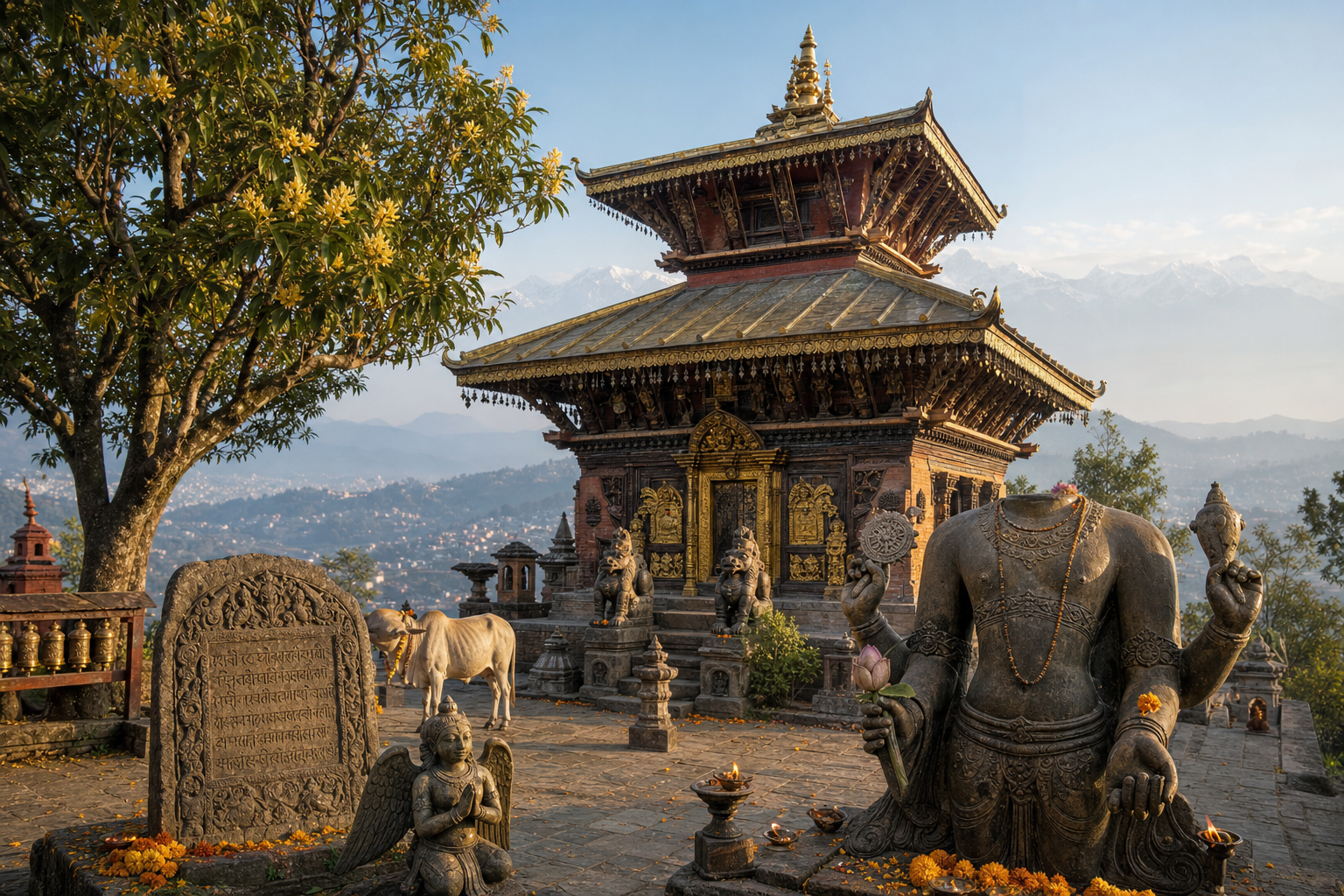
Changu Narayan, known in Nepal as चाँगुनारायण मन्दिर, stands on a wooded ridge above the Kathmandu Valley in the Bhaktapur district. The shrine is dedicated to Bhagavan Vishnu as Narayana, yet its fame rests not only on antiquity, architecture, and royal inscriptions, but also on a striking sacred memory: the story of Vishnu appearing without a head. In that image, the temple preserves a profound teaching on ego, repentance, divine justice, and the possibility of purification.
The temple is widely regarded as one of Nepal’s oldest surviving Hindu temples and among the most important Vaishnava pilgrimage sites of the Himalayan region. It forms part of the Kathmandu Valley UNESCO World Heritage property, a cultural landscape where Hindu and Buddhist traditions have lived in close conversation for centuries. Unlike a museum monument frozen in time, Changu Narayan remains a living temple, where ritual, local memory, sculpture, and scholarship continue to meet.
The historical importance of Changu Narayan is anchored by the celebrated Licchavi inscription associated with King Manadeva, dated to 464 CE. This Sanskrit inscription is among the earliest known epigraphic records of Nepal and is central to the study of Nepalese history, kingship, religion, and political culture. For historians, it confirms that the site was already significant in the early medieval period. For devotees, it reinforces the sense that Narayana’s presence on this hill has been honored across many generations.
The temple’s setting strengthens its sacred atmosphere. Changu Narayan is situated on a hill historically associated with Dolagiri and surrounded in tradition by champaka trees. A visitor approaching the complex encounters not merely a building, but a layered sacred geography: the hill, the courtyard, the stone images, the Garuda figures, the wooden struts, the subsidiary shrines, and the living practices of worship. The physical ascent toward the temple mirrors an inner ascent from ordinary perception toward reflection and reverence.
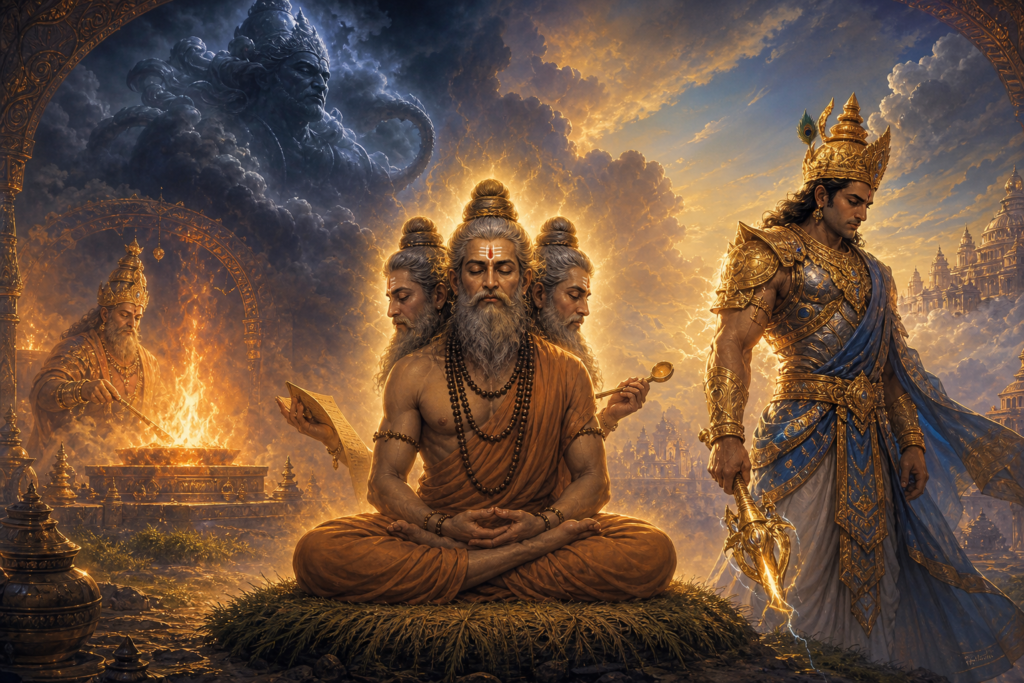
The famous legend of the headless Vishnu is preserved in local tradition and later textual retellings. According to the narrative, a Brahmin named Sudarshan lived near a great champaka tree and owned a sacred Kapila cow. The cow’s milk was used for offerings, and therefore its disappearance became a matter of religious concern. When the cow began returning without milk, Sudarshan followed it and discovered that a radiant figure emerged from the tree and drank the milk. Overcome by anger and unable to recognize the divine presence before him, he struck the figure with a sword and severed its head.
Only after the act did the truth become clear: the figure was Bhagavan Vishnu. The deity manifested with divine attributes such as the conch, discus, mace, and lotus, and the stunned Brahmin was filled with remorse. The story then deepens beyond a simple miracle tale. Vishnu explains that the event was connected with an earlier karmic episode involving the death of a Brahmin named Sumati during a battle with the demon Chandra. Because of that act, Shukracharya had pronounced that Vishnu would one day be beheaded by a descendant of Sumati. Sudarshan’s action, while morally troubling, fulfilled a cosmic consequence already woven into the narrative fabric.
This legend is not a crude story of divine injury. It is a theological meditation on karma, responsibility, and the limits of human perception. Sudarshan’s anger blinds him; he sees theft where there is mystery, intrusion where there is grace, and wrongdoing where there is a hidden divine play. The severed head becomes an icon of humbled certainty. In the presence of Narayana, human ego is shown to be fragile, reactive, and often unable to recognize the sacred when it appears in unexpected form.
The narrative also reveals an important feature of Hindu thought: divinity is not diminished by entering into the moral order of the world. Vishnu’s acceptance of karmic consequence does not reduce his divinity; it reveals cosmic integrity. Dharma is not presented as a rule imposed only on the weak. Even divine narratives demonstrate that actions have consequences, vows carry power, and repentance opens the way to restoration. This is one reason the story continues to speak across time.
The headless Vishnu of Changu Narayan therefore becomes a powerful symbol of humility. The head often represents intellect, pride, argument, and self-assertion. Its removal in this sacred story can be read as the end of ego-centered perception. Where ego ends, the divine begins to be seen more clearly. The temple’s memory does not glorify violence; rather, it transforms a violent moment into a lesson about self-restraint, recognition, repentance, and surrender.
Changu Narayan’s iconography expands this teaching through stone and wood. The temple courtyard includes important images associated with Vishnu, including Garuda Narayan, Vaikuntha Vishnu, Vishnu Vikrant or Trivikrama, Narasimha, and Vishvarupa themes connected with the Bhagavad Gita. These forms present Vishnu as protector, cosmic sovereign, avatara, and inner guide. Together they show the Vaishnava understanding of the divine as both transcendent and intimately present in the moral struggles of the world.
The presence of Garuda is especially significant. Garuda is not merely Vishnu’s vehicle, but also a symbol of devotion, courage, and upward movement. In Changu Narayan’s artistic program, Garuda’s posture before Narayana teaches the discipline of surrender. The devotee does not approach the divine through arrogance, but through attentiveness. This visual theology complements the legend of Sudarshan, whose failure begins precisely in the absence of patient recognition.
The temple’s architecture is also a document of Nepalese sacred technology. The pagoda structure, timber roof system, carved struts, gilded doors, protective animal guardians, and sculptural panels all represent the Newar genius for combining ritual function with aesthetic refinement. The temple is not simply decorated; its visual structure teaches. Guardians at the entrances mark the transition from common space to sacred space. The roof struts carry both physical weight and symbolic meaning. The carved forms turn architecture into theology.
Changu Narayan also demonstrates the plural and interconnected character of dharmic civilization. The site is primarily Vaishnava, yet its sacred environment includes connections with Shiva, Shakti, Krishna, and local protective deities. Buddhist reverence is also associated with the temple through the identification of the deity in some traditions with Hariharihari Vahan Lokeshwara. This does not erase Vaishnava identity; rather, it reflects the Kathmandu Valley’s long-standing pattern of layered devotion, where different dharmic communities honor sacred presence through their own theological languages.
This shared reverence is important in the modern world. Hinduism, Buddhism, Jainism, and Sikhism each preserve distinctive teachings, disciplines, and histories, yet they also share a civilizational respect for sadhana, ethical refinement, self-transformation, and liberation from ego. Changu Narayan offers a living example of how sacred spaces can sustain difference without hostility. Its story invites reflection not on sectarian competition, but on the deeper dharmic effort to overcome pride, anger, and ignorance.
The legend of Sudarshan is therefore psychologically relevant as well as theological. Human beings often react before they understand. A perceived loss becomes anger; anger becomes action; action becomes regret. The story captures this familiar sequence with unusual force. Its enduring value lies in the moment after recognition, when remorse is not wasted in despair but redirected toward worship, humility, and transformation. In that movement, the legend becomes a guide for ethical life.
The temple’s survival has not been without difficulty. Like many heritage structures in Nepal, Changu Narayan has faced earthquakes, theft, environmental pressures, and the challenges of conservation. The 2015 Nepal earthquake brought renewed attention to the fragility of Kathmandu Valley’s sacred architecture. Preservation here is not only about protecting old stones and timber; it is about preserving ritual memory, local craftsmanship, Sanskrit epigraphy, Newar artistic knowledge, and the devotional continuity of a community.
For students of Hindu temples, Changu Narayan offers an unusually rich case study. It combines early inscriptional history, Vaishnava theology, Himalayan sacred geography, Newar architecture, multi-tradition reverence, and a morally complex legend. The temple shows how Hindu sacred sites often function simultaneously as places of worship, archives of political history, repositories of art, and schools of philosophical reflection. Its importance cannot be reduced to a single category.
The story of Bhagavan Vishnu without a head should therefore be read with care. It is not a tale of divine weakness, but of divine teaching. It does not encourage fear of God, but reverence for dharma. It does not celebrate Sudarshan’s anger, but exposes its danger. It does not present karma as fatalism, but as a moral order within which even painful events can become occasions for awakening. The headless form becomes a mirror in which human pride sees its own incompleteness.
In the end, Changu Narayan remains powerful because it unites beauty with moral seriousness. The hilltop temple, the ancient inscription, the Garuda imagery, the Vaishnava sculptures, and the legend of the severed head all point toward one central insight: the divine is recognized only when ego becomes quiet enough to see. That is the enduring gift of Changu Narayan to Nepal, to Vaishnava tradition, and to the wider dharmic world.
Further reading may be found through the UNESCO World Heritage Centre’s Kathmandu Valley listing at https://whc.unesco.org/en/list/121/ and general historical summaries of Changu Narayan at https://en.wikipedia.org/wiki/Changu_Narayan_Temple. These references are useful starting points for understanding the site’s heritage status, inscriptional importance, and place within Nepal’s temple history.
Inspired by this post on Hindu Blog.





Leave a Reply
You must be logged in to post a comment.