
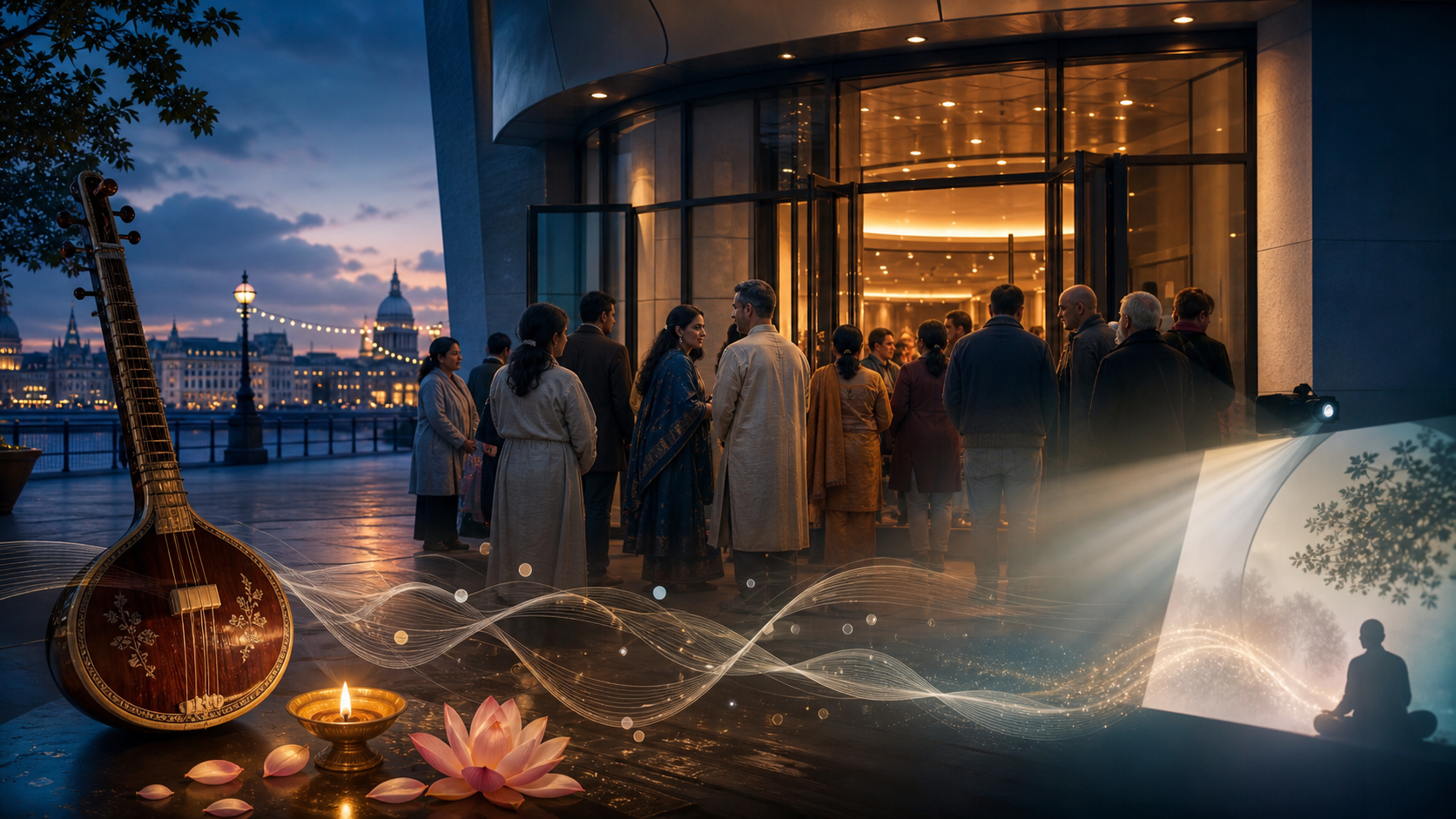

The Song of Grace, presented through its official trailer and announced in connection with a UK premiere at Riverside Studios, invites a careful reading as more than a routine film announcement. The available source material is minimal, yet the title, trailer format, and premiere setting together create a meaningful cultural frame: a work that appears to place spiritual feeling, artistic expression, and public gathering at the centre of its identity. In that sense, the trailer is not merely a promotional object; it is a threshold into a larger conversation about grace, music, memory, and the continuing relevance of spiritual cinema in contemporary public life.
The phrase “song of grace” carries a wide emotional and philosophical range. A song suggests rhythm, voice, devotion, repetition, and embodied memory. Grace suggests a movement beyond calculation: compassion received without bargaining, inner transformation that cannot be forced, and a softening of human ego before something greater than the self. Across Dharmic traditions, this language can be heard through concepts such as kripa, anugraha, prasada, compassion, humility, and the discipline of self-refinement. The title therefore resonates with audiences interested in Hindu spirituality, Buddhist compassion, Jain ethical restraint, and Sikh devotion, while also remaining accessible to viewers from other faiths and philosophical backgrounds.
A trailer, when approached academically, functions as a condensed argument. It selects images, sound, silence, pacing, typography, and emotional cues to tell viewers how a film wants to be received. In a spiritually themed work, these choices matter especially because the subject cannot be reduced to plot alone. Spiritual cinema often depends on atmosphere: a glance held a second longer than expected, a pause before speech, a musical phrase that suggests surrender, or a visual movement from darkness into light. The technical craft of such a trailer lies in its ability to imply inward transformation without exhausting the mystery of the full film.
The announcement of a UK premiere at Riverside Studios adds further significance. Riverside Studios in Hammersmith, London, describes its history as beginning on the site of a Victorian ironworks that became a film studio in 1933, later passed through an important BBC period, and then developed into a multi-arts venue. Its official history records associations with film, theatre, television, visual art, comedy, dance, and international performance. A premiere in such a venue places The Song of Grace within a lineage of cross-cultural artistic exchange rather than treating it as an isolated screening.
That setting matters for the Indian and Dharmic diaspora in the United Kingdom. London has long been a meeting place for religious communities, migrant memory, artistic experimentation, and intergenerational negotiation. A spiritually inclined film shown in such a city can become a shared cultural experience: elders may read it through the lens of devotion and tradition, younger viewers may approach it through cinema and identity, and seekers may encounter it as an invitation to reflect on the interior life. The public act of watching together turns a trailer and premiere into a community event.
The idea of grace has a particular depth in Hindu thought. In many devotional traditions, grace is not opposed to discipline; it completes discipline. A devotee may practice sadhana, chant, study scripture, serve others, and cultivate ethical conduct, yet the final transformation is often described as arriving through divine compassion. Shaiva, Vaishnava, Shakta, and Vedantic traditions each give distinct language to this relationship between effort and blessing. A film bearing the name The Song of Grace therefore naturally evokes the emotional world of bhakti, where music becomes a vehicle for surrender and remembrance.
Buddhist traditions approach the question from another angle, often emphasizing compassion, mindfulness, interdependence, and liberation from craving. While the vocabulary of grace may not operate in exactly the same way across Buddhist schools, the experience of unexpected compassion, the guidance of a teacher, and the transformation of suffering into wisdom are deeply familiar themes. A spiritually reflective film can therefore speak across doctrinal boundaries when it attends to shared human conditions: sorrow, longing, moral confusion, repentance, gratitude, and awakening.
Jainism contributes another crucial perspective through its emphasis on ahimsa, self-discipline, non-possessiveness, and the purification of karma. In a Jain ethical frame, grace may be understood less as an external intervention and more as the clarity that emerges when violence, pride, attachment, and carelessness are reduced. If a film asks audiences to listen for grace, it can also ask them to examine the subtle forms of harm that accumulate in ordinary life. That ethical seriousness is valuable for any cinema that seeks more than sentiment.
Sikh tradition, with its profound devotional music and theology of nadar, hukam, seva, and remembrance of the Divine Name, makes the word “song” especially resonant. The Guru Granth Sahib is not merely read; it is sung, heard, and lived through the disciplined beauty of kirtan. A title that joins song with grace can therefore be understood as pointing toward the transformative power of sacred sound. It suggests that music is not decoration but a path by which the heart becomes receptive to truth.
For this reason, the film’s title can be read as a bridge across Dharmic traditions. Hindu bhakti, Buddhist compassion, Jain restraint, and Sikh devotion do not collapse into one identical system, and they should not be treated as interchangeable. Yet they share a civilizational respect for disciplined inner life, ethical conduct, teacherly guidance, and the possibility that human beings can become more truthful, less selfish, and more compassionate. A blog committed to unity among Dharmic traditions can legitimately approach The Song of Grace through that shared horizon.
The technical value of a spiritual trailer depends on restraint. Commercial trailers often rely on spectacle, rapid escalation, and excessive exposition. By contrast, the most effective trailers for contemplative cinema allow silence and suggestion to do serious work. They reveal enough to establish emotional stakes while withholding enough to preserve contemplative attention. The viewer is not simply told what to think; the viewer is placed in a mood of inquiry. That distinction is important because spiritual subjects are easily weakened when handled with melodrama or slogans.
Sound design is especially central to a work framed by the word “song.” In cinema, sound can create theological and emotional space before any dialogue begins. A sustained note can evoke longing; a chant-like rhythm can suggest discipline; natural sound can restore attention to the present moment; silence can make the viewer aware of inner restlessness. If The Song of Grace uses music as more than background accompaniment, it may belong to a larger tradition of films where the sonic world carries spiritual meaning as strongly as the visual image.
Visual composition also shapes the viewer’s encounter with grace. Spiritual cinema often uses thresholds: doorways, rivers, roads, lamps, temples, stages, windows, and faces turned toward or away from light. These images work because they translate interior movement into visible form. A person standing at a doorway may represent moral hesitation; a river may suggest purification or passage; a lamp may indicate knowledge; a musical performance may become a form of offering. The trailer thumbnail alone cannot establish the full visual grammar of the film, but it does signal that the moving image is central to the viewer’s first encounter with the work.
The UK premiere dimension is also important from a cultural heritage perspective. Diaspora communities often carry memory through festivals, temples, gurdwaras, community halls, music schools, language classes, and now increasingly through cinema. A premiere becomes an occasion where heritage is not merely preserved but interpreted in a new public setting. It allows viewers to ask how spiritual vocabulary travels across geography, how devotional emotion survives migration, and how younger generations encounter inherited traditions through contemporary media.
There is also a broader academic point about representation. Films connected to spirituality must avoid reducing religious life to exotic imagery, decorative ritual, or generic inspiration. Responsible spiritual cinema should respect practice, context, discipline, and lived community. It should recognize that devotion is not escapism; it often emerges from struggle, responsibility, grief, service, and moral uncertainty. The strongest reading of The Song of Grace would therefore focus not only on beauty, but on the demands that grace places upon human conduct.
Such a reading is emotionally relatable because the search for grace is not confined to saints, monks, scholars, or artists. Ordinary life repeatedly produces moments in which people need forgiveness, patience, courage, and a renewed sense of direction. Families experience misunderstanding; communities experience fragmentation; individuals carry regrets that cannot be solved by intellect alone. A film that treats grace seriously can help viewers name these experiences without reducing them to private sentiment. It can remind audiences that healing often begins when pride loosens and attention becomes more honest.
In the context of Dharmic unity, this point has contemporary urgency. Hinduism, Buddhism, Jainism, and Sikhism have distinct histories, scriptures, practices, and philosophical commitments, yet they also share a commitment to ethical transformation. Public cultural works can either sharpen divisions or cultivate mutual recognition. A film framed around grace, music, and spiritual reflection can contribute to the latter when it is received with maturity. It can encourage communities to value difference without losing sight of shared civilizational concerns: compassion, truthfulness, restraint, service, wisdom, and liberation from ego.
The premiere at Riverside Studios also places the film within London’s wider ecosystem of independent and international arts. Riverside’s official story emphasizes its role as a multi-arts venue that has hosted cinema, theatre, television, visual art, dance, and music across decades. That history is relevant because spiritually serious films often need venues that can welcome conversation rather than only consumption. A premiere audience does not merely watch; it interprets, discusses, questions, and carries the work outward into community life.
The most constructive way to approach The Song of Grace is therefore to treat the trailer as an invitation to attentive viewing. It should prompt questions rather than premature conclusions. What kind of grace does the film imagine: divine, human, artistic, communal, or ethical? How does music function: as performance, prayer, memory, or transformation? What does the UK premiere reveal about the global circulation of spiritual narratives? How might diaspora audiences receive the work differently from audiences closer to its original cultural setting?
These questions make the trailer valuable even before the full film is encountered. In an era of fast media, a spiritually oriented trailer asks viewers to slow down. It offers a reminder that cinema can still serve as a space of reflection, not only entertainment. When linked to a venue with Riverside Studios’ artistic history and to themes that resonate with Dharmic traditions, The Song of Grace becomes a meaningful cultural moment: a meeting of sound, image, devotion, and community memory.
Ultimately, the promise of The Song of Grace lies in its capacity to bring viewers toward a more generous interior posture. The title suggests that grace is not a static concept but something heard, received, practiced, and shared. A song must be voiced, but it must also be listened to. In that balance between expression and receptivity, the film’s spiritual significance can be located. For audiences invested in Hindu spirituality, Dharmic traditions, cultural heritage, and thoughtful cinema, the UK premiere offers an opportunity to engage a work that appears to ask one of the oldest questions in a contemporary form: how does the human heart become open to transformation?
Reference context: Riverside Studios’ public history is available at https://riversidestudios.co.uk/about-us/our-story/.
Inspired by this post on Dandavats.









Leave a Reply
You must be logged in to post a comment.