
Lingaraj Temple, Bhubaneswar: A Monument of Shiva, Harihara, and Odisha’s Sacred Memory
Lingaraj Temple in Bhubaneswar stands among the most important Hindu temples of Odisha and remains one of the defining sacred landmarks of eastern India. Dedicated primarily to Lord Shiva, worshipped here as Lingaraj, the temple also carries a distinctive Harihara character, bringing together Shaiva and Vaishnava devotional currents in a manner deeply characteristic of Odisha’s religious history. Its presiding sacred presence is associated with the Swayambhu Shivalinga, while Shiva’s consort is venerated in the tradition as Parvati, Annapurna, or Girija.
The temple is not merely an archaeological monument or a tourist destination. It is a living Hindu temple, a site of continuous ritual practice, a major pilgrimage centre, and a visual expression of Kalinga temple architecture at its mature height. In the old sacred geography of Bhubaneswar, the shrine belongs to Ekamra Kshetra, a name that evokes the ancient memory of a land of mango groves and sacred worship. This layered identity gives Lingaraj Temple its unusual power: it is simultaneously historical, mythological, architectural, devotional, and civic.
The Sacred Geography of Ekamra Kshetra
Bhubaneswar is traditionally known as Ekamra Kshetra. The word “Ekamra” means “one mango,” and the name is connected to the belief that Lord Shiva manifested beneath a sacred mango tree in this region. The Ekamra Purana, a Sanskrit text associated with this sacred geography, presents Bhubaneswar not as an ordinary city but as a consecrated landscape where divine presence, natural environment, and ritual memory converge.
According to the traditional account, the deity of Lingaraj was originally associated with a mango tree. The Ekamra Purana states that the presiding deity was not seen as a lingam during the Satya and Treta yugas, but emerged in lingam form during the Dvapara and Kali yugas. This detail is significant because it places the temple’s sacred identity within a long cosmological timeline rather than within a purely political or dynastic history.
The lingam at Lingaraj Temple is regarded as Swayambhu, meaning self-manifested. It is not treated as a man-made icon in the ordinary sense, but as a naturally present sacred form. The source tradition describes the lingam as a natural, unshaped stone resting on a Sakti. Such a form belongs to an older layer of Hindu worship in which divine presence is perceived in the earth itself, not only in sculpted imagery.
This sacred geography also makes Lingaraj Temple emotionally resonant for devotees. A visitor approaching the old city of Bhubaneswar encounters not only stone and sculpture, but a sense of continuity: the memory of forest, water, shrine, procession, daily puja, and community life. The temple’s meaning emerges from this continuity between myth, place, and practice.
Historical Development of the Temple
The Lingaraj Temple in its present form is generally dated to the late eleventh century CE, though traditions and textual references indicate that parts of the sacred complex or earlier worship at the site may go back much further, possibly to the sixth or seventh century CE. The temple’s development therefore should be understood as a process rather than a single event. It grew across generations, with additions, repairs, ritual expansions, and artistic refinements reflecting changing religious and political circumstances.
The construction of the major temple is commonly associated with the Somavanshi ruler Yayati I, also remembered in related traditions as Jajati Keshari. He is said to have shifted his capital from Jajpur to Bhubaneswar, a move that would have strengthened the city’s sacred and political importance. Even where historical claims require careful scrutiny, the association between royal patronage and temple building is consistent with the broader pattern of medieval Odisha.
Inscriptions connected with the temple point to sustained patronage. An inscription dated to Saka year 1094, corresponding to 1172 CE, records gifts of gold coins by Rajaraja II. Another inscription associated with Narasimha I mentions offerings of betel leaves, or tambula, to the presiding deity. Other stone inscriptions refer to royal grants made under Chodaganga to nearby village communities, showing how the temple functioned not only as a place of worship but also as an institution connected to land, economy, and social organization.
The Ganga dynasty, which rose in Odisha in the early twelfth century, played an important role in the religious environment of the region. With the increasing prominence of the Jagannath tradition at Puri, Vaishnava influence became more visible in Odisha’s temple culture. At Lingaraj Temple, this influence did not erase the Shaiva foundation of the shrine. Instead, it added another layer to it. The presence of Vaishnava elements, including the Dwarapalas Jaya and Prachanda and the symbolic use of the Pinaka bow on the temple flag, points to a deliberate articulation of Hari-Hara unity.
This blending is one of the most valuable lessons of the temple. Odisha’s sacred traditions show that Shaivism and Vaishnavism could coexist, interact, and mutually enrich each other within shared ritual space. Lingaraj Temple therefore becomes an architectural and devotional argument for unity within Hindu Dharma, where distinct sampradayas retain their identities while participating in a wider sacred civilization.
The Deula Form and Kalinga Temple Architecture
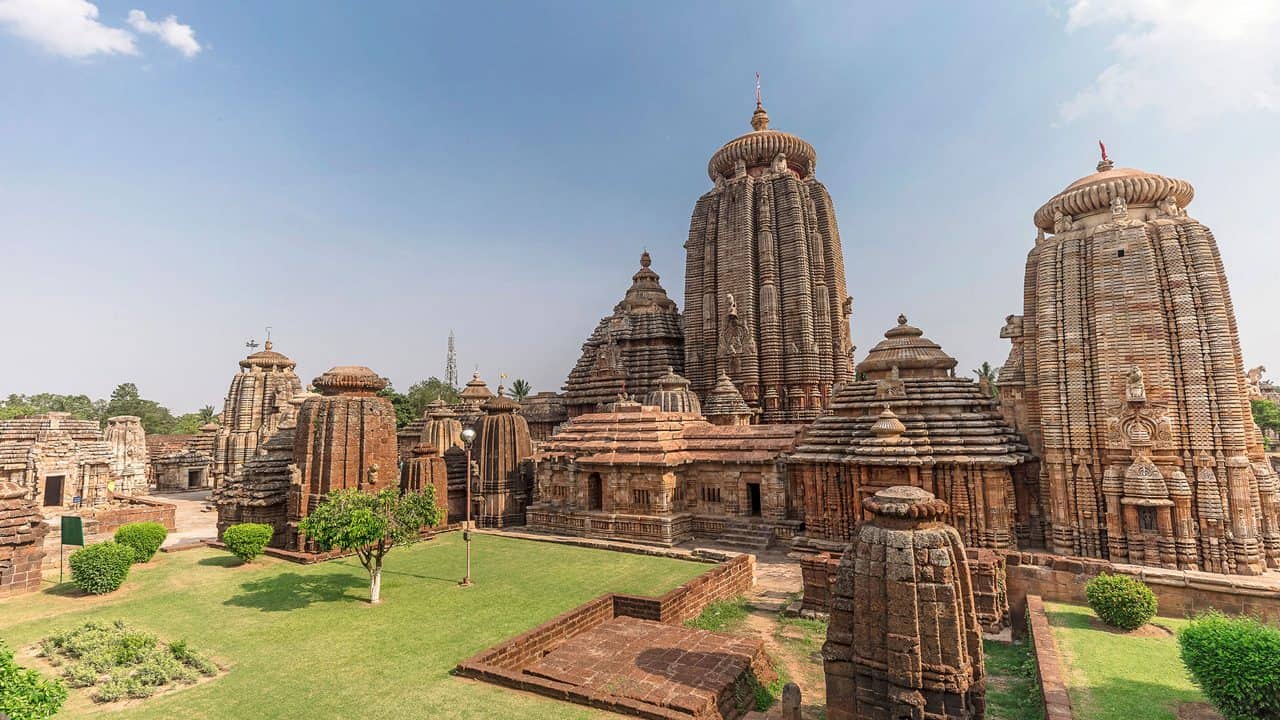
Architecturally, Lingaraj Temple is among the finest examples of the Kalinga style of temple architecture. It is the largest temple in Bhubaneswar and dominates the old city with its approximately 180-foot tower. The complex is enclosed within a large laterite compound wall, with the temple rising above a courtyard that contains around 150 smaller shrines. This arrangement creates a sacred urban world inside the temple walls: a main sanctum, subsidiary shrines, ritual routes, festival spaces, and water-linked sacred geography.
The temple follows the Deula architectural system, consisting of four principal components arranged on an axial plan: the vimana, the jagamohana, the natamandira, and the bhoga-mandapa. These parts are aligned in descending or graduated sequence, creating a movement from public ritual space toward the sanctum. The visitor’s experience is therefore architectural as well as devotional, moving from the outer world toward concentrated sacred presence.
The vimana contains the sanctum and carries the towering superstructure. This is the spiritual and visual centre of the temple. Its sculptural surface is richly worked from base to summit, showing the extraordinary technical skill of Odisha’s ancient craftsmen. The height of the tower allows it to be seen from a distance, making it a landmark not only for pilgrims but for the city itself.
The jagamohana serves as the assembly hall. It has entrances from the north and south, and its perforated windows include sculptural images of lions standing on their hind legs. Such details are not ornamental afterthoughts; they help define the temple’s symbolic atmosphere. The lion, in many Indic contexts, suggests strength, royal authority, and sacred guardianship.
The natamandira, or festival hall, reflects the importance of music, dance, and performative ritual in temple culture. Historically, the dance hall is associated with the devadasi tradition that formed part of the religious and artistic life of many major temples. Its walls contain sculpted figures of couples and women, showing how sacred art in Odisha incorporated human beauty, fertility, auspiciousness, and refined aesthetic expression.
The bhoga-mandapa is the hall of offerings. Its pyramidal roof, crowned by an inverted bell form and Kalash, gives the structure a distinct silhouette. The exterior walls display sculptures of beasts and human figures, reinforcing the temple’s larger artistic vision: the divine world, human world, animal world, and natural world are presented as part of one sacred order.
Sculpture, Symbolism, and the Fortress-Like Exterior
The walls of Lingaraj Temple are richly adorned with sculptural panels depicting mythological themes, divine figures, animals, creepers, flowers, human forms, and auspicious motifs. The outer walls are especially striking because they combine density with discipline. The surface is alive with detail, yet the overall architectural mass remains coherent and dignified.
The high walls, built using red sandstone and laterite, give the temple a fortress-like appearance when viewed from outside. This quality is not merely defensive in a physical sense. It also creates a strong boundary between sacred and secular space. The temple compound becomes a protected ritual universe, set apart from ordinary movement while still anchoring the city’s identity.
The temple faces east, a common orientation in Hindu temple architecture because the rising sun is associated with illumination, auspiciousness, and renewal. The main entrance lies on the eastern side, while smaller entrances are found to the north and south. The entrance porch is traditionally described as having a sandalwood door, adding another sensory layer to the temple’s ritual environment.
At the entrance, the presence of the Trishul with Lord Shiva at the centre and Lord Vishnu on either side conveys a deeply important theological message. Lingaraj Temple is not a site of sectarian rivalry. It is a symbol of Hari-Hara harmony. The temple shows how Odisha’s sacred culture integrated devotion to Lord Shiva and Lord Vishnu within one larger dharmic framework.
The historian James Fergusson famously described the shrine as “one of the finest examples of purely Hindu temple in India.” While modern scholarship may use more precise architectural and historical categories, the remark still captures the impression produced by the temple: it is a highly developed expression of Hindu sacred architecture, ritual continuity, and artistic imagination.
The Swayambhu Shivalinga and Daily Worship
The sanctum sanctorum houses the Swayambhu Shivalinga, traditionally described as approximately 8 feet in diameter and about 8 inches high above its base. The scale is unusual and reinforces the sense that this is not a conventional sculpted icon but a sacred manifestation rooted in the earth. Devotees experience the lingam as a living presence rather than as an art object.
Daily worship includes offerings of water, milk, and bhanga, following established ritual customs. Such offerings belong to a long Shaiva tradition of abhisheka, in which the lingam is ritually bathed and honored. The act is simple in form but profound in meaning: water cools, milk nourishes, and the repeated rhythm of offering creates continuity between devotee, deity, priestly tradition, and sacred time.
For many devotees, the temple’s power lies not only in its antiquity but in its daily life. A thousand years of architecture may impress the mind, but the sound of bells, the movement of priests, the fragrance of offerings, and the presence of pilgrims give the temple its living heart. Lingaraj Temple is therefore best understood as a functioning sacred institution, not as a silent ruin.
Bindu Sarovar and Ekamra Van
To the north of Lingaraj Temple lies Bindu Sarovar, also called Bindusagar, a sacred temple tank that forms an essential part of the ritual geography of the shrine. The lake is traditionally described as about 700 feet wide and 1300 feet long. It becomes especially important during Chandan Yatra, when ritual activity moves from the temple into the water landscape.
The presence of a sacred tank near the temple reflects a larger Indian temple pattern in which water is not peripheral but central. Water purifies, receives ritual movement, and links the temple to seasonal cycles. In the case of Lingaraj Temple, Bindu Sarovar also deepens the memory of Ekamra Kshetra as a sacred landscape rather than a single isolated structure.
On the western bank of the lake lies Ekamra Van, a garden whose name recalls the “forest of a single mango tree.” The garden contains plants associated with Hindu deities and with medicinal traditions. This detail is important because it connects temple culture to ecology, Ayurveda, sacred botany, and memory of older landscape-based worship.
Festivals at Lingaraj Temple
Festivals at Lingaraj Temple transform the shrine from a daily ritual centre into a large public sacred gathering. The most important annual festival is Shivaratri, observed in the month of Phalgun, usually falling in February or March. On this day, thousands of devotees come to offer worship to Lord Shiva. Many observe fasting, and the raising of the Mahadipa, the great lamp, is a major ritual moment associated with the night of devotion.
During the month of Shravana, usually July or August, large numbers of bol bom pilgrims carry water from the Mahanadi River and walk to the temple. This practice links physical effort, pilgrimage discipline, and devotion. The journey itself becomes a form of worship, reminding devotees that sacred experience is often reached through endurance, humility, and collective movement.
Chandan Yatra, the sandalwood ceremony, begins on Akshaya Tritiya in the Hindu month of Vaishakha, usually April or May. The festival is observed for about three weeks, with temple servants and deities associated with processions in Bindu Sarovar. Sandalwood paste is applied to the deities and temple functionaries as a cooling ritual during the hot season. The ceremony combines climate, devotion, aesthetics, and seasonal wisdom in a characteristically Indic manner.
The annual Car Festival of Lord Lingaraj is known as Ashokashtami. It is celebrated on the eighth day of Chaitra, usually in March or April. During this festival, the image of Lord Lingaraj is taken in a decorated chariot to the Rameswar Temple, also known as Mausi Maa Temple. After four days, the deity returns to Lingaraj Temple following a ritual bath at Bindu Sarovar. The festival is traditionally associated with the removal of sorrow and suffering, making it emotionally meaningful for devotees who seek both spiritual strength and inner relief.
Access, Preservation, and the Visitor Experience
Lingaraj Temple remains an active Hindu place of worship, and entry into the temple compound is restricted to Hindus. For non-Hindu visitors, a viewing platform beside the wall provides a view of the temple’s exterior. This platform is associated with the colonial-era visit of Lord Curzon, then Viceroy of India. The arrangement reflects the tension that often surrounds living temples: they are sacred spaces with ritual rules, while also being objects of architectural and historical interest to a wider public.
The temple is maintained jointly by the Temple Trust Board and the Archaeological Survey of India. This shared responsibility matters because Lingaraj Temple is both a living ritual institution and a protected heritage monument. Conservation must therefore respect the needs of worship, the integrity of architecture, and the expectations of pilgrims who encounter the temple as sacred reality rather than as museum property.
Visitors should approach the temple with respect for its rules and ritual environment. Footwear is not permitted inside the main temple premises, and electronic gadgets including cameras are generally restricted. Those seeking puja services are advised to approach authorized temple priests and avoid informal intermediaries. Such practical care helps preserve the dignity of the temple experience.
How to Reach Lingaraj Temple
Lingaraj Temple is located at Rath Road, Lingaraj Nagar, in the old town area of Bhubaneswar, Odisha. From Bhubaneswar Railway Station, the distance is approximately 5 km and can usually be covered in 15 to 20 minutes by road, depending on traffic. From Biju Patnaik International Airport, the distance is around 4 to 5 km, making it a short and convenient journey for air travellers.
From Puri, the temple is approximately 60 km away. This makes it suitable for a day trip or as part of a combined Bhubaneswar-Puri pilgrimage and heritage itinerary. Bhubaneswar is well connected by road and national highways, and local transport options such as taxis, auto rickshaws, and buses make access relatively easy.
For those exploring the wider sacred landscape of Bhubaneswar, nearby sites such as Mukteswara Temple, Rajarani Temple, Ananta Vasudeva Temple, Brahmeswara Temple, Parasurameswara Temple, Udayagiri and Khandagiri Caves, and Dhauli Shanti Stupa add further historical and spiritual depth. Together, these sites explain why Bhubaneswar is often called the Temple City of India.
Why Lingaraj Temple Still Matters
Lingaraj Temple matters because it preserves multiple kinds of inheritance at once. It preserves the Shaiva devotion of Odisha, the Vaishnava influence of the Jagannath tradition, the artistic maturity of Kalinga temple architecture, the sacred geography of Ekamra Kshetra, and the living practices of Hindu pilgrimage. Few monuments can carry so many layers without losing their central identity.
Its most enduring message is one of dharmic unity. The temple does not flatten difference; it harmonizes it. Lord Shiva remains central, yet Lord Vishnu is visibly honored. The Swayambhu lingam remains the heart of the shrine, yet the temple’s symbolism recognizes Hari-Hara integration. In a time when religious traditions are often misunderstood through rigid categories, Lingaraj Temple offers an older and more nuanced model of coexistence.
As a heritage site, the temple rewards architectural study. As a sacred site, it rewards devotion. As a cultural site, it rewards reflection on how communities remember, build, worship, and transmit meaning across centuries. Lingaraj Temple is therefore not only a monument of Bhubaneswar; it is a living chapter in the civilizational history of Hindu Dharma and Odisha’s sacred landscape.
References
Sources consulted include Bhubaneswar Tourism’s Lingaraja Temple guide and the official Lord Lingaraj Temple website, along with the traditional historical and architectural details preserved in the supplied source material.
Inspired by this post on Hindu Post.









Leave a Reply
You must be logged in to post a comment.