
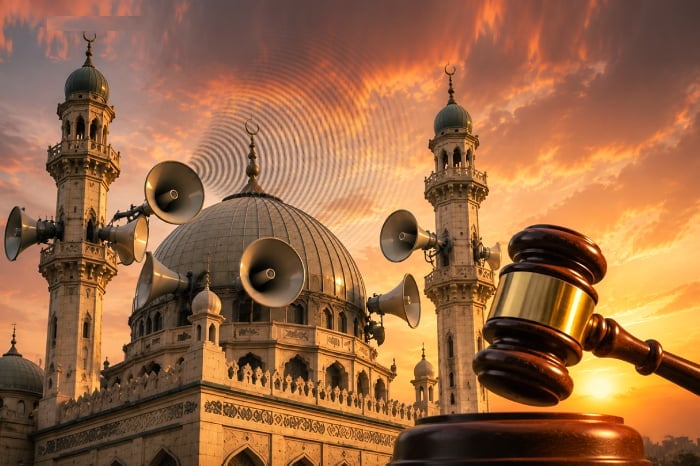
The Bombay High Court’s observation that illegal loudspeakers on mosques are not a fundamental right has reopened an important constitutional conversation in India: how should a democratic society balance religious freedom, public order, environmental regulation, and the everyday right of citizens to live without avoidable noise? The court directed the Maharashtra government to report on action taken against noise pollution from mosques, while making clear that unlawful sound amplification cannot be protected as an essential religious entitlement.
The legal point is narrow but significant. The issue is not whether citizens may pray, assemble, or follow religious customs. Those rights are protected under India’s constitutional framework. The issue is whether the use of loudspeakers, especially when installed or operated without permission or beyond prescribed decibel limits, can claim the same constitutional protection. The Bombay High Court’s approach places the answer firmly within the discipline of law: religious practice is protected, but illegal amplification is not.
Public reporting on related Bombay High Court proceedings has noted that the court has repeatedly relied on the principle that loudspeakers are not integral to the practice of religion. In a related Nagpur bench matter, the court cited Supreme Court reasoning that no religion requires prayer to be performed by disturbing the peace of others through amplified sound. This judicial line does not target a faith tradition; it applies a neutral civic rule to all public sound systems, whether used for religious, political, commercial, or celebratory purposes.

At the heart of the matter is the distinction between freedom of worship and freedom from unlawful intrusion. Article 25 of the Constitution of India protects freedom of conscience and the right freely to profess, practise, and propagate religion, but that freedom is expressly subject to public order, morality, health, and other constitutional provisions. Noise pollution falls directly within the domain of health and public order. Therefore, the state may regulate the time, manner, volume, and permission requirements for loudspeakers without extinguishing the underlying right to worship.
This distinction is especially important in dense Indian cities and towns, where homes, schools, hospitals, courts, markets, temples, mosques, gurdwaras, churches, monasteries, and community halls often exist within the same acoustic space. A sound amplified from one building rarely remains confined to that building. It enters bedrooms, classrooms, clinics, old-age homes, study rooms, and workplaces. For students preparing for examinations, patients recovering from illness, infants trying to sleep, workers returning from night shifts, and elderly citizens coping with stress or hypertension, noise is not a minor inconvenience. It can become a daily civic burden.

India’s Noise Pollution (Regulation and Control) Rules, 2000 were designed to address precisely this problem. These rules classify areas into industrial, commercial, residential, and silence zones, and prescribe ambient noise limits for day and night. They also regulate loudspeakers and public address systems, especially during night hours. The rules do not treat sound as a purely private matter because amplified sound affects a shared environment. A loudspeaker may be installed on private or institutional premises, but its impact travels beyond the boundary wall.
The Bombay High Court’s direction to the state government is therefore not merely procedural. By asking for a report on action taken, the court is testing whether statutory rules are being enforced in practice. India does not suffer from a shortage of laws on noise pollution; the harder problem has often been uneven enforcement, complaint fatigue, administrative hesitation, and the fear that regulation of religious sound may be misrepresented as hostility toward religion. A rights-based society cannot allow such hesitation to neutralize public health law.
The phrase “not a fundamental right” should be understood carefully. It does not mean that a mosque, temple, gurdwara, church, or any other religious institution is denied dignity or constitutional respect. It means that the mechanical device of amplification cannot be elevated above the law. Prayer remains prayer without a loudspeaker. Devotion remains devotion without unauthorized decibel levels. The spiritual substance of a tradition is not diminished when it respects the health, peace, and lawful rights of neighbours.
This principle also aligns with the wider dharmic understanding of social responsibility. Hinduism, Buddhism, Jainism, and Sikhism all contain deep traditions of restraint, compassion, self-discipline, and concern for the well-being of others. The civilizational value is not merely the freedom to perform one’s own practice, but the wisdom to perform it without causing avoidable harm. In that sense, lawful sound regulation can be seen not as an attack on religious life, but as a civic expression of mutual respect.
For India’s plural society, this point matters. The solution to noise pollution cannot be selective outrage. It must apply equally to illegal loudspeakers at mosques, temples, religious processions, political rallies, wedding venues, festival stages, commercial events, and private celebrations. A law that is enforced only against one community will produce distrust. A law that is enforced consistently will strengthen public confidence. The legitimacy of noise regulation depends on neutrality, transparency, and equal treatment.
The court’s position also challenges a common misunderstanding of secularism. Secular governance does not require the state to ignore religion, nor does it require the state to suppress religion. It requires the state to protect all faiths while ensuring that no institution, majority or minority, claims immunity from ordinary public law. When amplified sound violates legal limits, the state’s duty is to regulate the violation, not to debate the theology of the community involved.

Noise pollution has measurable consequences. Medical and environmental research has long associated excessive noise with stress, sleep disturbance, impaired concentration, irritability, cardiovascular strain, and reduced quality of life. These effects do not depend on the religious or cultural identity of the sound source. A citizen disturbed at 5 a.m., during school hours, late at night, or in a silence zone experiences the sound as a health and environmental issue. The law must therefore focus on impact, not identity.
The controversy around mosque loudspeakers often becomes emotionally charged because the azaan has religious significance for Muslims. That significance deserves to be acknowledged with seriousness. At the same time, constitutional protection of religious expression does not automatically include the right to use external amplification in violation of statutory rules. A democratic society must be capable of saying both things together: religious sentiment is real, and legal limits are real.
The same reasoning applies across traditions. A temple cannot claim an unlimited right to blare devotional music through the night. A political party cannot claim a democratic right to violate decibel norms during rallies. A wedding procession cannot claim cultural entitlement to disturb an entire neighbourhood. A festival committee cannot treat public space as an acoustic monopoly. The Bombay High Court’s reasoning becomes strongest when read as a universal civic standard rather than a community-specific rebuke.
Effective enforcement should begin with documentation. Authorities must identify unauthorized loudspeakers, verify permissions, measure decibel levels, map silence zones, and record violations. The state government’s report to the court should ideally clarify how many complaints were received, how many inspections were conducted, how many permissions were granted, how many devices were removed, how many notices were issued, and whether repeat violations led to prosecution. Without such data, enforcement becomes anecdotal and vulnerable to political pressure.

Police and pollution control authorities also need clear standard operating procedures. Citizens should not be forced to repeatedly complain before obvious violations are addressed. If a loudspeaker is operating without permission or beyond legal hours, enforcement agencies should be able to act suo motu under the law. Complaint-based enforcement often places the burden on residents, who may fear social backlash or communal misunderstanding. A predictable administrative system protects both citizens and religious institutions by reducing confrontation.
Religious institutions, too, can play a constructive role. Local committees can voluntarily audit their sound systems, keep speakers directed inward where possible, use lower volumes, avoid overlapping amplification, respect night-time restrictions, and maintain permission documents. Such compliance does not weaken religious identity. It demonstrates maturity, discipline, and regard for neighbours. In many communities, respectful dialogue between residents and religious managers can resolve noise issues before they become litigation.
The deeper social lesson is that rights and responsibilities cannot be separated. A citizen who values freedom of worship should also value another citizen’s right to rest, study, heal, and live peacefully. A community that asks for respect must also offer respect. A state that promises equality must enforce laws without fear or favour. The Bombay High Court’s intervention is important because it places this balance back at the centre of public discussion.
There is also a constitutional humility in the court’s approach. It does not attempt to rank religions or decide spiritual merit. It asks a simpler legal question: is an illegal loudspeaker a fundamental right? The answer is no. Once that is accepted, the remaining questions become administrative: was permission granted, were decibel limits followed, were time restrictions respected, and did the authorities act when violations occurred?
For Maharashtra, the ruling carries practical implications. Urban areas such as Mumbai, Navi Mumbai, Thane, Pune, Nagpur, and other growing towns face constant pressure from traffic, construction, religious events, political mobilization, and commercial sound. If noise rules are not enforced consistently, citizens gradually lose faith in the state’s ability to maintain basic civic order. Courts then become the last resort for what should have been routine governance.
The Bombay High Court’s statement should therefore be read as a call for institutional seriousness. The state government must not merely file a formal report; it must show whether the law is functioning on the ground. Police stations, municipal bodies, and pollution control authorities must coordinate enforcement. Religious and community leaders must be consulted, but consultation cannot become a substitute for compliance. Public peace requires both sensitivity and firmness.
In a civilizational society as diverse as India, harmony cannot depend on the loudest sound. It must depend on shared restraint, lawful conduct, and reciprocal dignity. The Bombay High Court’s message is ultimately larger than one category of loudspeakers or one set of institutions. It affirms that faith may be freely practised, but public space must remain governed by law. That balance is essential for religious freedom, community harmony, and the health of ordinary citizens.
Inspired by this post on Hindu Jagruti Samiti.










Leave a Reply
You must be logged in to post a comment.