
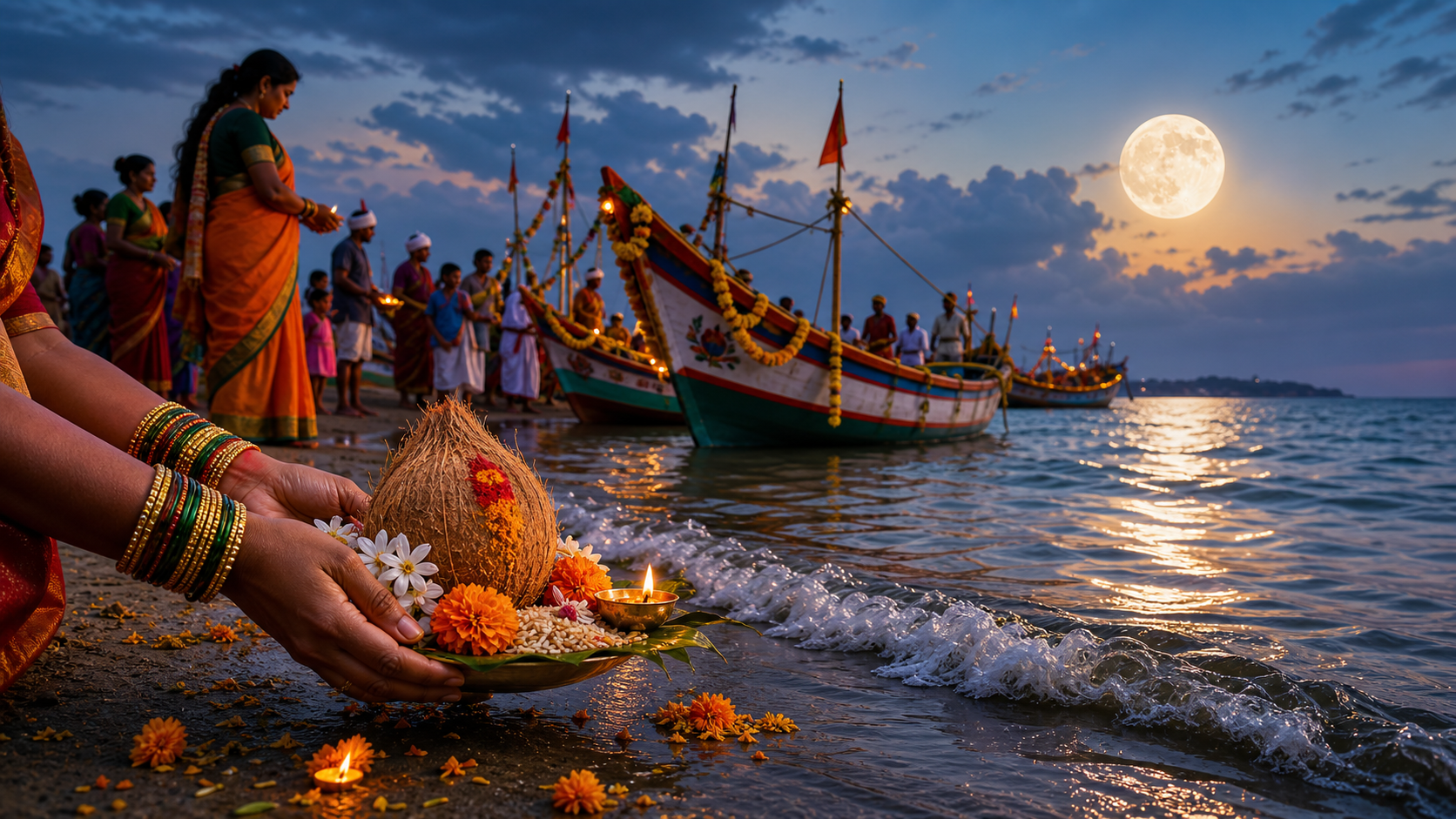
Narali Purnima 2026, also known as Narial Pournami or Nariyal Poornima, falls on Friday, August 28, 2026. It is observed on Shravan Purnima, the full moon day of the sacred Shravan month, and it holds special importance in coastal Maharashtra, especially among fishing communities along Mumbai, the Konkan coast, and nearby maritime settlements.
The festival is often described as a thanksgiving observance to Varuna, the deity associated with waters, oceans, cosmic order, and life-sustaining rains. Its central ritual is the offering of a coconut to the sea, accompanied by prayers for calm waters, protection from storms, safe voyages, and a prosperous fishing season. In this simple act, the sea is not treated as a resource to be exploited, but as a living presence deserving reverence, restraint, and gratitude.
The name itself explains the ritual. In Marathi, naral refers to coconut, while Purnima refers to the full moon. Narali Purnima therefore means the full moon associated with the coconut offering. The alternate forms Narial Pournami and Nariyal Poornima reflect regional pronunciations and linguistic variations across western India, but the spiritual idea remains consistent: the community acknowledges the ocean as both provider and power.
In the Hindu lunar calendar, Shravan is one of the most devotional months of the year. It corresponds broadly to July and August in the Gregorian calendar and is closely associated with the monsoon season. The full moon of Shravan gathers many observances into one day, including Raksha Bandhan in several regions, Upakarma among some communities, and Narali Purnima in coastal Maharashtra. This layering of rituals shows how Hindu festivals often adapt to ecology, occupation, family life, and regional memory without losing their wider dharmic framework.
For coastal communities, the timing is practical as well as sacred. The monsoon sea is powerful, unpredictable, and often unsafe for traditional fishing activity. Narali Purnima marks a ritual transition toward renewed engagement with the sea after the intense rains. In contemporary practice, actual fishing schedules are also shaped by weather advisories, conservation rules, local regulations, and market conditions, but the festival continues to preserve the older cultural memory of restarting maritime life with humility rather than haste.
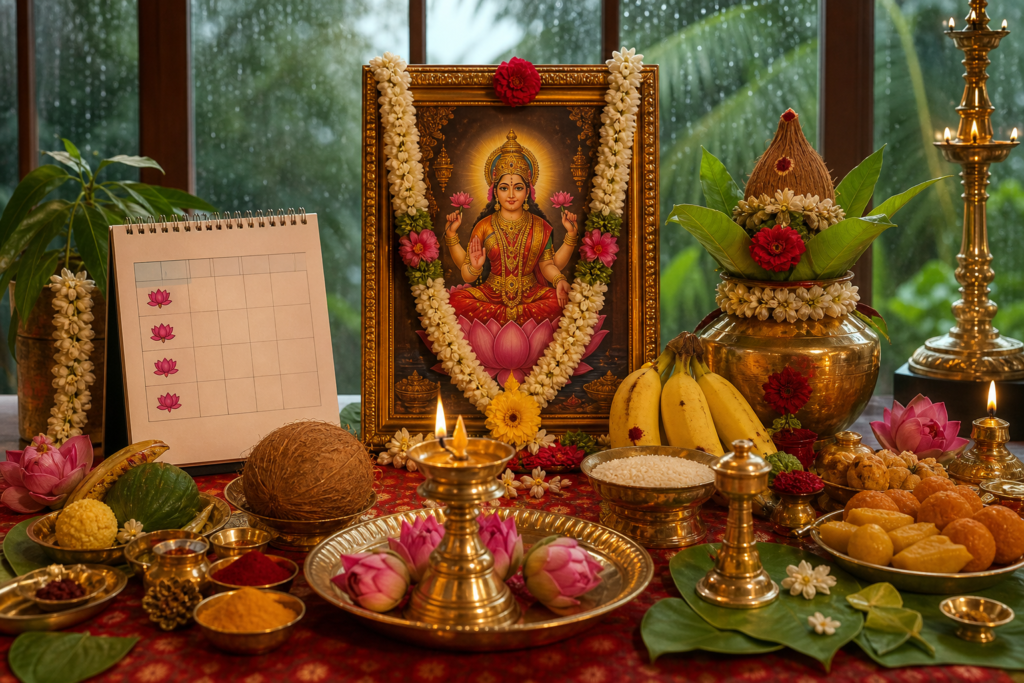
The coconut is not an accidental offering. In Hindu ritual culture, the coconut is widely understood as a symbol of auspiciousness, purity, fertility, and self-surrender. Its hard outer shell, inner water, and nourishing kernel make it a compact symbol of layered existence. When it is offered to the sea, it expresses the devotee’s recognition that human life depends on forces larger than individual effort: rainfall, tides, winds, fish populations, safe boats, skilled hands, and collective discipline.
In many fishing settlements, the day begins with cleaning and decorating boats. Flags, flowers, fresh paint, garlands, and traditional motifs may be used to honor the vessels that carry families into uncertain waters. The boat is not merely equipment; it is livelihood, inheritance, memory, and risk held together in wood, fiber, metal, rope, and faith. This reverence for tools and vessels is common across Indian traditions, where the means of livelihood are treated with gratitude.
The puja normally includes prayers to Varuna, offerings of coconut, flowers, rice, incense, lamps, and sometimes community processions toward the shore. Elders, boat owners, crew members, women, children, and priests may all participate according to local custom. The ritual is public, but its emotional center is deeply domestic: every fishing family understands that prosperity and safety cannot be separated.
Narali Purnima is therefore not only a festival of abundance. It is also a festival of vulnerability. The sea gives fish, trade routes, employment, and identity, but it also demands caution. A community that has watched storms gather quickly over the horizon knows that devotion is not superstition; it is a disciplined cultural language for living with uncertainty. The offering to the sea becomes a way of saying that courage must be accompanied by reverence.
The Koli community, one of the historically significant fishing communities of Maharashtra, is closely associated with Narali Purnima celebrations in Mumbai and coastal regions. In places such as Koliwadas, the festival often includes traditional dress, song, dance, food, and public gatherings. These celebrations are not decorative additions to the ritual; they are cultural archives in motion, preserving maritime vocabulary, kinship networks, oral memory, and local identity.
Food also plays a meaningful role. A well-known preparation associated with the day is Narali Bhat, a sweet coconut rice made with rice, coconut, jaggery or sugar, ghee, and aromatic spices such as cardamom. Its ingredients mirror the mood of the festival: grain from the land, coconut from the coast, sweetness for auspicious beginnings, and shared food for community cohesion. Through such dishes, ritual becomes sensory and memorable, especially for children who first learn festivals through taste, fragrance, and family gatherings.
Although Narali Purnima is regional, its meaning is not narrow. It belongs to the larger dharmic pattern of honoring natural forces rather than separating spirituality from ecology. Rivers, mountains, forests, animals, tools, teachers, ancestors, and celestial rhythms are all treated as participants in moral life. This approach is visible across Hinduism and also resonates with broader dharmic values found in Buddhism, Jainism, and Sikhism: gratitude, restraint, compassion, discipline, interdependence, and responsible action.
The ecological message of Narali Purnima is especially relevant today. Coastal communities face changing weather patterns, marine pollution, overfishing pressures, plastic waste, and economic uncertainty. A festival that teaches reverence for the sea can also encourage practical responsibility: cleaner coastlines, respect for breeding seasons, careful use of nets, reduced waste, and community-led conservation. In this sense, the traditional ritual has contemporary environmental depth.
The festival also shows how dharma operates through place. A farming community may honor cattle, soil, rain, or harvest; a maritime community honors the sea, boats, tides, and fish. The principle is the same even when the ritual form differs. Narali Purnima is thus a regional expression of a universal dharmic ethic: livelihood should be pursued with gratitude, self-control, and awareness of dependence on the natural world.
Shravan Purnima also links Narali Purnima with family-centered observances such as Raksha Bandhan in many parts of India. In some coastal homes, the day may include both the sea offering and the tying of rakhi, showing how public livelihood and private affection can coexist within one sacred calendar. The same full moon can bless the ocean, renew a fishing season, strengthen sibling bonds, and mark scriptural or ritual study in other communities.
Such diversity is one of the strengths of Hindu festivals. A single tithi can carry different meanings across regions without contradiction. Narali Purnima in Maharashtra, Raksha Bandhan in northern India, and Upakarma among certain Vedic lineages all demonstrate the plural structure of Hindu practice. The calendar does not impose uniformity; it allows communities to remember what sustains them.
From an academic perspective, Narali Purnima can be understood as a convergence of ritual ecology, occupational identity, lunar timekeeping, and community resilience. The festival organizes social life around a shared moment of renewal. It gives maritime labor a sacred vocabulary, transforms risk into collective prayer, and situates economic activity within ethical limits. This is why it remains meaningful even as fishing technology, urban coastlines, and market systems change.
For many families in coastal Maharashtra, Narali Purnima is also a memory of belonging. The sight of decorated boats, the sound of folk songs, the fragrance of coconut rice, and the gathering of neighbors near the shore create a powerful emotional continuity between generations. Elders transmit not only ritual steps but also practical wisdom: when to respect the wind, how to read the water, why greed at sea can become dangerous, and why gratitude must precede livelihood.
The offering to Varuna also deserves careful interpretation. Varuna is not merely a local sea god in a narrow sense; in older Hindu thought, Varuna is associated with cosmic order, waters, moral law, and the unseen bonds that hold existence together. When fishing communities pray to Varuna, they are not only asking for fish. They are invoking order in a domain that can appear chaotic, asking that human action remain aligned with the rhythms of nature.
This alignment is central to dharmic life. Dharma does not separate ritual from conduct. A coconut offered to the sea has little meaning if the same sea is polluted without concern. A prayer for abundance is incomplete without restraint. Narali Purnima therefore invites a larger reflection on how communities can preserve livelihood while respecting ecological limits.
In 2026, the date of August 28 gives devotees and cultural observers a clear occasion to prepare. Families may check local panchang details for tithi timing and regional practice, especially because Hindu observances can vary by location and tradition. However, the widely given date for Narali Purnima 2026 is Friday, August 28, coinciding with Shravan Purnima.
Typical observances may include early bathing, home worship, preparing coconut-based dishes, visiting the shore, joining community puja, offering coconut to the sea, decorating boats, praying for safety, and sharing festive meals. Some families also combine the day with Raksha Bandhan customs, depending on regional and household tradition. The emphasis remains on auspicious renewal, protection, and gratitude.
Narali Purnima should not be reduced to folklore alone. It is a living cultural institution that connects theology, labor, food, family, climate, and local identity. It preserves the dignity of fishing communities by placing their work within a sacred frame. It also teaches non-coastal observers to see the sea not simply as scenery or commerce, but as a relationship.
The festival’s continuing relevance lies in its balance. It is devotional without being detached from livelihood. It is regional without being sectarian. It is joyful without ignoring danger. It is traditional while still capable of speaking to modern ecological concerns. Such balance is one reason Narali Purnima remains a powerful example of Hindu cultural traditions in Maharashtra.
For readers seeking broader calendar context, Shravan Purnima is also associated with other observances described in public festival references such as Shravana month, while the specific coastal observance is summarized in references on Narali Poornima. These references support the general identification of the festival with Shravan Purnima, coastal Maharashtra, Varuna worship, coconut offerings, and the ceremonial renewal of fishing activity.
Ultimately, Narali Purnima 2026 is best understood as a festival of reverent dependence. The coconut placed before the waves carries a complete worldview: nature sustains life, livelihood requires humility, communities survive through shared discipline, and prosperity is meaningful only when it is aligned with dharma. On August 28, 2026, the full moon of Shravan will once again illuminate this old and enduring wisdom along the coast of Maharashtra.
Inspired by this post on Hindu Pad.






Leave a Reply
You must be logged in to post a comment.