

The viral circulation of Pandit Vijay Kumar Sharma’s speech at an International Quds Day event has become more than a passing social-media controversy. It has opened a wider discussion about India’s religious diversity, its civilisational instinct for plural dialogue, and the complicated ways in which Indian voices respond to conflicts in the Middle East. The speech drew attention because Sharma publicly praised Iran’s resistance to Western pressure, criticised the United States, and placed Ayatollah Ali Khamenei within a larger narrative of anti-Western defiance. Whether one agrees with the substance of those remarks or not, the episode deserves careful analysis rather than casual outrage.
The original video was framed around an Indian multi-faith delegation that reportedly travelled to Iran to pay respects following the death of Ali Khamenei and later engaged with circles associated with Mojtaba Khamenei. The language surrounding the event online was often mocking, emotional, and ideologically charged. A more responsible assessment requires separating verifiable political context from social-media theatre. Iran, India, the United States, Israel, Palestine, and the wider Middle East all sit within a geopolitical matrix shaped by energy security, sanctions, religious symbolism, strategic autonomy, and competing civilisational narratives.
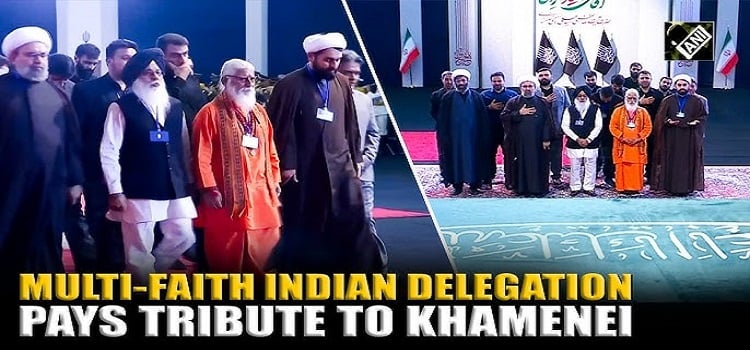
International Quds Day itself carries a long political history. Established by the Islamic Republic of Iran in 1979, it is observed on the last Friday of Ramadan and is presented by Iran as a day of solidarity with Palestinians. In practice, it has also become a platform for strong criticism of Israel, American policy in West Asia, and Western influence more broadly. This background matters because speeches delivered at Quds Day events are rarely neutral diplomatic statements. They are usually shaped by ideological opposition, symbolic politics, and the language of resistance.

Pandit Vijay Kumar Sharma’s remarks therefore need to be read within that performative and political setting. His statement that many people had waited for someone to “put the USA on its knees” was not merely rhetorical flourish; it reflected a strand of global opinion that views American power through the lens of sanctions, military interventions, and asymmetric influence. For many audiences in Asia, Africa, and the Middle East, such language resonates because memories of colonialism, intervention, and unequal global power remain politically alive. At the same time, academic clarity requires acknowledging that anti-American rhetoric can easily become reductionist when it ignores the internal complexities of countries such as Iran, Israel, India, and the United States.

Sharma’s praise for Ayatollah Ali Khamenei also triggered strong reactions because Khamenei remains one of the most consequential and controversial figures in modern Middle Eastern politics. Supporters portray him as a leader who resisted sanctions, military threats, and Western pressure. Critics point to Iran’s record on political repression, civil liberties, regional militancy, and ideological control. Any serious analysis must hold both realities in view: Iran has indeed endured decades of external pressure, but resistance to foreign power does not automatically absolve a state of responsibility toward its own citizens or neighbouring societies.
The Indian dimension is especially important. India has historically maintained relations with Iran while also deepening ties with the United States, Israel, Gulf countries, and other strategic partners. This is not accidental inconsistency; it is a feature of Indian foreign policy often described as strategic autonomy or multi-vector diplomacy. India imports energy, protects diaspora interests, engages in infrastructure projects such as Chabahar, cooperates with Israel in defence and agriculture, and works with the United States in technology and security. In this environment, an Indian religious speaker expressing admiration for Iran does not represent the entire Indian state or the full spectrum of Indian public opinion.

India’s public sphere is unusually diverse. Hindu, Buddhist, Jain, Sikh, Muslim, Christian, and other voices frequently participate in debates about global affairs, sometimes from spiritual conviction, sometimes from political ideology, and sometimes from civilisational memory. A multi-faith delegation in Iran may therefore be interpreted in different ways: as interfaith outreach, as symbolic diplomacy, as ideological theatre, or as a controversial intervention in a polarised geopolitical conflict. The meaning depends heavily on context, intent, and the accuracy of public presentation.

From a Dharmic perspective, the most constructive approach is neither blind endorsement nor reflexive hostility. Hindu, Buddhist, Jain, and Sikh traditions all contain deep resources for ethical reflection on power, suffering, violence, restraint, justice, and truth. Dharma does not require passivity in the face of injustice, but it also cautions against intoxication with anger. Ahimsa, satya, viveka, karuna, and seva are not slogans; they are disciplines that demand discernment. When geopolitical conflicts are discussed by religious leaders, these principles should elevate the conversation rather than intensify division.
The viral debate also reveals how quickly online audiences convert a speech into a tribal marker. Supporters celebrated Sharma as a bold voice challenging American dominance. Critics accused him of glorifying Iranian authority and importing Middle Eastern ideological conflict into Indian discourse. Both reactions contain understandable concerns. Many people across the Global South do question Western power. Many others are uneasy when religious figures praise authoritarian or militarised political systems without sufficient moral qualification. The responsible middle ground is to analyse the speech as an expression of personal political belief, not as a settled verdict on India, Hindu society, or Dharmic traditions.
The phrase “multi-faith” deserves particular attention. Interfaith engagement is valuable when it builds trust, protects minorities, encourages peace, and promotes mutual respect. It becomes problematic when it is reduced to political optics or used to legitimise one side of a conflict without acknowledging suffering across communities. A genuinely Dharmic interfaith ethic would recognise Palestinian suffering, Israeli security fears, Iranian national anxieties, American strategic interests, and the vulnerability of civilians across the region. Moral clarity is strongest when it does not become selective compassion.

This is where the speech’s emotional appeal becomes understandable but incomplete. Many ordinary people feel that global institutions treat some conflicts with urgency and others with indifference. They see sanctions harming civilians, wars destabilising societies, and powerful states escaping accountability. Such frustrations are real. Yet the answer cannot be the romanticisation of any state simply because it opposes another powerful state. Anti-imperial language must still be tested against ethical standards, human rights, minority protection, and the dignity of dissent.

India’s civilisational experience offers a better framework. The Indian tradition has long absorbed debate, disagreement, and multiple paths without requiring uniformity of belief. The Dharmic idea of unity is not sameness; it is disciplined coexistence. This is why public commentary on Iran, the United States, Israel, Palestine, or any other geopolitical subject should avoid contempt toward communities and focus instead on policies, power structures, historical causes, and humanitarian outcomes. Mockery may win attention, but it rarely produces understanding.

The online references to Mojtaba Khamenei, including mocking nicknames, also demonstrate the difficulty of discussing opaque political transitions in authoritarian systems. When a public figure is absent, silent, or shielded by a political establishment, speculation fills the vacuum. However, serious commentary should distinguish between documented political facts and ridicule. Iran’s succession politics, clerical authority, Revolutionary Guard influence, and public legitimacy are significant enough to study without relying on personal insults or sensational framing.
For Indian audiences, the more useful question is not whether one speaker praised Iran too strongly or criticised America too sharply. The deeper question is how Indian civil society should speak about global conflict while remaining faithful to its own ethical inheritance. A Dharmic public voice should be courageous enough to criticise domination, but careful enough not to sanctify repression. It should defend the dignity of oppressed peoples, but avoid turning distant conflicts into domestic hostility. It should encourage debate, but reject dehumanisation.
The speech also illustrates the growing influence of short-form video in shaping international political opinion. A few clipped sentences can travel faster than a full argument. Viewers may encounter only the most provocative line, stripped of context and amplified by captions, reactions, and partisan accounts. This creates a distorted public sphere in which complex geopolitical positions are judged through fragments. Responsible readers and viewers should therefore ask basic questions: What was the event? Who organised it? What was the full speech? What claims were made? Which facts are verified? Which parts are interpretation?
In the end, Pandit Vijay Kumar Sharma’s viral speech is significant not because it settles the debate over Iran, America, or the Middle East, but because it exposes the pressures now placed on religious voices in a globalised media environment. Spiritual identity, national interest, anti-imperial sentiment, humanitarian concern, and political ideology are increasingly mixed together. That mixture can produce solidarity, but it can also produce confusion. The need of the hour is disciplined speech rooted in dharma, truth, compassion, and geopolitical literacy.
A mature reading of the episode would recognise Iran’s role in resisting Western pressure, acknowledge the legitimate debate over American foreign policy, and still insist that no political leadership should be placed beyond ethical scrutiny. It would also recognise India’s distinctive position: a civilisation with ancient plural traditions, a modern state with complex strategic interests, and a society capable of hearing many voices without surrendering judgment. The viral video should therefore be treated as an opportunity for reflection, not merely as another moment of outrage.
Disclaimer: The referenced video material is discussed for reporting, research, commentary, and public-interest analysis. Credit for the original media belongs to its respective creator and publisher.
Inspired by this post on Hindu Human Rights Blog.

Leave a Reply
You must be logged in to post a comment.