
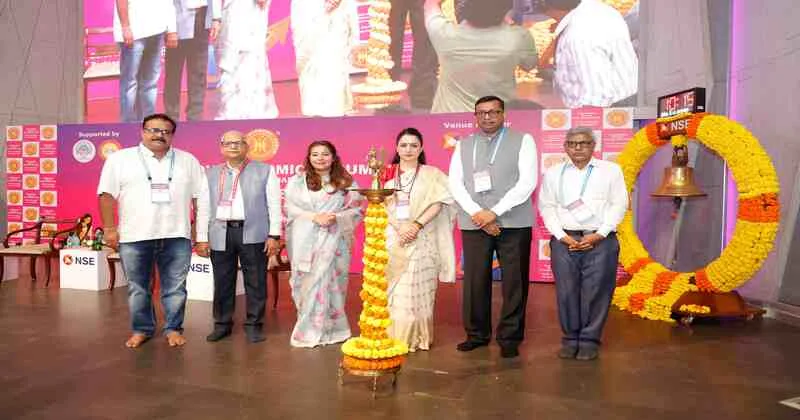
The World Hindu Economic Forum’s Mumbai felicitation ceremony, held under the theme “Celebrating Women Entrepreneurship -From Sankalp to Samriddhi,” deserves attention not merely as an awards programme, but as a meaningful indicator of how India’s economic imagination is changing. According to the report published by Organiser on June 28, 2026, the event brought together successful women entrepreneurs, industry representatives, policymakers, and public figures to recognise women’s economic empowerment and leadership.
The phrase “From Sankalp to Samriddhi” carries a layered meaning in the Indian context. Sankalp is not a casual wish; it is a disciplined resolve. Samriddhi is not merely private wealth; it suggests prosperity that sustains families, communities, institutions, and the wider nation. In that sense, the event placed women entrepreneurs within a larger civilisational and developmental framework, where enterprise is seen as both an economic activity and a form of social contribution.
Mumbai was an appropriate setting for such a gathering. As India’s financial capital and one of the country’s most important commercial centres, the city represents both opportunity and pressure. It is home to formal finance, informal enterprise, family businesses, startups, professional networks, export-linked industries, and service-sector innovation. For women entrepreneurs, Mumbai also reflects a familiar paradox: access to markets and capital exists, but the path to credibility, scale, and institutional recognition often remains uneven.
Mumbai Mayor Smt. Ritu Tawde attended the programme as Chief Guest, while Shri Ravikant Mishra, Secretary of the World Hindu Economic Forum and Hindu Economic Forum, presided over the event. Their presence gave the ceremony a public-institutional dimension, signalling that women’s entrepreneurship is no longer treated as a peripheral welfare concern. It is increasingly understood as central to India’s economic growth, urban development, job creation, and the long-term aspiration of a Viksit Bharat.
Mayor Ritu Tawde congratulated the awardees and linked their achievements to the broader national emphasis on women’s self-reliance and economic participation. She observed that under Prime Minister Narendra Modi’s leadership, women’s economic empowerment, self-reliance, and entrepreneurship have been consistently promoted across the country. She also referred to the Nari Shakti Vandan Adhiniyam as a reflection of the vision that women should receive equal opportunities to advance in every sphere of life.
Her remarks are significant because they connect political representation, economic agency, and social recognition. The Nari Shakti Vandan Adhiniyam, formally associated with the Constitution (One Hundred and Sixth Amendment) Act, 2023, provides for one-third reservation for women in the Lok Sabha and State Legislative Assemblies, subject to the constitutional process linked with census and delimitation. Even before its full electoral effects are realised, its symbolic value has entered public discourse: women are not to be viewed only as beneficiaries of development, but as decision-makers and builders of institutions.
The ceremony’s central message was therefore larger than felicitation. It recognised that entrepreneurship is one of the most practical routes through which women convert capability into public value. A woman who builds an enterprise does more than generate income. She negotiates suppliers, manages credit risk, adopts technology, trains workers, handles compliance, serves customers, and often supports extended family responsibilities at the same time. Her work is managerial, financial, emotional, and social in equal measure.
This makes women’s entrepreneurship a technical subject as much as a cultural one. The growth of a business depends on access to working capital, timely payments, credit history, collateral, digital literacy, market discovery, regulatory clarity, tax compliance, mentorship, procurement access, and the ability to hire and retain talent. Many women-led enterprises begin with strong product knowledge or local trust, but face difficulty when they attempt to move from household-scale operations to formal, scalable businesses. Events such as this can help bridge that gap by creating visibility and networks.
India’s policy environment has also shifted in favour of entrepreneurship-led development. Programmes such as Startup India, Stand-Up India, the Pradhan Mantri Mudra Yojana, Udyam registration for MSMEs, digital payments infrastructure, and government-backed skilling initiatives have expanded the vocabulary of enterprise beyond large corporations. The most important change is psychological: business ownership is increasingly discussed as a legitimate aspiration for women in small towns, semi-urban areas, professional households, traditional trading communities, and first-generation entrepreneurial families.
Yet recognition should not obscure the structural barriers that remain. Women entrepreneurs continue to face challenges in securing risk capital, negotiating property-linked collateral, entering male-dominated business networks, balancing care responsibilities, travelling for market expansion, and receiving serious attention from institutional buyers. In many cases, women are visible as workers but less visible as owners. They may contribute to family enterprises without being formally named as partners, directors, or decision-makers. Economic empowerment becomes durable only when ownership, authority, and financial literacy are aligned.
That is why the World Hindu Economic Forum’s emphasis on honouring women entrepreneurs has social importance. Public felicitation creates a record of achievement. It tells younger women that enterprise is not an exception reserved for a few urban elites. It also tells families that supporting a daughter’s or wife’s business ambition is not a departure from responsibility; it may be one of the most constructive ways to strengthen the household and society. In many Indian homes, such recognition changes the tone of conversation around risk, mobility, investment, and leadership.
The Dharmic lens adds further depth to this discussion. Hindu, Buddhist, Jain, and Sikh traditions have all preserved ethical reflections on livelihood, self-discipline, service, restraint, generosity, and social duty. Economic life, in this broader framework, is not treated as morally empty. Wealth has value when it is generated through ethical means, shared responsibly, and used to sustain community welfare. Women entrepreneurs working with integrity, resilience, and social consciousness naturally fit into this civilisational understanding of prosperity.
In Hindu economic thought, prosperity is often connected with responsibility rather than mere accumulation. Lakshmi is revered not as a symbol of greed, but as auspicious abundance that must be honoured through discipline, cleanliness, order, generosity, and dharma. The same principle applies to modern enterprise. A business that pays workers fairly, honours contracts, serves customers honestly, and reinvests in society becomes more than a profit-seeking unit. It becomes a node of trust.
Women-led businesses are especially important in this regard because they frequently reinvest gains into education, nutrition, healthcare, household stability, and community uplift. This is not to romanticise women as naturally self-sacrificing, but to recognise a pattern often observed in development economics: when women gain control over income and assets, the benefits frequently extend across generations. The entrepreneur’s balance sheet and the family’s future become closely connected.
The Mumbai event also points toward the need for stronger entrepreneurial ecosystems. Awards and public appreciation are valuable, but the next stage requires sector-specific mentoring, credit facilitation, digital commerce training, export readiness, legal awareness, branding support, and procurement linkages. Women entrepreneurs need access not only to inspiration, but to practical systems that reduce friction. A founder who understands GST compliance, intellectual property, packaging standards, e-commerce logistics, and invoice financing is better positioned to scale sustainably.
Industry bodies, banks, investors, chambers of commerce, and community organisations can play a decisive role here. The most effective support is often not a one-time grant, but a network that helps entrepreneurs solve recurring problems: delayed payments, unreliable vendors, lack of professional accounting, weak digital marketing, limited market intelligence, and absence of peer learning. For women founders, peer networks are especially valuable because they create spaces where business challenges can be discussed without social hesitation.
The term Viksit Bharat should therefore be understood in concrete economic terms. A developed India will require more women as employers, exporters, innovators, manufacturers, technologists, financiers, educators, and social entrepreneurs. It will also require respect for different scales of enterprise. A woman running a food-processing unit, a textile brand, a fintech startup, a consulting practice, a rural self-help enterprise, or a family manufacturing business is participating in the same national story of productive capacity.
The emotional force of such a ceremony lies in its ability to make labour visible. Behind every awardee is usually a history of uncertainty: the first loan application, the first customer complaint, the first employee hired, the first failed product, the first profitable month, and the first moment when family members begin to see the enterprise as serious work. These experiences are rarely captured in economic statistics, yet they form the human foundation of entrepreneurship.
From an academic perspective, the event can be read as part of a broader transition in Indian society. Women’s empowerment is moving from the language of protection to the language of participation. The shift is visible in politics, education, digital access, formal finance, startup culture, and community leadership. The felicitation of women entrepreneurs in Mumbai reflects that transition: it honours achievement while also inviting institutions to build stronger pathways for future entrepreneurs.
The World Hindu Economic Forum’s initiative is therefore best understood as a call to align economic development with cultural confidence and social responsibility. When women entrepreneurs are recognised within a Dharmic and national framework, the message is not narrow or exclusionary. It is a reminder that prosperity becomes meaningful when it strengthens families, creates dignified work, preserves ethical conduct, and contributes to the common good.
In that sense, “From Sankalp to Samriddhi” is more than an event theme. It is a developmental formula. Resolve must become enterprise. Enterprise must become employment. Employment must become dignity. Dignity must become shared prosperity. The women honoured in Mumbai represent that chain of transformation, and their recognition offers a powerful model for India’s journey toward inclusive economic growth.
Inspired by this post on Hindu Post.








Leave a Reply
You must be logged in to post a comment.