
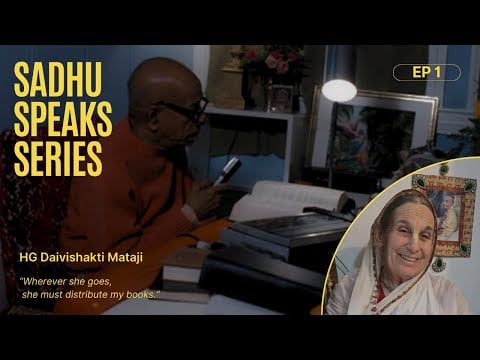
Watch the featured Sadhu Speaks conversation with Her Grace Daivishakti Mataji on YouTube.
The Sadhu Speaks conversation with Her Grace Daivishakti Mataji presents more than a devotional interview. It offers a concentrated study in spiritual perseverance, guru-seva, sacred communication, and the disciplined culture of book distribution within the Hare Krishna Movement. Speaking from Sri Vrindavana Dham, Daivishakti Mataji reflects on a life shaped by the instructions of Srila Prabhupada, especially the instruction to distribute transcendental literature as a form of service, education, and compassion.
Her journey is significant because it spans approximately 55 years of devotional practice and public outreach. In a religious culture where spoken instruction, lived example, and sacred text are deeply interwoven, such a long period of service becomes a historical testimony. It reveals how Krishna consciousness is transmitted not only through temples, festivals, kirtan, and ritual observance, but also through books carried into streets, homes, campuses, airports, and public spaces where spiritual curiosity may appear unexpectedly.
Book distribution in the ISKCON tradition is not merely a publishing activity. It is a theological practice rooted in the conviction that spiritual knowledge has transformative power when made accessible. Srila Prabhupada repeatedly emphasized the importance of books because they preserve philosophy, guide practice, and allow seekers to encounter Bhagavad Gita, Srimad Bhagavatam, and other Vaishnava teachings beyond the limits of geography and personal association. In this sense, a book becomes a portable temple of instruction, reflection, and remembrance.
Daivishakti Mataji’s reflections are especially compelling because they connect obedience to the guru with sustained emotional intelligence. A single instruction may inspire initial enthusiasm, but maintaining that instruction for decades requires steadiness, humility, and inner renewal. The ecstasy of book distribution, as suggested by the conversation, is not sentimental excitement alone. It is the joy that arises when service becomes a meditation and when repeated effort becomes an offering to Krishna rather than a pursuit of personal recognition.
The setting of Sri Vrindavana Dham deepens the significance of the discussion. Vrindavan is not simply a geographical location in Vaishnava memory; it is revered as the sacred land of Krishna’s pastimes and as a living center of bhakti. To speak about the distribution of spiritual literature in that atmosphere draws attention to a central principle of devotional life: sacred places nourish practice, but the fruits of that practice are meant to be shared. The inward mood of Vrindavan and the outward mission of book distribution are not contradictory. They complete one another.
From an academic perspective, the conversation also illustrates the sociology of devotional transmission. Religious movements endure when they create systems for preserving memory, training new generations, and carrying teachings into changing social environments. ISKCON’s book distribution culture has historically served all three functions. It preserves Srila Prabhupada’s teachings, trains devotees in discipline and communication, and brings Hindu spiritual philosophy into dialogue with modern readers who may have little prior exposure to Vaishnava theology.
The practice also requires a refined understanding of human encounter. A devotee distributing books must approach strangers without coercion, speak with clarity, accept rejection without bitterness, and recognize sincerity in unexpected forms. This creates a practical school of humility. Every exchange becomes a lesson in patience, listening, and respect. In a world marked by distraction and suspicion, such service demands both conviction and gentleness.
For many seekers, the most relatable part of this subject is the difficulty of consistency. Enthusiasm is often strongest at the beginning of a spiritual journey, when practices feel new and the mind is eager. The deeper challenge is to remain faithful when service becomes repetitive, when the body tires, when public response is unpredictable, and when results are not immediately visible. Daivishakti Mataji’s 55-year meditation on Srila Prabhupada’s instruction demonstrates that mature bhakti is measured not only by intensity but by continuity.
This continuity is important for understanding seva. In Hindu spiritual traditions, seva is not reducible to volunteer work. It is action performed with sacred intention, offered beyond the ego, and aligned with dharma. Within Krishna consciousness, seva is inseparable from remembrance of Krishna and service to the guru-parampara. When book distribution is approached in this spirit, the act of offering a book becomes an extension of compassion: an invitation to study, chant, question, and gradually transform consciousness.
The conversation also highlights the role of women in devotional leadership. Daivishakti Mataji is presented as a dedicated disciple of Srila Prabhupada and as a saintly guide in devotional life. Such recognition matters because the history of spiritual communities is often preserved through the visible labor of those who teach, organize, mentor, cook, travel, distribute literature, care for devotees, and quietly sustain institutions. Her example helps broaden the understanding of leadership from position-based authority to realized service.
In technical terms, book distribution involves several layers of discipline. There is theological literacy, because the distributor must know what is being shared. There is communicative skill, because the message must be presented according to time, place, and person. There is logistical organization, because books must be printed, transported, accounted for, and placed responsibly. There is ethical responsibility, because sacred literature should be distributed with respect for the recipient’s dignity. There is also inner sadhana, because public service without spiritual grounding can easily become mechanical.
The phrase “book distribution ecstasy” can be misunderstood if separated from this discipline. Ecstasy in bhakti is not ordinary excitement or a marketing slogan. It refers to the deep devotional happiness that arises when the heart feels connected to Krishna’s service. That happiness may appear in moments of visible success, such as meeting a sincere reader, but it may also appear in sacrifice, fatigue, and perseverance. The devotional tradition often treats hardship in service as meaningful when it is accepted with surrender and remembrance.
Srila Prabhupada’s emphasis on books also reflects the wider Hindu respect for shastra. Sacred texts are not merely doctrinal manuals; they are instruments of culture, memory, ethics, metaphysics, and practice. Bhagavad Gita teaches disciplined action, devotion, knowledge, and surrender. Srimad Bhagavatam presents theology through narrative, poetry, cosmology, and the lives of devotees. Making such literature available to the public is therefore a form of cultural preservation as well as spiritual outreach.
This has particular relevance in the modern digital age. Spiritual content now circulates through videos, podcasts, short clips, social media posts, and online communities. These tools are valuable, but books still offer a different mode of learning. They require attention, patience, and contemplation. They allow complex ideas to unfold without the pressure of instant reaction. Daivishakti Mataji’s life of book distribution reminds contemporary readers that depth cannot be replaced by speed, even when technology expands the reach of dharma.
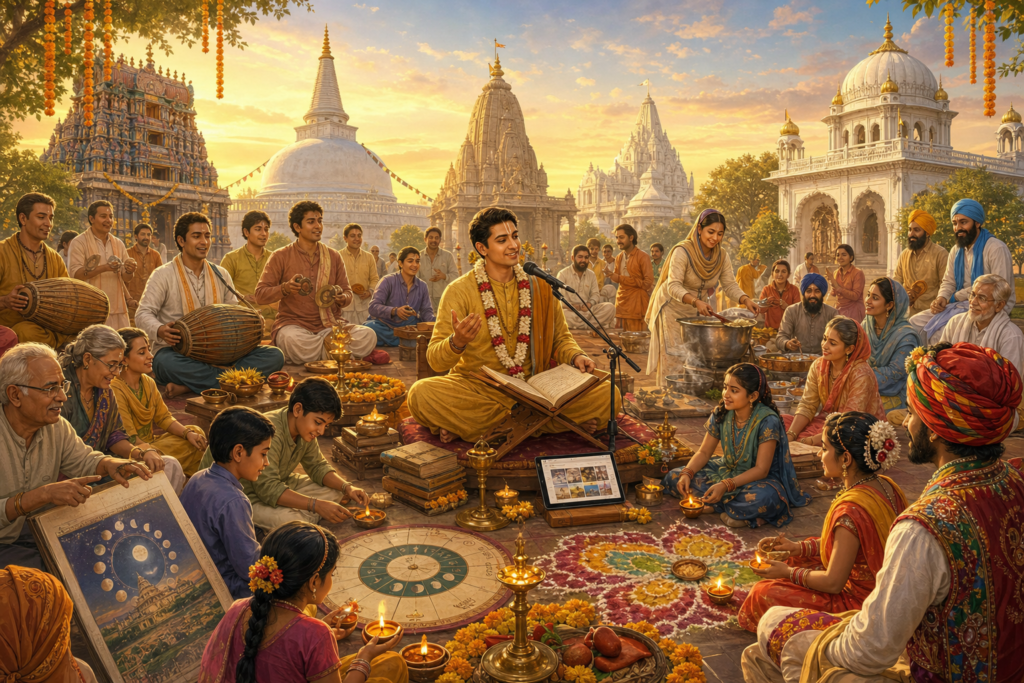
The discussion also serves the broader goal of unity among dharmic traditions. Hinduism, Buddhism, Jainism, and Sikhism each preserve distinctive teachings, practices, and lineages, yet they share a civilizational respect for disciplined practice, ethical refinement, sacred sound, teachers, renunciation, compassion, and liberation from lower tendencies. Presenting Vaishnava book distribution in this broader dharmic spirit encourages appreciation rather than sectarian narrowness. The goal is not to diminish difference, but to honor sincere paths that elevate consciousness and cultivate responsibility.
Daivishakti Mataji’s example therefore belongs to more than one institutional history. It belongs to the larger history of devotees who carry sacred knowledge across generations. Such figures make tradition visible through action. Their lives show that philosophy is not preserved only in libraries or commentaries, but also in the hands of practitioners who stand before the public with courage, humility, and faith.
There is also an emotional dimension to the conversation. Many people remember the first spiritual book that changed the direction of their thinking. It may have appeared through a temple visit, a friend, a street encounter, a college table, or a moment of personal crisis. The distributor may never know what later grows from that brief exchange. This uncertainty makes the service both demanding and beautiful. The visible act is small; the invisible consequence may be profound.
The interview, as introduced, is described as unfiltered, and that quality is important. Devotional life is often publicly represented through festivals, music, processions, and moments of joy. Yet serious practitioners also know the realities behind the joy: sacrifice, discipline, misunderstanding, aging, travel, exhaustion, and the need to keep the heart soft. A credible account of book distribution must include both realities and ecstasies, because mature spirituality does not deny difficulty. It transforms difficulty into service.
Her Grace Daivishakti Mataji’s 55 years of dedication reveal a principle that remains relevant for every serious practitioner: the instruction of the spiritual master becomes powerful when it is allowed to shape daily life. The instruction is not simply remembered as a historical moment. It is revisited, practiced, tested, and internalized. Over time, it becomes a constant meditation, guiding choices and giving meaning to ordinary effort.
The enduring lesson of this Sadhu Speaks episode is that sacred literature distribution is a form of devotional courage. It asks the practitioner to trust the potency of shastra, the mercy of Krishna, and the guidance of Srila Prabhupada. It also asks for respect toward every person encountered. In that balance of conviction and compassion, book distribution becomes not only a service to a tradition but a service to humanity’s search for wisdom.
Inspired by this post on Dandavats.








Leave a Reply
You must be logged in to post a comment.