
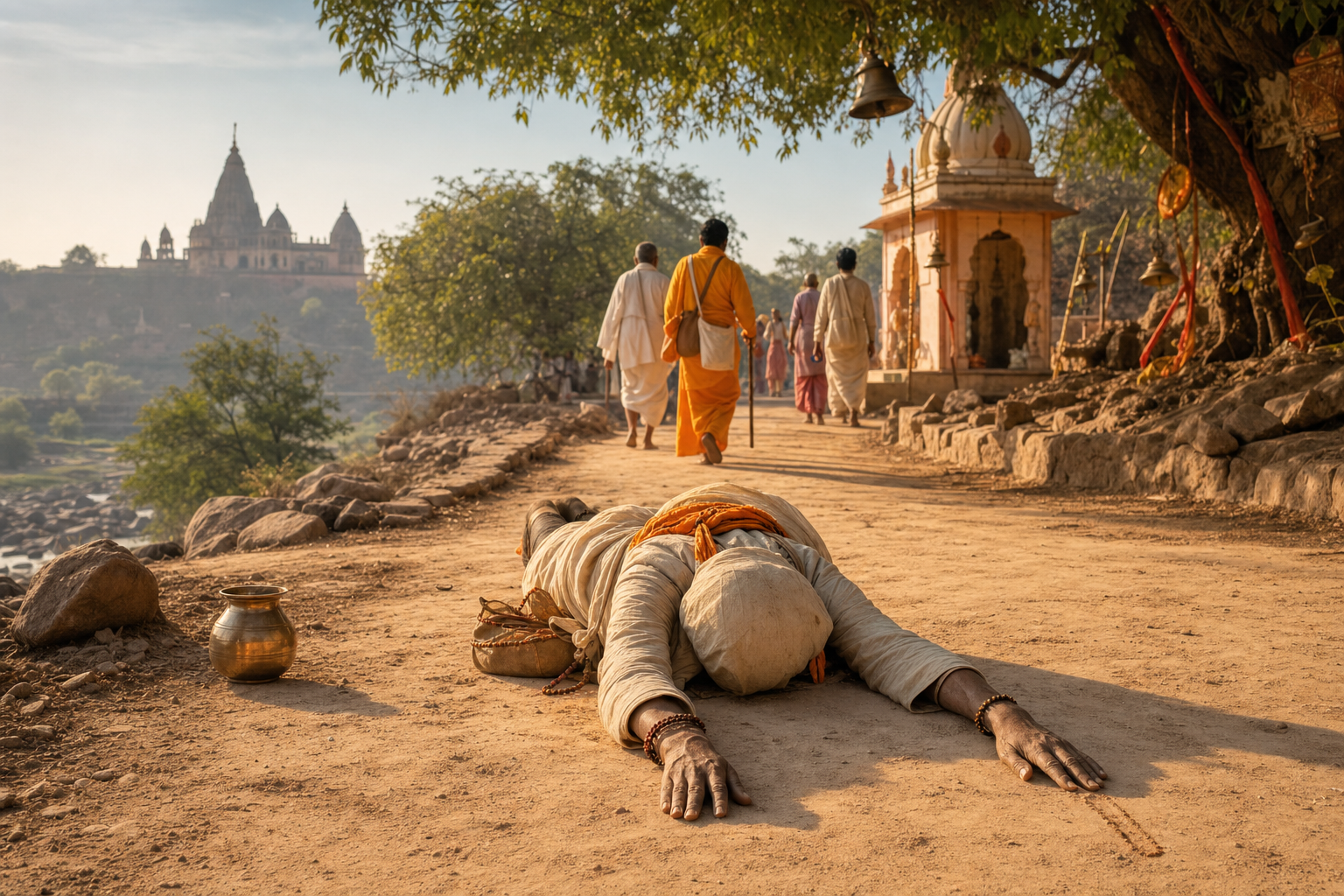
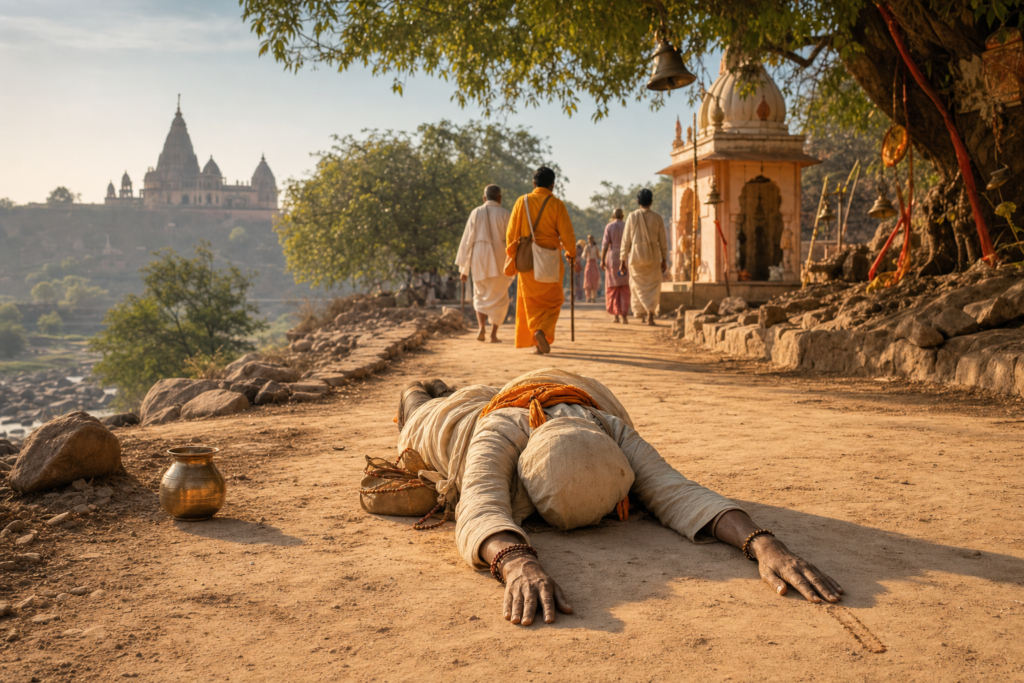
Dandavats parikrama occupies a distinctive place within the wider Hindu pilgrimage tradition because it unites geography, bodily discipline, devotional emotion, and theological surrender into a single act of worship. The practice is often remembered not merely as a journey around a sacred site, but as a disciplined movement of the whole person toward humility. In this form of parikrama, the pilgrim offers repeated full-body prostrations, rises, marks the place reached by the fingertips, steps forward to that point, and repeats the act again. What appears externally as a slow and demanding physical undertaking is inwardly understood as a form of sadhana, tapas, bhakti, and embodied remembrance.
The word dandavat evokes the image of the body stretched straight like a staff, offered flat upon the earth in reverence. Parikrama, meaning circumambulation, refers to moving around a sacred presence while keeping it as the spiritual center. Together, dandavats parikrama becomes a powerful expression of devotion in which the body itself becomes the medium of prayer. Every prostration communicates a theological idea: the sacred is not approached through pride, argument, or display, but through reverence, patience, and surrender.
In many Vaishnava settings, particularly in relation to Vrindavan, Govardhan, and other Krishna-centered tirthas, dandavats parikrama is associated with deep bhakti. Govardhan parikrama, for example, is linked to the memory of Lord Krishna lifting Govardhan Hill to protect the people of Vraja. Circumambulating such a sacred landscape is not simply movement through space; it is participation in a living theological memory. The pilgrim encounters trees, dust, stones, shrines, ponds, village pathways, and temple sounds as parts of a sacred ecology shaped by centuries of devotion.
The memories attached to dandavats parikrama are therefore layered. There is the memory of the body: aching knees, dust-covered clothes, measured breathing, and the repeated contact of forehead, palms, chest, and limbs with the ground. There is also the memory of sound: mantras, kirtan, temple bells, the murmur of other pilgrims, and the quiet discipline of repetition. There is finally the memory of inner transformation: the slow weakening of impatience, the softening of ego, and the discovery that spiritual progress often happens one small movement at a time.
From an academic perspective, dandavats parikrama may be studied as a form of embodied religion. In many modern discussions, religion is reduced to belief, doctrine, or institutional identity. Dharmic traditions, however, preserve a broader understanding in which knowledge, action, ritual, discipline, and lived experience are interwoven. A pilgrim performing dandavats parikrama is not only thinking about devotion; the pilgrim is physically enacting it. This makes the practice a significant example of how Hindu spirituality translates metaphysical ideas into disciplined daily and ritual action.
The emotional force of the practice lies in its deliberate slowness. Ordinary travel values speed, efficiency, and arrival. Dandavats parikrama reverses that logic. The destination matters, but the manner of movement matters more. Each prostration interrupts the impulse to rush. Each rise requires renewed intention. The path becomes a teacher because it compels the pilgrim to accept heat, fatigue, dust, delay, and dependence. In this sense, the practice becomes a critique of restless modernity without needing to speak polemically against it.
Memories of such a pilgrimage often remain vivid because the experience involves total sensory participation. The earth is not an abstract symbol; it is felt directly. The sacred landscape is not viewed from a distance; it is touched repeatedly. The body does not remain a passive carrier of the mind; it becomes an instrument of worship. This is why accounts of dandavats parikrama frequently emphasize small details: the coolness of early morning ground, the harshness of midday dust, the kindness of strangers offering water, and the quiet resilience of elders who continue despite visible discomfort.
Such memories also reveal the communal dimension of Hindu pilgrimage. Although the act of prostration is intensely personal, it is rarely isolated from community. Other pilgrims may walk nearby, chant, offer assistance, maintain the path, guide newcomers, or simply witness the vow with respect. This communal presence reflects a broader principle within Sanatana Dharma: spiritual practice may be inward, but it is nourished by shared culture, inherited tradition, and collective reverence. Dandavats parikrama becomes both personal sadhana and cultural continuity.
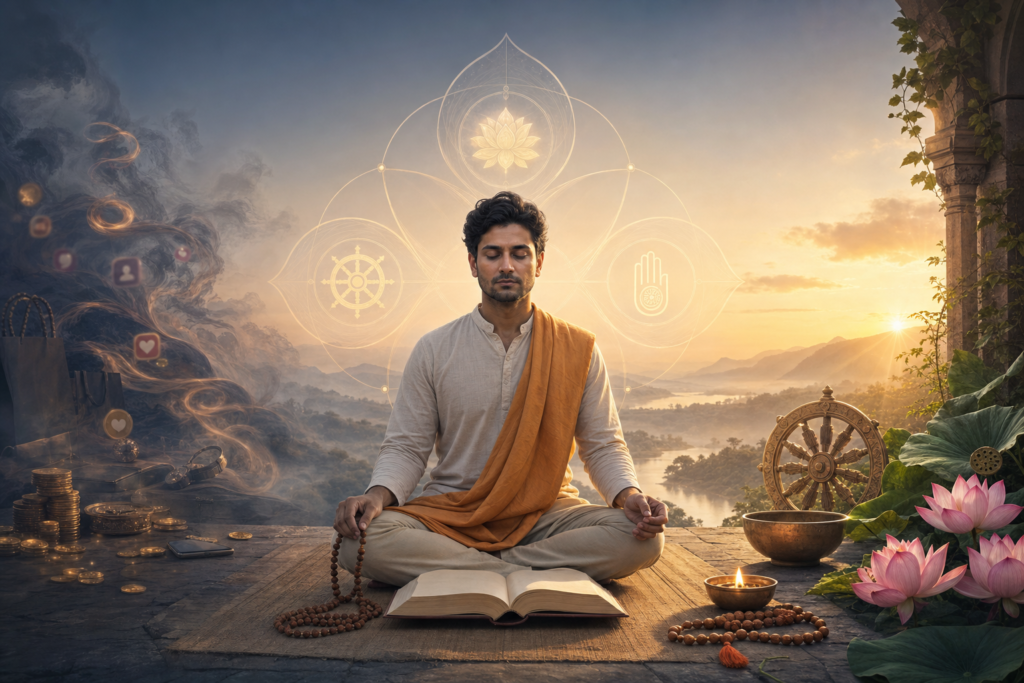
The practice also resonates with wider dharmic values found across Hinduism, Buddhism, Jainism, and Sikhism, especially the emphasis on humility, self-discipline, reverence, and service. Prostration, circumambulation, pilgrimage, restraint, and mindful repetition appear in different forms across dharmic traditions. The theological language may differ, but the ethical movement is recognizably connected: the individual self is trained to move away from arrogance and toward awareness. This shared civilizational grammar supports unity among dharmic traditions without erasing their distinct identities.
Within Hindu thought, dandavats parikrama can be interpreted through the lens of bhakti yoga. Bhakti is not sentiment alone; it is disciplined love directed toward the divine. When the body bows again and again, devotion becomes measurable not in public performance but in endurance, sincerity, and steadiness. The pilgrim’s progress is counted not by prestige but by surrender. This is why the practice has enduring spiritual significance among devotees who understand that humility is not weakness, but a conscious reorientation of the self before the sacred.
The physical demands of dandavats parikrama should not be romanticized in a careless way. It requires preparation, awareness, and respect for bodily limits. Hydration, seasonal conditions, cleanliness, appropriate clothing, and the condition of the pilgrimage path all matter. Elderly pilgrims, those with injuries, and those with medical concerns may need modified forms of participation. Hindu tradition has long recognized intention, capacity, and adhikara as important considerations in practice. Spiritual seriousness does not require neglect of health; rather, health allows devotion to be sustained with clarity.
At the same time, the austerity of the practice has a legitimate place in understanding Hindu spirituality. Tapas is not mere hardship; it is disciplined heat, the intentional friction through which inner impurities are confronted. In dandavats parikrama, discomfort can reveal impatience, pride, comparison, and the desire for recognition. The repetitive act of bowing becomes a mirror. The pilgrim may begin with a vow, but the path gradually exposes the quality of that vow. In this way, the external discipline becomes an internal education.
The sacred geography of parikrama is especially important. Hindu pilgrimage does not treat place as neutral. A tirtha is a crossing point, a location where divine memory, ritual practice, scriptural association, and community devotion converge. When devotees perform parikrama around a hill, temple, river, shrine, or sacred town, they are not merely circling matter. They are moving around a center of meaning. This circular movement teaches that life itself must be reorganized around dharma rather than around egoic desire.
Dandavats parikrama also preserves a profound pedagogy of scale. A long route that could be walked in hours may take days, weeks, or even longer when performed through full prostrations. The scale of the sacred path is thereby experienced differently. Distance is no longer an abstraction on a map; it is measured through breath, effort, and repeated surrender. This altered scale allows the pilgrim to perceive pilgrimage as a gradual unfolding rather than a completed itinerary.
The memory of dust is particularly meaningful in many devotional traditions. In Vaishnava language, the dust of sacred places and the dust of devotees’ feet are often honored as spiritually charged symbols of humility and grace. During dandavats parikrama, this symbolism becomes tangible. Dust settles on the body, clothing, and hands, quietly dissolving ordinary concerns about social presentation. The pilgrim’s appearance changes, and with it, the sense of self may also change. What is socially humbling becomes spiritually dignifying.
The role of mantra and nama-smarana is equally central. Many pilgrims coordinate movement with remembrance of divine names, especially names of Krishna, Rama, Radha, Shiva, Devi, or the chosen Ishta. In such practice, the body moves, the lips chant, the mind returns, wanders, and returns again. This rhythm reflects a realistic understanding of human attention. Devotion is not assumed to be constantly perfect; it is cultivated through repetition. The path becomes a training ground for returning the mind to the sacred center.
In contemporary life, memories of dandavats parikrama carry an additional significance. Many people live in environments dominated by digital speed, fragmented attention, and bodily inactivity. A practice that requires the whole body, a real landscape, disciplined breathing, and sustained intention offers an alternative model of human development. It reminds modern seekers that spirituality is not only consumed as information. It is practiced through time, restraint, relationship, and embodied commitment.
There is also an ethical dimension in the way pilgrims depend upon one another. A demanding parikrama often reveals the importance of seva. Someone may offer water, protect a pilgrim from traffic, help maintain cleanliness, provide directions, or simply give space without disturbance. These small acts create a moral environment around the pilgrimage. The sacred journey is therefore not limited to the individual performing dandavats; it includes all who help preserve the dignity, safety, and sanctity of the route.
Environmental awareness naturally belongs in any serious discussion of pilgrimage. Sacred landscapes require care. The reverence shown through prostration should extend to the path itself, including cleanliness, protection of water bodies, respect for local communities, and avoidance of waste. A pilgrim who bows to sacred geography also accepts responsibility toward that geography. In this sense, dandavats parikrama can support an ecological reading of dharma, where devotion and stewardship are inseparable.
The practice also raises important questions about memory and transmission. Many younger devotees encounter dandavats parikrama through family stories, temple communities, videos, pilgrimage accounts, or the testimony of elders. These memories become part of cultural education. They communicate that Hindu tradition is not only preserved in books, although scriptures are essential, but also in bodies, vows, journeys, songs, and lived examples. A single remembered act of devotion can become a teaching more powerful than a formal lecture.
For those who have witnessed dandavats parikrama, the image often remains unforgettable: a devotee slowly advancing along the path, bowing fully to the earth, rising, and bowing again. The scene carries no need for spectacle. Its power comes from restraint. It quietly asks what human beings are willing to honor, what they are willing to endure, and what they consider worthy of surrender. Such questions are not confined to one pilgrimage route; they belong to the broader spiritual life.
Dandavats parikrama memories therefore deserve preservation not as nostalgia alone, but as spiritual and cultural documentation. They illuminate the relationship between Hindu pilgrimage, bhakti, sacred geography, bodily discipline, and community life. They also help modern readers understand why traditional practices continue to matter. In an age that often values visibility over depth, this practice teaches the opposite: the most transformative movement may be slow, humble, repetitive, and almost silent.
The enduring lesson of dandavats parikrama is that devotion is not measured only by words. It may be measured by patience, by the willingness to bow, by care for the sacred path, by respect for fellow pilgrims, and by the gradual purification of intention. Its memories remain powerful because they join the physical and the metaphysical in one disciplined act. Through each prostration, the pilgrim remembers that the sacred center is not conquered by movement; it is approached through humility.
Inspired by this post on Dandavats.




Leave a Reply
You must be logged in to post a comment.