
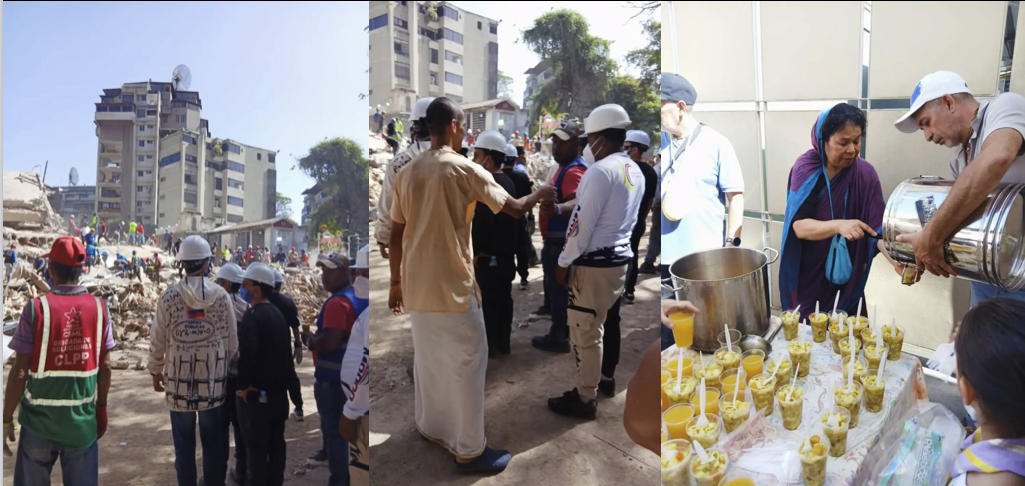
In the aftermath of the powerful earthquake that struck Venezuela, ISKCON Venezuela has expanded its humanitarian response through its Food for Life service, offering free, hot, and nutritious prasadam meals to families affected by the disaster and to emergency responders engaged in search-and-recovery work. The initiative reflects a practical form of dharmic service: food is not treated merely as relief material, but as a stabilizing source of care, dignity, and community support at a moment when ordinary life has been disrupted.
Earthquakes create a distinct kind of humanitarian emergency because the damage is immediate, physical, and psychologically destabilizing. Homes may become unsafe, water and electricity supplies may be interrupted, roads can be obstructed, and families are often forced into temporary shelter with little warning. In such conditions, cooked food becomes one of the most urgent needs. Dry rations are useful, but hot meals carry an additional value: they can be consumed immediately, shared across age groups, and distributed quickly to those who lack kitchens, fuel, utensils, or safe spaces to cook.
ISKCON Venezuela’s relief effort is significant because it combines community organization with a tested model of vegetarian food distribution. Food for Life programs associated with the Hare Krishna movement have historically emphasized freshly prepared, sanctified vegetarian meals, often served during crises, public gatherings, and daily welfare programs. In this context, prasadam is not presented only as food in the conventional sense. It is food prepared with devotion and offered in a spirit of seva, carrying both nutritional and spiritual meaning for those who receive it.
The use of the term prasadam is important. In Vaishnava practice, prasadam refers to food that has been offered to Krishna and then distributed as grace. In a relief setting, this concept assumes a public and humanitarian dimension. It allows service to move beyond transactional charity and toward a culture of respectful giving. A person standing in a disaster-relief line is not reduced to a victim or a statistic; that person is approached as a member of the wider human family, deserving nourishment, warmth, and consideration.
From a technical relief perspective, hot-meal distribution after an earthquake requires careful coordination. Volunteers must secure ingredients, cooking fuel, clean water, preparation areas, transport, containers, and serving points. Food must be cooked in hygienic conditions, protected from contamination, and distributed while still safe to consume. Where infrastructure is damaged, even simple logistics become complex. A working community kitchen can therefore become an important node in the wider recovery network, especially when it serves both displaced families and the emergency personnel who are working long hours in difficult environments.
Emergency responders often become an overlooked population in relief operations. Search-and-recovery teams, medical workers, police, civil defense personnel, and local volunteers may work through exhaustion, emotional strain, dust, debris, aftershock anxiety, and continuous public pressure. Providing them with nourishing meals is not separate from helping survivors; it supports the operational capacity of the response itself. When responders are fed, they can continue their work with greater steadiness and endurance.
For affected families, food relief also has a psychological function. After a disaster, people frequently describe the first shared hot meal as a moment when fear briefly gives way to human connection. Children are calmed by routine. Elderly people receive food that is easier to digest than packaged snacks. Parents gain a measure of relief when they know that at least one immediate need has been met. In this sense, prasadam distribution can support emotional resilience as well as physical survival.
The Food for Life model is especially suited to this kind of situation because it relies on repeatable systems rather than abstract goodwill alone. Community kitchens can scale according to available supplies and volunteer capacity. Rice, lentils, vegetables, grains, and other vegetarian staples can be prepared in large quantities, are generally cost-efficient, and can meet diverse dietary needs without depending on complex menus. Vegetarian food also reduces certain storage and handling risks compared with many perishable animal products, which can be difficult to manage during power interruptions or transportation delays.
At the same time, effective relief must remain grounded in local realities. Venezuela’s social, economic, and infrastructural conditions make disaster response especially demanding. Any food distribution program must account for road access, fuel availability, neighborhood-level needs, local authorities, community leaders, and the safety of volunteers. The strongest relief work is usually collaborative: temples, civic groups, neighbors, emergency workers, and local institutions each contribute what they can. ISKCON Venezuela’s role is therefore best understood as one part of a broader humanitarian effort rather than an isolated intervention.
The dharmic principle behind such service is not sectarian competition but shared responsibility. Hindu, Buddhist, Jain, and Sikh traditions all preserve powerful teachings on compassion, restraint, generosity, and service to living beings. In the Vaishnava vocabulary of ISKCON, this service may be expressed through prasadam and Krishna consciousness. In Sikh tradition, langar demonstrates the same civilizational principle through the open community kitchen. In Jain thought, ahimsa deepens the ethic of care for life. In Buddhist practice, compassion becomes a disciplined response to suffering. These traditions differ in theology and practice, yet they converge in the moral insight that hunger must be answered with service.
That convergence matters in times of disaster. Crisis strips public life down to essentials: water, food, shelter, medical care, trust, and organized action. Philosophical differences do not disappear, but they become less urgent than the shared duty to protect life. A relief kitchen serving prasadam after an earthquake becomes a practical expression of unity among dharmic traditions, because it demonstrates that spiritual life is not confined to ritual spaces. It enters the street, the shelter, the rescue zone, and the anxious household waiting for news.
Food relief also carries an ethical lesson about dignity. In many disasters, survivors must repeatedly explain their need to institutions, aid workers, or officials. A well-run prasadam distribution effort can reduce that burden by offering food without humiliation. The most humane service is orderly, clean, and respectful. It avoids spectacle. It does not turn suffering into publicity. It recognizes that the person receiving assistance today may be the person serving others tomorrow.
The academic study of disaster relief often emphasizes resilience, supply chains, community networks, and social capital. ISKCON Venezuela’s Food for Life response illustrates these ideas in a religious and cultural form. A temple community already organized around worship, cooking, volunteering, and distribution can redirect those capacities toward emergency relief. The same habits that sustain devotional life, including discipline, cooperation, cleanliness, and regular offering, can become assets in a humanitarian crisis.
There is also a broader lesson for faith-based organizations. Relief work is most credible when it is immediate, practical, and inclusive. The value of a spiritual community in a crisis is measured not by slogans but by its ability to reduce suffering. Free meals, clean water, medical coordination, temporary shelter support, and reliable communication are concrete forms of compassion. In this case, ISKCON Venezuela’s emphasis on hot prasadam meals gives the response a clear and measurable focus.
Such work should also be understood within the historical memory of ISKCON’s food distribution programs. Food for Life has become one of the movement’s most recognizable public-service initiatives, drawing from Srila Prabhupada’s insistence that no one near a temple should go hungry. That principle has traveled across countries and circumstances, from daily feeding programs to emergency relief after natural disasters. Its continuing relevance lies in its simplicity: when suffering is visible, the first response should be service.
In Venezuela, the immediate priority remains the welfare of affected families and the stability of rescue-and-recovery operations. Food alone cannot rebuild homes, restore infrastructure, or heal grief. Yet it can hold a community together during the first fragile days of recovery. It can help a responder continue searching. It can help a parent feed a child. It can help neighbors gather around something warm, orderly, and compassionate when the ground beneath them has quite literally shifted.
ISKCON Venezuela’s Food for Life earthquake relief effort therefore deserves attention not only as a news event but as a case study in dharmic humanitarianism. It shows how devotion can become logistics, how theology can become nutrition, and how community service can become resilience. In a world where disasters often expose social fragmentation, a hot plate of prasadam can quietly affirm a deeper truth: human beings recover best when care is organized, shared, and offered without discrimination.
Inspired by this post on Dandavats.






Leave a Reply
You must be logged in to post a comment.