
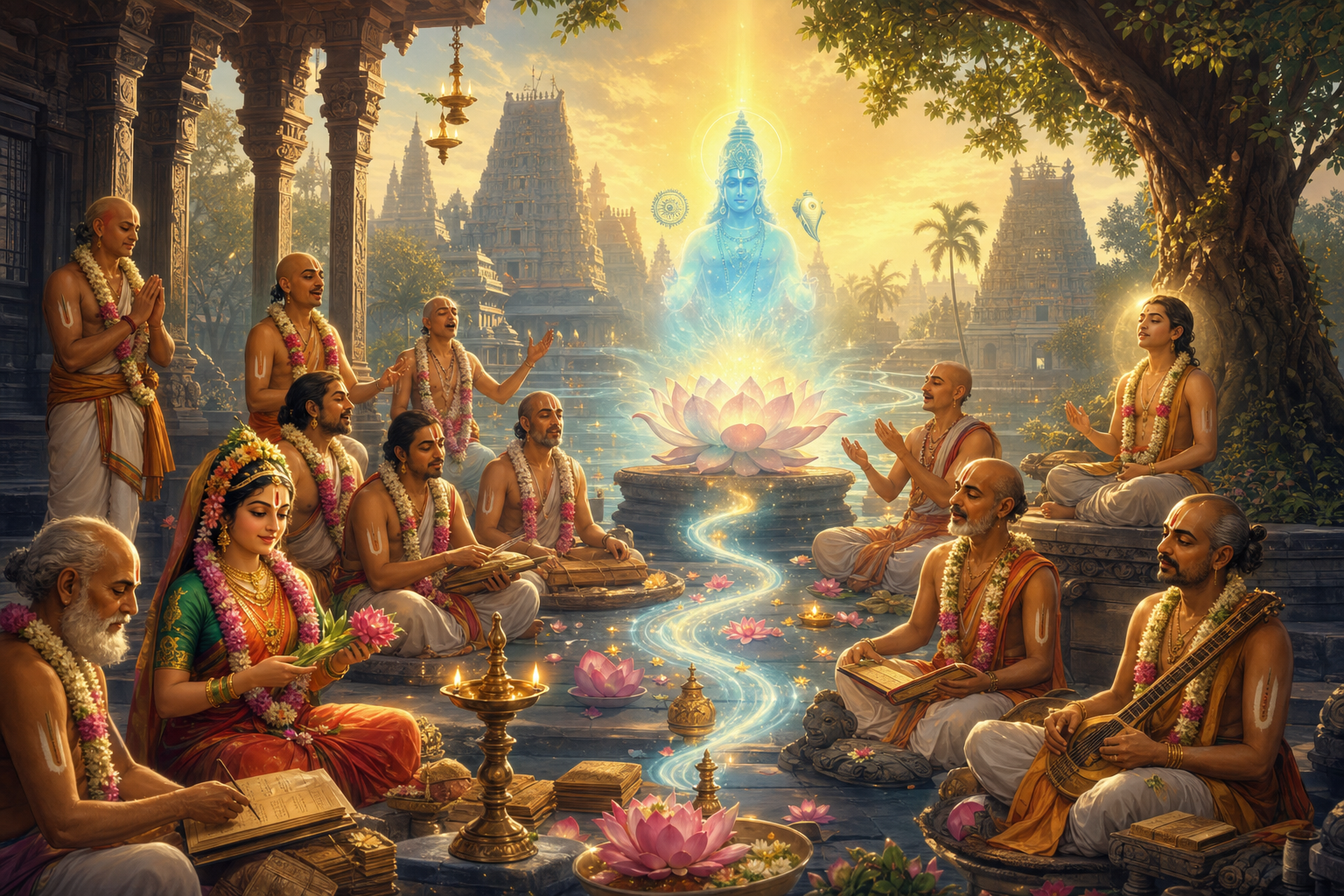
The Alvars, also written as Azhwars, occupy a formative place in the religious, literary, and philosophical history of South India. In Tamil devotional memory, the word Alvar is commonly understood as “one who is immersed,” especially one immersed in the ecstatic love of Lord Vishnu. This image of immersion is more than a poetic metaphor; it captures the emotional, theological, and social force of their hymns. Their songs present devotion not as a secondary ornament of religion, but as a way of knowing, seeing, serving, and surrendering to the Divine.
The Alvars are traditionally counted as twelve Vaishnava saint poets associated with Tamilakam, the Tamil-speaking region of South India. Their historical dates are debated, with many scholarly accounts placing them broadly between the early medieval centuries, while devotional tradition often situates them in a much larger sacred chronology. The most practical way to approach them is to recognize both layers: historically, they were central to the growth of Tamil Vaishnava bhakti; spiritually, they are remembered as luminous figures whose love for Vishnu transcended ordinary measures of time.
Their importance rests on a simple but profound transformation. The Alvars expressed lofty Vedantic and Puranic ideas in Tamil, making intense theological reflection available through song, image, longing, praise, and temple-centered devotion. Their poetry does not read like abstract doctrine alone. It moves through tears, wonder, separation, surrender, friendship, maternal affection, and divine intimacy. For many readers, this is what makes the Alvars enduring: their hymns show that spiritual knowledge can be intellectually deep while remaining emotionally alive.
The twelve Alvars are usually listed as Poigai Alvar, Bhoothath Alvar, Pey Alvar, Thirumazhisai Alvar, Nammalvar, Madhurakavi Alvar, Kulasekhara Alvar, Periyalvar, Andal, Thondaradipodi Alvar, Tiruppan Alvar, and Thirumangai Alvar. This list itself reveals a distinctive feature of the tradition: the Alvars came to be remembered across different social locations, temperaments, poetic voices, and devotional moods. Their collective legacy is not uniformity, but a shared orientation toward Vishnu expressed through many human experiences.
The first three, Poigai Alvar, Bhoothath Alvar, and Pey Alvar, are often called the Mudhal Alvars, or the first Alvars. Tradition narrates that they met during a storm at Tirukkovalur, standing together in a narrow space where the presence of the Divine became overwhelming. Their hymns are remembered for their compact brilliance and mystical intensity. In the devotional imagination, their meeting is not merely a biographical event; it symbolizes how bhakti turns even cramped and difficult circumstances into a space of revelation.
Nammalvar is among the most revered of the Alvars and is often treated as a theological heart of the tradition. His Tiruvaymoli, part of the larger Naalayira Divya Prabandham, is regarded in Sri Vaishnava tradition as one of the most profound Tamil expressions of devotion and Vedantic insight. Nammalvar’s poetry gives voice to the soul’s dependence on the Divine, the pain of separation, the joy of surrender, and the conviction that Vishnu is both cosmic sovereign and intimate refuge.
Madhurakavi Alvar presents another important dimension of bhakti: devotion to the guru. His hymns are directed not primarily to Vishnu in the usual manner, but to Nammalvar, his spiritual master. This does not diminish Vaishnava theology; rather, it clarifies the role of the realized teacher as the one through whom divine knowledge becomes embodied and approachable. In this sense, Madhurakavi Alvar’s contribution is small in number but immense in doctrinal significance.
Andal, the only woman among the twelve Alvars, holds a uniquely beloved place in Tamil Vaishnava devotion. Her Tiruppavai and Nachiyar Tirumoli are treasured for their lyrical beauty, ritual importance, and theological depth. Andal’s voice joins bridal mysticism, communal observance, and personal longing for Krishna. Her presence also demonstrates that the bhakti movement was not merely a male monastic or scholastic phenomenon; it gave sacred authority to an intensely personal, poetic, and feminine mode of devotion.
Periyalvar is remembered for a devotional mood marked by protective affection toward the Divine child. This is one of the striking features of Hindu devotional literature: the devotee may approach God not only as servant, subject, or seeker, but also as parent, friend, beloved, and caretaker. Such emotional variety is not sentimental excess. It reflects a sophisticated theology of relationship, where the infinite is encountered through deeply human forms of love.
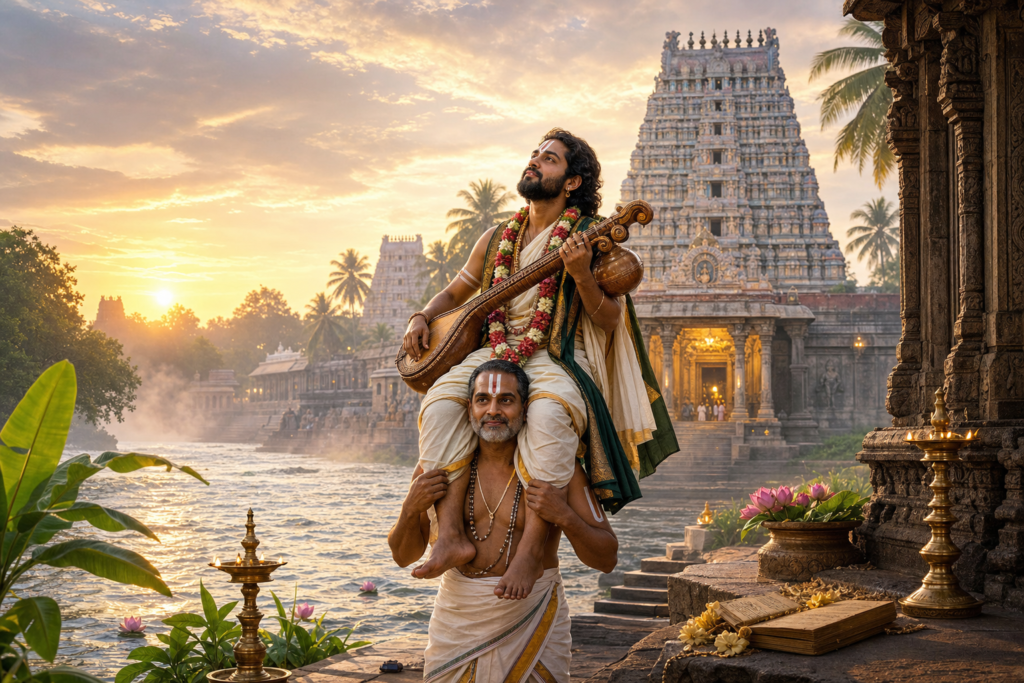
Tiruppan Alvar is closely associated with Lord Ranganatha of Srirangam. His Amalanadipiran is a brief but exquisite hymn that contemplates the divine form from the feet upward. The poem is significant for both its devotional beauty and its social memory. Traditions surrounding Tiruppan Alvar emphasize that spiritual worth cannot be reduced to birth or status. In the presence of genuine devotion, hierarchy loses its ultimate claim, and the devotee’s vision becomes the measure of sanctity.
Thirumangai Alvar is remembered as one of the most prolific and dynamic of the Alvars. His life narratives often describe a dramatic transformation from worldly power and restlessness toward intense service to Vishnu. His hymns celebrate many sacred sites and helped strengthen the network of Divya Desams, the Vishnu temples praised in Alvar poetry. Through him, temple geography, pilgrimage, liturgy, and poetry became tightly woven into the public life of Vaishnava devotion.
The collected hymns of the Alvars are known as the Naalayira Divya Prabandham, the “Four Thousand Divine Compositions.” The compilation is traditionally associated with Nathamuni, the early Sri Vaishnava acharya who is said to have recovered and organized these Tamil hymns. Within Sri Vaishnava tradition, the Prabandham came to be honored as the Dravida Veda or Tamil Veda, not as a rejection of Sanskrit sacred learning, but as a complementary revelation of divine truth in Tamil devotional language.
This point is essential for understanding the Alvars with fairness. Their movement should not be reduced to a simplistic opposition between Sanskrit and Tamil, or between ritual and emotion. The Alvar tradition helped create a synthesis in which Vedic, Puranic, temple, poetic, and vernacular currents met. Later Sri Vaishnava teachers, especially Ramanujacharya, developed philosophical systems that drew from Sanskrit Vedanta while also revering the Tamil devotional canon. The result was one of the great integrative achievements of Hindu civilization.
Theologically, the Alvars helped prepare the ground for Vishishtadvaita Vedanta, especially through themes later systematized by Sri Vaishnava acharyas. Their hymns repeatedly affirm the reality of the Divine, the dependence of the individual soul, the saving power of grace, and the path of surrender. In technical terms, their poetry touches the classic concerns of tattva, hita, and purushartha: the nature of reality, the means to attain the Divine, and the supreme goal of life.
Yet the Alvars did not write as detached philosophers in the modern academic sense. Their theology is sung, enacted, embodied, and felt. A hymn may begin in longing, turn into metaphysical insight, and conclude in surrender. This is why their work remains important not only for scholars of Hindu philosophy, but also for devotees, musicians, temple communities, and readers seeking a language for spiritual vulnerability. Their poetry allows devotion to become a disciplined form of knowledge.
The Alvars also shaped the sacred geography of South India. The 108 Divya Desams are temples praised in their hymns, and these shrines continue to define Vaishnava pilgrimage. Places such as Srirangam, Kanchipuram, Tirupati, Srivilliputhur, Alvar Tirunagari, and many others are not merely architectural sites. They are living archives of song, ritual, memory, and theological imagination. The Alvars made geography devotional, and they made devotion spatial.
Their contribution to Tamil literature is equally significant. The Alvars expanded the expressive possibilities of Tamil by using it for refined theology, mystical experience, and temple liturgy. Their compositions employ rich imagery from nature, love poetry, kingship, motherhood, separation, and ritual life. This literary achievement helped demonstrate that regional languages could carry the full weight of sacred thought. In that sense, the Alvars stand among the great makers of Indian vernacular religious literature.
The emotional range of Alvar poetry is one reason it remains accessible across centuries. The soul may appear as a lover yearning for Krishna, a mother worried for a daughter consumed by divine longing, a servant praising the Lord’s feet, or a pilgrim overwhelmed by the beauty of a temple deity. These are not random literary devices. They are carefully shaped devotional perspectives that make metaphysical truths intimate and memorable.
The Alvars also belong to the wider bhakti movement that transformed many regions of India. Alongside the Shaiva Nayanars of Tamil Nadu and later saints across India, they helped place devotion at the center of public religious culture. Their message did not erase ritual, temple worship, philosophy, or scriptural learning. Instead, it insisted that these become meaningful through love, humility, and surrender. This insight remains relevant in every age, especially when religious life risks becoming mechanical or merely inherited.
From the perspective of dharmic unity, the Alvars offer a model of rootedness without narrowness. They were unmistakably Vaishnava, deeply devoted to Vishnu, Narayana, Krishna, Rama, and the temple forms of the Lord. At the same time, their legacy can be appreciated within the broader family of Hindu, Buddhist, Jain, and Sikh traditions as an example of disciplined devotion, poetic refinement, ethical humility, and the search for liberation. Their particular path enriches the wider dharmic landscape rather than diminishing other sincere paths.
This is also why the Alvars should be read with both devotion and historical care. Hagiographies preserve sacred meanings through miracle, symbolism, and theological memory. Historical study asks different questions about dating, authorship, social context, and literary development. These approaches need not be enemies. When held together responsibly, they allow the Alvars to be seen as both revered saints and major contributors to Indian intellectual and cultural history.
The continuing recitation of the Naalayira Divya Prabandham in temples shows that the Alvars are not figures of the past alone. Their hymns still structure festivals, daily worship, processions, and community identity. When these verses are sung before the deity, literature becomes liturgy. When they are studied, devotion becomes theology. When they are remembered across generations, cultural heritage becomes living practice.
The enduring power of the Alvars lies in their ability to unite beauty, doctrine, and surrender. They teach that the Divine can be approached through disciplined learning, temple worship, poetic imagination, and the softened heart. Their world is intellectually serious but never spiritually dry. It is devotional without being anti-intellectual, emotional without being shallow, and regional without being provincial.
In the Alvars, Tamil bhakti found one of its most radiant forms. Their hymns gave voice to longing for Lord Vishnu, strengthened the sacred geography of the Divya Desams, shaped Sri Vaishnava theology, and enriched Indian literature. To study them is to encounter a tradition in which language becomes offering, poetry becomes philosophy, and devotion becomes a path of transformation. Their message remains clear: the highest truth is not merely to be argued about, but to be loved, sung, served, and realized.
Inspired by this post on Hindu Pad.



Leave a Reply
You must be logged in to post a comment.